
Time to First Token · o3
7185ms
Time to First Token · Qwen3.6 27B (Reasoning)
1480ms
Deep dive into reasoning, benchmarks, and latency insights.
The current catalog does not contain complete performance evidence for both models, so this page does not declare an overall winner. Use the available fields as comparison signals and validate the models on your own workload.
Key decision metrics at a glance.
| Model | Metric | Value | Unit | Source / snapshot |
|---|---|---|---|---|
| o3 | Reasoning | 9.0 | benchmark or capability score | Artificial Analysis · current catalog |
| Qwen3.6 27B (Reasoning) | Reasoning | 6.0 | benchmark or capability score | Artificial Analysis · current catalog |
| o3 | Coding | 6.0 | benchmark or capability score | Artificial Analysis · current catalog |
| Qwen3.6 27B (Reasoning) | Coding | 5.0 | benchmark or capability score | Artificial Analysis · current catalog |
| o3 | Multimodal | 3.0 | benchmark or capability score | Artificial Analysis · current catalog |
| Qwen3.6 27B (Reasoning) | Multimodal | 3.0 | benchmark or capability score | Artificial Analysis · current catalog |
| o3 | Long Context | 4.0 | benchmark or capability score | Artificial Analysis · current catalog |
| Qwen3.6 27B (Reasoning) | Long Context | 5.0 | benchmark or capability score | Artificial Analysis · current catalog |
| o3 | Blended Price / 1M tokens | $3.5 | USD per 1M tokens | Artificial Analysis · current catalog |
| Qwen3.6 27B (Reasoning) | Blended Price / 1M tokens | $1.35 | USD per 1M tokens | Artificial Analysis · current catalog |
| o3 | P95 Latency | — | milliseconds | Artificial Analysis · current catalog |
| Qwen3.6 27B (Reasoning) | P95 Latency | — | milliseconds | Artificial Analysis · current catalog |
| o3 | Tokens per second | 119.185 | tokens per second | Artificial Analysis · current catalog |
| Qwen3.6 27B (Reasoning) | Tokens per second | 58.081 | tokens per second | Artificial Analysis · current catalog |
Data provided by Artificial Analysis; live values use the current catalog.
This radar chart visually maps the core capabilities (reasoning, coding, math proxy, multimodal, long context) of `o3` vs `Qwen3.6 27B (Reasoning)`.
This grouped bar chart provides a side-by-side comparison for each benchmark metric.
Lower time to first token is better; higher tokens per second is better.
Compare input and output pricing in USD per 1M tokens.
o3$4
Qwen3.6 27B (Reasoning)$1.5
Qwen3.6 27B (Reasoning) costs $2.5 less per run
This article is a dated snapshot published on 2026-08-07. Live cards above use the current catalog; missing live fields are not inferred.
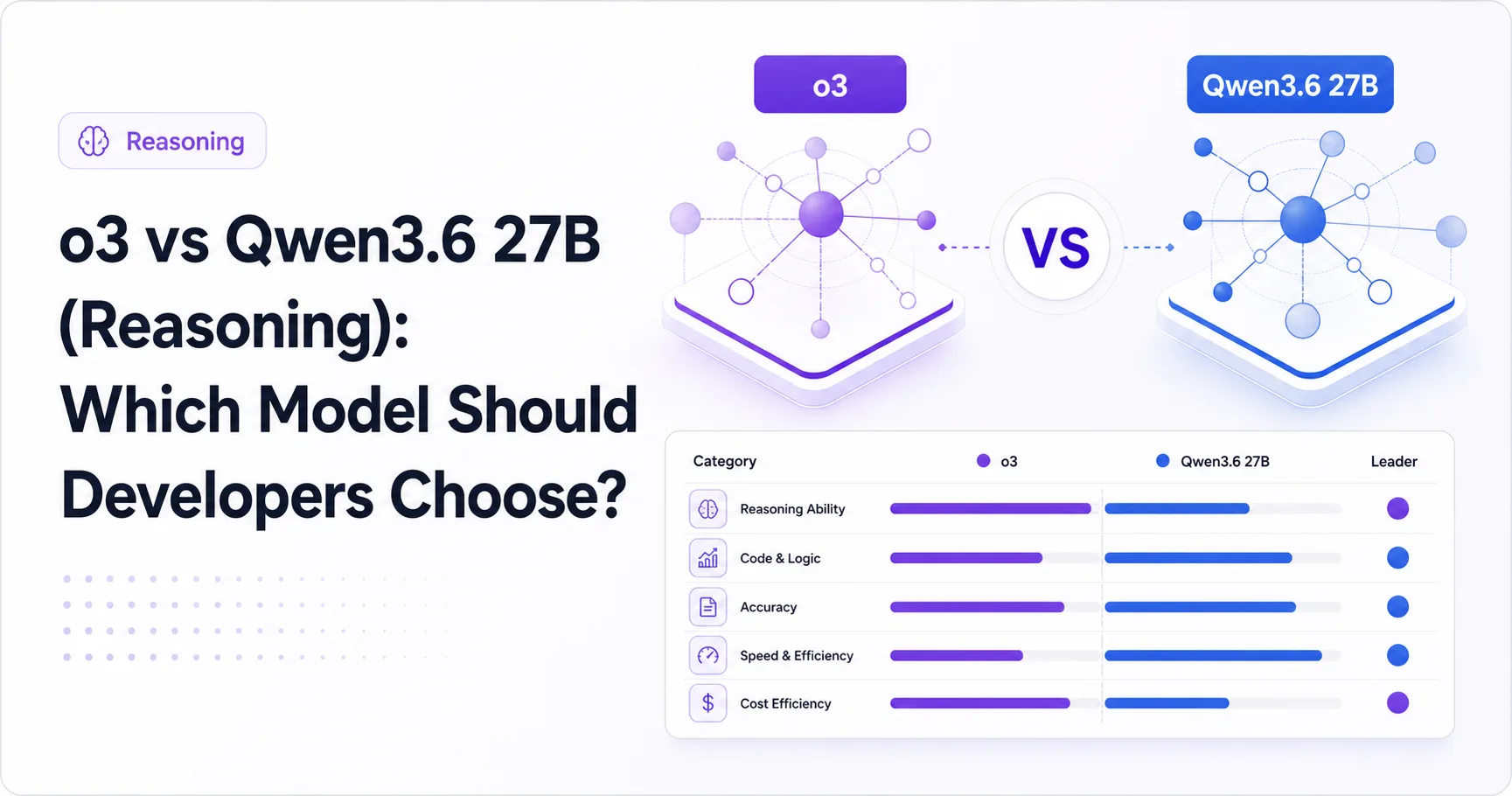
o3 is the faster measured option, while Qwen3.6 27B (Reasoning) is cheaper and scores higher on the shared Intelligence Index.\n\nThe comparison is useful for routing decisions, but it is not a complete model leaderboard. The supplied data gives o3 an Intelligence Index of 30.4 and a Math Index of 88.3. Qwen3.6 27B (Reasoning) has an Intelligence Index of 37.1 and a Coding Index of 53.7. Those tests do not form a complete overlap, so developers should avoid treating one model as the universal winner.\n\nThe availability question is equally important. OpenAI's current model directory does not list o3 among the models presented as current frontier models. The supplied research also found no verified official documentation for Qwen3.6 27B (Reasoning). That leaves deployment status, stable aliases, context limits, and API behavior unresolved for both models.\n\nData provided by https://artificialanalysis.ai/.
Qwen3.6 27B (Reasoning) offers the stronger value signal, but o3 remains the better fit for latency-sensitive generation.\n\nThe shared Intelligence Index favors Qwen3.6 27B (Reasoning) at 37.1, compared with 30.4 for o3. The supplied benchmark set also reports a 53.7 Coding Index for Qwen3.6 27B (Reasoning), while o3 has an 88.3 Math Index. Because the coding and math measurements are not available for both models, neither score proves a broad capability advantage.\n\nCost creates a clearer separation. Qwen3.6 27B (Reasoning) is listed at $1.35 per 1M blended tokens, compared with $3.5 for o3. Its input price is $0.6 versus $2, and its output price is $3.6 versus $8. The lower output price matters for reasoning workflows that generate long explanations, code, or intermediate steps.\n\nSpeed points in the opposite direction. o3 produces a median 128.056 output tokens per second, compared with 57.366 for Qwen3.6 27B (Reasoning). Both models have a reported latency of 0.3 seconds. This suggests that o3's advantage appears during generation rather than initial request setup.\n\nThe largest unresolved issue is operational certainty. OpenAI's model documentation does not currently list o3, and its pricing documentation does not list o3 pricing. No verified source was supplied for Qwen3.6 27B (Reasoning).
o3 is the clear speed choice, but the available benchmarks do not establish a complete task-quality winner.\n\nThe measured generation gap is substantial: o3 reaches 128.056 median output tokens per second, while Qwen3.6 27B (Reasoning) reaches 57.366. Developers will notice that difference in streamed answers, especially when a request produces a long response. It can reduce the time a user watches an answer unfold, even though both models show the same reported 0.3-second latency.\n\nThat speed advantage does not automatically make o3 the better production model. A fast model can still be a poor choice if the workload is dominated by token volume, expensive output, or tasks where the other model has stronger measured quality. Qwen3.6 27B (Reasoning) has the higher shared Intelligence Index, 37.1 compared with o3 at 30.4. That result supports testing Qwen for general reasoning workloads, but it does not explain which task families create the gap.\n\nThe benchmark coverage also creates a hard comparison boundary. Qwen3.6 27B (Reasoning) has a reported Coding Index of 53.7, while o3 has no corresponding coding value in the supplied snapshot. o3 has a reported Math Index of 88.3, while Qwen3.6 27B (Reasoning) has no corresponding math value. The Artificial Analysis data therefore supports targeted conclusions, not a universal quality ranking.\n\nEvidence is insufficient for claims about context handling, tool use, multimodal behavior, or failure modes. Neither supplied research set provides verified material for those dimensions.
Qwen3.6 27B (Reasoning) is the lower-cost option, especially for applications that generate many output tokens.\n\nThe listed blended price is $1.35 per 1M tokens for Qwen3.6 27B (Reasoning), compared with $3.5 for o3. The output price shows an even sharper distinction, at $3.6 for Qwen3.6 27B (Reasoning) versus $8 for o3. That difference matters when responses contain detailed reasoning, generated code, structured documents, or repeated revisions.\n\nInput-heavy applications also favor Qwen3.6 27B (Reasoning). Its input price is $0.6 per 1M tokens, compared with $2 for o3. Long prompts, retrieved documents, conversation history, and code context can make input pricing a material part of the bill. The Artificial Analysis snapshot provides the listed prices used here.\n\nThe cheaper model can become more expensive in practice if it requires retries, longer prompts, additional validation calls, or human review. The supplied research does not provide reliability, failure-rate, or task-success measurements, so that break-even point cannot be calculated responsibly.\n\nThere is also an operational pricing risk. OpenAI's current pricing page does not list o3, while no verified pricing source was supplied for Qwen3.6 27B (Reasoning). Treat the data snapshot as a comparison input, then confirm the actual endpoint and billing terms before committing production spend.
Qwen3.6 27B (Reasoning) leads on 3 of 3 metrics
Qwen3.6 27B (Reasoning) is the default value pick, while o3 is the safer experimental choice for fast streamed responses and math-focused evaluation.\n\nChoose Qwen3.6 27B (Reasoning) first when your main constraint is inference cost, your workload produces substantial output, or your application needs a general reasoning candidate with a higher shared Intelligence Index. Its listed blended price is $1.35 per 1M tokens, and its output price is $3.6 per 1M tokens. Those figures make it the natural starting point for high-volume batch processing, document transformation, and code-generation trials. The Coding Index of 53.7 also gives developers a concrete coding signal to test, although o3 lacks a matching coding measurement.\n\nChoose o3 when interactive speed is a primary product requirement, or when your evaluation is centered on mathematical reasoning. Its median output speed is 128.056 tokens per second, and its supplied Math Index is 88.3. The higher $8 output price can still be justified if faster responses improve user completion, reduce waiting, or support a premium workflow.\n\nDo not make a final procurement decision from the benchmark scores alone. The comparison lacks verified context-window data, output limits, API parameters, multimodal details, stable aliases, and failure-mode evidence. OpenAI's model directory does not currently list o3, and the research contains no verified public source for Qwen3.6 27B (Reasoning).\n\nThe practical next step is a small, workload-specific bake-off. Use identical prompts, measure successful task completion, count retries, record output length, and verify that each model has a supported production endpoint.
o3 is not ready for an unverified production commitment until its current endpoint and pricing status are confirmed.\n\nThe supplied research found no official statement confirming whether o3 remains directly callable, has a stable alias, or has been replaced. The same research found no verified official documentation for Qwen3.6 27B (Reasoning). Developers should therefore separate measured benchmark performance from deployment readiness.\n\nThe OpenAI model directory and OpenAI pricing page are the relevant official checks for o3. No comparable verified source was supplied for Qwen3.6 27B (Reasoning).
Qwen3.6 27B (Reasoning) is the better default value choice because it has a 37.1 shared Intelligence Index and a $1.35 blended price, but the benchmark coverage is incomplete.
o3 is faster for streamed generation, with a median output speed of 128.056 tokens per second compared with 57.366 for Qwen3.6 27B (Reasoning).
Qwen3.6 27B (Reasoning) is cheaper for long answers because its listed output price is $3.6 per 1M tokens, compared with $8 for o3.
The available evidence cannot answer that reliably because Qwen3.6 27B (Reasoning) has a 53.7 Coding Index, while no corresponding o3 coding value is supplied.
The available evidence cannot establish that choice because o3 has an 88.3 Math Index, while no corresponding Qwen3.6 27B (Reasoning) math value is supplied.
Developers should verify endpoint availability, stable model aliases, context limits, output limits, API parameters, billing terms, and failure behavior because the supplied research does not confirm them.