
Time to First Token · o3
7185ms
Time to First Token · Qwen3.7 Max
0ms
Deep dive into reasoning, benchmarks, and latency insights.
The current catalog does not contain complete performance evidence for both models, so this page does not declare an overall winner. Use the available fields as comparison signals and validate the models on your own workload.
Key decision metrics at a glance.
| Model | Metric | Value | Unit | Source / snapshot |
|---|---|---|---|---|
| o3 | Reasoning | 9.0 | benchmark or capability score | Artificial Analysis · current catalog |
| Qwen3.7 Max | Reasoning | 6.0 | benchmark or capability score | Artificial Analysis · current catalog |
| o3 | Coding | 6.0 | benchmark or capability score | Artificial Analysis · current catalog |
| Qwen3.7 Max | Coding | 7.0 | benchmark or capability score | Artificial Analysis · current catalog |
| o3 | Multimodal | 3.0 | benchmark or capability score | Artificial Analysis · current catalog |
| Qwen3.7 Max | Multimodal | 4.0 | benchmark or capability score | Artificial Analysis · current catalog |
| o3 | Long Context | 4.0 | benchmark or capability score | Artificial Analysis · current catalog |
| Qwen3.7 Max | Long Context | 6.0 | benchmark or capability score | Artificial Analysis · current catalog |
| o3 | Blended Price / 1M tokens | $3.5 | USD per 1M tokens | Artificial Analysis · current catalog |
| Qwen3.7 Max | Blended Price / 1M tokens | $3.75 | USD per 1M tokens | Artificial Analysis · current catalog |
| o3 | P95 Latency | — | milliseconds | Artificial Analysis · current catalog |
| Qwen3.7 Max | P95 Latency | — | milliseconds | Artificial Analysis · current catalog |
| o3 | Tokens per second | 119.185 | tokens per second | Artificial Analysis · current catalog |
| Qwen3.7 Max | Tokens per second | 0 | tokens per second | Artificial Analysis · current catalog |
Data provided by Artificial Analysis; live values use the current catalog.
This radar chart visually maps the core capabilities (reasoning, coding, math proxy, multimodal, long context) of `o3` vs `Qwen3.7 Max`.
This grouped bar chart provides a side-by-side comparison for each benchmark metric.
Lower time to first token is better; higher tokens per second is better.
Compare input and output pricing in USD per 1M tokens.
o3$4
Qwen3.7 Max$4.375
o3 costs $0.375 less per run
This article is a dated snapshot published on 2026-08-07. Live cards above use the current catalog; missing live fields are not inferred.
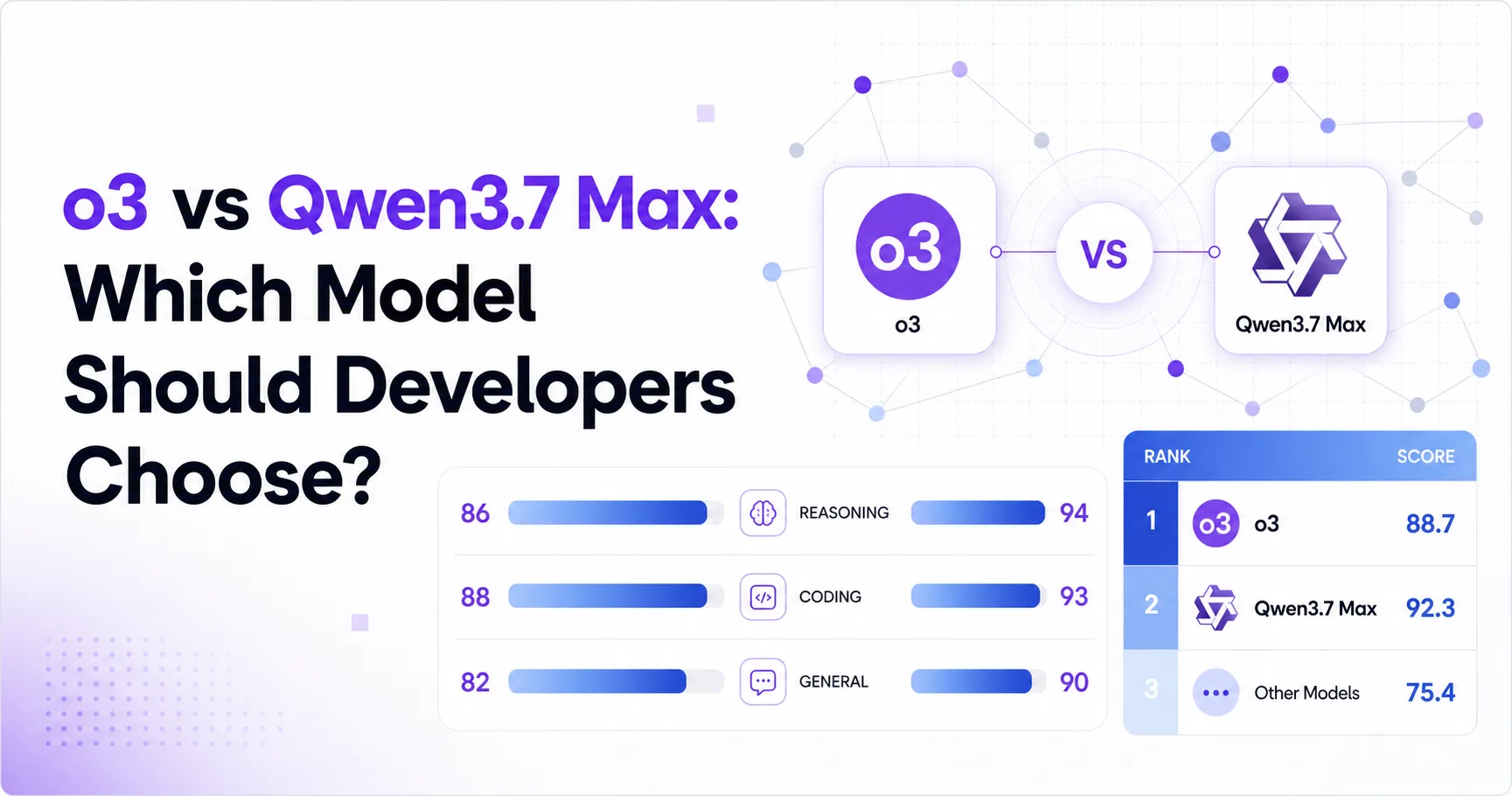
o3 and Qwen3.7 Max present a provisional choice between stronger measured general intelligence and stronger measured speed. Qwen3.7 Max leads the Artificial Analysis Intelligence Index at 46, while o3 records 30.4. Qwen3.7 Max also produces 204.156 median output tokens per second, compared with o3 at 128.056. The latency figure is identical at 0.3 seconds for both models, so the practical speed advantage comes from generation throughput rather than initial response latency.
The comparison has a major qualification: the supplied evidence does not establish that either model is currently available under a stable production API identity. OpenAI's current model directory does not list o3, and the research brief provides no verifiable official source for Qwen3.7 Max. Developers should therefore treat the benchmark and price snapshot as decision inputs, not as proof of deployability. Data provided by Artificial Analysis.
Qwen3.7 Max is the stronger measured general-purpose option, while o3 remains the more attractive specialist choice for mathematics and input-heavy workloads.
| Decision factor | o3 | Qwen3.7 Max | What it means |
|---|---|---|---|
| Intelligence Index | 30.4 | 46 | Qwen3.7 Max has the stronger reported general score |
| Math Index | 88.3 | Not reported | o3 has the only supplied math result |
| Coding Index | Not reported | 66 | Qwen3.7 Max has the only supplied coding result |
| Median output speed | 128.056 | 204.156 | Qwen3.7 Max is better suited to long generated responses |
| Latency | 0.3 seconds | 0.3 seconds | Neither has a measured first-response advantage |
| Blended price | $3.5 | $3.75 | o3 is cheaper under the supplied mix |
The scores are not a complete head-to-head evaluation. The datasets do not provide an o3 coding score or a Qwen3.7 Max math score, so developers cannot claim that either model wins those missing dimensions. The 46 versus 30.4 intelligence result supports a measured advantage for Qwen3.7 Max, but it does not prove better behavior for every coding, reasoning, or agent workflow.
The official evidence is asymmetric. OpenAI's current model directory does not list o3, and the brief provides no official Qwen3.7 Max product page. That gap is more important than a small price difference for teams planning a durable integration.
Qwen3.7 Max is the better measured choice for interactive generation because its higher output throughput can shorten the visible wait during long answers.
The difference between 204.156 and 128.056 median output tokens per second matters most after generation begins. It can make streamed coding assistance, document drafting, and multi-step tool responses feel more responsive. The same 0.3-second latency for each model changes the interpretation: Qwen3.7 Max does not start faster in the supplied measurement. It writes faster once the response is underway.
That distinction affects product design. A chat interface that shows short answers may see little user-perceived benefit from throughput. An agent that emits long plans, code patches, or structured results can benefit substantially because token generation occupies more of the total interaction. The measured advantage therefore favors Qwen3.7 Max for sustained output, not every request.
Quality remains harder to interpret than speed. Qwen3.7 Max has a 46 Intelligence Index, while o3 has 30.4, but the supplied data does not explain task composition, variance, or whether the evaluation matches a developer's workload. Qwen3.7 Max has a reported coding index of 66, but o3 has no comparable coding value in the brief. o3 has an 88.3 math index, but Qwen3.7 Max has no comparable math value. A team choosing for code review, theorem solving, or tool execution still needs a representative acceptance set.
The research brief also contains no reliable community evidence about streaming behavior, coding ergonomics, or failure patterns. Those questions remain open rather than settled in either model's favor.
o3 is cheaper on the supplied blended-token price, but Qwen3.7 Max can be economically preferable when output volume and interaction time dominate.
The blended prices are $3.5 for o3 and $3.75 for Qwen3.7 Max per 1M blended tokens. That gives o3 the lower headline cost for the supplied 3-to-1 input-to-output mix. o3 also charges $2 for 1M input tokens, compared with $2.5 for Qwen3.7 Max. These differences favor o3 for workloads dominated by large prompts, repeated context, retrieval payloads, or conversation history.
The output side reverses the ordering. Qwen3.7 Max costs $7.5 per 1M output tokens, while o3 costs $8. A generation-heavy workload can therefore narrow or reverse the blended-cost conclusion, depending on its actual input-output ratio. Developers should model prompt size, completion length, retries, and tool traces separately. A short answer with a large context behaves differently from a long autonomous response with a compact prompt.
Speed can also change effective cost. Qwen3.7 Max's 204.156 median output tokens per second may reduce user waiting and improve throughput per worker, but the supplied data does not provide infrastructure pricing, concurrency limits, rate limits, or utilization measurements. No cost conclusion should assume that faster generation automatically reduces the application's total bill.
Official pricing evidence is incomplete for o3. OpenAI's API pricing page does not list a current o3 price in the research brief, so the Artificial Analysis snapshot should not be treated as a confirmed present-day OpenAI invoice rate. No verifiable Qwen3.7 Max pricing page was supplied either.
o3 leads on 2 of 3 metrics
Qwen3.7 Max is the default pick for a new general developer workflow, provided the team can verify access and operational terms before committing.
Choose Qwen3.7 Max for interactive assistants, long-form code generation, and workflows where sustained output speed matters. Its 46 Intelligence Index is the stronger supplied general result, and its 204.156 median output tokens per second favors visible streaming throughput. The recommendation is provisional because the research brief contains no official product page, stable alias, API endpoint, context-window specification, or documented limitation for Qwen3.7 Max.
Choose o3 for mathematics-focused tasks, prompt-heavy workloads, or a comparison process that values the supplied specialist evidence over general scoring. Its 88.3 Math Index is the only reported math result, and its $2 input price is lower than Qwen3.7 Max's $2.5. That does not establish that o3 is superior for every reasoning task. It establishes a clearer case for mathematical evaluation and input-cost sensitivity.
Do not select either model solely from the current official catalog. OpenAI's Models documentation lists newer frontier models in the supplied research, but does not list o3. The same research found no verifiable official Qwen3.7 Max documentation. A production decision should first confirm endpoint access, model identifier stability, context limits, output limits, multimodal support, rate limits, and retirement policy.
A practical rollout should use a small task set covering the application's highest-cost prompts and most failure-sensitive outputs. Compare correctness, refusal behavior, tool-call validity, output length, latency, and retry frequency. The supplied research provides no reliable community tests for these operational behaviors, so local validation is necessary.
o3 and Qwen3.7 Max both lack enough official operational evidence to support an unqualified production recommendation.
The most important unresolved question is access. The supplied material does not confirm a stable API endpoint for either model. The next question is evaluation comparability. Each model has at least one missing category, so the reported scores cannot prove a complete winner. Pricing also needs workload-specific validation because the blended ranking changes between input and output tokens.
Teams should record the exact model identifier, endpoint, date, prompt mix, output mix, retry policy, and acceptance criteria during a pilot. That evidence can resolve uncertainties that the supplied research does not address. The absence of a sourced failure case is not evidence that failures do not exist.
Qwen3.7 Max is the better provisional overall choice because it leads the supplied Intelligence Index at 46 and generates 204.156 median output tokens per second. The conclusion remains conditional because official availability, context limits, and production failure behavior are not verified.
o3 is cheaper under the supplied 3-to-1 blended-token mix at $3.5 versus $3.75 per 1M blended tokens. o3 also has the lower input price, but Qwen3.7 Max has the lower output price, so output-heavy workloads may change the economic ranking.
Qwen3.7 Max is faster during response generation at 204.156 median output tokens per second versus o3 at 128.056. Both models show 0.3 seconds of latency in the supplied data, so the evidence supports higher sustained throughput rather than faster initial response.
Developers should choose o3 for coding only after a local task evaluation, because the supplied data reports no o3 coding index. Qwen3.7 Max has a coding index of 66, but the missing o3 result prevents a direct coding comparison.
Developers should consider o3 for mathematics because it has a reported Math Index of 88.3, while no comparable Qwen3.7 Max math result is supplied. That evidence identifies o3 as the better-supported math candidate, not a universal proof of mathematical superiority.
The supplied research cannot confirm production readiness for either model because it does not verify stable endpoints, aliases, context windows, output limits, or retirement policies. Teams should verify access and run an application-specific pilot before committing to either integration.