
Claude 4.1 Opus (Reasoning)
AvailableAnthropic · 2025-08-05 · 32,000 tokens
An AI model from Anthropic, strongest at reasoning, suited to a broad range of AI workloads.
Supported modalities:textimagecode
Quick Overview
Text Generation3/10
Code Generation6/10
Reasoning8/10
Multimodal3/10
Benchmark Results
Scores from leading benchmark suites.
artificial analysis intelligence34.5
artificial analysis math80.3
Performance Metrics
Latency and throughput performance.
Dive Deeper
AI model analysis
Claude 4.1 Opus (Reasoning) Review: Strong Math Position, Weak Product Availability
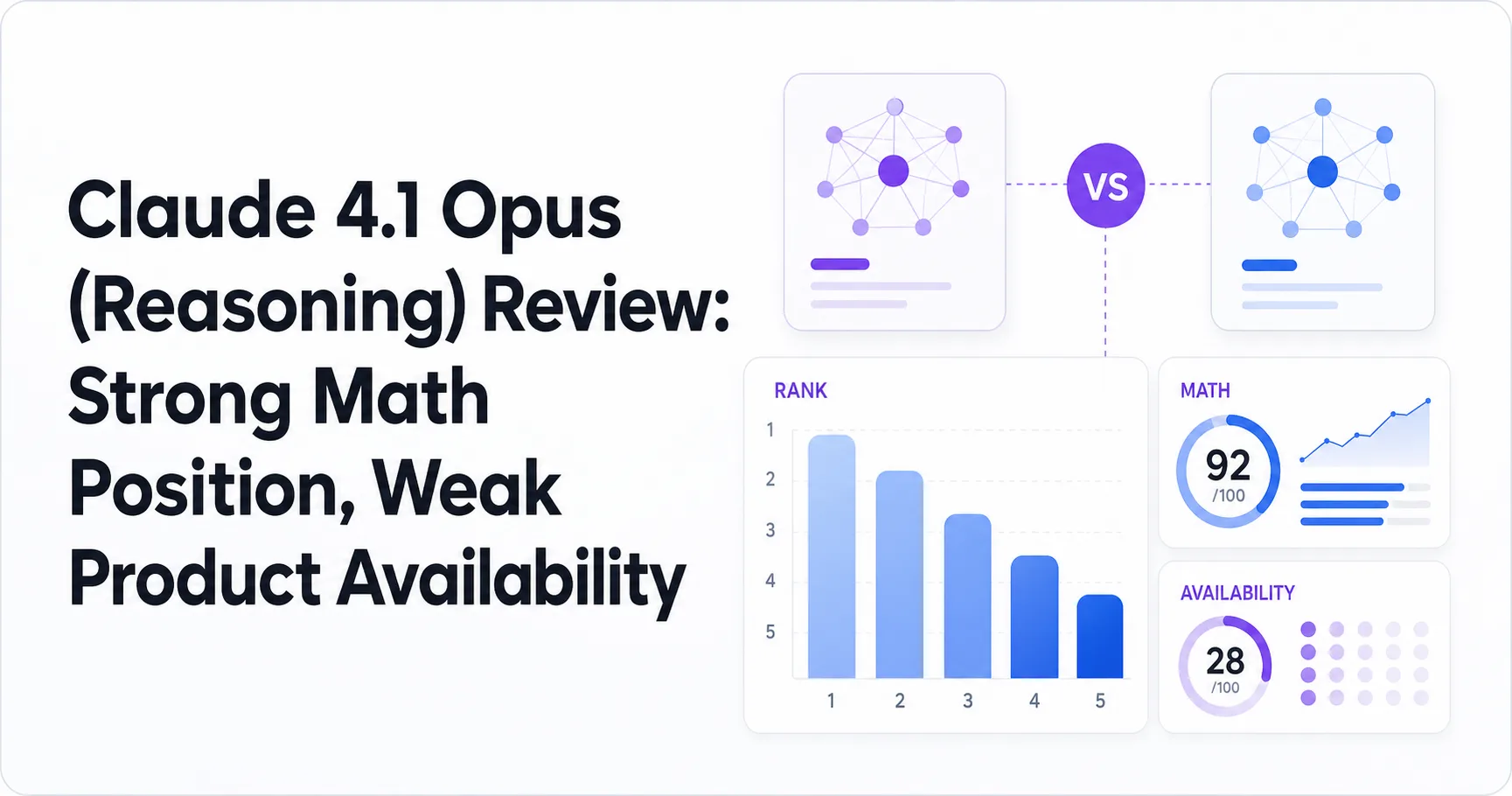
- **Where it stands:** Claude 4.1 Opus (Reasoning) ranks 109 of 578 on the Artificial Analysis Intelligence Index at 33.7 - **Price:** $30 per 1M blended tokens - **Speed:** output tokens per second not reported, 0.3s to first token - **Pick it when:** you specifically need this model through Amazon Bedrock or Google Cloud and your workload benefits from its relatively strong math ranking - **Watch out:** current official documentation does not confirm a stable API identifier, context window, output limit, or model-specific failure profile
Claude 4.1 Opus (Reasoning) is a constrained specialist, not a default production choice
Claude 4.1 Opus (Reasoning) is difficult to recommend as a general-purpose production model because Anthropic currently marks Claude Opus 4.1 as retired, with Bedrock and Google Cloud listed as exceptions (Claude pricing).
The benchmark data gives Claude 4.1 Opus (Reasoning) a middle-ranking position on the Artificial Analysis Intelligence Index, at 109 of 578 models with a score of 33.7. That placement does not support calling it a broad leader. Its math position is more persuasive, at 64 of 265 with a score of 80.3. The gap suggests a model whose value may depend heavily on task mix.
Developers should treat availability as the first selection filter. Anthropic’s current model overview does not show the slug claude-4-1-opus-thinking, and it does not confirm a model-specific API ID, alias, context window, or output ceiling (Claude models overview). Those omissions make deployment planning less certain than the benchmark scores alone imply.
The practical verdict is narrow: investigate Claude 4.1 Opus (Reasoning) when an approved cloud channel exposes it and mathematical reasoning matters. Do not make it the default choice for a new application without confirming access, identifiers, quotas, and behavior in your own workload.
The data supports a math-oriented evaluation, but not a broad capability premium
Claude 4.1 Opus (Reasoning) earns consideration for math-heavy tasks, while its overall intelligence ranking does not justify paying a large premium without workload-specific evidence.
| Decision factor | Claude 4.1 Opus (Reasoning) | Nearby reference point | Selection implication |
|---|---|---|---|
| Broad intelligence position | 109 of 578 | GLM-4.7 (Reasoning), GPT-5 (medium), KAT Coder Pro V2, MiniMax-M2.5, and Qwen3.5 397B A17B (Reasoning) all show 33.7 on this index | The available data does not show a broad intelligence advantage |
| Math signal | 64 of 265 at 80.3 | GLM-4.7 (Reasoning) shows 95; GPT-5 (medium) shows 91.7 | Claude remains credible, but it is not the strongest nearby math reference |
| Blended price | $30 per 1M tokens | Nearby references range from $0.525 to $3.4375 | Claude requires a specific quality or access reason |
| Availability | Retired on Anthropic’s pricing page, with Bedrock and Google Cloud exceptions | No comparable availability claim is established here | Access risk may dominate model quality |
The closest-model data also shows missing evidence. Coding scores are available for some nearby models, but not for Claude 4.1 Opus (Reasoning). Median output speed is unavailable for Claude and most references. Therefore, developers cannot infer coding quality or throughput from this brief alone.
Anthropic’s official overview describes general Claude capabilities such as text and image input, text output, multilingual ability, and vision, but the page does not clearly confirm that every statement applies specifically to this model (Claude models overview).
Claude 4.1 Opus (Reasoning) looks more defensible for mathematical reasoning than for general engineering
Claude 4.1 Opus (Reasoning) has its clearest evidence in mathematics, where its score of 80.3 places it at 64 of 265 evaluated models.
That ranking is useful as a directional signal. It says the model belongs in a math-focused evaluation set, especially for tasks involving symbolic manipulation, quantitative explanation, structured derivation, or mathematical checking. It does not prove reliability on production code, tool use, long-context retrieval, or agentic workflows. The research brief found no reliable community tests with a verifiable methodology for those areas.
The comparison set changes the interpretation. GLM-4.7 (Reasoning) reaches 95 on the same math index, while GPT-5 (medium) reaches 91.7. Claude 4.1 Opus (Reasoning) therefore appears mathematically capable, but its nearby alternatives provide stronger signals in the supplied data. KAT Coder Pro V2 also reports a coding score of 59.5, while Claude has no supplied coding score. That absence prevents a fair coding conclusion.
Latency does not resolve the choice. Claude 4.1 Opus (Reasoning) has a reported 0.3s time to first token, but its median output speed is not reported. A fast first token can still coexist with slow completion on reasoning-heavy responses.
The evidence is insufficient to identify a characteristic failure mode. No official source supplied a model-specific list of weaknesses, and no independently verifiable community evaluation was found.
Claude 4.1 Opus (Reasoning) is expensive enough that quality must be demonstrated per workload
Claude 4.1 Opus (Reasoning) is hard to justify on price alone because its $30 blended-token price is far above every nearby reference listed in the data brief.
The official price is $15 per million input tokens and $75 per million output tokens (Claude pricing). The blended figure therefore represents a meaningful operating commitment for applications that generate long answers, use repeated reasoning loops, or serve high request volume. The right question is not whether the model is affordable in isolation. The question is whether its task success reduces review, retry, or orchestration cost enough to offset the premium.
The nearby references are materially cheaper in the supplied comparison. GLM-4.7 (Reasoning) is listed at $1 per 1M blended tokens, GPT-5 (medium) at $3.4375, and both KAT Coder Pro V2 and MiniMax-M2.5 at $0.525. Qwen3.5 397B A17B (Reasoning) is listed at $1.35. Claude’s benchmark position does not show a broad intelligence lead over these references, so a general cost argument is weak.
Prompt caching may improve repeated-context economics, but the official page lists separate cache-write and cache-hit prices rather than proving savings for a particular workload (Claude pricing). Developers should measure cache hit rates, output length, retries, and human correction before approving the premium.
The evidence is insufficient to estimate total cost of ownership because output speed, context limits, quotas, and failure rates are not established for this model.
Choose Claude 4.1 Opus (Reasoning) only after access and task-level quality are proven
Claude 4.1 Opus (Reasoning) is a conditional pick for cloud-constrained teams with a validated math-heavy workload, not a sensible blind default for new development.
Choose it when all of the following are true:
- Your organization can access the model through Amazon Bedrock or Google Cloud, which Anthropic identifies as exceptions to its retired status (Claude pricing).
- Your evaluation emphasizes mathematical reasoning or related quantitative work.
- Your tests show a meaningful improvement in accepted answers, reduced retries, or lower review effort.
- Your platform team can confirm the exact model identifier, limits, quotas, and operational support path.
Avoid it when price sensitivity is central, when coding evidence is required before launch, or when you need a stable Anthropic API path. The supplied data shows cheaper nearby models with the same Artificial Analysis Intelligence Index score of 33.7, plus stronger nearby math scores from GLM-4.7 (Reasoning) and GPT-5 (medium). That does not establish that those models are better for every task, but it does raise the evidence burden for Claude.
A sensible evaluation should compare representative prompts rather than rely on index rank. Include math correctness, explanation quality, code modification, tool-call recovery, long-output stability, and review time. Keep the deployment decision provisional until the access path and production limits are documented.
Anthropic’s overview does not confirm the model-specific context window, output maximum, or stable alias (Claude models overview). Those unknowns are release-blocking details for many developer workflows.
FAQ for developers evaluating Claude 4.1 Opus (Reasoning)
Claude 4.1 Opus (Reasoning) requires an availability check before benchmark results can become a deployment decision.
The official documentation gives a partial product picture. Anthropic’s overview describes current Claude capabilities and access channels, while the pricing page identifies Claude Opus 4.1 as retired with limited cloud exceptions (Claude models overview, Claude pricing).
Data provided by https://artificialanalysis.ai/.
Frequently asked questions
Is Claude 4.1 Opus (Reasoning) still available for production use?
Claude 4.1 Opus (Reasoning) may still be available through Amazon Bedrock or Google Cloud, but Anthropic marks Claude Opus 4.1 as retired, so teams must verify regional access, identifiers, quotas, and support before production use.
Is Claude 4.1 Opus (Reasoning) good for mathematical tasks?
Claude 4.1 Opus (Reasoning) is a credible math candidate because it ranks 64 of 265 on the Artificial Analysis Math Index at 80.3, although nearby models in the supplied data score higher.
Is Claude 4.1 Opus (Reasoning) good value for developers?
Claude 4.1 Opus (Reasoning) is difficult to call good value without workload evidence because its $30 blended-token price is much higher than nearby references, while its broad intelligence ranking does not show a clear lead.
Can developers rely on a documented context window and output limit?
Claude 4.1 Opus (Reasoning) does not have a confirmed model-specific context window or maximum output in the supplied official overview, so developers should treat both as unknown until their provider documents them.
Should developers use Claude 4.1 Opus (Reasoning) for coding agents?
Claude 4.1 Opus (Reasoning) should enter a coding-agent evaluation only as a hypothesis because the supplied brief contains no model-specific coding score, verified community test, or official failure analysis.
Sources
- Claude models overviewVerifying Anthropic's documented Claude capabilities, access channels, model identifiers, aliases, context information, and model-specific documentation gaps.
- Claude pricingVerifying Claude Opus 4.1 lifecycle status, Bedrock and Google Cloud exceptions, input and output pricing, and prompt caching prices.
- Artificial AnalysisAttributing the supplied benchmark, ranking, latency, and pricing dataset.
Published: