
Claude Fable 5 (Adaptive Reasoning, Max Effort, Opus 4.8 Fallback)
AvailableAnthropic · 2026-06-09 · 32,000 tokens
An AI model from Anthropic, strongest at code generation, suited to a broad range of AI workloads.
Supported modalities:textimagecode
Quick Overview
Text Generation6/10
Code Generation8/10
Reasoning6/10
Multimodal5/10
Benchmark Results
Scores from leading benchmark suites.
artificial analysis intelligence62.1
artificial analysis coding76.5
Performance Metrics
Latency and throughput performance.
Dive Deeper
AI model analysis
Claude Fable 5 review: elite benchmark standing, expensive agent economics
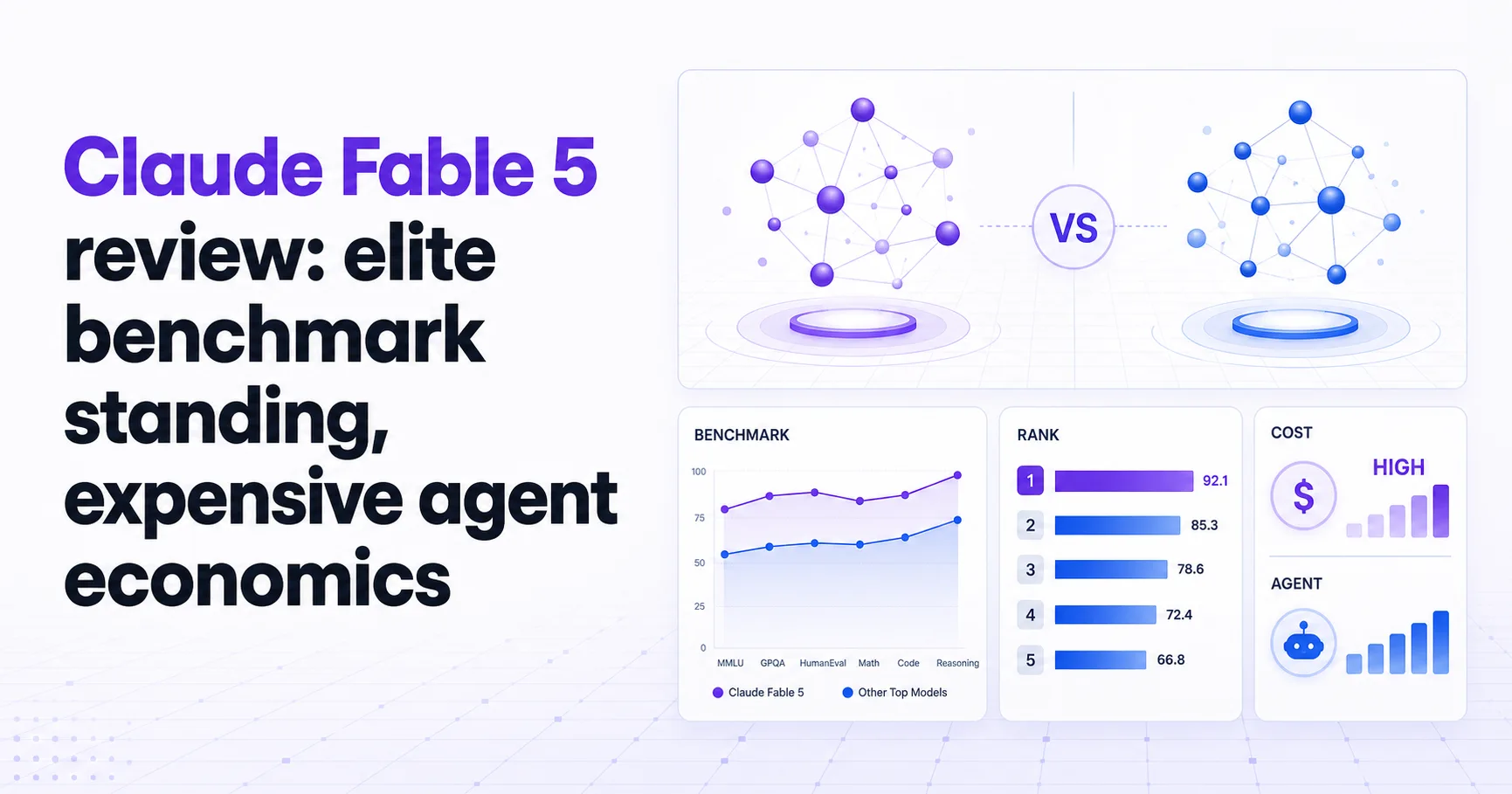
- **Where it stands:** Claude Fable 5 ranks 3 of 578 on the Artificial Analysis Intelligence Index at 59.9 - **Price:** $20 per 1M blended tokens - **Speed:** 70.509 output tokens per second, 0.3s to first token - **Pick it when:** You need long-running agent work and can justify $20 per 1M blended tokens - **Watch out:** Claude Fable 5 ranks 7 of 202 on coding, but the supplied evidence does not predict reliability on your exact workload
Claude Fable 5 at a glance
Claude Fable 5 merits a shortlist for complex agent work, but its price and autonomy make it a selective choice.
Anthropic positions Claude Fable 5 as a model for long-running agents, with text and image input, text output, multilingual support, and vision capabilities in the official model overview.
That positioning matters for developers building systems that must maintain task state, inspect large repositories, or combine reasoning with tools. The model supports memory, code execution, programmatic tool calling, context editing, compaction, and vision, according to Anthropic’s model introduction.
Adaptive thinking stays enabled, and developers adjust depth with the effort parameter rather than turning reasoning off, as described in Anthropic’s Fable 5 announcement and the effort documentation. The API does not return raw chain-of-thought. Developers can request summarized thinking or omit thinking output, with omission as the default, according to Anthropic’s model behavior documentation.
The practical reading is simple: Fable 5 is built for work that benefits from planning, tool use, and verification. It is less attractive when a short answer is the whole product.
Data provided by https://artificialanalysis.ai/.
Executive summary
Claude Fable 5 is a top-tier candidate, but nearby models make workload fit more important than the model label.
On the provided Artificial Analysis snapshot, Claude Fable 5 ranks 3 of 578 on the Intelligence Index and 7 of 202 on the Coding Index. Those positions justify serious evaluation. They do not establish that every agent, codebase, or customer-facing workflow will perform equally well.
Several adjacent entries, including Claude Opus 5 variants and GPT-5.6 Sol variants, remain credible alternatives in the supplied rankings. The selection question is therefore not whether Fable 5 is capable. It is whether its extra autonomy and agent tooling earn their operating cost for your workload.
| Decision lens | Claude Fable 5 | Adjacent references | What to infer |
|---|---|---|---|
| Broad capability | A leading shortlist position in the supplied snapshot | Claude Opus 5 and GPT-5.6 Sol variants remain close | Strong candidate, not proof of universal superiority |
| Coding | A top-tier coding result | GPT-5.6 Sol variants are credible coding references | Run repo-level evaluations before selecting |
| Agent execution | Explicit support for memory, code execution, programmatic tool calling, and context editing | The brief does not establish equivalent behavior for adjacent models | Fable’s practical edge is plausible, not measured head-to-head |
| Spend control | Effort can adjust depth while adaptive thinking remains enabled | Lower-priced adjacent entries appear in the snapshot | Budget for variance and inspect real task cost |
Claude Fable 5 is most compelling when a successful task requires sustained reasoning and verification. The supplied evidence is weaker for simple classification, short-form generation, or predictable high-volume workloads. Developers should treat the benchmark position as a screening signal, then test completion quality, tool discipline, and total cost on representative tasks.
Performance: what the ranking means in practice
Claude Fable 5’s strongest case is complex, multi-step work, where high aggregate ranks matter more than isolated response speed.
The Artificial Analysis benchmark snapshot places Claude Fable 5 at 3 of 578 on its Intelligence Index and 7 of 202 on its Coding Index. For developer selection, that combination is meaningful: the model is competitive across broad reasoning and software-oriented evaluation pools. It supports putting Fable 5 near the front of a serious evaluation queue.
The ranking still leaves important questions unanswered. It does not show how often the model completes a repository change without intervention, how consistently it follows tool contracts, or how much rework a human must perform. It also does not reveal whether performance holds across different languages, frameworks, data formats, or failure budgets. Those are workload questions, not leaderboard questions.
The response profile is suitable for interactive agent loops. The supplied data reports 0.3s to first token and a median output rate of 70.509 tokens per second. That combination can make planning and verification feel responsive, but it should not be read as a promise of short wall-clock task time. Adaptive thinking can vary the amount of internal work, and autonomous tool use can add browser checks, screenshots, scripts, and other actions.
Anthropic’s official release announcement describes tests involving software engineering, financial analysis, visual tasks, long-context memory, and scientific research. Those cases match the model’s intended role better than a short-answer demo. They also show why developers should evaluate complete task traces rather than only final text.
Community evidence points in the same direction, with important caveats. A Hacker News report describes Fable 5 researching micropython-wasm and producing a wheel intended to support full Python WASM. Another Hacker News discussion describes the model launching a browser, inspecting a window, taking screenshots, and checking a frontend fix. These are useful examples of capability and initiative, not standardized repeated tests.
The supplied evidence is insufficient to estimate reliability, tool-call volume, or quality variance for a specific production workload. The Reddit discussion contains both fast-success reports and complaints about long thinking or stalled work, but it does not provide a reproducible protocol.
Cost: when the premium is justified
Claude Fable 5 is expensive for routine generation, and its price makes sense only when successful completion offsets reasoning and tool overhead.
The snapshot reports a blended price of $20 per 1M tokens. Anthropic’s pricing documentation lists $10 per 1M input tokens and $50 per 1M output tokens. The output price matters because agent workflows often produce plans, patches, tool arguments, test results, and explanations in the same task.
This pricing profile favors high-value tasks over broad default routing. A model that saves a developer from debugging a difficult migration can justify a premium. The same model may be wasteful for extraction, short rewrites, routine summaries, or simple support responses where a cheaper model can meet the quality target.
Prompt caching can change the economics for applications that reuse large instructions, repository context, or stable reference material. The official pricing page separates cache writes from cache hits, so caching should be part of the cost design rather than an afterthought. Developers should measure cache reuse, output length, retries, and tool calls together.
Behavior can also raise the effective cost beyond the token price. The frontend example in the Hacker News report involved browser inspection, screenshots, and verification for a local fix. The report is anecdotal, but it illustrates a real production concern: an autonomous agent may spend more to establish confidence than a narrowly instructed model would spend producing an answer.
The effort setting provides a control for matching reasoning depth to task value, while Anthropic’s documentation makes clear that adaptive thinking itself remains part of the model behavior. Use lower effort for bounded tasks and reserve deeper settings for work where failure is materially costly. The exact cost threshold remains workload-specific, and the supplied evidence does not provide a controlled cost-per-success comparison.
Recommendation: who should choose Claude Fable 5
Claude Fable 5 is a good pick for autonomous engineering agents, long-context research, and visual workflows where verification quality matters more than unit cost.
Anthropic’s model introduction describes the tools and controls that support this role. The official release announcement adds examples across code migration, finance, vision, memory, and science. Together with the strong Artificial Analysis rankings, those sources support a focused recommendation for difficult, open-ended work.
| Use case | Recommendation | Reason |
|---|---|---|
| Long-running repository agents | Strong pick | Coding strength and proactive verification match the workflow |
| Research over large, persistent context | Test, then pick | The model is designed for long-running reasoning, but recall and citation quality need task-level validation |
| Visual debugging and browser workflows | Promising pick with controls | Community evidence shows active inspection and verification behavior |
| Low-cost extraction or routine summarization | Avoid as the default | Premium output economics and adaptive reasoning can exceed the task value |
| Sensitive or strictly governed data | Review compliance before adoption | Anthropic documents a retention policy and no Zero Data Retention availability for Fable 5 |
The nearby Claude Opus 5 and GPT-5.6 Sol variants remain useful reference points because the snapshot places them close enough to make a cheaper alternative evaluation rational. Fable 5 should win only if it produces better task outcomes, fewer human interventions, or better verification on your data.
Developers should also avoid treating Max Effort as a separate API model. Anthropic’s effort documentation describes it as an effort setting. A production integration should set effort deliberately, constrain tool loops, record token and tool usage, and route refusal responses through the documented fallback mechanism.
Before adopting Claude Fable 5
Claude Fable 5 needs production guardrails before it belongs in an unattended agent.
Integration is straightforward at the API identity level. Anthropic lists claude-fable-5 as the API model ID and stable alias, with access through Claude API, Amazon Bedrock, Claude Platform on AWS, Google Cloud, and Microsoft Foundry in the model overview. Anthropic’s access restoration notice records resumed availability, while the current overview still lists the model.
Request handling needs explicit application logic. A safety refusal can appear as a successful API response with stop_reason set to refusal, according to Anthropic’s refusal documentation. An integration that checks only transport-level failures can therefore misclassify a refusal as a completed task. Anthropic documents fallbacks through the fallbacks parameter, SDK middleware, or an application-managed retry path.
Data governance also needs review. Anthropic’s Fable 5 model documentation states that the model is not available under Zero Data Retention. Teams with strict retention or residency requirements should confirm the permitted data boundary before sending production content.
Finally, the evidence base remains uneven. Official material describes broad test areas, and community posts show ambitious real tasks, but the supplied brief does not include a reproducible independent evaluation for reliability, cost variance, or refusal frequency. That gap should shape the rollout plan: start with a representative task set, trace every tool call, and keep a fallback model available.
Frequently asked questions
Is Claude Fable 5 worth the price for a production agent?
Claude Fable 5 is worth the price when an agent must complete complex work with planning, verification, and tool use, because aggregate rankings alone cannot price your failure rate. The Artificial Analysis snapshot supports serious evaluation, while Anthropic’s release examples show the kinds of difficult workflows that may justify the premium.
Is Claude Fable 5 suitable for coding agents?
Claude Fable 5 is a strong coding-agent candidate, supported by its 7 of 202 Coding Index position and a detailed Hacker News engineering report. Developers should still test repository-level completion, patch quality, test execution, and human intervention before relying on it in production.
Can developers disable Claude Fable 5's reasoning?
Claude Fable 5 does not allow adaptive thinking to be disabled, but developers can tune reasoning depth with the effort parameter. Anthropic’s thinking documentation and effort documentation describe the available control and the limits of that control.
How should an application handle a Claude Fable 5 refusal?
Claude Fable 5 refusals require semantic response handling, because the API can return a refusal through stop_reason instead of a transport failure. Follow Anthropic’s refusal and fallback guidance, inspect the stop reason, and route eligible failures through a documented fallback or retry policy.
Is Claude Fable 5 appropriate for sensitive production data?
Claude Fable 5 is not an automatic fit for sensitive workloads with strict retention requirements, because Anthropic documents that the model is unavailable under Zero Data Retention. Review the official model documentation with your compliance team before sending protected data.
Sources
- Claude models overviewModel positioning, API identity, supported platforms, input modalities, and availability
- Introducing Claude Fable 5 and Claude Mythos 5Agent capabilities, adaptive thinking, thinking output, refusals, fallback behavior, and data retention
- Claude API pricingInput, output, blended, and prompt caching pricing
- EffortReasoning depth controls and the meaning of Max Effort
- ThinkingAdaptive thinking behavior and thinking output controls
- Refusals and fallbackRefusal response handling and fallback implementation
- Claude Fable 5 and Claude Mythos 5Official benchmark claims, capability examples, and safety boundaries
- Claude Fable 5 access restoredAvailability restoration
- Claude Fable 5, Hacker NewsCommunity evidence about a complex Python WASM engineering task
- Claude Fable is relentlessly proactive, Hacker NewsCommunity evidence about browser inspection, screenshots, verification, and tool overhead
- What's everyone's take on Claude Fable 5?Anecdotal reports about speed, quota consumption, stalled work, and interaction behavior
- Artificial AnalysisBenchmark rankings, pricing, latency, and output speed data
Published: