
Claude Opus 4.7 (Adaptive Reasoning, Max Effort)
AvailableAnthropic · 2026-04-16 · 32,000 tokens
An AI model from Anthropic, suited to a broad range of AI workloads.
Supported modalities:textimagecode
Quick Overview
Text Generation6/10
Code Generation7/10
Reasoning6/10
Multimodal5/10
Benchmark Results
Scores from leading benchmark suites.
artificial analysis intelligence55.0
artificial analysis coding73.6
Performance Metrics
Latency and throughput performance.
Dive Deeper
AI model analysis
Claude Opus 4.7 Review: Strong Coding Performance at a Premium Cost
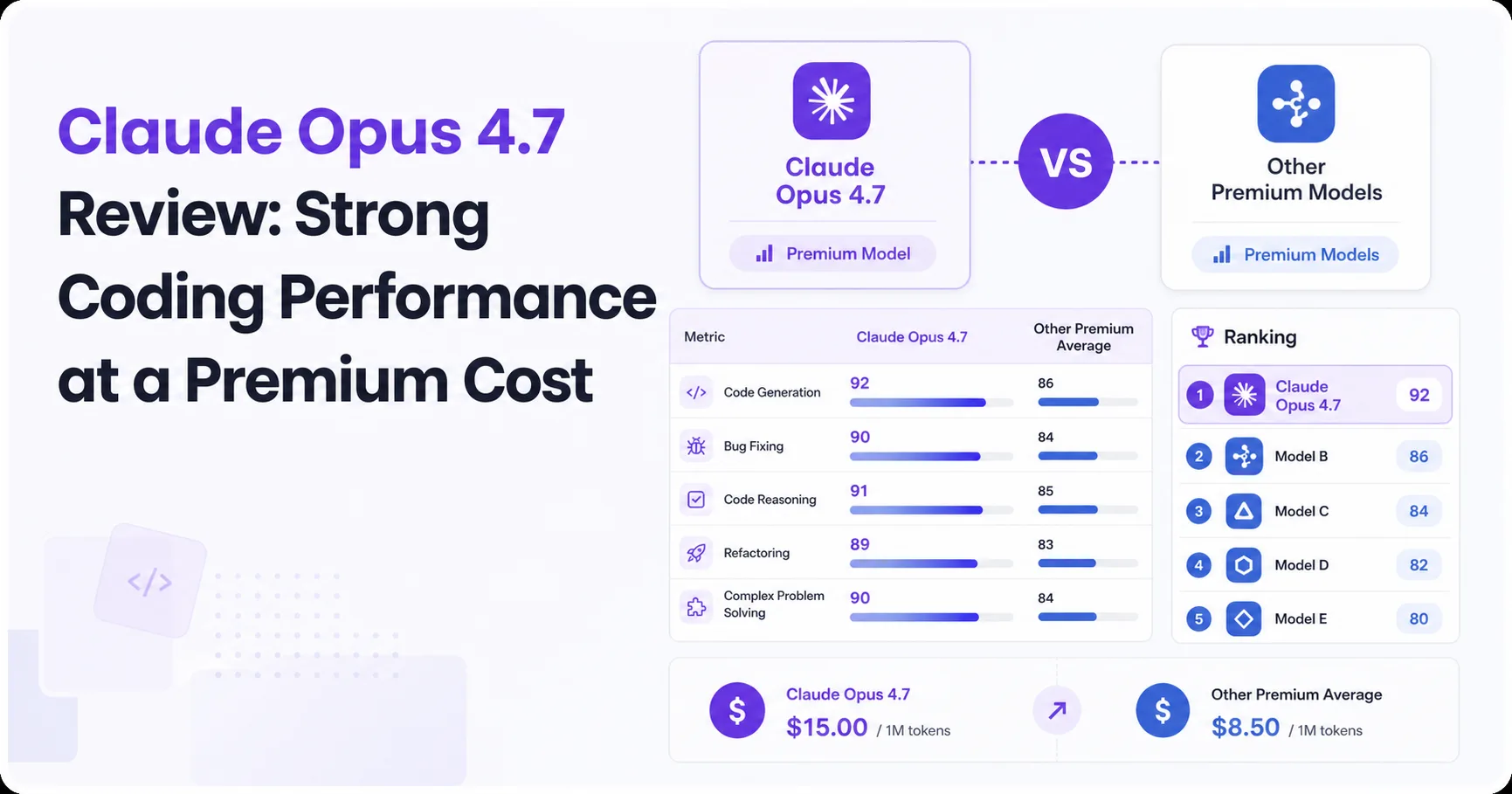
- **Where it stands:** Claude Opus 4.7 ranks 15 of 578 on the Artificial Analysis Intelligence Index at 53.5 - **Price:** $10 per 1M blended tokens - **Speed:** No median output-token rate is reported, with 0.3s to first token - **Pick it when:** Repository-level coding matters, supported by a rank of 14 of 202 on the Coding Index - **Watch out:** 0.3s first-token latency does not answer the missing sustained output-speed question
Claude Opus 4.7 at a glance
Claude Opus 4.7 is a premium high-capability model for developers who value complex task execution over low-cost throughput. Anthropic positions Claude Opus 4.7 for complex, long-running software engineering and agent work, with stronger instruction following and output verification described in its launch announcement. That positioning matches the supplied ranking: Claude Opus 4.7 ranks 15 of 578 on the Artificial Analysis Intelligence Index and 14 of 202 on its Coding Index, with scores of 53.5 and 73.6 respectively, according to Artificial Analysis. The practical verdict is narrower than the headline. Claude Opus 4.7 deserves serious evaluation for repository work, code review, and tool-using agents, but evidence remains incomplete for sustained output speed and dependable retrieval across very large contexts. The data brief reports 0.3s to first token but no median output-token rate, so initial responsiveness and completion throughput remain different questions. Data provided by https://artificialanalysis.ai/
Executive summary
Claude Opus 4.7 sits in the top tier of the supplied rankings, but its premium price makes workload fit more important than raw capability. Claude Opus 4.7’s ranking is close enough to the leading references that the decision should be framed around workload economics and failure tolerance, not a simple winner label. The adjacent models show why the model is compelling for difficult engineering work but weak as a universal default, based on the supplied Artificial Analysis data.
| Reference model | What its position means for an Opus decision |
|---|---|
| Claude Sonnet 5 | The lower-cost Anthropic option raises the bar for choosing Opus. Opus needs a harder task, a stronger result, or fewer correction loops to justify the premium. |
| GPT-5.6 Sol (medium) | The nearby OpenAI model is stronger on the supplied coding index, so Opus should win on workflow fit rather than name recognition. |
| Grok 4.5 | The lower-cost alternative makes routine generation a poor place to pay for Opus’s extra capability. |
| GPT-5.5 (xhigh) | This reference model ranks above Opus on both supplied indexes, so Opus is not the universal leader. |
Claude Opus 4.7’s best case is a workflow where the model must interpret a large task, make several related changes, use tools, and verify the result. Anthropic’s official positioning supports that use case, while the ranking data supports treating the model as a serious coding candidate. The weaker case is high-volume work with predictable prompts, modest reasoning demands, or strict sustained-throughput targets. The supplied snapshot does not reveal whether Opus reduces total engineering cost after retries, review, and tool failures, so teams should measure completed-task cost instead of token price alone.
Performance: what the ranking means in practice
Claude Opus 4.7 is a strong choice for coding and complex agent work, but its benchmark rank does not prove reliable long-context retrieval. A coding rank of 14 of 202 supports using Claude Opus 4.7 as a serious candidate for code generation, refactoring, debugging, test creation, and repository-level changes, according to the supplied Artificial Analysis snapshot. This is a selection signal, not a guarantee that every repository task will finish correctly without supervision.
Anthropic explicitly describes Claude Opus 4.7 as a model for complex, long-running software engineering and agent tasks in its launch announcement. That makes the model more relevant for tasks with dependencies between planning, editing, tool calls, and verification. It also suggests a different evaluation standard from simple answer quality. Developers should inspect whether the model chooses the right files, preserves existing behavior, handles failed tools, and verifies its own changes.
Adaptive reasoning and max effort can improve difficult work, but they can also increase response time and output consumption. The migration guide treats effort and total output limits as application-level controls, which means the strongest configuration may not be the best default for every request. A low-effort setting may be adequate for routine edits, while difficult debugging may justify more reasoning budget.
Long-context capability needs separate testing. A Hacker News discussion interprets Anthropic’s model-card results as evidence that retrieval quality can decline as context grows. The discussion is not an independent controlled benchmark, so it cannot establish a precise failure rate. It does establish a practical warning: a large context window should be treated as capacity, not as proof of stable recall across the entire window.
Community feedback is similarly mixed. A Reddit discussion reports complaints about meta-commentary, long planning, and delayed execution, while other replies describe stable coding and document work. These reports lack controlled methods, so they are useful for designing tests, not for settling the model’s general quality. The data brief also reports 0.3s to first token but no median output-token rate. Sustained completion speed therefore remains an evidence gap.
Cost: when the premium is justified
Claude Opus 4.7 is costly for routine generation, but the price can be rational when one correct engineering change avoids repeated review or tool loops. The supplied blended price is $10 per 1M tokens, while the listed input and output prices are $5 and $25 per 1M tokens. That spread matters because agentic coding tasks often produce substantial output through explanations, patches, tests, and verification. The economics can deteriorate quickly when the model spends heavily on reasoning and still needs correction, based on the Artificial Analysis data and Anthropic’s pricing documentation.
Claude Opus 4.7 makes more sense when the cost of an incorrect change is high. Examples include production incident analysis, security-sensitive code review, difficult migrations, and changes that require understanding interactions across many files. The model is harder to justify for routine summarization, simple extraction, repetitive transformation, or large batches of predictable requests. In those workloads, lower-cost adjacent models create a strong alternative according to the supplied comparison set.
Prompt caching and batch processing can change the effective economics. Anthropic’s pricing page documents both mechanisms, so teams with repeated instructions, stable repository context, or asynchronous workloads should model those paths separately from standard synchronous calls. The tokenizer change also means nominal prices may understate actual usage for the same source text. Anthropic documents that migration effect in the pricing documentation and migration guide.
The missing output-token rate limits the cost-performance conclusion. The snapshot supplies first-token latency but not sustained generation speed, so it cannot show whether Opus finishes a task faster than a cheaper model. Teams should record successful task completion, reviewer intervention, retries, tool failures, and total tokens. Without those measurements, the premium remains a bet on quality rather than a proven reduction in engineering cost.
Recommendation for developers
Claude Opus 4.7 is worth choosing for high-value engineering workflows that reward persistence, verification, and strong coding judgment. The recommendation is strongest when the model must understand an unfamiliar codebase, coordinate related edits, use tools, and explain or test the result. Anthropic’s official model positioning directly supports this class of work, and the supplied coding rank of 14 of 202 supports serious consideration.
Use Claude Opus 4.7 when:
- A wrong change creates meaningful review, rollback, or operational cost.
- The task combines repository understanding, implementation, testing, and verification.
- The workflow benefits from adaptive reasoning and can tolerate variable response length.
- Prompt caching or batch execution can reduce repeated-context cost.
Choose another model first when:
- The workload is dominated by routine requests and price is the main constraint.
- Sustained output speed matters more than deep reasoning.
- The application depends on reliable retrieval from very large contexts without task-specific testing.
- Existing prompts depend on older Claude behavior, assistant prefills, manual extended thinking, or non-default sampling settings.
Claude Opus 4.7 should therefore be evaluated as a premium specialist and possibly as a selective router target, not automatically as the default model for every request. The adjacent results show that cheaper or similarly priced alternatives can be competitive on the supplied indexes. The Reddit reports also suggest that interaction style and execution discipline may vary by workflow. Evidence is insufficient to claim that Opus consistently lowers total task cost, handles every long-context workload, or produces the fastest completed result.
Production caveats before adoption
Claude Opus 4.7 requires a migration and evaluation plan before production adoption. The stable model identifier is claude-opus-4-7, and the model overview documents its supported model behavior and version rules. Developers should verify availability through the Models API because the pricing page and current model documentation do not present exactly the same lifecycle picture.
The migration guide flags changes to thinking configuration, assistant prefills, sampling parameters, and output limits. Prompts that worked with earlier Claude models should be regression-tested rather than copied unchanged. The official launch announcement also describes automatic blocking for prohibited or high-risk cybersecurity requests, so legitimate security workflows need an approved operating path. These constraints do not disqualify the model, but they make harness design and acceptance testing part of the model choice.
Frequently asked questions
Is Claude Opus 4.7 worth its price for production coding?
Claude Opus 4.7 is worth the price when failures create expensive review or tool-loop costs, but it is a poor default for high-volume routine generation. Its coding rank of 14 of 202 supports serious evaluation, while the supplied data does not prove lower total cost per completed task. See the Artificial Analysis data.
Is Claude Opus 4.7 reliable for long-context repositories?
Claude Opus 4.7 can accept large repository context, but developers should validate retrieval on their own codebase before relying on it. Community discussion cites possible recall degradation as context grows, and those observations are interpretations rather than controlled independent tests. See the Hacker News discussion and Anthropic’s model overview.
Should developers use max effort by default?
Claude Opus 4.7 should use max effort selectively, because adaptive reasoning can improve difficult tasks while increasing output consumption and response time. The migration guide recommends treating effort and total output limits as part of the application’s budget rather than fixed defaults.
What prompt changes are needed when migrating to Claude Opus 4.7?
Claude Opus 4.7 needs stricter prompt testing after migration, because stronger literal instruction following can change behavior from prompts tuned for older Claude models. Developers should remove incompatible legacy thinking and assistant-prefill patterns before comparing results, as described in the launch announcement and migration guide.
Can Claude Opus 4.7 handle cybersecurity tasks?
Claude Opus 4.7 may block high-risk cybersecurity requests, so legitimate security teams should plan for the provider’s verification path and test allowed workflows before committing. The official announcement describes automatic detection and blocking for prohibited or high-risk requests.
Sources
- Introducing Claude Opus 4.7Model positioning, software engineering and agent workflows, instruction following, effort controls, and cybersecurity restrictions.
- Models overviewStable model identifier, model version rules, supported behavior, and migration-related model details.
- PricingListed model pricing, blended cost context, prompt caching, batch processing, tokenizer considerations, and availability signals.
- Migration guideAdaptive reasoning, effort settings, output limits, prompt migration, sampling restrictions, and legacy API incompatibilities.
- Opus 4.7 is a genuine regression and I'm tired of pretending it isn'tAnecdotal community reports about verbosity, planning behavior, coding, and technical collaboration.
- So Opus 4.7 is measurably worse at long-context retrieval compared to Opus 4.6Community interpretation of long-context retrieval degradation and its methodological limitations.
- Artificial AnalysisSupplied benchmark rankings, scores, pricing snapshot, latency, adjacent-model comparisons, and data attribution.
Published: