
Claude Opus 5 (Adaptive Reasoning, High Effort)
AvailableAnthropic · 2026-07-24 · 32,000 tokens
An AI model from Anthropic, strongest at code generation, suited to a broad range of AI workloads.
Supported modalities:textimagecode
Quick Overview
Text Generation6/10
Code Generation8/10
Reasoning6/10
Multimodal5/10
Benchmark Results
Scores from leading benchmark suites.
artificial analysis intelligence61.5
artificial analysis coding76.5
Performance Metrics
Latency and throughput performance.
Dive Deeper
AI model analysis
Claude Opus 5 (High Effort) Review: Top-Tier Reasoning With Real Workflow Costs
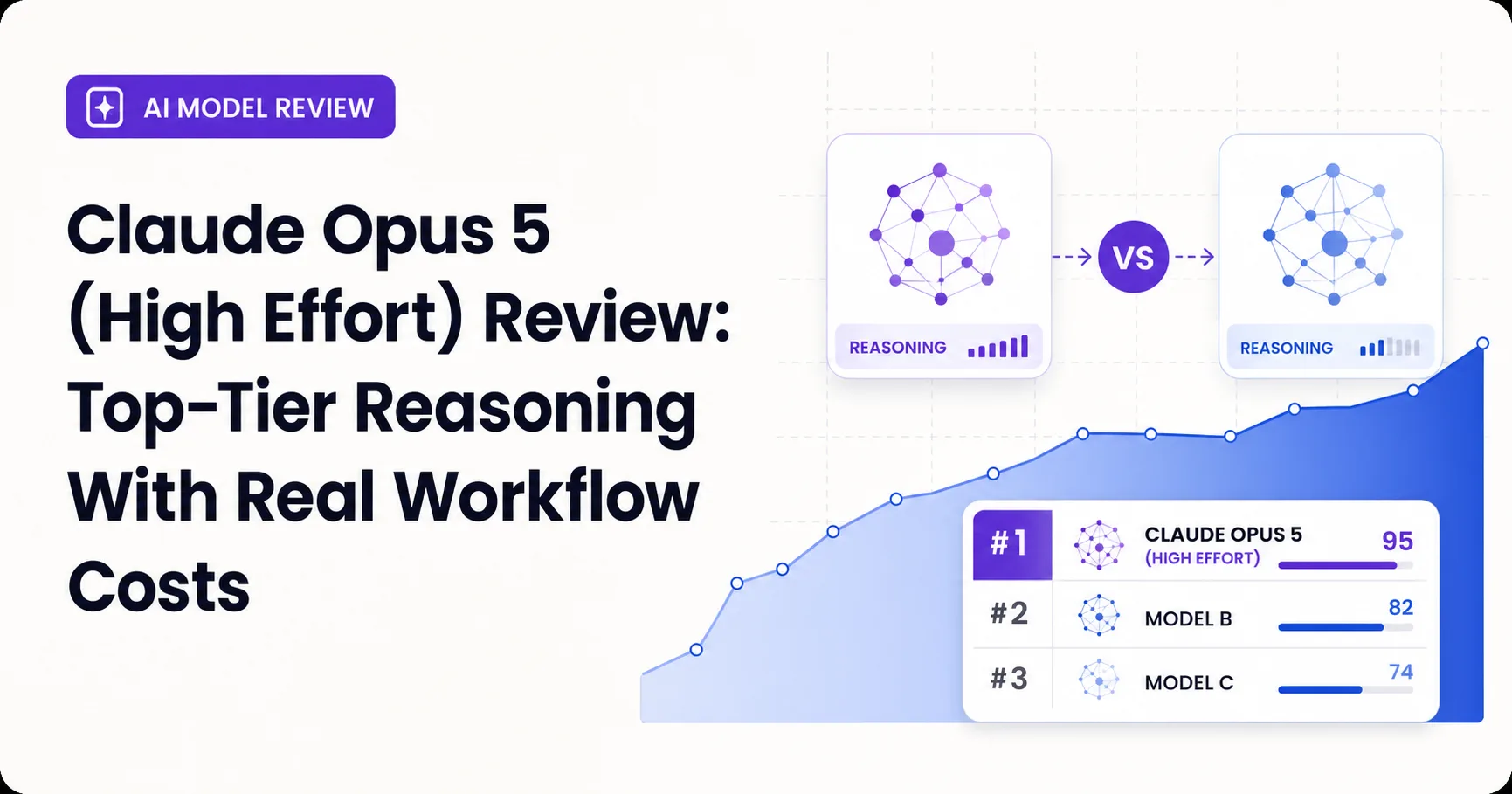
- **Where it stands:** Claude Opus 5 (Adaptive Reasoning, High Effort) ranks 4 of 578 on the Artificial Analysis Intelligence Index at 58.9 - **Price:** $10 per 1M blended tokens - **Speed:** 54.599 output tokens per second, 0.3s to first token - **Pick it when:** long-running coding agents, complex repository changes, and multi-step work where independent execution matters - **Watch out:** evidence is insufficient to prove a stable real-world coding success rate or user-experience distribution
Claude Opus 5 review: the short verdict
Claude Opus 5 (Adaptive Reasoning, High Effort) is a top-tier reasoning model whose strongest case is difficult, long-running developer work. Claude Opus 5 ranks 4 of 578 on the Artificial Analysis Intelligence Index at 58.9, and 7 of 202 on the Artificial Analysis Coding Index at 76.5. Data provided by https://artificialanalysis.ai/. The same evaluation data is available from Artificial Analysis.
Anthropic positions Claude Opus 5 for complex agentic coding and enterprise work, with added emphasis on deep reasoning, long-horizon tasks, visual understanding, scientific research, office documents, and multi-agent collaboration (Introducing Claude Opus 5). That positioning matches the supplied rankings better than a broad claim that it is the best model for every coding request.
The practical verdict is selective. Claude Opus 5 is compelling when a model must plan, act, inspect results, and continue without constant intervention. It is less attractive for routine transformations, high-volume generation, or workflows that need short, predictable answers. Its high-effort setting makes the model more capable for hard work, but it also raises the cost of giving the model too much autonomy.
What the benchmark position means for developers
Claude Opus 5 (Adaptive Reasoning, High Effort) belongs on a serious shortlist, but its value depends on assigning it work worth thinking through. The supplied data shows a model with stronger general intelligence standing than coding standing, although both positions are near the front of their respective evaluation sets. That combination favors mixed tasks where coding is part of a larger reasoning loop.
The closest models clarify the tradeoff without changing the main conclusion:
| Reference model | What Claude Opus 5 gives up | What Claude Opus 5 gains |
|---|---|---|
| GPT-5.6 Sol (max) | Coding score and output speed | Lower blended price with the same intelligence score (Artificial Analysis) |
| Claude Fable 5 | Intelligence score and output speed | Lower blended price with the same coding score (Artificial Analysis) |
| GPT-5.6 Sol (xhigh) | Coding score and output speed | Higher intelligence score and lower blended price (Artificial Analysis) |
| Kimi K3 (max) | Intelligence score, coding score, and output speed | Stronger supplied evaluation position, at a higher blended price (Artificial Analysis) |
This is a useful middle position. Claude Opus 5 is cheaper than the other listed premium alternatives while retaining a stronger intelligence score than the lower-priced Kimi reference. It does not win the supplied comparison on coding score or output speed, so the purchase case must come from task completion quality, autonomy, or reduced human review.
Anthropic also describes Claude Opus 5 as available for text and image input, text output, multilingual work, and visual understanding through several cloud and platform channels (Models overview). Those capabilities widen its fit, but the brief does not provide task-level evidence showing how much they improve developer outcomes.
Performance: strong reasoning, with autonomy as the real variable
Claude Opus 5 (Adaptive Reasoning, High Effort) is a top-tier general intelligence model with excellent, but not clearly dominant, coding performance. Its intelligence rank of 4 of 578 at 58.9 indicates broad capability near the front of a large model set. Its coding rank of 7 of 202 at 76.5 indicates strong coding ability, while the nearby coding scores show that the lead is contestable (Artificial Analysis).
For developers, the ranking matters most when a task mixes several forms of work. A repository migration may require understanding unfamiliar code, choosing a change strategy, editing several files, running checks, interpreting failures, and revising the patch. Claude Opus 5 appears well suited to that pattern because Anthropic explicitly targets complex agentic coding, long-running tasks, deep reasoning, and multi-agent collaboration (Introducing Claude Opus 5). The model also accepts image input and supports visual understanding, which can help with screenshots, diagrams, design references, and technical artifacts (Models overview).
The ranking does not establish a repository-level success rate. The supplied snapshot does not show task-level pass rates, error categories, correction counts, or the effect of different prompts and tool environments. It therefore supports a shortlist decision, not a guarantee that Claude Opus 5 will finish a particular codebase more reliably than every alternative.
Autonomy is the main practical variable. Developers in an r/ClaudeAI discussion reported useful long-running execution after giving the model a clear goal, but also described verbosity, slow-feeling responses, overthinking on simple tasks, scope drift, and large changes made without sufficient confirmation (Is Opus 5 actually that bad, or is it just Reddit hype?). These are individual reports without a common test method, so they should shape safeguards rather than serve as measured failure rates.
The Hacker News discussion does not close that evidence gap. Its FreeCAD reconstruction example is presented as a notable case, but the brief identifies it as matching an Anthropic example rather than an independent replication (Claude Opus 5, Introducing Claude Opus 5). Claude Opus 5 therefore looks strongest for supervised autonomy, with explicit scope, checkpoints, and tests.
Cost: reasonable for high-value work, expensive for casual delegation
Claude Opus 5 (Adaptive Reasoning, High Effort) is economically rational for high-value tasks, not for undifferentiated high-volume generation. The supplied blended price is $10 per 1M tokens, with $5 input tokens and $25 output tokens. That places Claude Opus 5 below the listed GPT-5.6 Sol variants and Claude Fable 5, but above Kimi K3 (max) in the supplied comparison (Artificial Analysis).
The price makes sense when a successful run replaces substantial engineering time, handles a complex investigation, or reduces the number of human review cycles. It becomes harder to justify when requests are short, repetitive, or mostly input-heavy. The output price matters especially for an adaptive reasoning model because thinking and final text share the output limit. Anthropic warns that default thinking can increase both latency and cost for long tasks (Claude Opus 5 update, Thinking).
Effort should be treated as a behavior control, not as a strict token budget. Lower effort can reduce token use, but difficult requests may still consume substantial reasoning. Applications that need a hard ceiling should enforce max_tokens and monitor actual usage instead of assuming that an effort setting alone controls spend (Effort).
Repeated context can improve the economics because Anthropic provides prompt caching with separate write, refresh, and cache-hit pricing (Anthropic Pricing). That matters for repository agents, policy-heavy enterprise prompts, and document workflows that reuse the same instructions. Caching does not solve the core issue, however. If the model is allowed to overthink simple work or produce unnecessarily long output, a cheaper model with tighter behavior may deliver better value.
The cost conclusion is straightforward: Claude Opus 5 is priced like a model that should earn its place through difficult task quality. Teams should route routine work elsewhere and reserve high effort for requests where reasoning has measurable value.
Recommendation: where Claude Opus 5 belongs in a model stack
Claude Opus 5 (Adaptive Reasoning, High Effort) is my pick for complex coding agents that can run with clear scope and human review at checkpoints. The model should be treated as a high-value worker inside a routing strategy, not as the only model in a production stack.
| Use case | Recommendation | Reason |
|---|---|---|
| Long-running repository changes | Choose Claude Opus 5 | Its supplied intelligence and coding positions support difficult work, while Anthropic explicitly targets agentic coding and long-horizon tasks (Artificial Analysis, Introducing Claude Opus 5). |
| Enterprise workflows with review gates | Choose with checkpoints | Anthropic positions the model for enterprise work, while community reports suggest that clear scope and updated project instructions can reduce unwanted autonomy (Introducing Claude Opus 5, Is Opus 5 actually that bad, or is it just Reddit hype?). |
| Screenshot, diagram, or document-assisted debugging | Consider it strongly | Claude Opus 5 supports image input and visual understanding through the documented model interfaces (Models overview). |
| Routine rewriting, extraction, or bulk generation | Usually skip it | The output price and reports of overlong responses make a high-effort model a weak fit for simple, repetitive work (Anthropic Pricing, Is Opus 5 actually that bad, or is it just Reddit hype?). |
| Latency-sensitive interactive loops | Benchmark alternatives | The supplied output speed trails the adjacent GPT-5.6 Sol variants and Claude Fable 5, even though first-token latency is the same in the supplied data (Artificial Analysis). |
| Strict tool protocols with thinking disabled | Avoid that configuration | Anthropic warns that disabled thinking can cause tool calls to appear as ordinary text or expose internal XML tags (Claude Opus 5 update). |
I would not describe Claude Opus 5 as the definitive coding winner from this brief alone. The coding rank is strong, but the supplied neighboring scores include higher results, and the independent community evidence lacks a consistent test method. The safer decision is to run a representative repository trial with fixed prompts, tool permissions, review gates, and cost tracking.
Choose Claude Opus 5 when the failure cost of shallow reasoning is high. Route away from it when short answers, low output spend, or predictable interaction matters more than autonomous depth.
Integration checks before production use
Claude Opus 5 (Adaptive Reasoning, High Effort) needs a short integration review before production adoption. The model page slug in this review is claude-opus-5-high, but Anthropic documents claude-opus-5 as the official API ID and stable alias, so applications should use the documented identifier rather than infer an API name from the page slug (Models overview, Model IDs and versioning).
Keep adaptive thinking enabled for difficult tool-using work unless testing proves that a simpler configuration is safer. Anthropic documents effort levels, strict interactions between effort and thinking, and the risk of malformed tool behavior when thinking is disabled (Claude Opus 5 update, Effort, Thinking).
Teams should also test streaming, output ceilings, cache behavior, provider-specific features, and fallback handling. The documented beta features include mid-conversation tool changes and server-side fallbacks, while long thinking requests can impose transport and batching requirements (Claude Opus 5 update, Thinking). Finally, maintain an operational fallback plan because Anthropic recorded an elevated-errors incident affecting Claude Opus 5 services (Elevated errors on Claude Opus 5).
Frequently asked questions
Is Claude Opus 5 worth its price for coding?
Claude Opus 5 is worth its price for difficult, high-value developer work, but it is usually poor value for routine edits and high-volume generation. Its coding rank of 7 of 202 supports serious consideration, while the $25 output price and reported verbosity argue for selective routing (Artificial Analysis, Anthropic Pricing, Is Opus 5 actually that bad, or is it just Reddit hype?).
Should developers keep high effort enabled by default?
Claude Opus 5 should keep adaptive thinking enabled for difficult tool-using work, while effort should be tuned around task difficulty and a hard max_tokens ceiling. Anthropic documents configuration limits and warns that disabled thinking can produce malformed tool behavior (Claude Opus 5 update, Effort, Thinking).
Is Claude Opus 5 fast enough for interactive products?
Claude Opus 5 is fast enough for many interactive requests on the supplied measurement, but its reported speed does not settle end-to-end experience for long thinking tasks. Community reports describe slow-feeling responses, so teams should benchmark complete workflows rather than rely on first-token latency alone (Artificial Analysis, Is Opus 5 actually that bad, or is it just Reddit hype?).
What is the main reason not to choose Claude Opus 5?
Claude Opus 5 is a poor fit when predictable brevity, strict tool-call formatting with thinking disabled, or low output cost matters more than top-tier reasoning. Anthropic documents malformed tool-call risks, and community reports describe overthinking and scope drift (Claude Opus 5 update, Thinking, Is Opus 5 actually that bad, or is it just Reddit hype?).
Can developers use Claude Opus 5 across cloud providers?
Claude Opus 5 is available through Claude API, Amazon Bedrock, Google Cloud, and Microsoft Foundry, subject to provider-specific feature support. Anthropic documents the supported platforms and separate beta features, so deployment parity should be tested before migration (Models overview, Claude Opus 5 update).
Sources
- Artificial AnalysisEvaluation rankings, scores, pricing comparison, output speed, and latency data attribution.
- Introducing Claude Opus 5Anthropic positioning for agentic coding, enterprise work, long-horizon tasks, reasoning, and collaboration.
- Models overviewSupported modalities, deployment platforms, model identity, and API availability.
- What's new in Claude Opus 5Adaptive thinking, effort behavior, beta features, fallback behavior, and disabled-thinking risks.
- ThinkingThinking configuration, tool use, output limits, streaming considerations, and configuration constraints.
- EffortEffort levels and the distinction between behavior control and hard token budgets.
- Anthropic PricingInput, output, blended, and prompt caching pricing.
- Model IDs and versioningOfficial API identifier and stable snapshot naming guidance.
- Is Opus 5 actually that bad, or is it just Reddit hype?Developer reports about verbosity, speed, overthinking, scope drift, and autonomous coding behavior.
- Claude Opus 5Community discussion of the FreeCAD reconstruction example and its lack of independent replication.
- Elevated errors on Claude Opus 5Operational incident history and production fallback considerations.
Published: