
Claude Opus 5 (Adaptive Reasoning, Low Effort)
AvailableAnthropic · 2026-07-24 · 32,000 tokens
An AI model from Anthropic, suited to a broad range of AI workloads.
Supported modalities:textimagecode
Quick Overview
Text Generation5/10
Code Generation7/10
Reasoning6/10
Multimodal4/10
Benchmark Results
Scores from leading benchmark suites.
artificial analysis intelligence52.5
artificial analysis coding66.9
Performance Metrics
Latency and throughput performance.
Dive Deeper
AI model analysis
Claude Opus 5 Low Effort Review: Strong Coding Candidate, Expensive Default
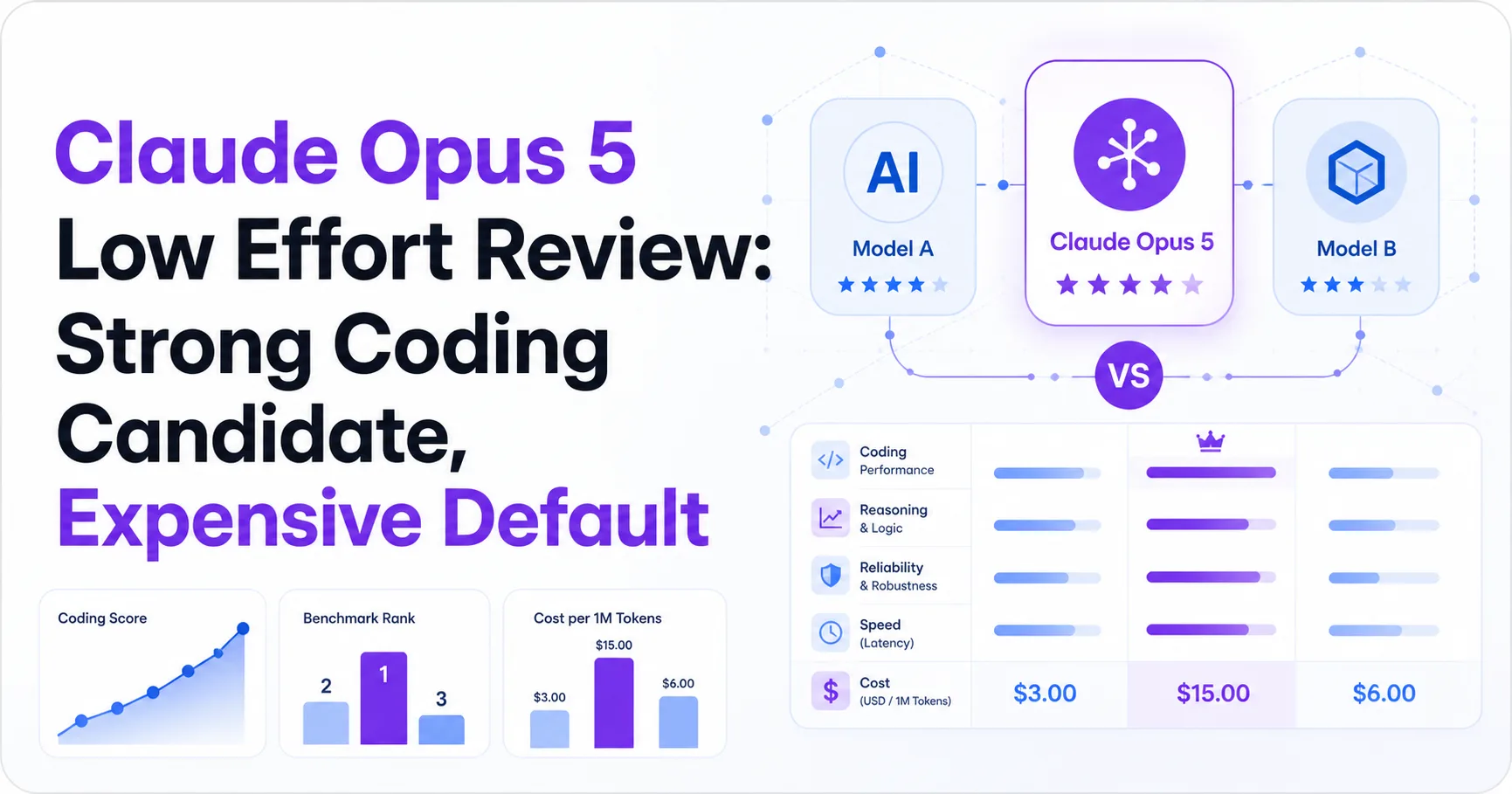
- **Where it stands:** Claude Opus 5 (Adaptive Reasoning, Low Effort) ranks 22 of 578 on the Artificial Analysis Intelligence Index at 50.6 - **Price:** $10 per 1M blended tokens - **Speed:** 55.017 output tokens per second, 0.3s to first token - **Pick it when:** You need strong reasoning for complex coding and agent workflows, and human review is available - **Watch out:** Independent, method-transparent evidence for the low-effort configuration remains insufficient
Claude Opus 5 Low Effort: The Short Verdict
Claude Opus 5 (Adaptive Reasoning, Low Effort) is a serious candidate for complex coding and agent workflows, with benchmark results placing it near the front of the field. Artificial Analysis places this configuration at 50.6 on its Intelligence Index and 66.9 on its Coding Index. Those results make Claude Opus 5 worth shortlisting, but they do not prove that low effort is the right setting for every workload.
Anthropic positions Claude Opus 5 for complex agentic coding and enterprise work. The model accepts text and images, produces text, supports multiple languages, and includes visual understanding, according to the model overview and launch announcement. The low-effort label describes a configuration of claude-opus-5, rather than a separate API model. Adaptive thinking remains part of the model’s behavior, while output_config.effort controls the requested reasoning intensity through the effort guide and Claude Opus 5 update notes.
Data provided by https://artificialanalysis.ai/
Summary: Strong Enough to Shortlist, Too Costly to Standardize Blindly
Claude Opus 5 (Adaptive Reasoning, Low Effort) offers a quality-first tradeoff, but low effort does not make it an automatic choice for every production workload. Its intelligence ranking is unusually strong across the supplied model field, while its coding ranking remains behind several nearby alternatives. The result is a model that deserves a serious pilot, not an unconditional default.
| Decision lens | Claude Opus 5 Low Effort | Nearby reference point |
|---|---|---|
| General capability | Strong candidate for difficult reasoning and broad enterprise tasks | Nearby models remain competitive on the intelligence measure |
| Coding | Good shortlist option for complex repository work | Several adjacent models score higher on the coding measure |
| Economics | Premium pricing requires meaningful task value | Multiple nearby models cost less in the supplied snapshot |
| Interaction style | Better for planned, delegated work than constant micro-direction | Faster alternatives may suit high-frequency interaction |
| Control surface | Low effort changes reasoning behavior without guaranteeing short visible answers | Teams still need prompt and output controls |
The model overview identifies claude-opus-5 as the stable API name and documents its supported delivery platforms. That reduces naming ambiguity across deployments. Still, Anthropic’s effort documentation describes effort as a behavior signal rather than a strict token budget. Low effort can reduce reasoning, tool use, latency, and cost, while sacrificing some capability. It may also leave visible answers longer than expected.
The supplied research does not provide a controlled comparison of low effort against higher effort on the same tasks. That evidence gap matters more than the label. Developers should evaluate the configuration with their own repositories, tools, and acceptance tests.
Performance: Upper-Tier Ranking, Uneven Practical Fit
Claude Opus 5 (Adaptive Reasoning, Low Effort) ranks 22 of 578 on the Artificial Analysis Intelligence Index and 32 of 202 on its Coding Index. The intelligence position signals broad strength across a large comparison set. The coding position is also strong, but it is less dominant than the general ranking suggests. Several nearby models score higher on the supplied coding measure, including Muse Spark 1.1 and GPT-5.5.
That distinction changes how developers should read the benchmark. Claude Opus 5 belongs on a shortlist for architecture work, multi-file changes, difficult debugging, repository analysis, and agent tasks that require planning before execution. The result does not establish that it will produce the best patch for every language, framework, or codebase. Benchmark rankings identify a promising candidate. They do not replace tests for instruction following, tool selection, regression safety, or recovery after a failed command.
Anthropic’s model overview and launch announcement frame the model around complex agentic coding and enterprise work. That positioning fits the ranking better than a simple chat or autocomplete role. For routine edits, the model may spend more effort than the task warrants. The effort guide says lower effort can reduce reasoning and tool calls, but it can also reduce capability. Anthropic recommends starting with high effort and lowering it after application-specific evaluation.
Community evidence adds a practical warning. A Reddit discussion describes mixed experiences involving slowness, overthinking, verbosity, and suitability for long autonomous tasks. A Hacker News report describes a project where the model reportedly ignored repository deployment guidance. An X post reports an unfavorable work experience alongside a strong blind-test ranking. None of these reports uses a transparent, reproducible method. Together, they suggest that benchmark strength and interaction quality may diverge.
The practical performance verdict is therefore conditional: Claude Opus 5 Low Effort looks strong for high-value delegated engineering, but developers should add repository constraints, tool-call checks, and human approval before allowing autonomous changes.
Cost: Premium Economics Need Premium Task Value
Claude Opus 5 (Adaptive Reasoning, Low Effort) is costly for routine throughput, so its price makes sense only when stronger task completion offsets lower volume economics. The supplied snapshot lists a blended price of $10 per 1M tokens. Nearby references include Muse Spark 1.1 at $2 and Gemini 3.6 Flash at $3, while offering higher output speed in the same dataset. This makes Claude Opus 5 a poor default for simple, repetitive generation when quality differences are small.
The price can still be rational for work where failures are expensive. Complex refactoring, production debugging, architecture review, security-sensitive code changes, and long-running agent tasks can justify a premium if the model reduces rework. That is a workload hypothesis, not a demonstrated savings claim. The supplied data does not include task completion cost, human review time, retry rates, or production error rates.
Prompt caching may improve the economics of applications that repeatedly send the same large instructions or repository context. Anthropic’s pricing documentation explains the available cache pricing, while the Claude Opus 5 update notes document prompt-caching support. The benefit depends on request shape and cache-hit behavior, so teams should measure it instead of assuming it.
Low effort is also an imperfect cost-control mechanism. Anthropic’s effort guide says effort can reduce thinking and tool use, but it is not a strict output budget. A low-effort request can still produce a long visible answer. Developers should control output format separately and inspect actual token usage.
The cost verdict is simple: use Claude Opus 5 Low Effort where each successful response has substantial value. Use a cheaper nearby model for high-volume work unless application tests show a clear quality advantage.
Recommendation: Shortlist It for Difficult Work, Keep a Fallback
Claude Opus 5 (Adaptive Reasoning, Low Effort) is best suited to high-value engineering work that benefits from deliberate planning and human review. The model is worth testing for complex repository changes, agentic coding, enterprise analysis, and tasks where a wrong answer creates expensive follow-up work. It is less attractive as a universal assistant for simple requests, rapid micro-edits, or cost-sensitive batch generation.
| Choose Claude Opus 5 Low Effort when | Prefer a nearby alternative when |
|---|---|
| The task needs broad reasoning and multi-step execution | The workload is repetitive and price-sensitive |
| Engineers can review patches and tool actions | Users expect rapid, conversational iteration |
| A failed response costs more than a premium request | A cheaper model already meets acceptance tests |
| The application can tune effort per task | The application needs predictable output limits |
Low effort should be treated as a candidate operating point, not the model’s universal personality. Anthropic advises starting with high effort and lowering it after evaluation. That recommendation appears in the effort guide. Developers should compare effort settings on representative tasks, then keep the lowest setting that preserves acceptance quality.
The deployment story is reasonably clear. The model deprecations page lists the model as active, and the model overview documents provider availability and model identifiers. Operational readiness still requires monitoring. An official Claude Opus 5 elevated-errors incident shows why production systems should retain retries, fallbacks, and visibility into failures. That incident does not establish a fixed model failure rate, but it is relevant to service design.
flowchart LR
  A[Shortlist] --> B[Repository pilot]
  B --> C{Acceptance tests pass}
  C -->|Yes| D[Limited production]
  C -->|No| E[Change effort or model]
Final recommendation: shortlist Claude Opus 5 Low Effort for difficult, high-value work, but do not standardize it without a controlled quality and cost pilot.
Before Deployment: Questions the Benchmark Cannot Answer
Claude Opus 5 (Adaptive Reasoning, Low Effort) needs a controlled pilot because benchmark strength does not establish reliable low-effort behavior for every application. Developers should test repository instruction following, tool-call correctness, patch quality, output discipline, recovery after failure, latency under realistic prompts, and spend under representative traffic.
The supplied ranking data answers where the model stands relative to other models. It does not answer whether the model follows a specific claude.md, respects a deployment policy, or produces acceptable changes in a particular codebase. The official effort guide also makes clear that low effort is not a strict visible-length control.
Community reports remain useful as risk prompts, not as failure-rate estimates. The available Reddit report, Hacker News report, and blind-test discussion on X do not disclose enough method detail to settle the question. Evidence is insufficient for a broad claim that low effort is either consistently excellent or consistently frustrating.
Frequently asked questions
Is Claude Opus 5 Low Effort a separate API model?
No, Claude Opus 5 (Adaptive Reasoning, Low Effort) uses the claude-opus-5 model with an effort setting, so deployment logic should treat low effort as configuration rather than a separate model ID. The effort guide and Opus 5 update notes document this behavior.
Is Claude Opus 5 Low Effort good for coding?
Yes, Claude Opus 5 (Adaptive Reasoning, Low Effort) is a credible coding choice, but its supplied coding ranking trails several nearby models, so teams should test repository-specific tasks before standardizing. Anthropic explicitly positions the model for complex agentic coding in its model overview, while Artificial Analysis provides the comparative ranking.
Is Claude Opus 5 Low Effort worth the price?
Claude Opus 5 (Adaptive Reasoning, Low Effort) is worth its price only when task quality, difficult reasoning, or reduced rework matters more than raw throughput and low token cost. The supplied snapshot places its blended rate above several nearby alternatives, while the pricing documentation explains caching and usage-cost mechanics.
Should developers disable thinking with Claude Opus 5?
Developers should keep thinking enabled unless controlled tests justify disabling it, because Anthropic documents risks involving tool calls appearing as ordinary text and internal XML appearing in visible responses. The Claude Opus 5 update notes describe those compatibility concerns and effort restrictions.
Does community feedback prove that Claude Opus 5 is unreliable?
No, community feedback does not establish a stable failure rate, because the available reports describe individual experiences without transparent, reproducible test methods. Developers can use the Reddit discussion, Hacker News report, and X post to design tests, not to replace them.
Is Claude Opus 5 ready for production deployment?
Claude Opus 5 is available for direct API use, but production readiness still requires monitoring and fallback design because an official service incident demonstrates operational risk without proving a fixed model-quality failure rate. The deprecation page covers current status, and the official incident record documents the service event.
Sources
- Artificial AnalysisBenchmark rankings, pricing snapshot, latency, and throughput data
- Claude models overviewModel positioning, API naming, supported capabilities, and provider availability
- What's new in Claude Opus 5Adaptive thinking, effort behavior, API restrictions, and prompt caching
- Effort parameterEffort settings, reasoning tradeoffs, and output-length limitations
- Claude API pricingPricing and prompt-caching economics
- Model deprecationsCurrent model status and deployment stability context
- Introducing Claude Opus 5Official model positioning and launch context
- Elevated errors on Claude Opus 5Operational availability incident context
- Is Opus 5 actually that bad, or is it just Reddit hype?Community reports about speed, verbosity, overthinking, and autonomous work
- Ask HN: Do you think Opus 5 will improve?Project-level report about repository instructions and deployment behavior
- BIG NEWS: Opus 5 is here...and I hate working with itCommunity blind-test and work-experience report
Published: