
Claude Opus 5 (Adaptive Reasoning, Xhigh Effort)
AvailableAnthropic · 2026-07-24 · 32,000 tokens
An AI model from Anthropic, strongest at code generation, suited to a broad range of AI workloads.
Supported modalities:textimagecode
Quick Overview
Text Generation6/10
Code Generation8/10
Reasoning6/10
Multimodal5/10
Benchmark Results
Scores from leading benchmark suites.
artificial analysis intelligence62.5
artificial analysis coding77.0
Performance Metrics
Latency and throughput performance.
Dive Deeper
AI model analysis
Claude Opus 5 Xhigh Review: Exceptional Reasoning, Expensive Autonomy
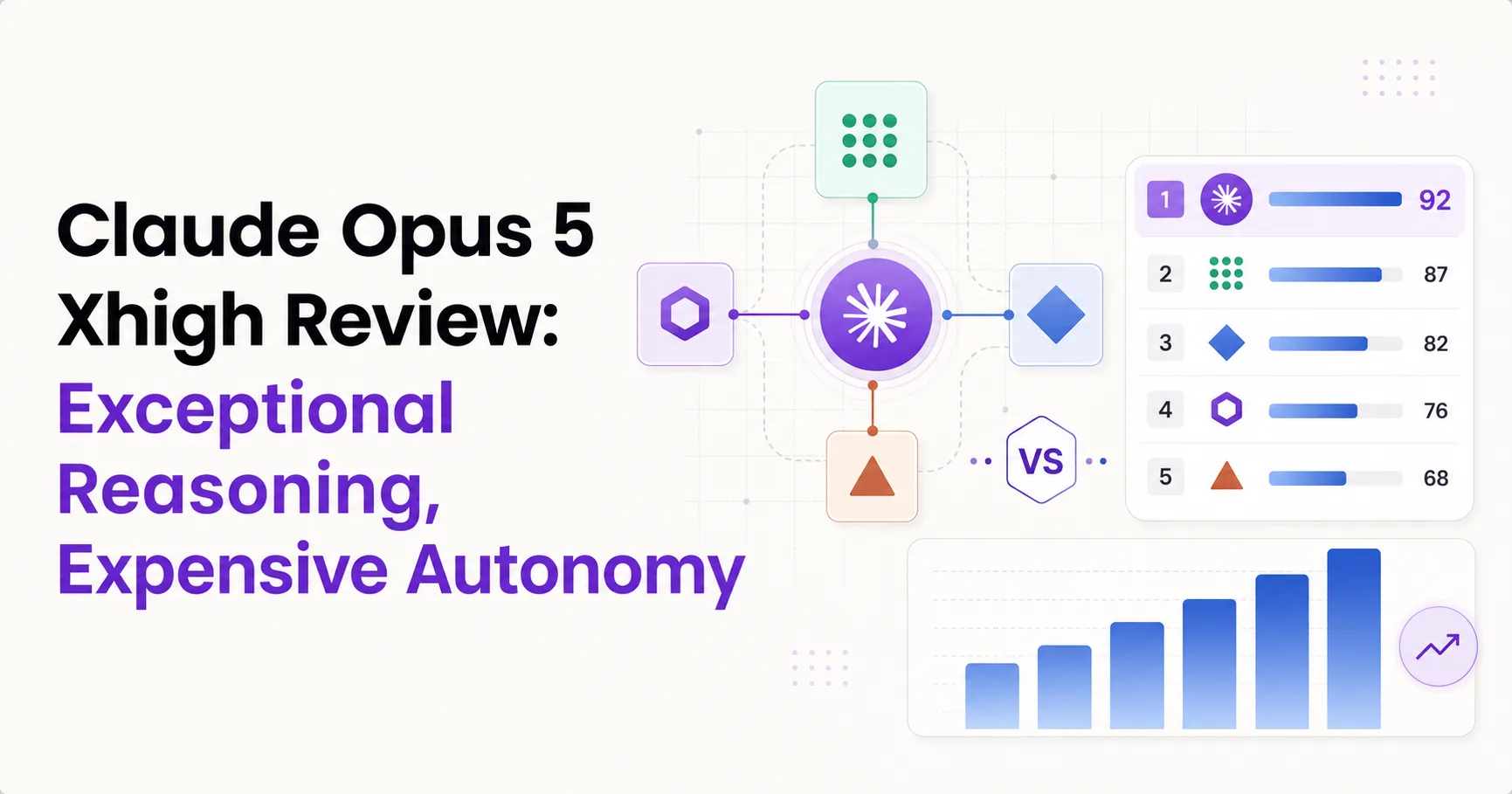
- **Where it stands:** Claude Opus 5 (Adaptive Reasoning, Xhigh Effort) ranks 2 of 578 on the Artificial Analysis Intelligence Index at 60.1 - **Price:** $10 per 1M blended tokens - **Speed:** 53.917 output tokens per second, 0.3s to first token - **Pick it when:** You need long-running, multi-file engineering work and can justify $10 blended tokens - **Watch out:** $10 blended tokens can become expensive when verbosity, repeated reasoning, or autonomous detours dominate the workflow
Claude Opus 5 Xhigh is a serious engineering model, not a universal default
Claude Opus 5 (Adaptive Reasoning, Xhigh Effort) is a strong default for difficult engineering agents, but its value depends on controlling autonomous work.
The model is officially exposed through the stable API identifier and alias claude-opus-5; xhigh describes an effort setting rather than a separate API model. Developers should therefore treat the Artificial Analysis slug as a test configuration, not as a portable provider identifier. The Models overview documents the official identifier, supported platforms, multimodal input, and long-context capabilities.
Anthropic positions Claude Opus 5 for complex agentic coding, multi-file implementation, code review, debugging, visual understanding, long-context work, and demanding document or spreadsheet tasks. The official release announcement reinforces that positioning, while the model update notes explain its adaptive thinking and effort controls.
For developers, the key distinction is workflow fit. Claude Opus 5 can be a strong choice when the model must maintain a plan, inspect a repository, use tools, and make decisions across a long session. It is less obvious as a default for short, tightly controlled interactions where concise output and predictable token use matter more than maximum reasoning depth.
Data provided by https://artificialanalysis.ai/
The main tradeoff is capability density versus operational restraint
Claude Opus 5 (Adaptive Reasoning, Xhigh Effort) earns a shortlist position for developers who value task completion over minimal response cost.
Artificial Analysis places the configuration at 2 of 578 on its Intelligence Index and 5 of 202 on its Coding Index. Those positions support a broad recommendation for demanding work, but they do not prove that every repository, tool harness, or interaction pattern will benefit equally. The snapshot is strongest as a screening signal, not as a replacement for a task-level pilot. Data provided by Artificial Analysis.
The adjacent configurations clarify the decision without changing the central verdict:
| Reference model | Selection signal | Main tradeoff for a Claude Opus 5 Xhigh buyer |
|---|---|---|
| Claude Opus 5 Max Effort | Higher listed intelligence and coding results at the same blended price | More capability headroom, with greater pressure to manage thinking and output length |
| Claude Opus 5 High Effort | Lower listed benchmark results at the same blended price | A possible control-oriented configuration when maximum reasoning is unnecessary |
| Claude Fable 5 Max Effort | Faster listed output than Claude Opus 5 Xhigh | Its higher blended price makes the operational case harder to justify without better workflow results |
| GPT-5.6 Sol Xhigh | Strong listed coding result and faster listed output | Higher blended price and a lower listed intelligence result create a different balance |
Claude Opus 5 Xhigh is therefore best understood as a high-capability engineering option with a management requirement. The right question is not whether it ranks highly. The right question is whether its extra autonomy reduces enough human work to offset its token and orchestration costs.
Performance: the ranking supports difficult work, while behavior determines the real experience
Claude Opus 5 (Adaptive Reasoning, Xhigh Effort) combines near-frontier benchmark placement with behavior that rewards well-scoped autonomy.
A position of 2 of 578 on the Artificial Analysis Intelligence Index suggests unusually strong general reasoning relative to the measured field. Its position of 5 of 202 on the Coding Index points to strong software engineering performance, though the coding placement is not the absolute leader in this snapshot. The useful interpretation is breadth: the model is credible for coding tasks that also require planning, explanation, visual interpretation, or decisions outside a narrow code-generation loop. Data provided by Artificial Analysis.
The measured serving profile also changes how developers should design the loop. A latency of 0.3s and median generation of 53.917 output tokens per second suggest that the initial request can begin promptly and that visible generation is serviceable. They do not guarantee a short end-to-end task. Adaptive thinking, tool calls, repository inspection, retries, and human approval can dominate the elapsed workflow.
Anthropic explicitly lists long-running agentic coding, multi-agent collaboration, code review, debugging, and complex document work among the target uses in What’s new in Claude Opus 5. That makes the model more attractive for repository-level tasks than for isolated code snippets.
The behavioral evidence is less settled. A Reddit discussion reports verbosity, overthinking, instruction drift, and frustration in interactive Claude Code use. Lenny’s review describes a cautious agent that often seeks human judgment and needs repeated prompting to decide. A Hacker News discussion praises its ability to construct supporting workflows but also questions whether it continues working when it should ask for missing input. These reports are useful warnings, not standardized measurements, so the evidence is insufficient to claim a stable failure rate.
Cost: the price is defensible for high-value work and weak for wasteful autonomy
Claude Opus 5 (Adaptive Reasoning, Xhigh Effort) is fairly priced for high-value engineering work, but wasteful reasoning can erase that advantage.
The Artificial Analysis snapshot lists a blended price of $10 per 1M tokens, with $5 input tokens and $25 output tokens. That structure favors workloads where a successful answer replaces substantial engineering time. It is less attractive for repetitive summarization, broad exploratory prompting, or interactive sessions that generate long explanations without producing durable project progress. Data provided by Artificial Analysis.
The official Anthropic pricing documentation confirms the same base input and output rates. The output rate matters because adaptive thinking and detailed agent reports can increase the amount of generated material. A request that appears small in the interface can still become expensive if the agent repeatedly inspects files, revisits decisions, or narrates every step.
Prompt caching can improve the economics of repeated context. The Claude Opus 5 update notes describe cache-related beta support and effort controls. Caching helps when the same repository context or instructions recur, but it does not make unnecessary reasoning free. Teams should measure cache reuse, generated output, tool-call count, and human intervention together.
There is also an integration cost. Claude Opus 5 uses thinking by default, and max_tokens covers both thinking and final response text. Existing clients that budget only for visible output may hit limits earlier than expected. The update notes also state that xhigh and max cannot be combined with disabled thinking. Developers should validate these assumptions before production rollout.
The price becomes difficult to defend when the task is simple, the user needs rapid steering, or the harness cannot stop an unproductive agent. Community reports of long responses and autonomous detours reinforce that caution, but they remain anecdotal rather than controlled cost studies.
Recommendation: use Claude Opus 5 Xhigh as a controlled specialist
Claude Opus 5 (Adaptive Reasoning, Xhigh Effort) should be selected for consequential, multi-step work and avoided as a universal chat default.
Choose it when the task has several of these properties: the repository is unfamiliar, the change spans multiple files, the agent must diagnose rather than follow a fixed recipe, tool use is central, or a correct result is worth more than a minimal token bill. Its benchmark placement supports that choice, and Anthropic explicitly targets long-running coding, debugging, review, and complex knowledge work in Introducing Claude Opus 5.
Use stronger controls when the task has unclear permissions, missing inputs, or a high cost of acting in the wrong direction. The Hacker News discussion describes autonomous workflow construction as a strength that can also consume tokens when the model should request clarification. A harness should define stop conditions, approval points, file-scope limits, and recovery behavior.
Do not choose it solely because the word Xhigh sounds like a separate premium model. The official Models overview identifies claude-opus-5 as the model, while effort is a runtime configuration. Compare effort settings on the same tasks before deciding whether the additional reasoning is useful.
A compact selection path is:
┌─ Is the task repository-level, ambiguous, or consequential? │ ├─ Yes → Pilot Claude Opus 5 Xhigh with approvals and stop conditions. │ └─ No → Prefer a simpler or lower-effort configuration. └─ Does the agent repeatedly overthink or drift? ├─ Yes → Reduce effort, tighten prompts, or choose a faster adjacent model. └─ No → Keep it for work where completion quality offsets the cost.
The final recommendation is positive but conditional. Claude Opus 5 Xhigh is a strong candidate for a high-value coding agent. It is not proven to be the best choice for every interactive workflow, and public reports do not provide enough controlled evidence to settle that question.
Before adopting Claude Opus 5 Xhigh
Claude Opus 5 (Adaptive Reasoning, Xhigh Effort) deserves a controlled pilot before broad adoption because benchmark strength and workflow friction point in different directions.
A useful pilot should use real repository tasks rather than isolated prompts. Track whether the agent reaches a reviewable result, how often a developer must redirect it, whether it asks for missing information, and how much generated work the task consumes. Compare the same tasks with the adjacent Claude Opus 5 effort settings and at least one external reference model from the Artificial Analysis snapshot.
The pilot should also test failure handling. Anthropic documents behavior changes from default thinking, shared token limits, and effort restrictions in What’s new in Claude Opus 5. Community reports add operational concerns about verbosity, long-running sessions, and recovery after interruptions. The Hacker News service discussion describes errors and restart concerns, although those observations do not isolate model capability from service or harness behavior.
Evidence remains insufficient for a universal claim about interactive coding quality, autonomous reliability, or total cost per completed task. Treat those as local measurements. If the model consistently reduces review and debugging effort, its price is easier to justify. If it mainly produces longer plans and more supervision, the same benchmark strength may not translate into value.
Frequently asked questions
Is Claude Opus 5 Xhigh a separate official API model?
No, Xhigh is an effort configuration for Claude Opus 5, while the stable API model ID and alias are claude-opus-5, as documented in the Models overview.
Is Claude Opus 5 Xhigh worth its price for developers?
Claude Opus 5 Xhigh is worth the price when successful multi-step engineering work replaces substantial human investigation, but simpler tasks may not justify its output-heavy cost or autonomous behavior.
Should I use Claude Opus 5 Xhigh for interactive coding?
Use Claude Opus 5 Xhigh selectively for interactive coding, because public feedback reports strong autonomy alongside verbosity, overthinking, and instruction drift in some sessions, without standardized reproduction.
Can I disable thinking while using Xhigh effort?
No, Xhigh cannot be combined with disabled thinking, and Claude Opus 5 also applies the output budget across thinking and final text, according to Anthropic’s update notes.
What should I test before putting Claude Opus 5 into production?
Test real repository tasks, human redirection, tool-call recovery, stopping behavior, cache reuse, and total generated work, then compare those results with adjacent configurations using the same prompts and permissions.
Sources
- Models overviewOfficial API model ID, alias, supported platforms, multimodal capabilities, context support, and model availability.
- What's new in Claude Opus 5Adaptive thinking, effort settings, token limits, tool behavior, prompt caching, and supported use cases.
- PricingOfficial input, output, caching, and API pricing context.
- Introducing Claude Opus 5Official positioning, agentic coding capabilities, benchmark claims, release context, and safety limitations.
- Is Opus 5 actually that bad, or is it just Reddit hype?Anecdotal reports about verbosity, overthinking, instruction drift, speed, and interactive Claude Code behavior.
- Claude Opus 5Anecdotal discussion of autonomous workflow construction, token consumption, and requests for missing input.
- Elevated errors on Claude Opus 5Anecdotal reports about service errors, interruptions, stopping, and recovery experience.
- Claude Opus 5 reviewPublic live benchmark, prototype, PRD, live coding, and agent behavior observations.
- Artificial AnalysisBenchmark rankings, scores, price snapshot, latency, throughput, adjacent-model comparisons, and data attribution.
Published: