
Claude Sonnet 4.6 (Adaptive Reasoning, Max Effort)
AvailableAnthropic · 2026-02-17 · 32,000 tokens
An AI model from Anthropic, suited to a broad range of AI workloads.
Supported modalities:textimagecode
Quick Overview
Text Generation5/10
Code Generation6/10
Reasoning6/10
Multimodal4/10
Benchmark Results
Scores from leading benchmark suites.
artificial analysis intelligence48.4
artificial analysis coding63.0
Performance Metrics
Latency and throughput performance.
Dive Deeper
AI model analysis
Claude Sonnet 4.6 (Adaptive Reasoning, Max Effort) Review: Strong Coding, Expensive Defaults
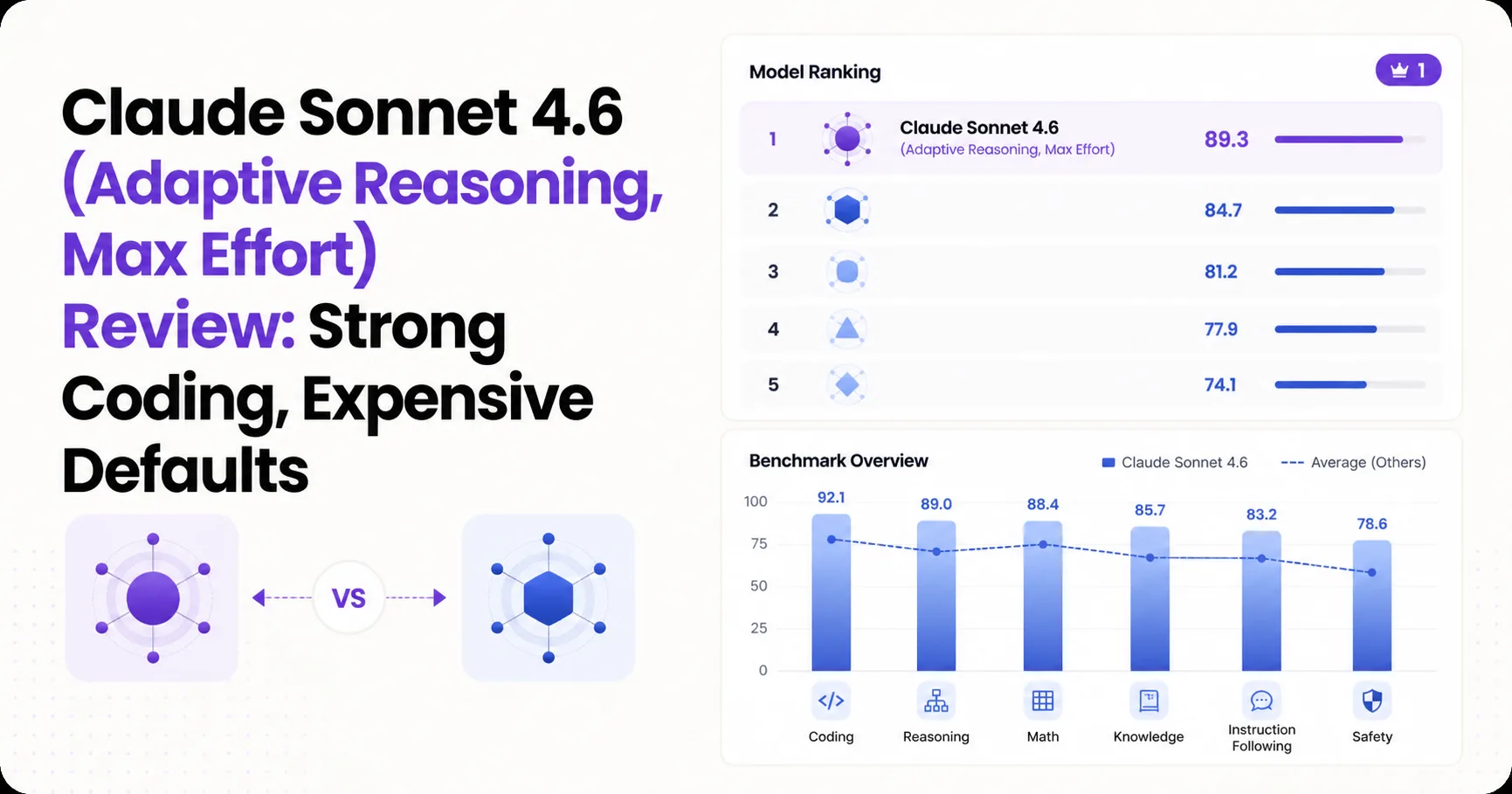
- **Where it stands:** Claude Sonnet 4.6 (Adaptive Reasoning, Max Effort) ranks 31 of 578 on the Artificial Analysis Intelligence Index at 47.2 - **Price:** $6 per 1M blended tokens - **Speed:** output throughput is not reported, 0.3s to first token - **Pick it when:** you need a strong general-purpose coding model and can accept premium output pricing - **Watch out:** official sources do not provide independent model-specific benchmark methods, failure patterns, or synchronous output limits
Claude Sonnet 4.6 review: a capable coding model with a premium cost profile
Claude Sonnet 4.6 (Adaptive Reasoning, Max Effort) is a strong developer model whose benchmark position supports serious coding use, but its price and missing operational data weaken the case for a default choice. The model ranks 38 of 202 on the Artificial Analysis Coding Index with a score of 63, placing it among the stronger coding systems in the supplied comparison set. It also ranks 31 of 578 on the Artificial Analysis Intelligence Index at 47.2, which indicates broad capability rather than a narrow coding specialization.
Anthropic’s public documentation describes Claude models as supporting text and image input, text output, multilingual use, and vision capabilities, although the wording does not independently isolate every claim to this specific API variant. The Models overview also states that Claude 4.6 and later models use undated, fixed snapshot model IDs. That matters for developers who need reproducible deployments, because a fixed snapshot is different from an alias that silently follows a newer release.
The supplied evidence supports Claude Sonnet 4.6 as a credible engineering assistant, code reviewer, and general reasoning model. It does not establish that the model is the best option for every coding workload. Throughput is not reported in the data brief, and Anthropic has not published an independent specification sheet for this exact adaptive reasoning and maximum-effort configuration.
Summary: Claude Sonnet 4.6 earns consideration when quality matters more than token economics
Claude Sonnet 4.6 (Adaptive Reasoning, Max Effort) is worth considering for quality-sensitive development workflows, but the supplied comparisons show that nearby models can offer similar broad intelligence at lower cost. Its coding rank is stronger than its overall intelligence rank relative to their separate comparison pools. That pattern suggests a useful profile for repository work, code generation, debugging, and technical explanation, while leaving the exact task-level strengths unproven.
| Decision factor | Claude Sonnet 4.6 | Nearby reference point |
|---|---|---|
| General intelligence position | Strong, 31 of 578 | Gemini 3.1 Pro Preview is close at 46.5; GPT-5.6 Luna (high) is close at 46.1 |
| Coding position | Strong, 38 of 202 | Kimi K3 (low) scores 72; Gemini 3.1 Pro Preview scores 68.8 |
| Blended cost | Premium at $6 per 1M tokens | Gemini 3.1 Pro Preview and GPT-5.6 Terra (medium) are listed at $4.500000000000001 |
| Operational evidence | 0.3s first-token latency, no reported output throughput | Several nearby models also list 0.3s latency, while their throughput values differ |
These references are not substitutes for a controlled task evaluation. Kimi K3 (low) has a higher supplied coding score, while GPT-5.6 Luna (high) has a similar coding score and a much lower listed blended price. Claude Sonnet 4.6 therefore needs to win on your own prompts, tool use, reliability, or integration requirements to justify its premium.
Performance: the coding rank is persuasive, but the evidence does not explain the model’s practical failure boundary
Claude Sonnet 4.6 (Adaptive Reasoning, Max Effort) looks better suited to demanding coding work than to indiscriminate model routing. The model’s position of 38 of 202 on the Artificial Analysis Coding Index, combined with a score of 63, gives developers a meaningful reason to test it for implementation, refactoring, debugging, and codebase navigation. Its broader intelligence position of 31 of 578 at 47.2 supports use beyond programming, but the two rankings come from different comparison pools and should not be treated as a single universal score.
The useful conclusion is comparative rather than absolute. Kimi K3 (low) scores 72 on the supplied coding index, and Gemini 3.1 Pro Preview scores 68.8. Qwen3.7 Max scores 66, while GPT-5.6 Terra (medium) scores 64.7. Claude Sonnet 4.6 therefore appears competitive, but not dominant, within the listed coding references. A team choosing it should validate repository-specific behavior instead of assuming that a strong aggregate rank predicts fewer edits, better tests, or safer production patches.
The evidence gap is substantial. Anthropic’s Models overview does not provide a model-specific failure list, official benchmark results, or a complete specification sheet for this exact configuration. The data brief also reports no median output-token throughput. The 0.3s first-token latency is useful for responsiveness, but it cannot establish total completion time without throughput data. Developers should treat long-answer speed, tool-call cadence, and maximum-effort behavior as open questions.
Cost: Claude Sonnet 4.6 is difficult to justify for high-volume traffic without a quality advantage
Claude Sonnet 4.6 (Adaptive Reasoning, Max Effort) is priced for workflows where better answers can offset higher token spend, not for cost-minimized bulk generation. The data brief lists $6 per 1M blended tokens, with $3 per 1M input tokens and $15 per 1M output tokens. The output price is therefore the main economic pressure for agents that produce long explanations, large patches, or repeated tool summaries.
The adjacent references make the trade-off clear. Gemini 3.1 Pro Preview and GPT-5.6 Terra (medium) are each listed at $4.500000000000001 per 1M blended tokens. Qwen3.7 Max is listed at $3.75, while GPT-5.6 Luna (high) is listed at $0.45. Those models are not equivalent in behavior, routing, or ecosystem fit, so the comparison does not prove that any alternative will deliver the same quality on a developer’s workload. It does show that Claude Sonnet 4.6 carries a meaningful opportunity cost when requests are numerous or output-heavy.
Anthropic’s Pricing adds important conditions. Standard pricing is $3 per MTok for input and $15 per MTok for output. Cache writes and cache hits have separate prices, and the page lists a 1.1x multiplier for the US inference region on Claude 4.6 and later models. Prompt caching may improve repeated-context economics, but only if the application actually reuses stable prefixes and accounts for cache operations correctly. Batch workloads also need separate accounting from interactive traffic.
Recommendation: use Claude Sonnet 4.6 as a quality-oriented coding tier, then prove its premium with task-level tests
Claude Sonnet 4.6 (Adaptive Reasoning, Max Effort) is a good candidate for difficult engineering tasks when developers value strong coding performance and Anthropic’s model behavior more than the lowest unit cost. The supplied ranking supports a focused role in code generation, debugging, review, architecture discussion, and changes that require sustained reasoning. It does not support making the model the universal backend for every request.
Choose Claude Sonnet 4.6 when the workload has expensive failure consequences, substantial code context, or a need for a capable general assistant that can also handle visual input. Fixed snapshot IDs, as documented in the Models overview, can also suit teams that prioritize reproducibility over automatic version movement.
Choose a different model, or route selectively, when throughput and cost dominate. GPT-5.6 Luna (high) is listed with a similar coding score of 63.3 and a blended price of $0.45. Gemini 3.1 Pro Preview is listed with a coding score of 68.8 and a blended price of $4.500000000000001. These figures make a strong case for an evaluation matrix, not an automatic replacement.
The most important unresolved question is whether adaptive reasoning at maximum effort produces better accepted patches, fewer retries, or higher test pass rates for your repository. The supplied research does not answer that question. Run a representative evaluation with fixed prompts, tool permissions, test execution, output limits, and retry accounting before committing to broad deployment.
Data provided by https://artificialanalysis.ai/.
FAQ before choosing Claude Sonnet 4.6
Claude Sonnet 4.6 (Adaptive Reasoning, Max Effort) deserves a controlled developer evaluation because its coding rank is strong, while its cost and missing throughput data make workload fit decisive. The answers below separate supported facts from questions that remain unresolved in the supplied evidence.
Frequently asked questions
Is Claude Sonnet 4.6 (Adaptive Reasoning, Max Effort) good for coding?
Claude Sonnet 4.6 (Adaptive Reasoning, Max Effort) is a credible coding choice because it ranks 38 of 202 on the Artificial Analysis Coding Index with a score of 63. The result supports testing it for implementation, debugging, review, and repository tasks, but it does not prove superiority on your codebase.
Is Claude Sonnet 4.6 worth its price for production applications?
Claude Sonnet 4.6 (Adaptive Reasoning, Max Effort) is worth its price only when its quality reduces retries, review time, or costly engineering mistakes enough to offset $6 per 1M blended tokens. The supplied data cannot establish that business-level return, so teams should measure accepted outputs and total workflow cost.
How fast is Claude Sonnet 4.6?
Claude Sonnet 4.6 (Adaptive Reasoning, Max Effort) has a reported first-token latency of 0.3s, but its median output-token throughput is not reported in the supplied data brief. Developers therefore have evidence about initial responsiveness, but not about total time for long answers, large patches, or multi-step agent runs.
Does Claude Sonnet 4.6 support very large outputs?
Claude Sonnet 4.6 (Adaptive Reasoning, Max Effort) supports up to 300,000 output tokens through the Batch API with the output-300k-2026-03-24 beta header. Anthropic’s documentation does not establish that the same limit applies to the synchronous Messages API, so interactive applications should verify their actual endpoint limits.
What should developers verify before deploying Claude Sonnet 4.6?
Developers should verify accepted patch rate, test pass rate, retry frequency, tool-call behavior, long-output completion time, and regional pricing for Claude Sonnet 4.6. The public sources do not provide this model configuration’s failure patterns or a complete platform availability matrix, making workload-specific testing necessary.
Sources
- Models overviewClaude 4.6 fixed snapshot model IDs, Batch API output limit, multimodal model-family capabilities, and documented evidence gaps.
- PricingClaude Sonnet 4.6 input and output pricing, prompt caching prices, tokenizer information, and US inference region multiplier.
- Artificial AnalysisAttribution for the supplied benchmark rankings, scores, pricing snapshot, latency data, and adjacent-model comparisons.
Published: