
Gemini 3.1 Pro Preview
AvailableGoogle · 2026-02-19 · 1,000,000 tokens
An AI model from Google, suited to a broad range of AI workloads.
Supported modalities:textimagevideocode
Quick Overview
Text Generation5/10
Code Generation7/10
Reasoning6/10
Multimodal4/10
Benchmark Results
Scores from leading benchmark suites.
artificial analysis intelligence47.7
artificial analysis coding68.8
Performance Metrics
Latency and throughput performance.
Dive Deeper
AI model analysis
Gemini 3.1 Pro Preview Review: Strong Coding Results, Unclear Production Readiness
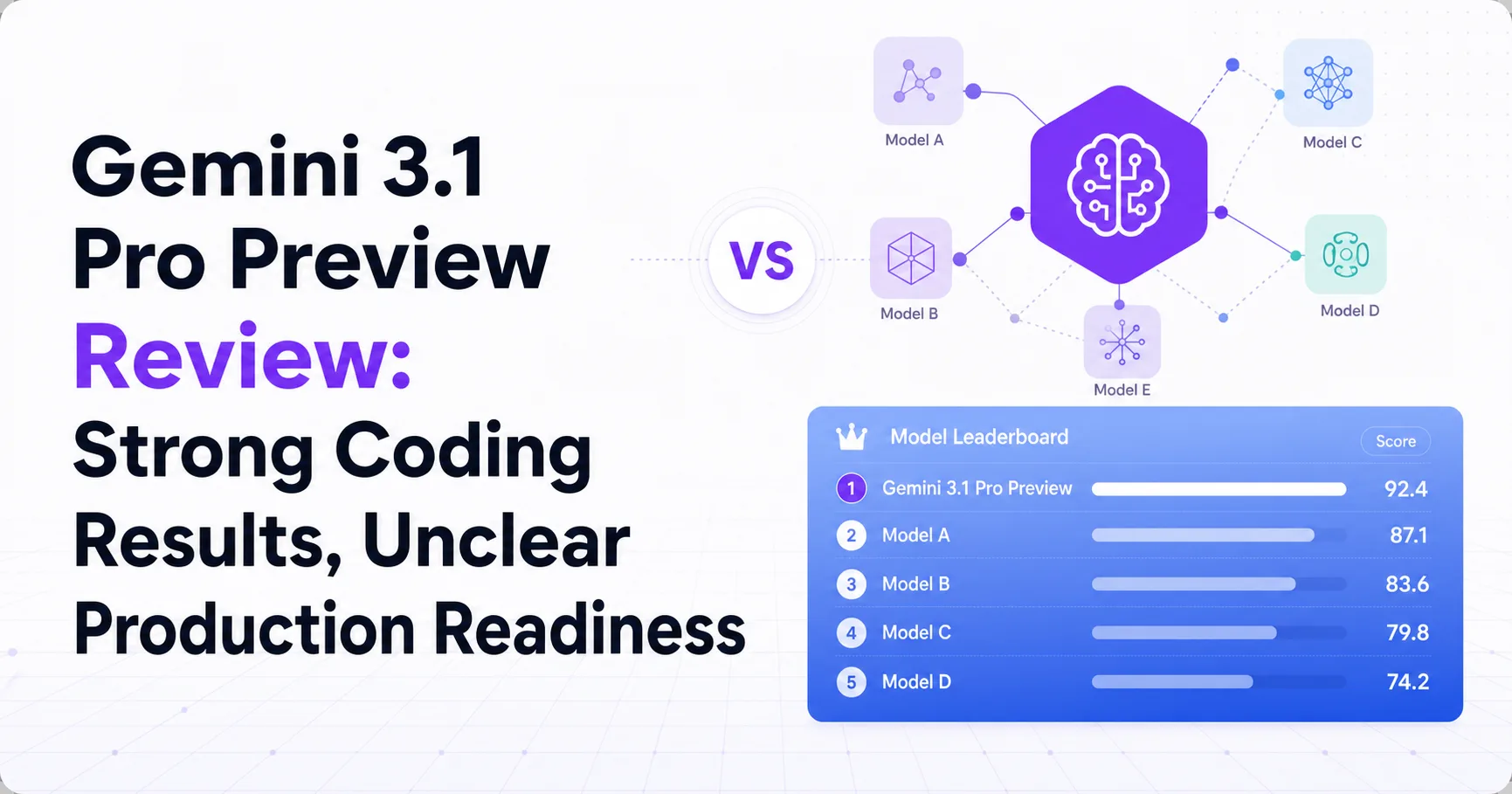
- **Where it stands:** Gemini 3.1 Pro Preview ranks 33 of 578 on the Artificial Analysis Intelligence Index at 46.5 - **Price:** $4.500000000000001 per 1M blended tokens - **Speed:** 129.625 output tokens per second, 0.3s to first token - **Pick it when:** You need a fast general-purpose model with a stronger coding position than its overall intelligence rank suggests - **Watch out:** Google’s documentation leaves the model’s context limits, output limits, and production stability unclear
Gemini 3.1 Pro Preview review
Gemini 3.1 Pro Preview is a fast, coding-oriented model whose benchmark position is more convincing than its production documentation. Google describes Gemini 3.1 Pro as a Preview model for advanced intelligence, complex problem solving, agentic coding, and vibe coding through the gemini-3.1-pro-preview API alias (Gemini API Models).
The available data places Gemini 3.1 Pro Preview near the top of the evaluated model pool for both general intelligence and coding. Its coding rank is 28 of 202, while its intelligence rank is 33 of 578. That combination suggests a capable developer tool, especially for software tasks that reward structured reasoning and implementation skill.
The central qualification is its Preview status. Google does not provide a clear context window, maximum output length, modality boundary, rate limit, tool-calling boundary, or stability commitment in the supplied material. Developers can therefore assess its observed performance, but they cannot yet assess its full operating envelope with the same confidence as its benchmark position.
Executive summary
Gemini 3.1 Pro Preview is a credible choice for coding-heavy workloads, but its undocumented operating limits make it a cautious production default. The model ranks 28 of 202 on the Artificial Analysis Coding Index at 68.8, placing it in a stronger relative position for coding than for general intelligence. Data provided by https://artificialanalysis.ai/.
Its overall intelligence rank, 33 of 578 at 46.5, still indicates a high position among evaluated models. The result is not a narrow coding specialist. It offers a broad capability profile with a particularly favorable coding signal.
The closest models show why the decision depends on workload priorities. Kimi K3 (low) scores higher on coding but is slower and more expensive. GPT-5.6 Luna (high) is much cheaper and faster, but scores lower on coding. Qwen3.7 Max is faster and cheaper, while Gemini 3.1 Pro Preview holds a higher coding score. Claude Sonnet 4.6 has a higher intelligence score but a lower coding score, with no supplied output-speed figure.
| Decision factor | Gemini 3.1 Pro Preview | Practical meaning |
|---|---|---|
| Coding position | Stronger than its general intelligence position | Favorable for implementation and agentic coding evaluation |
| Response behavior | High output speed with low first-token latency | Suitable for interactive developer workflows |
| Production confidence | Limited by Preview status and missing specifications | Requires targeted validation before broad rollout |
| Cost position | Mid-range among nearby models | Justified when coding quality matters more than minimum cost |
Performance: what the rankings mean in practice
Gemini 3.1 Pro Preview is more compelling for coding workflows than its general intelligence rank alone would suggest. Its coding score of 68.8 places it 28 of 202, while its intelligence score of 46.5 places it 33 of 578. These are not identical leaderboards, so the rankings should not be treated as directly interchangeable. They do show a consistent pattern: the model is competitive broadly and especially strong on the coding-oriented measure.
For developers, that profile favors tasks where the model must inspect requirements, form a plan, modify code, and explain the result. It is a reasonable candidate for repository assistance, code generation, refactoring proposals, test writing, and agentic coding experiments. The evidence does not prove that it will outperform every nearby model on every repository. It supports a narrower conclusion: coding is the clearest reason to evaluate this model.
The speed data strengthens that use case. Gemini 3.1 Pro Preview produces 129.625 output tokens per second with 0.3s to first token. That combination should feel responsive in interactive tools and can reduce the waiting cost of iterative coding conversations. Speed does not guarantee better code, and median throughput does not describe every request shape. Long reasoning traces, tool calls, provider load, and prompt size can still change the user experience.
The practical conclusion can reverse if your task depends on specifications that Google has not documented in the supplied sources. The context window, maximum output length, supported modalities, rate limits, and tool-calling boundaries remain unconfirmed. A developer handling large repositories or long-running agents should test those limits directly before committing to an architecture. Google’s model documentation identifies the model as Preview but does not provide the detailed failure modes or stability guarantees needed to infer production behavior (Gemini API Models).
Community evidence does not close this gap. The supplied research found no reliable, clearly attributable discussion of Gemini 3.1 Pro Preview’s coding experience, speed perception, model quirks, or disclosed testing methods. That means the benchmark position is the strongest available evidence, while claims about day-to-day behavior remain provisional.
Cost: when the price makes sense
Gemini 3.1 Pro Preview is worth its mid-range price when coding quality and interactive speed matter more than minimizing token spend. Its blended price is $4.500000000000001 per 1M tokens, with input priced at $2 per 1M tokens and output at $12 per 1M tokens. Data provided by https://artificialanalysis.ai/.
The nearby models expose the trade-off. GPT-5.6 Luna (high) costs $0.45 per 1M blended tokens and is faster at 164.222 output tokens per second, but its coding score is 63.3. Qwen3.7 Max costs $3.75 and produces 204.156 output tokens per second, yet its coding score is 66. Gemini 3.1 Pro Preview therefore does not win on cost or throughput. Its economic case rests on paying for the stronger coding result while retaining fast responses.
Kimi K3 (low) offers a higher coding score of 72, but costs $6 per 1M blended tokens and produces 35.898 output tokens per second. Claude Sonnet 4.6 costs the same $6 blended rate and has a coding score of 63, while the supplied data includes no output-speed figure. These comparisons make Gemini 3.1 Pro Preview a balanced option, rather than the obvious budget choice or the highest-scoring coding option.
The price can become unattractive for high-volume routine tasks. Simple classification, extraction, short transformations, and predictable boilerplate may not need a model positioned this high. The price can also become difficult to forecast because Google’s supplied pricing material does not confirm model-specific input, output, Batch, Flex, Priority, or caching prices. Google states that Paid plans provide higher limits, context caching, Batch API access, and advanced model access, and describes Batch API as offering a 50% cost discount, but that general statement does not establish Gemini 3.1 Pro Preview’s exact price under each mode (Gemini API Pricing).
Recommendation for developers
Gemini 3.1 Pro Preview is a strong shortlist candidate for coding assistants and agentic development workflows that can tolerate Preview-level uncertainty. The recommendation follows from its coding rank, responsive output profile, and balanced position against nearby models. It should be evaluated as a capable option, not accepted as a fully specified production baseline.
Choose Gemini 3.1 Pro Preview when your product needs interactive code generation, repository discussion, implementation planning, or iterative debugging. Its coding position is the clearest evidence in its favor. Its 0.3s time to first token and 129.625 output tokens per second also support user-facing developer experiences where waiting interrupts the work loop.
Choose another model when the primary goal is minimum cost, maximum throughput, or the highest available coding score among the supplied neighbors. GPT-5.6 Luna (high) is the cost and speed reference. Qwen3.7 Max is the throughput reference. Kimi K3 (low) is the coding-score reference. Those models are only comparison points, and none removes the need to test the exact prompts, repositories, tools, and acceptance criteria that matter to your product.
Before production adoption, run a focused evaluation covering code correctness, patch completeness, test quality, tool-call recovery, context exhaustion, maximum response length, rate-limit behavior, and failure recovery. The supplied research does not establish these boundaries. Google’s official page confirms the Preview label and API alias, but it does not provide enough detail to predict operational stability (Gemini API Models).
Final verdict: evaluate Gemini 3.1 Pro Preview seriously for coding, deploy it selectively after workload-specific testing, and keep a fallback until its limits and stability are better documented.
Evidence gaps and decision risks
Gemini 3.1 Pro Preview has a stronger measured case than documented case, so missing specifications should remain part of the buying decision. The supplied research confirms the model’s Preview status and positioning, but it does not confirm the context window, maximum output length, supported multimodal inputs, API parameters, rate limits, tool behavior, or detailed failure modes (Gemini API Models).
That evidence gap matters most for autonomous systems. A coding agent may need predictable context handling, reliable tool invocation, bounded outputs, and clear recovery behavior. None of those properties can be inferred safely from an intelligence or coding rank. The benchmark data can justify a test allocation. It cannot justify assumptions about every production interaction.
The research also found no reliable community material specifically describing this Preview model. Developers should therefore avoid treating anecdotal expectations about coding style, speed perception, or model quirks as established facts. The most defensible approach is to measure those properties in the target environment and record the model version, prompts, tools, and acceptance tests.
Questions developers should answer first
Gemini 3.1 Pro Preview deserves a controlled evaluation because its measured coding position is strong while its documented operating boundaries remain incomplete. The following questions focus on the practical choices that the supplied benchmark and research material can support.
The answers separate measured evidence from assumptions. They also identify where the available material is insufficient, so teams can turn uncertainty into explicit test cases before adoption.
Frequently asked questions
Is Gemini 3.1 Pro Preview good for coding?
Gemini 3.1 Pro Preview is a strong coding candidate because it ranks 28 of 202 on the Artificial Analysis Coding Index at 68.8, although repository-specific testing remains necessary.
Is Gemini 3.1 Pro Preview ready for production?
Gemini 3.1 Pro Preview should receive controlled production testing rather than automatic broad deployment because Google labels it Preview and the supplied documentation does not state stability guarantees.
Is Gemini 3.1 Pro Preview fast enough for an interactive coding assistant?
Gemini 3.1 Pro Preview is suitable for interactive evaluation because its median output speed is 129.625 tokens per second and its time to first token is 0.3s.
Is Gemini 3.1 Pro Preview cost-effective?
Gemini 3.1 Pro Preview can be cost-effective for coding-heavy work, but it is not the cheapest nearby option, so its value depends on whether its coding advantage reduces correction and review effort.
What is the biggest unknown about Gemini 3.1 Pro Preview?
Gemini 3.1 Pro Preview’s biggest uncertainty is its undocumented operating envelope, including context limits, maximum output length, rate limits, tool behavior, modalities, and production stability.
Sources
- Gemini API ModelsVerifying Gemini 3.1 Pro Preview’s official positioning, API alias, Preview status, and documented limitations.
- Gemini API PricingVerifying Google’s general paid-plan, context caching, Batch API, and pricing-discount statements, while noting that model-specific pricing was not supplied.
- Artificial AnalysisAttributing the supplied benchmark rankings, scores, pricing, latency, and output-speed data.
Published: