
Gemini 3.5 Flash (high)
AvailableGoogle · 2026-05-19 · 1,000,000 tokens
An AI model from Google, suited to a broad range of AI workloads.
Supported modalities:textimagevideocode
Quick Overview
Text Generation5/10
Code Generation7/10
Reasoning6/10
Multimodal4/10
Benchmark Results
Scores from leading benchmark suites.
artificial analysis intelligence52.0
artificial analysis coding70.1
Performance Metrics
Latency and throughput performance.
Dive Deeper
AI model analysis
Gemini 3.5 Flash (high) review: fast agentic coding with a cost caveat
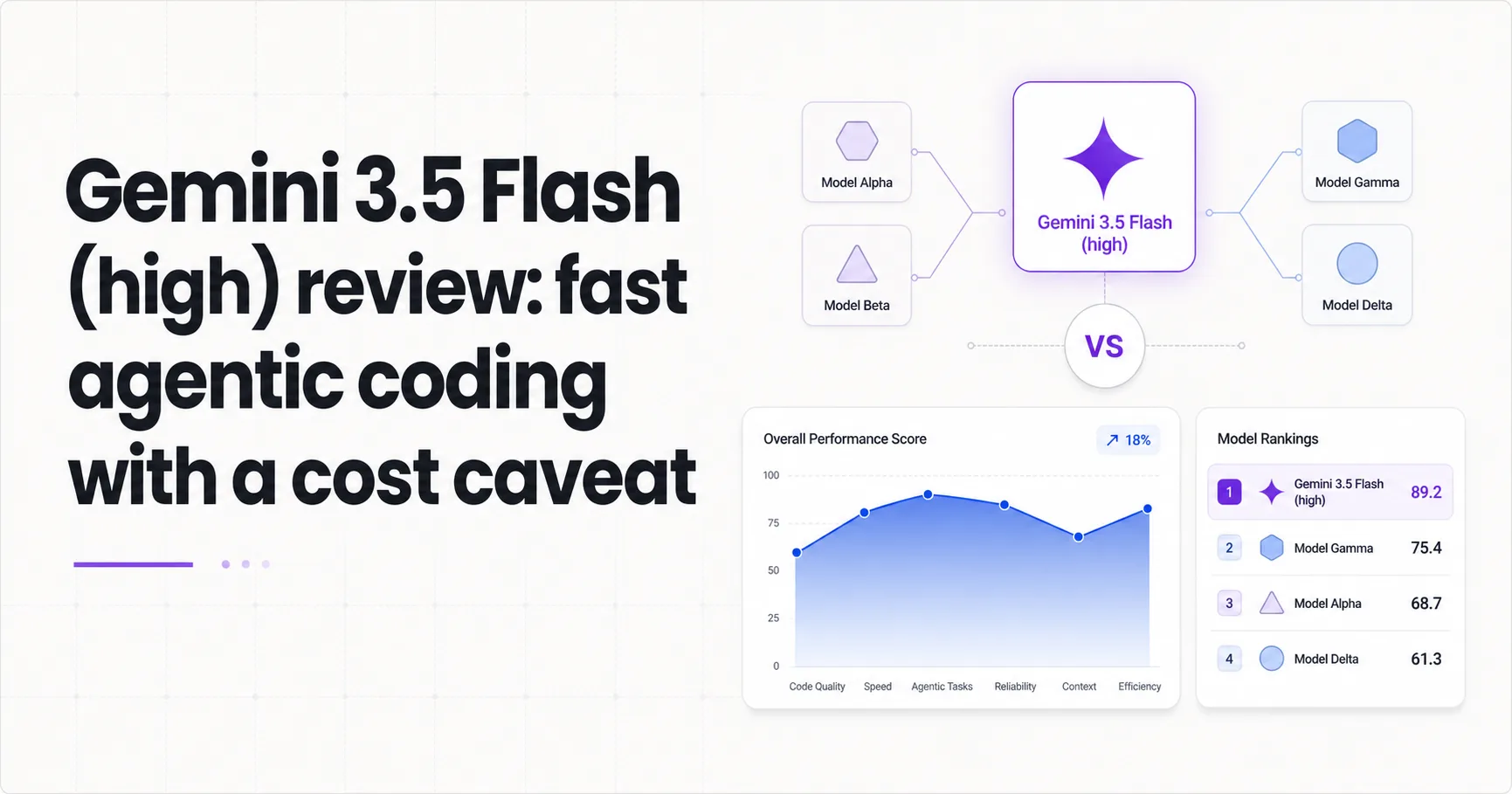
- **Where it stands:** Gemini 3.5 Flash (high) ranks 25 of 578 on the Artificial Analysis Intelligence Index at 50.2 - **Price:** $3.375 per 1M blended tokens - **Speed:** 270.227 output tokens per second, 0.3s to first token - **Pick it when:** You need a fast coding agent with multimodal input, tool use, and production API support - **Watch out:** Public evidence is insufficient on model-specific failure rates, hallucination rates, and long-context degradation
Gemini 3.5 Flash (high) review
Gemini 3.5 Flash (high) is a fast, production-ready choice for agentic coding, with Google positioning Gemini 3.5 Flash for stable agentic and coding workloads (model overview; launch announcement).
Gemini 3.5 Flash (high) uses the stable gemini-3.5-flash model with thinking_level=high, rather than a separate model alias (model page). On the Artificial Analysis Intelligence Index, Gemini 3.5 Flash (high) ranks 25 of 578 at 50.2. Its coding position is 24 of 202 at 70.1.
Those rankings support a practical conclusion: Gemini 3.5 Flash (high) belongs on a serious coding-agent shortlist. The placement is strong enough to justify a pilot, but it does not establish universal reliability across production repositories. The supplied research does not provide systematic model-specific failure-rate, hallucination-rate, or long-context degradation data.
Data provided by https://artificialanalysis.ai/. The comparative snapshot is referenced here as Artificial Analysis.
Executive summary
Gemini 3.5 Flash (high) earns a shortlist position because its coding standing nearly matches its general intelligence standing while its serving profile favors interactive use.
Google describes the model as suitable for complex, long-running agentic workflows and coding tasks (launch announcement). The model accepts text, images, video, audio, and PDF input, then produces text output (model page). Its feature surface also includes context caching, code execution, file search, function calling, structured output, Thinking, URL Context, and Google grounding tools (model page).
The adjacent-model snapshot gives useful context without changing the main verdict:
| Reference model | What the snapshot changes | Gemini 3.5 Flash (high) takeaway |
|---|---|---|
| Gemini 3.6 Flash (high) | Newer Google option with lower listed blended and output pricing, but slower measured output | Gemini 3.5 remains defensible when its measured speed and quality fit the workload |
| GPT-5.5 (medium) | Slightly stronger intelligence and coding standing, with a materially higher listed blended price | Gemini offers a cheaper route into a similar ranked tier |
| DeepSeek V4 Flash | Much lower listed blended price, with slower output and slightly lower measured standing | Gemini buys stronger measured placement and faster interaction |
| Claude Opus 5 (low) | Stronger general intelligence standing, but much slower measured output | Gemini is better suited to rapid interactive loops |
| Muse Spark 1.1 | Lower listed blended price with close general and coding standing | Gemini’s case rests on speed and Google’s tool and multimodal stack |
These comparisons use the supplied Artificial Analysis snapshot. They are reference points, not reasons to replace task-specific testing.
Performance: what the rankings mean in practice
Gemini 3.5 Flash (high) is best understood as a high-ranked interactive workhorse, not proof of universal reliability across every production task.
A coding position of 24 of 202 makes Gemini 3.5 Flash (high) a credible candidate for repository repair, code generation, debugging, and tool-driven development. The result suggests that the model should handle substantial coding workloads well enough to justify direct evaluation against existing agents. It does not prove that the model will produce correct patches without review, especially because the supplied research contains no systematic production failure study.
The general position of 25 of 578 supports broader use beyond coding. Developers can reasonably investigate the model for structured extraction, document workflows, multimodal analysis, and assistants that need several API capabilities in one service. The ranking still represents relative evaluation standing, not a guarantee for a particular language, framework, repository, or domain.
Google explicitly targets complex, long-running agentic workflows and coding tasks (launch announcement). The model page lists function calling, code execution, file search, structured outputs, URL Context, and grounding capabilities (model page). That combination makes Gemini 3.5 Flash (high) more interesting as an orchestrated worker than as a plain chat endpoint.
The thinking configuration is a major performance variable. Google supports minimal, low, medium, and high, with medium as the default; the documentation recommends high for complex reasoning, difficult mathematics, complex coding, and difficult agent tasks (official update). Developers should therefore compare configurations on representative tasks instead of assuming that high is always the best setting.
Tool integration also requires careful implementation. Gemini 3.x function calls require matching response identifiers, names, and counts, while multimodal function responses must appear inside the function-response content (official update). A strong benchmark result can still become a weak product experience if the surrounding tool protocol is implemented loosely.
Cost: where the value case can reverse
Gemini 3.5 Flash (high) is cost-effective for interactive coding only if its quality reduces retries, tool mistakes, or human review.
The supplied blended price is $3.375 per 1M tokens, while the output side is $9 per 1M tokens. The output price includes thinking tokens (Gemini API pricing). That detail matters because high reasoning can increase output consumption during difficult coding and agent tasks. A workflow that repeatedly invokes high may spend more than its simple input volume suggests.
Gemini 3.5 Flash (high) therefore occupies an awkward value position. Several adjacent models in the supplied snapshot are cheaper, including options with similar measured intelligence or coding standing. Other models are more expensive but offer slightly stronger measured results in one evaluation. Gemini’s economic case depends on the complete workflow: response quality, correction rate, tool-call success, review time, and latency all matter more than the blended token price alone.
Batch and Flex inference can improve economics for workloads that do not require ordinary interactive scheduling, while Priority inference serves latency-sensitive workloads at a different price point (Gemini API pricing). Context caching may also help applications that repeatedly send the same large instructions or documents, provided the cache behavior matches the request pattern (model page).
Grounding introduces another cost and architecture consideration. Google Search and Google Maps grounding are separately metered services, so the model price does not represent the full cost of a grounded assistant (Gemini API pricing). The free tier also allows content to be used for improving Google products, while paid-tier content is not used for that purpose (Gemini API pricing).
Community evidence reinforces the need for a quota test. One Reddit user reported positive speed and coding quality in Antigravity CLI, but also described rapid quota consumption during sustained use of high; the report does not provide a reproducible task set, request volume, token count, or latency study (Reddit report).
Recommendation: who should choose it
Gemini 3.5 Flash (high) deserves a production pilot for coding agents, multimodal document workflows, and tool-using assistants, but not a blanket migration.
Google’s documented modality and tool support makes the model a strong fit for applications that combine analysis with actions (model page). The ranked coding result strengthens that case, while the high output speed and low first-token latency in the supplied snapshot support interactive use. The recommendation remains conditional because benchmark placement does not answer reliability, quota stability, or long-context behavior for a specific application.
| Scenario | Recommendation | Reason |
|---|---|---|
| Agentic coding and repository repair | Strong pilot candidate | Coding standing is strong, and Google explicitly targets coding and long-running agents |
| Multimodal document intake | Strong pilot candidate | The model accepts images, video, audio, and PDF input, with structured output and tool support |
| Interactive assistants | Good candidate | The supplied serving profile favors responsive request loops |
| Bulk offline generation | Conditional | Batch or Flex may improve economics, while cheaper adjacent models may offer similar measured standing |
| Native audio or image generation | Poor fit | The model page lists audio generation and image generation as unsupported |
| Live API applications | Poor fit | Live API is not supported by this model |
| Computer-control agents | Experimental | Computer Use remains Preview and needs separate stability testing |
The rollout should compare default thinking with high thinking on real tasks. It should also validate exact function-call matching, grounded responses, long-document behavior, and quota consumption. High should be reserved for tasks where deeper reasoning changes the outcome, consistent with Google’s guidance (official update).
Choose Gemini 3.5 Flash (high) when speed, coding quality, multimodal input, and Google’s integrated tools outweigh the premium over cheaper alternatives. Avoid making it the sole model for unsupported modalities or for workloads whose main requirement is the lowest possible token cost.
Questions to answer before adoption
Gemini 3.5 Flash (high) requires careful decisions about thinking controls, tool-call validation, unsupported modalities, and quota behavior before production adoption.
The model choice and the configuration choice should be evaluated separately. High may improve difficult reasoning, but it can also increase output consumption and operational cost (official update). Teams should also distinguish documented capability from demonstrated reliability. The available research confirms the supported API surface, but it does not provide a systematic study of failure rates, hallucination rates, or long-context degradation.
The questions below focus on decisions that the data area cannot answer by itself. They are intended to turn the ranking and pricing evidence into a practical evaluation plan.
Frequently asked questions
Is Gemini 3.5 Flash (high) a separate model from Gemini 3.5 Flash?
Gemini 3.5 Flash (high) is not a separate model; it is the stable gemini-3.5-flash model configured with thinking_level=high (model page). The distinction matters for routing, logging, and cost analysis.
Should every request use thinking_level=high?
Developers should not use high for every request; Google recommends it for complex reasoning, difficult mathematics, complex coding, and difficult agent tasks (official update). Routine requests should be tested with the default configuration or a lower level.
Is Gemini 3.5 Flash (high) suitable for multimodal production applications?
Gemini 3.5 Flash (high) suits multimodal applications because it accepts text, images, video, audio, and PDF input, then returns text output (model page). It does not support native audio generation, image generation, or Live API.
Can the coding ranking be treated as a production reliability guarantee?
An Artificial Analysis rank is useful evidence of relative benchmark standing, but it is not a production reliability guarantee (Artificial Analysis). The supplied research found no systematic model-specific failure-rate, hallucination-rate, or long-context degradation study, and the independent coding report is not reproducible (Reddit report).
What should teams test before rollout?
Teams should test representative repositories, tool-call transcripts, long documents, grounded responses, and quota behavior before rollout, because the official function-calling contract is strict and community feedback reports rapid quota use during sustained coding sessions (official update; Reddit report).
Sources
- Gemini API ModelsModel status, stable positioning, and official model availability.
- Gemini 3.5: frontier intelligence with actionGoogle's positioning of Gemini 3.5 Flash for agentic workflows and coding tasks.
- Gemini 3.5 Flash model pageModel code, thinking configuration, modalities, tool support, output behavior, and unsupported capabilities.
- What's new in Gemini 3.5 FlashThinking levels, configuration guidance, thinking token behavior, and function-calling constraints.
- Gemini API PricingBlended pricing context, output token treatment, inference modes, caching, and grounding costs.
- Gemini API PricingFree-tier data-use policy and paid-tier content policy.
- Gemini 3.5 Flash is amazing (speed, quality) with the new Antigravity CLI but...Community coding experience, quota consumption feedback, and limits of independent testing evidence.
- Artificial AnalysisSupplied ranking, pricing, speed, and adjacent-model comparison snapshot.
Published: