
Gemini 3.6 Flash (high)
AvailableGoogle · 2026-07-21 · 1,000,000 tokens
An AI model from Google, suited to a broad range of AI workloads.
Supported modalities:textimagevideocode
Quick Overview
Text Generation5/10
Code Generation7/10
Reasoning6/10
Multimodal4/10
Benchmark Results
Scores from leading benchmark suites.
artificial analysis intelligence51.6
artificial analysis coding69.2
Performance Metrics
Latency and throughput performance.
Dive Deeper
AI model analysis
Gemini 3.6 Flash (high) Review: Fast, Capable, and Worth the Trade-offs
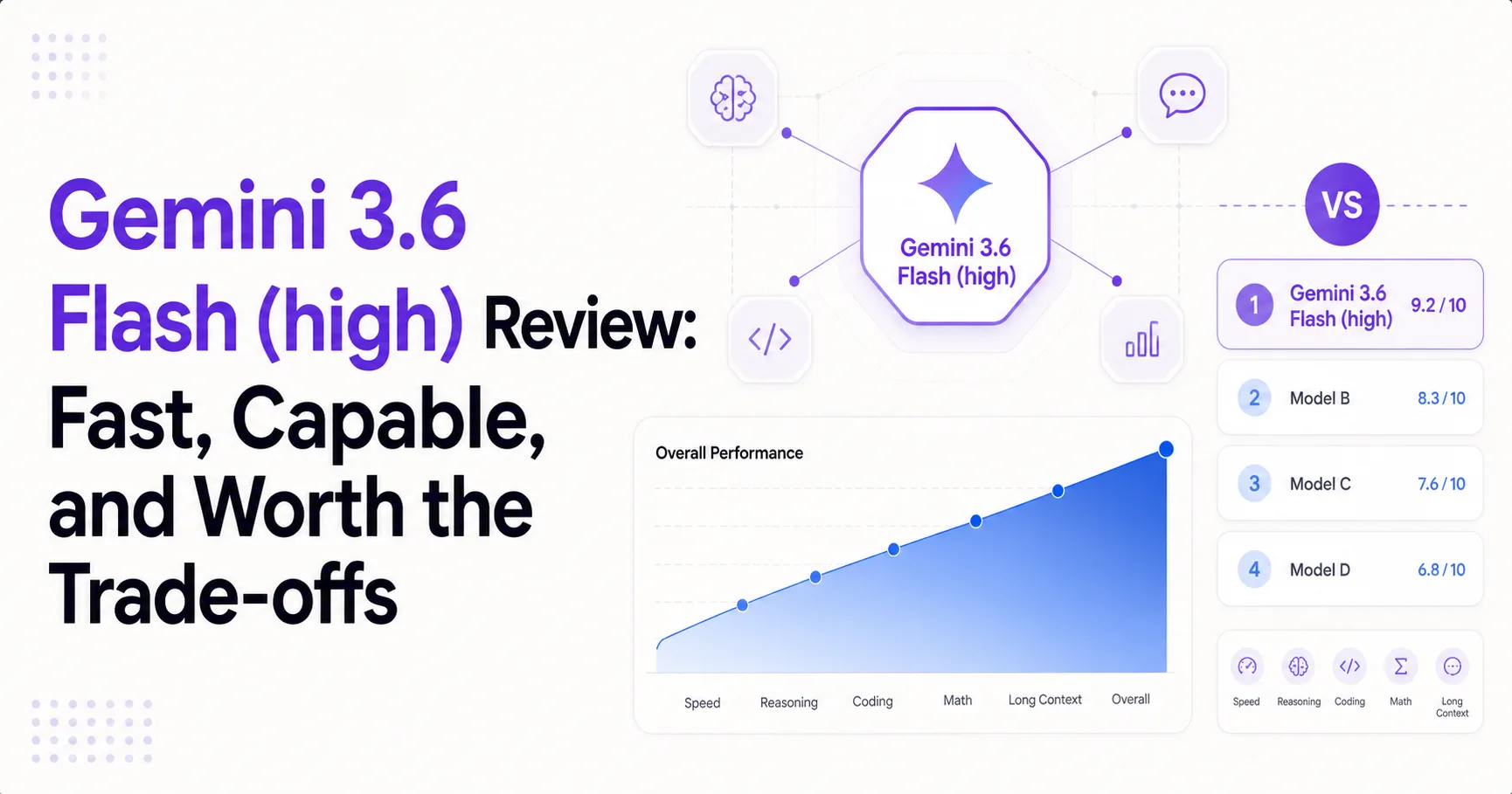
- **Where it stands:** Gemini 3.6 Flash (high) ranks 26 of 578 on the Artificial Analysis Intelligence Index at 50.1 - **Price:** $3 per 1M blended tokens - **Speed:** 230.958 output tokens per second, 0.3s to first token - **Pick it when:** you need fast multimodal agent loops backed by a 69.2 coding score and 230.958 output tokens per second - **Watch out:** the 26 of 202 coding rank is strong, but community coding feedback lacks a reproducible test method
Gemini 3.6 Flash (high) is a strong speed-first model for tool-assisted development
Gemini 3.6 Flash (high) is a fast, upper-tier multimodal model whose strongest case is tool-assisted development under tight response-time requirements. Artificial Analysis reports a rank of 26 of 578 on its Intelligence Index and 26 of 202 on its Coding Index, with 230.958 median output tokens per second and 0.3 seconds to first token.
Google positions the underlying Gemini 3.6 Flash as a stable Flash model for agentic and multimodal work, with emphasis on code generation, agent execution, and spatial reasoning. Google’s model overview and the official launch announcement support that positioning.
The main selection question is therefore practical: can Google’s tool surface and response speed reduce enough application work to justify its price? The answer is yes for interactive agents, multimodal coding assistants, and workflows already built around Google services. It is less convincing as a universal default for every software task.
One naming detail requires care. The official API documentation exposes gemini-3.6-flash, while the supplied dataset labels the evaluated configuration as Gemini 3.6 Flash (high). Google does not document high as an independent API model ID. A Hacker News discussion connects High with a product interface reasoning setting, but that community explanation is not official.
Data provided by https://artificialanalysis.ai/
The model occupies a useful middle ground between speed, tooling, and price
Gemini 3.6 Flash (high) is best understood as a practical middle-ground model, not the cheapest option or a complete proof of engineering reliability. Artificial Analysis provides the comparison data used below.
| Reference model | Gemini 3.6 Flash (high) advantage | Reference model advantage |
|---|---|---|
| Gemini 3.5 Flash (high) | Lower listed output price within the same Google model family | Higher reported output speed |
| DeepSeek V4 Flash 0731 | Faster reported generation and access to Google’s multimodal and grounding tools | Much lower listed token cost |
| GPT-5.5 (medium) | Lower listed cost and a direct fit for Google’s Search and Maps grounding | Higher supplied intelligence and coding scores |
| Muse Spark 1.1 | Faster reported generation and a broader documented Google tool surface | Lower listed blended price and higher supplied coding score |
This table is a routing guide, not a claim that one model wins every task. Gemini’s differentiator is the combination of fast interaction, multimodal input, structured output, code execution, file search, function calling, and Google grounding. The model documentation makes that integration surface explicit.
The same comparison also exposes the limits of the case. DeepSeek is the obvious alternative when token cost dominates. A stronger reasoning model may remain preferable when an occasional error is more expensive than additional inference cost. Gemini’s ranking supports a confident shortlist position, but the supplied evidence does not establish completed-task cost, tool-call success rate, or production reliability.
For most developers, Gemini 3.6 Flash (high) deserves an early evaluation slot when applications need quick, repeated turns across text, images, documents, or external tools. It should enter production only after task-specific testing.
Performance is strongest in interactive, tool-using workflows
Gemini 3.6 Flash (high) turns a high ranking into a strong default for interactive agent loops, but the ranking does not prove dependable completion of every software task. Artificial Analysis places it at 26 of 578 on the Intelligence Index and 26 of 202 on the Coding Index. Those positions support an upper-tier capability judgment across broad model populations, while leaving room for task-specific reversals.
The coding result is particularly relevant for developers. A coding rank of 26 of 202 suggests that Gemini 3.6 Flash (high) is not merely a fast general chatbot with weak programming ability. It is a serious candidate for repository questions, code transformation, debugging assistance, and agentic development. The result still does not tell you whether it edits a particular codebase safely, follows local conventions, or stops after a failing tool call.
Google’s model card evaluates the model across terminal work, desktop interaction, multimodal reasoning, and retrieval over long context. That breadth matches the model’s intended use. It supports a workflow where the model interprets a document or screen, calls a tool, inspects the result, and produces a structured next action. These signals indicate coverage, not deterministic execution.
The API surface reinforces that fit. The official model documentation lists text, images, video, audio, and PDF as inputs. It also documents code execution, file search, function calling, structured outputs, thinking, URL Context, Google Search grounding, and Google Maps grounding. Computer Use remains Preview. This makes the model attractive for visual debugging, document-heavy assistants, repository analysis, and location-aware applications.
The supplied speed snapshot reports 230.958 median output tokens per second and 0.3 seconds to first token. That combination favors interfaces with many short turns, such as coding copilots, support agents, and orchestration steps. It does not by itself prove stable tail latency, consistent throughput under load, or low cost per completed task.
Community feedback broadly agrees that Gemini Flash feels fast and is often accurate enough for ordinary questions and technical explanations. Coding opinions remain divided, and the Hacker News thread provides no reproducible test setup. Treat that evidence as a risk signal, not as a benchmark. The available material is insufficient to predict performance on your repository, tool chain, or failure policy.
The price is defensible for completed tasks, not for raw token volume
Gemini 3.6 Flash (high) earns its $3 blended-token position when latency and Google tooling reduce work per completed task. Artificial Analysis lists $1.5 input tokens per million and $7.5 output tokens per million in the supplied snapshot.
That input and output split matters more than the blended figure for agent applications. Output-heavy workflows can accumulate cost through explanations, retries, tool-call arguments, and repeated intermediate text. Google’s pricing documentation states that thinking tokens are included in output pricing. A workflow that asks for extensive reasoning or permits repeated execution should therefore track output volume directly.
Gemini 3.6 Flash (high) is not the lowest-cost routing choice among the supplied adjacent models. DeepSeek V4 Flash 0731 has a far lower listed token price, and Muse Spark 1.1 has a lower blended price. Those alternatives are stronger economic choices for simple classification, extraction, summarization, or other workloads where Google-specific tools do not remove application work.
The price becomes easier to defend when one request can combine multimodal interpretation with code execution, file search, or grounding. The model documentation shows why that can happen. A single model call may replace separate preprocessing or retrieval components. That benefit is architectural, however, and the supplied data does not measure it.
Google also offers Batch, Flex, and Priority service tiers, while Search and Maps grounding have their own pricing rules. Developers should model token charges and tool charges together using the Gemini API pricing page. Caching is supported, which may help repeated system instructions or reference material, but the evidence supplied here does not establish a cache hit rate or a completed-task savings figure.
The economic verdict is conditional. Gemini 3.6 Flash (high) is good value for fast, multimodal, tool-rich workflows. It is poor value if the application mainly emits long text, repeats avoidable process commentary, or can use a much cheaper model without additional engineering. A community report mentions verbosity and execution loops, but the method is not reproducible, so this remains a validation target rather than a settled conclusion.
Choose Gemini 3.6 Flash (high) when speed and Google integration are first-order requirements
Gemini 3.6 Flash (high) is worth choosing for fast, multimodal, tool-rich applications that already fit Google’s API ecosystem. Google’s launch announcement and model documentation support that intended use.
| Choose Gemini 3.6 Flash (high) when | Consider another route when |
|---|---|
| Interactive turns and first-token latency affect user experience | Token cost dominates and the task is simple, making DeepSeek V4 Flash a stronger economic candidate |
| Requests combine documents, images, video, audio, or PDFs with tools | The application requires image generation, audio generation, or Live API support |
| Google Search or Maps grounding fits the product workflow | Computer Use must have production-stable behavior rather than a Preview interface |
| A single model can replace several retrieval or preprocessing steps | The workload needs a proven cost per successful task that the supplied evidence does not provide |
The safest recommendation is to shortlist Gemini early, then measure it against your real workflow. Test tool-call recovery, structured output compliance, grounding accuracy, repository edits, response verbosity, and cost per completed task. Use the documented API name gemini-3.6-flash rather than assuming the dataset label high maps to a separate endpoint.
Do not select it solely because its rankings look strong. The Artificial Analysis snapshot supports broad capability and coding relevance, while the official model card documents hallucination and timeout risks. Those risks apply directly to production design. Add validation, retries, output checks, and human review wherever an incorrect action has material consequences.
The final verdict is favorable but bounded: Gemini 3.6 Flash (high) is a strong practical choice for responsive, Google-centered agent systems. It is not the automatic winner for lowest-cost inference, unsupported media generation, or untested high-stakes software engineering.
Verify the API label, context behavior, and operational limits before adoption
Gemini 3.6 Flash (high) needs explicit API, context, and tool-cost checks before a production commitment. The Google model overview lists Gemini 3.6 Flash as Stable, while the model-specific documentation identifies gemini-3.6-flash as the API model name.
The supplied data snapshot leaves context_window null. That means developers should confirm current context limits directly in Google’s documentation instead of inferring them from the evaluation label or from long-context benchmark coverage. Practical context behavior also depends on prompt structure, retrieval strategy, caching, and output length.
The official model card warns about hallucinations and occasional slowdowns or timeouts. It also makes clear that the model should not be treated as a continuously updated knowledge base. These constraints matter for coding agents, support systems, and any application that turns model output into an external action.
The evidence gap is clear. The supplied community material comes mainly from Hacker News, where users report fast responses and mixed coding experiences without a standardized test method. That is useful for forming hypotheses, not for approving a production rollout.
Frequently asked questions
Is Gemini 3.6 Flash (high) a good coding model?
Gemini 3.6 Flash (high) is a credible coding choice for fast, tool-assisted workflows, but the supplied ranking and mixed community feedback do not justify treating it as a universal software-engineering default. Artificial Analysis Hacker News
Is Gemini 3.6 Flash (high) good value?
Gemini 3.6 Flash (high) is good value when speed, multimodal input, and Google-native grounding reduce application work, while lower-cost alternatives remain better for simple, high-volume token processing. Gemini API pricing model documentation
Is high a separate Gemini API model?
Gemini 3.6 Flash (high) is not documented as a separate Google API model ID; developers should use the documented gemini-3.6-flash name and treat high as a product or interface setting until Google states otherwise. Model documentation Hacker News
What should developers test before production?
Developers should test hallucination, timeout behavior, tool-call retries, output verbosity, grounding accuracy, and completed-task cost, because the supplied sources do not provide a reproducible production-quality evaluation for those outcomes. Model card Gemini API pricing
Does Gemini 3.6 Flash (high) support image generation or Live API?
Gemini 3.6 Flash (high) does not support audio generation, image generation, or Live API, and Computer Use remains Preview, so those features should not anchor a production design. Model documentation
Sources
- Artificial AnalysisData snapshot rankings, pricing, throughput, latency, and adjacent-model comparison.
- Gemini API ModelsOfficial model status, Stable designation, and model positioning.
- Gemini 3.6 Flash Model DocumentationAPI model ID, supported inputs, tools, grounding, and unsupported capabilities.
- Gemini 3.6 Flash Model CardOfficial evaluation coverage, hallucination risk, timeout risk, and knowledge limitations.
- Introducing Gemini 3.6 FlashOfficial product positioning for agentic workflows, coding, and enterprise processes.
- Gemini API PricingInput and output pricing, thinking-token billing, service tiers, caching, and grounding charges.
- Gemini 3.6 Flash Community DiscussionSubjective community feedback about speed, coding quality, verbosity, and execution loops.
Published: