
GPT-5.1 (high)
AvailableOpenAI · 2025-11-13 · 400,000 tokens
An AI model from OpenAI, strongest at reasoning, suited to a broad range of AI workloads.
Supported modalities:textvideocode
Quick Overview
Text Generation4/10
Code Generation5/10
Reasoning9/10
Multimodal3/10
Benchmark Results
Scores from leading benchmark suites.
artificial analysis intelligence37.5
artificial analysis coding49.4
artificial analysis math94.0
Performance Metrics
Latency and throughput performance.
Dive Deeper
AI model analysis
GPT-5.1 (high) Review: Excellent Math, Unclear Production Fit
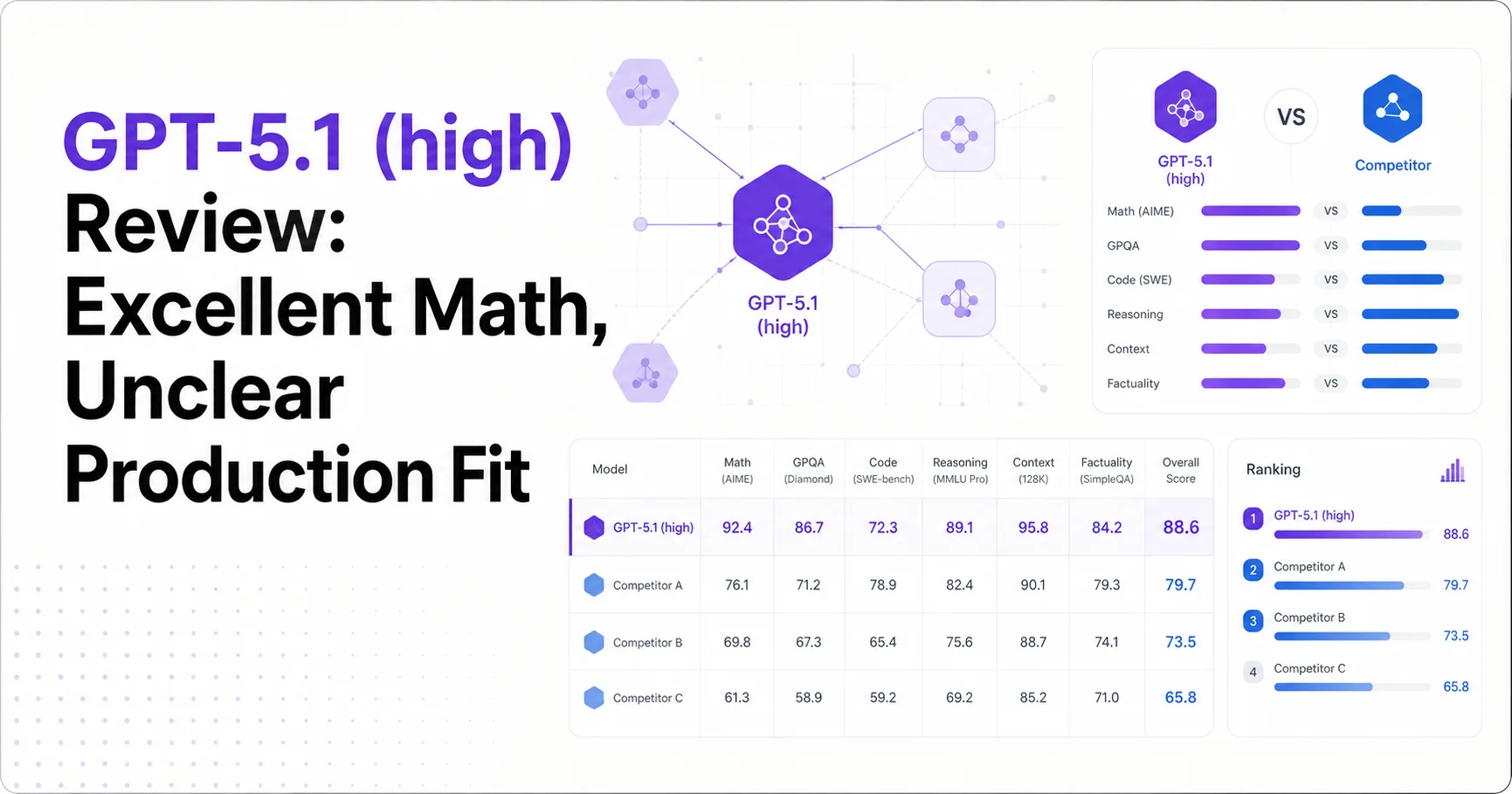
- **Where it stands:** GPT-5.1 (high) ranks 14 of 265 on the Artificial Analysis Math Index at 94 - **Price:** $3.4375 per 1M blended tokens - **Speed:** output speed is not reported, 0.3s to first token - **Pick it when:** mathematical reasoning matters more than verified availability or predictable production economics - **Watch out:** OpenAI's current model and pricing pages do not list gpt-5-1, so deployment status remains unconfirmed
GPT-5.1 (high) review for developers
GPT-5.1 (high) looks strongest as a math-oriented reasoning model, but its production status is not sufficiently documented for a low-risk default choice. Artificial Analysis places the model at 14 of 265 on its Math Index, while its broader Intelligence Index position is 86 of 578. That spread matters: the available evidence supports a focused strength in mathematical work more clearly than a general claim of all-purpose superiority.
The model’s measured first-token latency is 0.3 seconds, but output speed is not reported in the supplied data. The data brief lists a blended price of $3.4375 per 1M tokens, with input priced at $1.25 and output priced at $10 per 1M tokens. These figures provide a useful comparison point, but they should not be treated as confirmed current OpenAI list pricing because OpenAI’s pricing documentation does not list gpt-5-1.
The central buying question is therefore conditional. GPT-5.1 (high) may be attractive for workloads that benefit from strong mathematical reasoning and can tolerate uncertainty around access. Teams that need a documented context window, confirmed API status, stable aliases, or publicly described failure modes have insufficient evidence to approve it as a long-lived production dependency.
Executive summary
GPT-5.1 (high) earns serious consideration for math-heavy developer workflows, but the evidence does not justify treating it as a broadly superior production model.
| Decision area | GPT-5.1 (high) | Nearby alternatives in the data brief |
|---|---|---|
| Primary strength | High mathematical benchmark position | Qwen3.6 27B and MiMo-V2.5 show stronger coding scores in the supplied comparisons |
| General positioning | Mid-pack on the Intelligence Index relative to the full set | Grok 4.20 0309 v2 and Qwen3.6 27B sit close on intelligence positioning |
| Cost posture | Moderate blended cost with expensive output tokens | MiMo-V2.5 and Gemini 3.5 Flash-Lite are materially cheaper in the supplied data |
| Operational confidence | Unclear official listing and documentation | The brief does not establish equivalent documentation gaps for every adjacent model |
GPT-5.1 (high) is a plausible specialist choice when mathematical quality is the main acceptance criterion. It is a weaker default for high-volume generation, cost-sensitive automation, or systems that require confirmed lifecycle support. OpenAI’s model directory does not contain a separate gpt-5-1 entry in the supplied research, and it does not define high as an independently documented API reasoning setting.
The evidence also cannot establish whether the model remains callable, has moved under another identifier, or is simply absent from the current public catalog. That uncertainty should be treated as a selection constraint, not as proof that the model is unavailable.
What the benchmark position means in practice
GPT-5.1 (high) is most defensible for mathematical reasoning, while its coding and general intelligence positions call for narrower expectations.
A rank of 14 of 265 on the Artificial Analysis Math Index places GPT-5.1 (high) near the leading edge of the supplied math comparison set. That result supports use cases such as symbolic reasoning, quantitative explanation, proof-oriented assistance, and code tasks whose main difficulty is mathematical correctness. It does not prove reliable performance on every mathematical format, especially because the research brief provides no task-level breakdown or testing methodology beyond the index.
The broader picture is less decisive. GPT-5.1 (high) ranks 72 of 202 on the Artificial Analysis Coding Index and 86 of 578 on the Artificial Analysis Intelligence Index. Those positions suggest a capable model with a pronounced math advantage, rather than evidence of category leadership across software engineering and general reasoning.
The nearby-model data sharpens that interpretation. Qwen3.6 27B and MiMo-V2.5 have higher supplied coding scores, while Gemini 3.5 Flash-Lite is close on coding and cheaper. GPT-5.1 (high) may still win on a team’s specific coding tasks, but the supplied evidence cannot establish that outcome. Developers should run representative repositories, tests, tool calls, and long-horizon tasks before making a coding-first decision.
The model’s 0.3-second first-token latency is promising for interactive use. Output tokens per second are not reported, so total response time and streaming experience remain unresolved.
Cost and production economics
GPT-5.1 (high) is only cost-effective when its math advantage prevents more expensive retries, reviews, or downstream failures.
The data brief lists GPT-5.1 (high) at $3.4375 per 1M blended tokens, with output priced at $10 per 1M tokens. That output rate makes response length an important design variable. A workflow that produces long explanations, large patches, or repeated agent traces may cost more than its blended figure initially suggests. Short, high-value reasoning steps are a better economic fit than unrestricted generation.
The model’s 0.3-second time to first token supports responsive interfaces, but the absence of a reported median output rate prevents a complete throughput judgment. A fast first token can still coexist with slow completion on long answers. Teams should therefore measure end-to-end latency using their own prompt and output distributions.
The price comparison also changes the recommendation. The supplied nearby-model data lists MiMo-V2.5 and Gemini 3.5 Flash-Lite at lower blended prices, while Qwen3.6 27B is also cheaper. Those alternatives may be more suitable for bulk classification, routine coding assistance, or high-volume content transformation. GPT-5.1 (high) becomes easier to justify when a difficult mathematical decision is expensive to get wrong.
Official price certainty is missing. OpenAI’s current pricing page does not list gpt-5-1, so the supplied price should be validated against the actual endpoint, account tier, and availability before procurement. Batch, Flex, and Fast mode treatment cannot be confirmed from the research.
Recommendation for model selection
GPT-5.1 (high) is worth piloting for math-heavy reasoning, but it should not be adopted as an unverified general-purpose production default.
Choose GPT-5.1 (high) when the workload has three properties: mathematical reasoning is central, answer quality matters more than minimum token cost, and the team can tolerate uncertainty during validation. Examples include quantitative planning, technical analysis, numerical debugging, and developer tools that ask the model to explain or check difficult calculations.
Prefer another model when the workload is dominated by long outputs, high request volume, coding throughput, or strict platform governance. The supplied data gives MiMo-V2.5 and Qwen3.6 27B stronger coding positions than GPT-5.1 (high), while Gemini 3.5 Flash-Lite combines a nearby coding score with a lower listed cost. These are comparison signals, not proof that any alternative will perform better on a specific application.
| Use case | Recommendation | Reason |
|---|---|---|
| Mathematical analysis | Pilot GPT-5.1 (high) | Its strongest supplied ranking is on the Math Index |
| General chat or mixed tasks | Validate against alternatives | Its general ranking does not establish broad leadership |
| High-volume generation | Start with cheaper alternatives | Its listed output price can penalize long responses |
| Long-term API dependency | Wait for confirmation | Current OpenAI catalog and pricing documentation do not list gpt-5-1 |
OpenAI’s model documentation also leaves the context window, maximum output length, API parameters, modality support, and high reasoning definition unresolved for this model. Those omissions make a production approval premature without direct account-level verification.
Before you choose GPT-5.1 (high)
GPT-5.1 (high) requires direct validation before a team commits to it for production workloads.
The research brief found no reliable community posts clearly attributable to GPT-5.1 (high) or the gpt-5-1 API slug. It therefore cannot support firm claims about coding habits, speed perception, recurring refusal behavior, or known failure cases. Developers should treat the benchmark evidence as directional and test the exact access path they plan to operate.
The main unresolved questions are practical: whether the identifier is callable, whether it has a stable alias, what context and output limits apply, and whether the listed data price matches the team’s endpoint. The supplied research does not answer those questions. A short evaluation should record task accuracy, correction rate, output length, first-token latency, completion latency, and failure recovery behavior.
Frequently asked questions
Is GPT-5.1 (high) a good general-purpose model for developers?
GPT-5.1 (high) is not yet proven as the best general-purpose developer model because its supplied coding and intelligence rankings trail its much stronger mathematical position, while official documentation remains incomplete.
What is GPT-5.1 (high) best used for?
GPT-5.1 (high) is best suited to math-heavy reasoning tasks where correctness has higher value than minimum cost, such as quantitative analysis, numerical debugging, and proof-oriented technical assistance.
Is GPT-5.1 (high) available through the OpenAI API?
GPT-5.1 (high) availability is unconfirmed from the supplied official sources because OpenAI’s current model directory does not list gpt-5-1 as a separate entry or document high as an API variant.
Is GPT-5.1 (high) expensive compared with nearby models?
GPT-5.1 (high) carries a meaningful production cost because the supplied output price is $10 per 1M tokens, while several nearby models in the brief have lower blended prices.
Should a team choose GPT-5.1 (high) for coding agents?
GPT-5.1 (high) should be tested rather than assumed for coding agents because the supplied coding ranking is weaker than its math ranking, and nearby models show stronger coding scores in the comparison data.
Sources
- OpenAI ModelsVerifying the current model directory, documented capabilities, API model naming, and the absence of a separate gpt-5-1 entry in the supplied research.
- OpenAI PricingVerifying current listed pricing and whether gpt-5-1 appears in OpenAI's public pricing documentation.
Published: