
GPT-5.2 Codex (xhigh)
AvailableOpenAI · 2025-12-11 · 400,000 tokens
An AI model from OpenAI, suited to a broad range of AI workloads.
Supported modalities:textvideocode
Quick Overview
Text Generation4/10
Code Generation6/10
Reasoning6/10
Multimodal3/10
Benchmark Results
Scores from leading benchmark suites.
artificial analysis intelligence41.2
Performance Metrics
Latency and throughput performance.
Dive Deeper
AI model analysis
GPT-5.2 Codex (xhigh) Review: Strong Intelligence, Uncertain Product Status
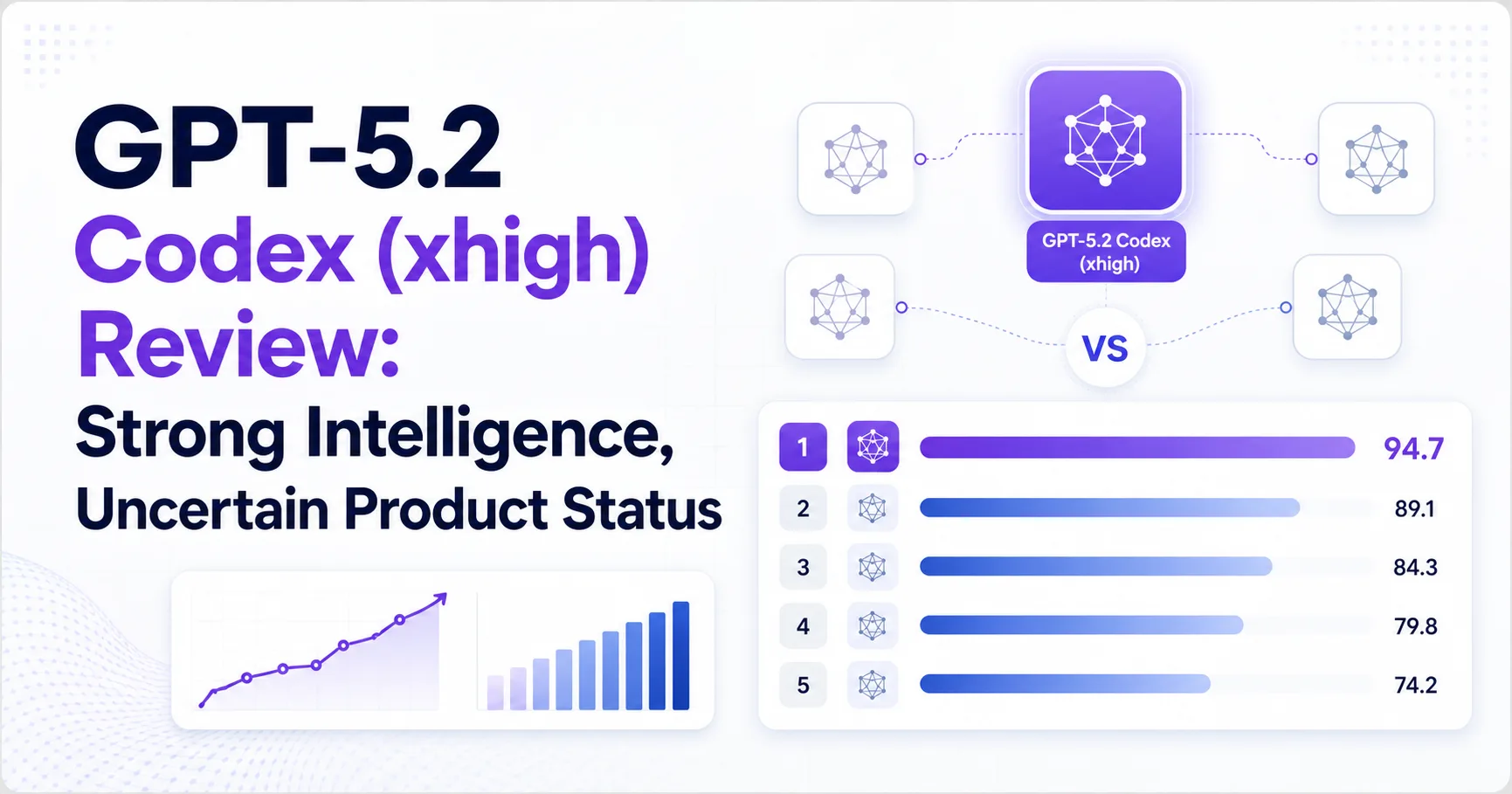
- **Where it stands:** GPT-5.2 Codex (xhigh) ranks 62 of 578 on the Artificial Analysis Intelligence Index at 40.1 - **Price:** $4.8125 per 1M blended tokens - **Speed:** output tokens per second not reported, 0.3s to first token - **Pick it when:** you need a high-ranked OpenAI model for carefully reviewed coding workflows and can tolerate uncertain availability - **Watch out:** official sources do not confirm a standalone GPT-5.2 Codex listing, API alias, lifecycle status, or coding-specific benchmark Data provided by https://artificialanalysis.ai/
GPT-5.2 Codex (xhigh) is a high-ranking model with an unresolved availability question
GPT-5.2 Codex (xhigh) combines a strong general benchmark position with incomplete official product evidence. The model ranks 62 of 578 on the Artificial Analysis Intelligence Index with a score of 40.1, placing it in roughly the upper part of the measured field. Data provided by Artificial Analysis.
That result makes GPT-5.2 Codex (xhigh) worth considering for developers who value broad model intelligence and already have a trusted route to access it. The result does not prove that the model is the best coding choice. The supplied dataset does not provide a coding-index score for GPT-5.2 Codex (xhigh), and it does not report output tokens per second.
The larger concern is product certainty. OpenAI’s current model directory does not list gpt-5-2-codex or GPT-5.2 Codex (xhigh) as an independent model entry. OpenAI’s current pricing page also does not list gpt-5.2-codex or an xhigh billing tier for it. Those omissions do not establish that the model cannot be called, but they leave access, naming, and lifecycle questions unanswered.
For a developer, GPT-5.2 Codex (xhigh) is therefore a conditional recommendation. The model looks capable enough to test, but production adoption should depend on verified endpoint access, stable naming, and repeatable task-level evaluation.
The benchmark position supports testing, but cheaper nearby models weaken the value case
GPT-5.2 Codex (xhigh) deserves a controlled trial, while its nearby alternatives make an automatic purchase decision difficult. The closest models sit near the same Intelligence Index score, yet several have lower blended prices in the supplied data. Data provided by Artificial Analysis.
| Decision factor | GPT-5.2 Codex (xhigh) | What the nearby data suggests |
|---|---|---|
| General intelligence | Strong measured position, with a score of 40.1 | Several nearby models measure at 40.0, 40.2, or 40.3 |
| Coding evidence | No coding-index score supplied for GPT-5.2 Codex (xhigh) | Nearby models have coding-index scores ranging from 52.9 to 56.2 where reported |
| Cost posture | $4.8125 per 1M blended tokens | Every listed nearby model has a lower blended price |
| Access confidence | Not confirmed by the current official listings | The supplied official pages do not clarify this model’s lifecycle |
The practical trade-off is straightforward. GPT-5.2 Codex (xhigh) has enough benchmark strength to justify evaluation, but the available comparison does not show a clear intelligence lead over the closest models. A developer choosing primarily on cost may find the alternatives easier to justify. A developer choosing on OpenAI alignment, existing tooling, or internal familiarity may still prefer GPT-5.2 Codex (xhigh), provided access is confirmed.
OpenAI’s model documentation describes current model capabilities at a catalog level, but it does not attribute a separate context window, maximum output length, multimodal profile, or API parameter set to GPT-5.2 Codex (xhigh). Those missing details matter for implementation planning.
GPT-5.2 Codex (xhigh) is better treated as a broad reasoning candidate than a proven coding specialist
GPT-5.2 Codex (xhigh) has a credible general-intelligence signal, but the supplied evidence is insufficient to predict coding performance with confidence. The Intelligence Index score is 40.1, and the rank is 62 of 578. Data provided by Artificial Analysis.
A rank near the front of a large model set usually supports testing for complex developer work. It can justify tasks such as repository understanding, implementation planning, debugging, and code review. Those are selection hypotheses, not measured conclusions for this model. The brief provides no task breakdown, test environment, sample size, or coding benchmark result for GPT-5.2 Codex (xhigh).
The nearby models create an important caution. GLM-5.1 (Reasoning), GPT-5.4 mini (xhigh), Inkling Small, and DeepSeek V4 Flash (Reasoning, Max Effort) have reported coding-index scores of 55.8, 56.1, 52.9, and 56.2 respectively. GPT-5.2 Codex (xhigh) has no corresponding coding score in the supplied data. That gap prevents a reliable claim that the Codex model is stronger or weaker at software tasks.
Latency is easier to interpret, but only narrowly. The dataset reports 0.3 seconds to first token. It does not report median output tokens per second. That means the model may feel responsive at the start of a request, while total completion time remains unknown. Interactive coding agents should measure full task completion time, tool-call pauses, retry behavior, and edit quality in their own environment.
The performance conclusion can therefore change under two conditions. If internal tests show superior repository-level accuracy, the missing coding score matters less. If coding quality is merely comparable to nearby models, the higher price and uncertain official status become more important.
GPT-5.2 Codex (xhigh) is difficult to defend on price unless it reduces developer rework
GPT-5.2 Codex (xhigh) is a premium-cost choice in this comparison, so its value depends on producing materially better outcomes per task. The blended price is $4.8125 per 1M tokens, with input priced at $1.75 and output priced at $14. Data provided by Artificial Analysis.
The cost issue is not simply that cheaper models exist. Every closest model in the supplied data has a lower blended price, including models with nearly identical Intelligence Index results. GLM-5.1 (Reasoning) is listed at $2.135 per 1M blended tokens. GPT-5.4 mini (xhigh) is listed at $1.6875. Inkling Small is listed at $0.525. DeepSeek V4 Flash (Reasoning, Max Effort) is listed at $0.17125. These figures make GPT-5.2 Codex (xhigh) a poor default for high-volume, low-risk generation unless its quality advantage is demonstrated internally.
The output rate also deserves attention. At $14 per 1M output tokens, verbose agent responses, repeated patches, and long diagnostic traces can raise spend quickly. The data does not show output throughput, so it cannot establish whether the higher output price buys faster completion. Developers should measure cost per accepted change, not just cost per request.
A reasonable economic case exists for high-consequence coding work. If GPT-5.2 Codex (xhigh) prevents a difficult regression, shortens investigation time, or produces patches that need fewer review cycles, the list price may be acceptable. The research brief contains no validated evidence for those outcomes. OpenAI’s pricing documentation also does not provide a current listed price for this exact model, so the supplied data price should be treated as an evaluation input rather than confirmed official availability pricing.
Choose GPT-5.2 Codex (xhigh) for verified specialist access, not as an untested production default
GPT-5.2 Codex (xhigh) is a sensible shortlist candidate for demanding coding experiments, but it is not yet a low-risk production default. Its rank of 62 of 578 and score of 40.1 support a serious evaluation. Data provided by Artificial Analysis.
Use GPT-5.2 Codex (xhigh) when all three conditions hold: your organization can verify a working endpoint, your tasks reward deep reasoning over lowest cost, and your evaluation shows fewer accepted-code failures than cheaper candidates. Suitable tests should use real repositories, realistic issue descriptions, hidden acceptance checks, and human review. The supplied material does not identify a validated test suite, so the team must create that evidence.
Avoid making it the default choice for large automated workloads based only on the Intelligence Index. Nearby models have similar general scores, lower blended prices, and reported coding-index values. That does not prove they are better for your repository. It does show that GPT-5.2 Codex (xhigh) needs a task-specific justification.
Access uncertainty is the decisive operational risk. The current OpenAI model directory does not contain an independent entry for gpt-5-2-codex. The current OpenAI pricing page lists gpt-5.3-codex as a Codex entry, but does not list gpt-5.2-codex. The brief therefore cannot confirm whether GPT-5.2 Codex (xhigh) remains directly callable, has a stable alias, or requires migration.
The final recommendation is to gate adoption on a short proof of value. Confirm access first. Then compare accepted patches, review effort, failure recovery, latency, and cost against one cheaper nearby model. Promote GPT-5.2 Codex (xhigh) only if it wins on the work your team actually ships.
The main evidence gap is model-specific documentation, not the absence of a benchmark signal
GPT-5.2 Codex (xhigh) has enough external measurement to merit testing, but not enough model-specific documentation to support confident system design. The supplied data provides a general benchmark score, rank, price fields, and first-token latency. Data provided by Artificial Analysis.
The official evidence is narrower. OpenAI’s model directory does not provide an independent entry for this model. It therefore does not confirm the context window, maximum output length, API parameters, multimodal capabilities, or official benchmark results for GPT-5.2 Codex (xhigh). The current pricing page does not confirm an exact public price or an xhigh API billing alias.
The research brief also found no reliable community posts with test methods, environments, sample sizes, or reproducible observations about this model’s coding behavior. That means claims about tool use, patch reliability, speed under load, and failure modes remain unverified. Evidence is especially thin for long-running coding agents, where repository context, tool orchestration, and retry policy can dominate model quality.
Developers should record these unknowns explicitly in an evaluation report. The missing information is not a reason to reject the model automatically. It is a reason to avoid treating the benchmark rank as a complete product specification.
Questions to answer before integrating GPT-5.2 Codex (xhigh)
GPT-5.2 Codex (xhigh) should pass an access and task-quality review before integration. The current OpenAI model directory and pricing page do not independently document the exact model entry.
The following questions focus on decisions that the supplied benchmark fields cannot answer alone.
Frequently asked questions
Is GPT-5.2 Codex (xhigh) a good choice for production coding agents?
GPT-5.2 Codex (xhigh) can be a good production choice only after endpoint access, coding quality, failure recovery, and cost are verified on your repositories. The model ranks 62 of 578 on the Artificial Analysis Intelligence Index, but the supplied data does not include a model-specific coding-index score or output throughput measurement.
Does GPT-5.2 Codex (xhigh) offer good value for money?
GPT-5.2 Codex (xhigh) offers defensible value only when its output reduces review effort, regressions, or repeated attempts enough to offset its $4.8125 blended price per 1M tokens. Every listed nearby model is cheaper, and the supplied evidence does not prove a quality advantage for this model.
Is GPT-5.2 Codex (xhigh) officially available through the OpenAI API?
GPT-5.2 Codex (xhigh) cannot be confirmed as a currently listed standalone API model from the supplied official evidence. OpenAI’s model directory does not show the exact entry, and its pricing page does not list the exact model or an xhigh billing alias.
How fast is GPT-5.2 Codex (xhigh) in practice?
GPT-5.2 Codex (xhigh) has a reported latency of 0.3 seconds to first token, but practical completion speed remains unknown because median output tokens per second are not reported. Developers should measure full task duration, tool pauses, retries, and accepted changes.
What should developers benchmark before choosing GPT-5.2 Codex (xhigh)?
Developers should benchmark repository-level issue resolution, patch acceptance, regression rate, review time, tool-call reliability, retry frequency, latency, and cost per accepted change. The supplied brief does not provide a validated task suite, test environment, or sample size for GPT-5.2 Codex (xhigh).
Sources
- Artificial AnalysisBenchmark score, ranking, pricing fields, and latency data supplied for GPT-5.2 Codex (xhigh) and nearby models.
- OpenAI ModelsChecking the official model directory, documented capabilities, model-specific availability, and lifecycle evidence.
- OpenAI API PricingChecking official Codex listings, exact model pricing, and the presence of a GPT-5.2 Codex or xhigh billing entry.
Published: