
GPT-5.4 nano (xhigh)
AvailableOpenAI · 2026-03-17 · 400,000 tokens
An AI model from OpenAI, suited to a broad range of AI workloads.
Supported modalities:textvideocode
Quick Overview
Text Generation4/10
Code Generation6/10
Reasoning6/10
Multimodal3/10
Benchmark Results
Scores from leading benchmark suites.
artificial analysis intelligence39.7
artificial analysis coding56.1
Performance Metrics
Latency and throughput performance.
Dive Deeper
AI model analysis
GPT-5.4 nano (xhigh) Review: Strong Coding Rank at a Low Blended Cost
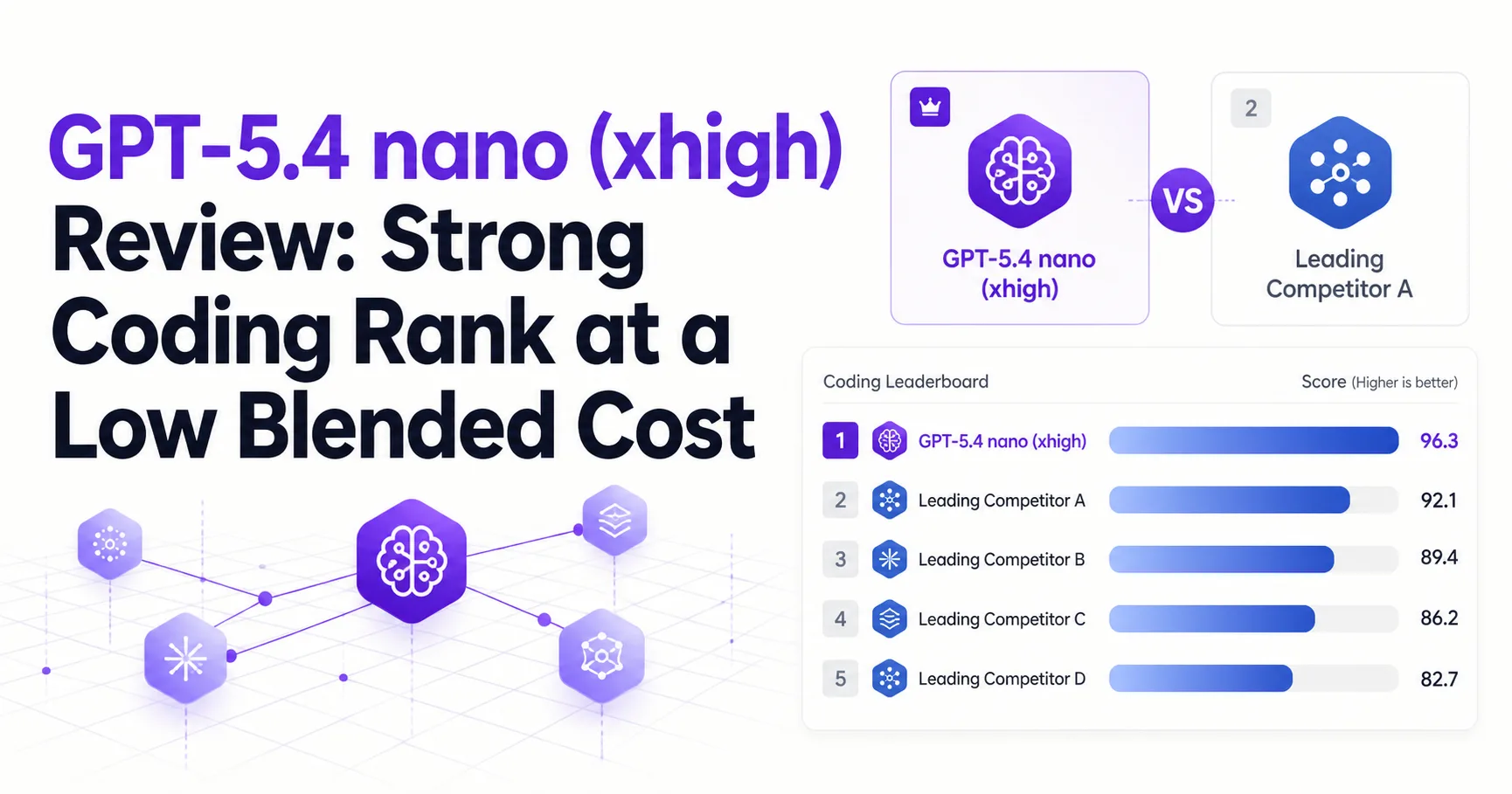
- **Where it stands:** GPT-5.4 nano (xhigh) ranks 73 of 578 on the Artificial Analysis Intelligence Index at 38.2 - **Price:** $0.4625 per 1M blended tokens - **Speed:** output throughput is not reported, 0.3s to first token - **Pick it when:** you need a low-cost coding model with a 56 of 202 coding rank - **Watch out:** context-window limits and output throughput remain unreported, so capacity planning evidence is incomplete
GPT-5.4 nano (xhigh) is a low-cost coding candidate with incomplete operational evidence
GPT-5.4 nano (xhigh) is most compelling for developers who want a low blended price and a comparatively strong coding position, while accepting gaps in published capacity and throughput data. The model ranks 56 of 202 on the Artificial Analysis Coding Index, which makes coding its clearest measurable strength. Its broader Intelligence Index position is 73 of 578, placing it in a stronger tier than the raw score alone may suggest. Artificial Analysis supplies the benchmark and pricing snapshot used here.
OpenAI lists the model in its official pricing catalogue at $0.20 per 1M input tokens and $1.25 per 1M output tokens. OpenAI Pricing also lists Batch and Flex prices, but the practical cost depends on workload shape, output volume, caching, and scheduling tolerance. The model has a measured first-token latency of 0.3 seconds, while median output tokens per second is not reported.
The central buying question is therefore not whether GPT-5.4 nano is cheap. It is whether its coding rank is sufficient for the tasks you need, and whether the missing throughput and context information can be resolved through your own tests.
GPT-5.4 nano offers a favorable middle ground, but nearby alternatives change the trade-off
GPT-5.4 nano (xhigh) offers one of the strongest cost-to-coding-position combinations in this comparison set, although the evidence does not establish a universal quality advantage. Its blended price is $0.4625 per 1M tokens, close to GPT-5.6 Luna at $0.45 and below MiniMax-M2.7 at $0.525. GPT-5.4 nano also records a higher coding score than both nearby models, at 56.1 compared with 50.7 and 52.6 respectively. Artificial Analysis provides these comparative figures.
The closest intelligence results are less decisive. GPT-5.4 nano scores 38.2, while GLM-5-Turbo, GPT-5.6 Luna, and MiniMax-M2.7 each score 38.1. That narrow separation does not prove a meaningful real-world quality gap. It does suggest that developers should select by task mix, reliability requirements, and integration fit rather than by the intelligence score alone.
| Decision factor | GPT-5.4 nano | Nearby alternative | Practical reading |
|---|---|---|---|
| Coding position | Stronger measured position | GPT-5.6 Luna or MiniMax-M2.7 | Prefer GPT-5.4 nano when code quality carries more weight than marginal price |
| Broad intelligence | Slightly ahead in the snapshot | GLM-5-Turbo, GPT-5.6 Luna, or MiniMax-M2.7 | Treat the difference as too narrow for a standalone decision |
| Cost | Low blended price | GPT-5.6 Luna is slightly lower | Test output length before choosing on price |
| Evidence quality | Missing throughput and context details | Nearby models also have incomplete fields | Benchmark your own workload before production commitment |
GPT-5.4 nano is better positioned for coding than for broad capability claims
GPT-5.4 nano (xhigh) should be evaluated first as a coding-oriented model, because its coding rank is materially better than its broader intelligence rank. The model places 56 of 202 on the Artificial Analysis Coding Index with a score of 56.1. It places 73 of 578 on the Artificial Analysis Intelligence Index with a score of 38.2. Artificial Analysis reports the ranking snapshot, but it does not explain which task families drive those positions.
For developers, the coding result supports testing GPT-5.4 nano on code generation, transformation, debugging, and repository assistance. It does not guarantee success on every software workflow. A benchmark rank can hide important differences in test composition, answer verification, tool use, context length, and tolerance for partially correct patches. The available research found no reliable community posts that document this model’s specific coding habits, tool-calling failures, or speed perception.
GPT-5.4 nano also has a 0.3-second latency figure, which supports interactive request flows that care about initial responsiveness. Output throughput is not reported, so the model’s behavior during long responses remains uncertain. A fast first token may still produce a slow overall interaction if generation throughput is weak. Developers building autocomplete, chat, or agent loops should measure time to usable answer, not only time to first token.
OpenAI’s model directory describes the latest models as supporting text and image input, text output, multilingual capability, and vision through the Responses API and official SDKs. OpenAI Models does not clearly attribute every listed capability to GPT-5.4 nano. Those capabilities should therefore be treated as catalogue-level guidance, not as a confirmed model-specific feature list.
The evidence is insufficient to recommend GPT-5.4 nano for long-context repository work. OpenAI does not publish a confirmed context-window limit for this model in the reviewed material, and the pricing page does not list long-context pricing. That absence does not prove long-context support is unavailable. It means production teams need a direct API test before relying on it.
GPT-5.4 nano is inexpensive when outputs stay controlled, not automatically in every workload
GPT-5.4 nano (xhigh) is cost-efficient for workloads with moderate output volume and repeatable prompts, but its output price makes response length a key cost driver. Standard pricing is $0.20 per 1M input tokens and $1.25 per 1M output tokens. The blended reference price is $0.4625 per 1M tokens. OpenAI Pricing lists cached input at $0.02 per 1M tokens, which can improve economics for repeated instructions and stable context.
The model becomes more attractive when your application sends substantial reusable context and receives compact answers. Caching can matter for repository assistants, support workflows, and structured extraction pipelines with stable system prompts. The opposite pattern can reverse the conclusion: long generated patches, verbose explanations, repeated retries, or agent loops can make output spend dominate the bill.
Batch and Flex pricing lower the listed standard rates to $0.10 per 1M input tokens, $0.01 per 1M cached input tokens, and $0.625 per 1M output tokens. These modes are relevant for asynchronous evaluation, bulk classification, offline code analysis, and other tasks that can tolerate different scheduling behavior. The reviewed material does not establish whether Flex offers the latency or availability profile your application needs.
GPT-5.6 Luna is slightly cheaper on the blended measure at $0.45 per 1M tokens, so GPT-5.4 nano is not the absolute price leader among the closest references. Its case depends on whether the higher coding score produces fewer retries, corrections, or human reviews. The data brief does not provide failure rates, token usage by task, or total cost per completed software change. Teams should compare completed outcomes, not token prices alone.
GPT-5.4 nano is a sensible first test for coding-heavy, cost-sensitive products
GPT-5.4 nano (xhigh) is worth piloting when coding quality matters, response initiation should feel quick, and the application can keep generated output under control. Its coding rank of 56 of 202 is the strongest direct argument for adoption. Its $0.4625 blended price keeps experimentation and high-volume use economically plausible. Artificial Analysis supports both parts of that assessment.
Use GPT-5.4 nano for code review drafts, test generation, small-to-medium refactors, structured developer assistance, and repository questions that fit within a verified context budget. Start with a small production-shaped evaluation. Include compiler or test-suite validation, retry rates, patch acceptance, tool-call correctness, and total tokens per successful task.
Avoid making it the default for every request before checking three unknowns: sustained output speed, maximum usable context, and model-specific failure modes. The research brief found no reliable public evidence for those areas. OpenAI also does not publish a complete model-specific parameter sheet or an official benchmark score for GPT-5.4 nano in the reviewed sources.
Choose a more expensive model when a failed answer has a high operational cost, when tasks require difficult multi-step reasoning, or when your own evaluation shows that stronger reliability offsets additional token spend. Choose GPT-5.4 nano when measured completion quality is adequate and its lower price improves throughput without increasing review work.
| Choose GPT-5.4 nano when | Keep testing before choosing when |
|---|---|
| Coding tasks dominate the request mix | Long context is central to the product |
| Output can be constrained or cached | Long responses and agent loops are common |
| Fast first-token response matters | Sustained generation speed is a hard requirement |
| You can validate outputs automatically | Errors require costly human intervention |
GPT-5.4 nano selection FAQ
GPT-5.4 nano (xhigh) is best treated as a strong coding candidate with several important unknowns that require workload-specific validation. OpenAI Models confirms the official model catalogue and API access path, while OpenAI Pricing confirms the listed pricing and stable model identifier. Artificial Analysis provides the comparative ranking snapshot.
Frequently asked questions
Is GPT-5.4 nano good for coding?
GPT-5.4 nano is a credible coding choice because it ranks 56 of 202 on the Artificial Analysis Coding Index, but developers should still validate generated patches, tests, tool calls, and repository-specific instructions before production use.
Is GPT-5.4 nano cheap for production workloads?
GPT-5.4 nano is inexpensive on a blended basis at $0.4625 per 1M tokens, especially with reusable cached input, but verbose outputs, retries, and agent loops can make total task cost materially higher than token pricing suggests.
How fast is GPT-5.4 nano?
GPT-5.4 nano has a measured latency of 0.3 seconds to first token, which supports responsive interactions, but median output tokens per second is not reported, so sustained generation speed remains an open production question.
Does GPT-5.4 nano support long context?
The reviewed sources do not confirm GPT-5.4 nano’s context-window limit or long-context pricing, so developers should not assume a specific capacity until direct API testing or clearer official documentation provides that evidence.
Should developers choose GPT-5.4 nano over GPT-5.6 Luna?
GPT-5.4 nano is preferable when its higher coding score matters more than GPT-5.6 Luna’s slightly lower blended price, but the difference is workload-dependent and should be tested with completed engineering tasks rather than isolated scores.
Sources
- Artificial AnalysisBenchmark rankings, scores, pricing snapshot, latency, and comparison-model data
- OpenAI ModelsOfficial model catalogue, unified capability descriptions, and API access context
- OpenAI PricingGPT-5.4 nano standard, cached, Batch, and Flex pricing, plus model identifier status
Published: