
GPT-5.5 (high)
AvailableOpenAI · 2026-04-23 · 400,000 tokens
An AI model from OpenAI, suited to a broad range of AI workloads.
Supported modalities:textvideocode
Quick Overview
Text Generation5/10
Code Generation7/10
Reasoning6/10
Multimodal5/10
Benchmark Results
Scores from leading benchmark suites.
artificial analysis intelligence54.7
artificial analysis coding71.6
Performance Metrics
Latency and throughput performance.
Dive Deeper
AI model analysis
GPT-5.5 (high) Review: Strong Capability, Uneven Value
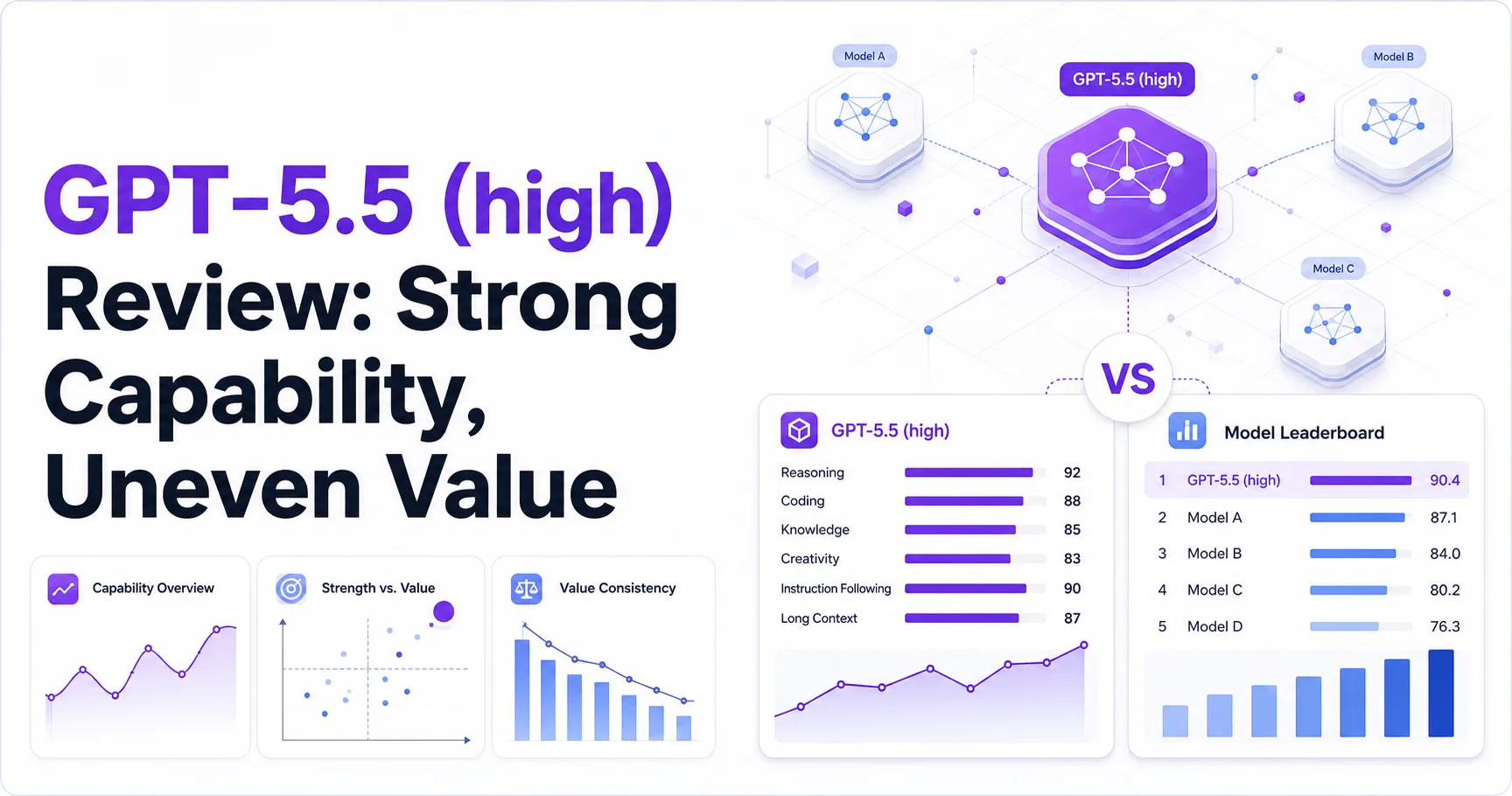
- **Where it stands:** GPT-5.5 (high) ranks 17 of 578 on the Artificial Analysis Intelligence Index at 53.1 - **Price:** $11.25 per 1M blended tokens - **Speed:** No median output-token rate is reported, with 0.3s to first token - **Pick it when:** Coding and tool-agent work justify a model ranked 17 of 202 with a 71.6 coding index - **Watch out:** No median output-token rate is reported, so sustained throughput remains unverified beside 0.3s first-token latency
GPT-5.5 (high) is a high-end model with credible developer fit, but its benchmark standing does not make it the obvious default.
GPT-5.5 (high) is a high-end model with credible developer fit, but its benchmark standing does not make it the obvious default. OpenAI maps this configuration to the gpt-5.5 API model with reasoning.effort set to high, while the API supports several reasoning levels (GPT-5.5 model page).
OpenAI positions GPT-5.5 for complex professional work involving coding, tool agents, long-context retrieval, computer operation, knowledge work, and scientific research (GPT-5.5 usage guide). The model page also lists text and image input, structured output, function calling, file search, web search, code execution, computer use, and MCP support (GPT-5.5 model page).
That combination makes GPT-5.5 (high) a serious candidate for applications where planning and tool orchestration matter. It does not establish that the model will produce the lowest total engineering cost or the most reliable long-running workflow. OpenAI’s current model directory still lists GPT-5.5, although newer GPT-5.6 variants are presented as recommended starting points (OpenAI model directory).
Data provided by https://artificialanalysis.ai/.
GPT-5.5 (high) ranks near the front of the measured field, yet nearby models make its value proposition difficult to defend.
GPT-5.5 (high) ranks near the front of the measured field, yet nearby models make its value proposition difficult to defend. The Artificial Analysis snapshot places GPT-5.5 (high) at 17 of 578 on intelligence and 17 of 202 on coding, which supports serious evaluation for demanding developer workloads (Artificial Analysis).
The adjacent-model records create a mixed decision rather than a clear winner:
| Adjacent model | What it changes in the decision |
|---|---|
| Claude Sonnet 5 (Adaptive Reasoning, Max Effort) | Near-parity measured results at a lower blended price make efficiency its main challenge to GPT-5.5 (high). |
| Claude Opus 4.7 (Adaptive Reasoning, Max Effort) | Lower blended cost and stronger measured coding performance make it a direct quality-value alternative. |
| GPT-5.6 Sol (medium) | The same blended price, stronger measured indices, and reported output speed create the strongest newer OpenAI comparison. |
| Grok 4.5 (high) | Lower cost with higher measured intelligence and coding results makes it a strong value challenger if workflow fit is comparable. |
| GPT-5.6 Terra (xhigh) | Lower cost and reported high output speed favor throughput, while its measured indices are lower. |
These comparisons come from the adjacent-model data in Artificial Analysis. GPT-5.5 (high) therefore makes the most sense when its tool ecosystem, reasoning behavior, or task completion quality matters more than the lowest token bill. The evidence does not show that GPT-5.5 dominates every nearby alternative. It shows a strong model surrounded by options that can win on price, coding measurements, or reported throughput.
GPT-5.5 (high) is most defensible for reasoning-heavy development workflows that reward planning, tool use, and verification.
GPT-5.5 (high) is most defensible for reasoning-heavy development workflows that reward planning, tool use, and verification. Artificial Analysis ranks GPT-5.5 (high) 17 of 202 on coding and 17 of 578 on intelligence, with a coding index of 71.6 and an intelligence index of 53.1 (Artificial Analysis).
For developers, the coding position is the clearest signal. A rank of 17 of 202 indicates strong standing across the measured coding field, not merely acceptable code completion. That supports use in repository changes, debugging, technical planning, and agent workflows where the model must connect several steps. The intelligence rank adds evidence that the result is not narrowly limited to coding tasks.
OpenAI’s published benchmark portfolio also targets terminal work, software engineering, tool use, browsing, computer interaction, mathematics, and cybersecurity (Introducing GPT-5.5). Those results are vendor-published measurements, so they are useful for understanding intended strengths but do not replace evaluation on a team’s own repositories, tools, and acceptance tests.
The most important limitation is reliability under long task sequences. OpenAI warns that higher reasoning effort can cause overthinking, unnecessary searches, or worse results when instructions conflict or tool access is too open (GPT-5.5 usage guide). The same guide recommends explicit success criteria, stopping conditions, tool rules, and verification for long-running work (GPT-5.5 usage guide).
Community evidence points in the same direction, but remains anecdotal. One Reddit user reports fast implementation alongside oversized files, duplicated logic, weak database design, and later bugs when architecture constraints were missing (Reddit coding report). A separate developer discussion reports premature completion, regressions, instruction drift, and unrelated changes in some Flutter and Xcode work, while explicitly acknowledging the lack of firm empirical evidence (OpenAI Developer Community report).
Available evidence is insufficient to claim that GPT-5.5 (high) is consistently better on real repositories than every adjacent model. The snapshot also reports 0.3s to first token but no median output-token rate, so sustained generation speed remains unverified (Artificial Analysis).
GPT-5.5 (high) is expensive enough that quality gains must be measured per completed task, not per request.
GPT-5.5 (high) is expensive enough that quality gains must be measured per completed task, not per request. The data snapshot lists a blended price of $11.25 per 1M tokens, while nearby models include substantially lower blended prices such as $4 for Claude Sonnet 5 and $3 for Grok 4.5 (Artificial Analysis).
That price can be reasonable when a stronger first attempt reduces retries, manual review, tool failures, or context rebuilding. It becomes difficult to justify for high-volume classification, routine rewriting, simple extraction, or other workloads where cheaper models deliver acceptable results. The relevant comparison is therefore successful tasks per dollar, not model quality in isolation.
OpenAI lists Batch and Flex pricing as lower-cost execution options, while Fast mode carries a higher price (API pricing). Teams should test those modes against queueing needs, service-level targets, and actual completion rates. A lower nominal rate does not help if a workflow needs repeated retries or expensive human correction.
Long-context workloads need extra care. OpenAI states that sessions beyond the model’s long-context threshold receive higher input and output multipliers (GPT-5.5 model page). GPT-5.5 also supports extended prompt caching but not in-memory prompt caching (API Changelog). Those details matter for applications that repeatedly send large instructions, repository context, or tool state.
Image-heavy workflows can add another hidden cost. OpenAI’s usage guide says the default image handling may preserve higher detail, which can increase input tokens and latency; teams seeking predictable economics should set an appropriate image_detail value (GPT-5.5 usage guide).
The cost conclusion is conditional. GPT-5.5 (high) is worth the premium when its measured capability prevents expensive failures. The evidence is insufficient to assume that premium without a task-level pilot.
GPT-5.5 (high) is worth choosing for high-stakes coding and tool-driven work, but not as an unmonitored general default.
GPT-5.5 (high) is worth choosing for high-stakes coding and tool-driven work, but not as an unmonitored general default. Choose it when a task requires multi-step reasoning, repository context, structured tool calls, image understanding, or careful technical synthesis, all areas highlighted in OpenAI’s model guidance (GPT-5.5 usage guide).
Adoption should include architecture rules, file-scope limits, explicit completion criteria, and automated validation. OpenAI recommends the Responses API for reasoning, tools, and multi-turn state, which fits this controlled-agent pattern (GPT-5.5 usage guide). A model with strong benchmark standing still needs tests that catch regressions, unrelated edits, malformed migrations, and premature completion.
Do not make GPT-5.5 (high) the default solely because it ranks well. Claude Sonnet 5 and Grok 4.5 offer lower-cost alternatives with close or higher measured results in the supplied comparison set. GPT-5.6 Sol presents a newer internal option with stronger measured indices at the same blended price, while GPT-5.6 Terra emphasizes lower cost and reported output speed. These comparisons come from Artificial Analysis, not from a full workflow study.
The best recommendation is a controlled pilot for tasks where failure is costly and reasoning depth matters. Keep a cheaper fallback for routine requests. Require a throughput test before promising interactive streaming performance because the available snapshot has no median output-token rate. Treat community complaints about drift and regressions as prompts for safeguards, not as settled model-wide facts (Reddit coding report, OpenAI Developer Community report).
OpenAI’s model directory continues to list GPT-5.5, while newer GPT-5.6 variants are presented as recommended starting points (OpenAI model directory). That positioning makes GPT-5.5 a valid specialist choice, but a less obvious greenfield default unless its workflow results justify the premium.
The decision questions developers should answer before adopting GPT-5.5 (high)
GPT-5.5 (high) deserves a controlled pilot before broad adoption because benchmark rank alone cannot establish workflow reliability. The key questions concern coding quality, total task cost, reasoning controls, sustained output speed, and behavior under long tool sequences.
The supplied evidence supports a strong capability case, especially for coding and complex professional work. It does not provide a reliable independent speed study, a universal reliability guarantee, or proof that the most expensive option produces the lowest total engineering cost. Teams should connect their decision to repository tests, tool traces, review effort, and successful task completion.
OpenAI’s official guidance provides the control model, while community reports identify failure modes worth testing. The FAQ below separates evidence-backed conclusions from areas where the evidence remains limited (GPT-5.5 usage guide).
Frequently asked questions
Is GPT-5.5 (high) a good default model for developers?
GPT-5.5 (high) is a strong candidate for a controlled default in reasoning-heavy applications, but its price and unreported output speed argue against universal deployment. The model fits complex coding and tool workflows, while cheaper adjacent models may serve routine requests more efficiently (Artificial Analysis).
How strong is GPT-5.5 (high) for coding?
GPT-5.5 (high) is a high-ranking coding model, placing 17 of 202 on the Artificial Analysis Coding Index at 71.6 in this snapshot for the measured field. That ranking supports serious evaluation, but repository-level reliability still requires local tests and review (Artificial Analysis).
Is GPT-5.5 (high) worth its price?
GPT-5.5 (high) can justify its price when better task completion reduces retries and human review, but the adjacent set contains materially cheaper alternatives with similar measured standing. Teams should compare successful tasks, correction effort, and tool failures rather than token price alone (Artificial Analysis).
Should teams use high reasoning effort for every request?
GPT-5.5 (high) should not use maximum reasoning indiscriminately, because OpenAI says higher effort can produce overthinking, unnecessary searches, or worse results under poor task controls. Reasoning settings should follow task complexity, stopping rules, tool limits, and validation requirements (GPT-5.5 usage guide).
What are the main adoption risks?
GPT-5.5 (high) carries adoption risks around long-task control, architecture quality, regressions, and sustained output speed, although the community evidence remains anecdotal rather than systematic. The data snapshot reports no median output-token rate, while user reports require independent validation (Artificial Analysis, Reddit coding report, OpenAI Developer Community report).
Sources
- Artificial AnalysisRanking, evaluation scores, pricing comparison, first-token latency, and adjacent-model data.
- GPT-5.5 model pageAPI model identity, reasoning configuration, capabilities, model availability, pricing conditions, and long-context behavior.
- GPT-5.5 usage guideOfficial positioning, reasoning controls, tool workflow guidance, stopping criteria, verification, and image handling.
- OpenAI model directoryCurrent model directory status and the positioning of newer GPT-5.6 variants.
- OpenAI API pricingStandard, Batch, Flex, and Fast mode pricing structure.
- OpenAI API ChangelogPrompt caching limitations and API availability context.
- Introducing GPT-5.5Official model positioning and vendor-published benchmark scope.
- GPT 5.5 isn't getting nerfed...Anecdotal coding, architecture, maintainability, and long-task feedback.
- GPT-5.5 seems to be degradedAnecdotal reports concerning instruction following, regressions, premature completion, and long-task behavior.
Published: