
GPT-5.6 Sol (high)
AvailableOpenAI · 2026-07-09 · 400,000 tokens
An AI model from OpenAI, strongest at code generation, suited to a broad range of AI workloads.
Supported modalities:textvideocode
Quick Overview
Text Generation6/10
Code Generation8/10
Reasoning6/10
Multimodal5/10
Benchmark Results
Scores from leading benchmark suites.
artificial analysis intelligence57.3
artificial analysis coding77.2
Performance Metrics
Latency and throughput performance.
Dive Deeper
AI model analysis
GPT-5.6 Sol (high) Review for Developers: Elite Coding Results, Unproven ROI
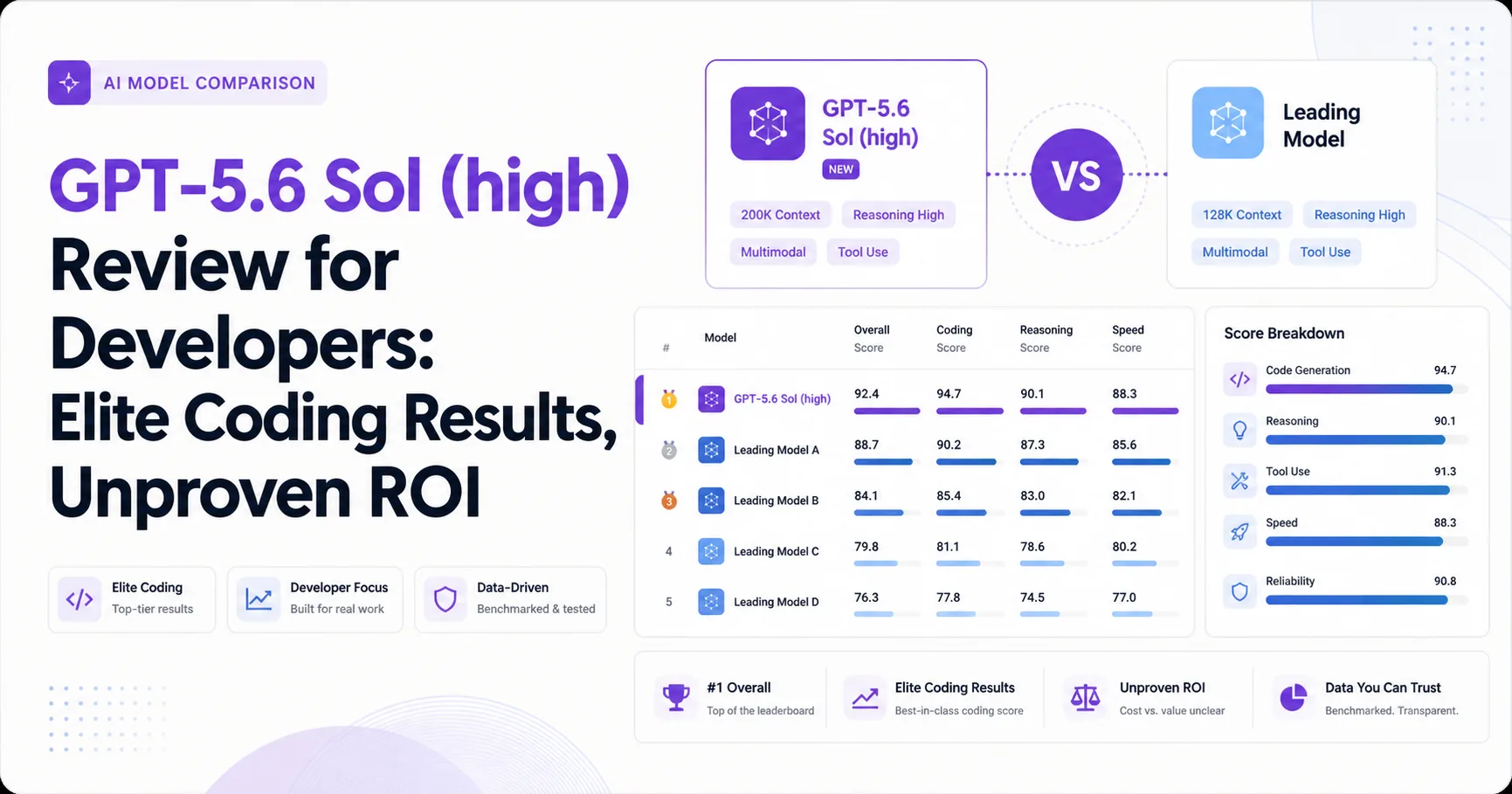
- **Where it stands:** GPT-5.6 Sol (high) ranks 4 of 202 on the Artificial Analysis Coding Index at 77.2 - **Price:** $11.25 per 1M blended tokens - **Speed:** 73.648 output tokens per second, 0.3s to first token - **Pick it when:** complex debugging and high-value coding can justify a rank of 4 of 202 - **Watch out:** inputs above 272K tokens trigger higher long-context pricing, while high-effort efficiency evidence remains limited
GPT-5.6 Sol (high) review
GPT-5.6 Sol (high) is a high-end reasoning configuration whose strongest case is complex coding, not universal value. OpenAI positions GPT-5.6 Sol for complex professional work, complex reasoning, and coding in its official model documentation.\n\nThe label GPT-5.6 Sol (high) should not be treated as a separate API model ID. The documented integration uses model: "gpt-5.6-sol" or the stable gpt-5.6 alias with reasoning.effort: "high" according to the reasoning models guide. That distinction matters because developers may otherwise build an invalid request or compare a configuration label with an independent model.\n\nThe data snapshot places GPT-5.6 Sol (high) at 4 of 202 on the Artificial Analysis Coding Index and 9 of 578 on the Artificial Analysis Intelligence Index. Those placements support a strong coding-first thesis, but they do not prove lower review time, higher task success, or better economics for every workflow. Data provided by https://artificialanalysis.ai/
Summary judgment
GPT-5.6 Sol (high) deserves a serious shortlist position for hard engineering work, while its premium requires proof at the task level.\n\nA coding rank of 4 of 202 is the clearest selection signal. The intelligence rank of 9 of 578 also indicates broad capability, but a broad index cannot tell a team whether the model will produce a cleaner patch, need fewer retries, or reduce reviewer effort. The practical question is therefore narrower: does high-effort reasoning improve the outcome of your most expensive engineering tasks?\n\n| Reference | What the snapshot suggests | Practical tradeoff |\n|—|—|—|\n| GPT-5.6 Sol (high) | Strongest coding signal among the listed references | Pay a premium for difficult engineering work |\n| Claude Opus 4.8 | Near-peer general capability with a lower coding signal | A credible alternative when cost discipline matters |\n| Claude Opus 5 medium | Similar general capability signal with a lower coding signal | Consider it when medium-effort economics matter more |\n| GPT-5.6 Terra max | Lower cost and faster output with a close coding signal | Better fit for throughput-sensitive workloads |\n| Kimi K3 | Higher intelligence signal but lower coding signal and slower output | Consider it for broader reasoning at lower cost |\n\nThese are decision references, not proof that the models are interchangeable. The Artificial Analysis snapshot supports relative positioning, while the official documentation and community reports leave high-effort success rate and total task cost unresolved. Developers should treat GPT-5.6 Sol (high) as a premium candidate for high-consequence work, not as a universal default. Data provided by https://artificialanalysis.ai/
Performance: what the rankings mean in real work
GPT-5.6 Sol (high) is best evaluated as a candidate for difficult repository work, agentic debugging, and long planning loops. OpenAI describes high reasoning effort as appropriate for complex debugging, deep planning, high-value coding, and long-running tasks in the reasoning models guide.\n\nThe coding placement suggests that GPT-5.6 Sol (high) should be tested first on tasks where reasoning quality compounds across several steps. Examples include tracing a failure across multiple modules, planning a risky migration, reviewing a large change, or coordinating tool calls around an unfamiliar codebase. The ranking does not establish that every generated patch will be correct. It indicates that this model belongs in the strongest group for coding evaluation in the supplied snapshot.\n\nThe speed data needs careful interpretation. The snapshot reports 0.3s to first token and 73.648 median output tokens per second. Those values describe the initial response and visible generation stage. They do not reveal how much hidden reasoning occurs before completion, how many tool calls a task needs, or how long a full coding session takes.\n\nOpenAI states that reasoning tokens consume the context window and count toward output billing. The same guide says max_output_tokens limits visible output, reasoning tokens, and other generated tokens, so a low limit can produce an incomplete response before the visible answer is finished reasoning models guide.\n\nCommunity evidence raises operational risks but does not settle them. A Reddit release discussion reports subjective slowness and over-engineering. A Hacker News discussion describes investigation drift, overextended conclusions, and defensive code, while also reporting better subjective results after lowering reasoning effort. Another Hacker News post describes a limited rewrite test, but the task scope is too narrow for general conclusions.\n\nEvidence is insufficient for a reliable claim about high-effort latency, token consumption, success rate, or stability. The official GPT-5.6 Sol model page does not provide those configuration-specific measurements.
Cost: where the premium becomes a decision
GPT-5.6 Sol (high) is expensive enough that its value depends on reducing engineer review and iteration, not raw token throughput alone. The supplied snapshot lists a blended price of $11.25 per 1M tokens, with $5 per 1M input tokens and $30 per 1M output tokens. Data provided by https://artificialanalysis.ai/\n\nThe output price matters because high reasoning can shift more of the request into generated reasoning and answer tokens. OpenAI documents that reasoning tokens are billed as output tokens and consume the context window reasoning models guide. A short visible answer can therefore conceal a larger generation budget. That makes raw price-per-token a weak proxy for cost per completed engineering task.\n\nLong context creates a separate budget risk. The OpenAI pricing documentation states that requests above 272K tokens receive higher long-context pricing. The model page lists a maximum input of 922,000 tokens and a context window of 1,050,000 tokens, so technical feasibility does not imply economical usage GPT-5.6 Sol model page. Large repository prompts, accumulated tool output, and long agent sessions need explicit budget controls.\n\nThe premium is defensible when a better plan prevents a failed migration, a repeated debugging loop, or substantial reviewer intervention. The premium is harder to defend for routine extraction, simple transformations, or high-volume requests where GPT-5.6 Terra max offers a lower-cost and faster reference point in the same snapshot.\n\nNo official source provides high-effort cost per successful task, token consumption by workload, or review-time savings. Developers should measure those variables directly before making GPT-5.6 Sol (high) the default model.
Recommendation: who should choose it
GPT-5.6 Sol (high) belongs in the shortlist for teams that value coding quality over the lowest unit cost. Its coding placement is strong enough to justify a serious evaluation, but the evidence does not support automatic deployment across every request type.\n\n| Choose GPT-5.6 Sol (high) when | Prefer an adjacent reference when |\n|—|—|\n| Complex debugging, deep planning, or high-value coding dominates the workload | Throughput and budget matter more than the strongest coding signal |\n| A failed result creates expensive review or rework | The task is routine, low-risk, or easy to validate automatically |\n| Tool-assisted repository work requires sustained reasoning | A lower-cost model can complete the task with acceptable review effort |\n| The team can measure task success and total engineering time | The team has no way to distinguish token cost from completed-task cost |\n\nGPT-5.6 Sol (high) should also be configured correctly. Developers should call gpt-5.6-sol or gpt-5.6 and set reasoning.effort: "high"; the label is not a separate gpt-5.6-sol-high API model model documentation.\n\nA lower reasoning setting may be sensible for smaller tasks, but the available support is anecdotal. The Hacker News report describing better results at medium or low effort is based on a single user’s configuration changes, not a controlled evaluation Hacker News discussion. Treat that report as a test hypothesis.\n\nThe recommended deployment pattern is selective use. Route complex coding and investigation tasks to GPT-5.6 Sol (high), then compare it with a cheaper or faster adjacent model on the same workload. Track successful completion, reviewer edits, retries, wall-clock time, and total token cost. Without those measurements, the model’s strong ranking remains a capability signal rather than a proven return on spend.
FAQ before you choose GPT-5.6 Sol (high)
GPT-5.6 Sol (high) answers the main buying questions clearly on interface and positioning, but evidence remains incomplete on high-effort economics. The following answers separate documented behavior from benchmark interpretation and anecdotal reports.
Frequently asked questions
Is GPT-5.6 Sol (high) a separate API model?
GPT-5.6 Sol (high) is not a separate API model ID; developers should use gpt-5.6-sol or gpt-5.6 with reasoning.effort: "high" according to the official model page and reasoning guide.
Is GPT-5.6 Sol (high) worth its premium price?
GPT-5.6 Sol (high) is worth the premium when difficult coding work creates expensive review, retries, or rework, but no official evidence proves that high effort lowers total task cost across workloads. The supplied Artificial Analysis data supports strong coding placement, not universal return on spend.
Is GPT-5.6 Sol (high) fast enough for interactive coding?
GPT-5.6 Sol (high) has a reported 0.3s time to first token and 73.648 median output tokens per second, but total task time remains uncertain because hidden reasoning and tool calls are not represented by those values. OpenAI explains the reasoning-token constraint in its reasoning guide.
What kind of work fits GPT-5.6 Sol (high) best?
GPT-5.6 Sol (high) fits complex debugging, deep planning, high-value coding, and long-running tool-assisted workflows best, matching OpenAI’s documented use cases for high reasoning effort. The model documentation also lists coding, structured outputs, function calling, and tool support.
What is the biggest selection risk?
GPT-5.6 Sol (high)'s biggest selection risk is uncertain high-effort efficiency, because official sources do not disclose configuration-specific token use, success rate, or latency. Community reports mention slowness, over-engineering, and investigation drift, but those reports lack standardized tasks and measurements in the Reddit discussion and Hacker News discussion.
Sources
- Artificial AnalysisData snapshot rankings, pricing, latency, output speed, and adjacent-model comparisons.
- GPT-5.6 Sol model pageOfficial model ID, alias, positioning, context limits, modalities, APIs, tools, and model configuration details.
- Reasoning modelsReasoning effort, reasoning tokens, output limits, incomplete responses, and high-effort use cases.
- OpenAI API pricingLong-context pricing threshold and service pricing rules.
- GPT-5.6: Frontier intelligence that scales with your ambitionOfficial benchmark claims and the absence of a separate high-effort benchmark breakdown.
- GPT-5.6 Sol / Codex Release Discussion MegathreadSubjective reports of slowness and over-engineering.
- Ask HN: How are you productive with GPT 5.6 Sol?Reports of investigation drift, defensive code, and changes in subjective results across reasoning settings.
- Is GPT-5.6 Sol Max Worth It?A limited rewrite-task test and its methodological limitations.
Published: