
GPT-5.6 Sol (medium)
AvailableOpenAI · 2026-07-09 · 400,000 tokens
An AI model from OpenAI, strongest at code generation, suited to a broad range of AI workloads.
Supported modalities:textvideocode
Quick Overview
Text Generation6/10
Code Generation8/10
Reasoning6/10
Multimodal5/10
Benchmark Results
Scores from leading benchmark suites.
artificial analysis intelligence55.6
artificial analysis coding76.3
Performance Metrics
Latency and throughput performance.
Dive Deeper
AI model analysis
GPT-5.6 Sol (medium) Review: A Strong Coding Model With a Premium Cost
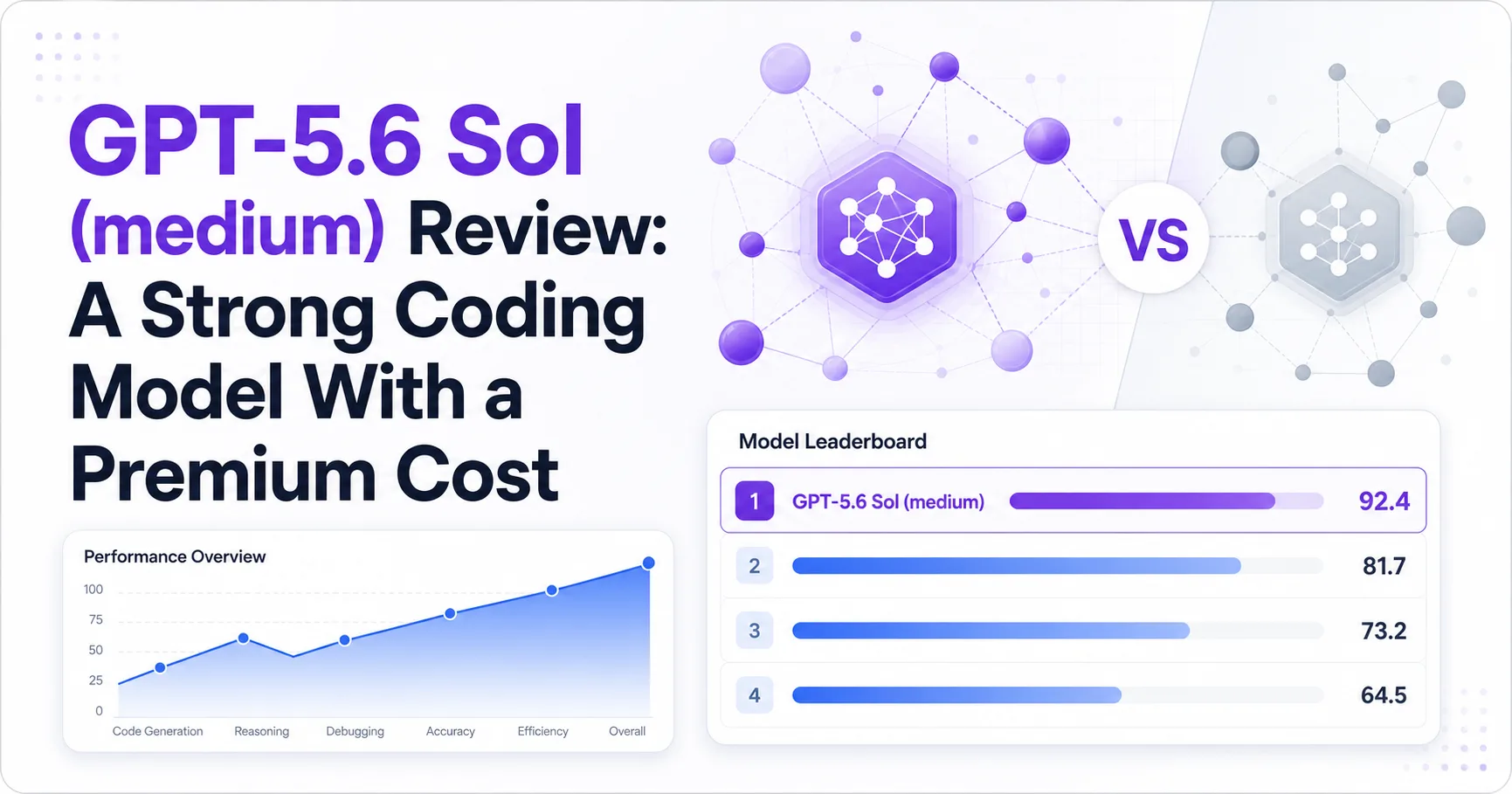
- **Where it stands:** GPT-5.6 Sol (medium) ranks 9 of 202 on the Artificial Analysis Coding Index at 76.3 - **Price:** $11.25 per 1M blended tokens - **Speed:** 69.865 output tokens per second, 0.3s to first token - **Pick it when:** You need complex coding and tool-using agent work with a top-9-of-202 coding signal - **Watch out:** The 14 of 578 intelligence rank does not prove performance on your codebase, and community evidence remains mixed
GPT-5.6 Sol (medium) at a glance
GPT-5.6 Sol (medium) is a strong choice for demanding coding and reasoning workloads, especially when output quality matters more than token cost.
OpenAI positions GPT-5.6 Sol as the flagship reasoning model in the GPT-5.6 family for complex professional work, complex reasoning, and coding (model page; model directory). The medium label describes the reasoning.effort setting, not a separate model slug, and OpenAI describes that setting as a balanced starting point (latest-model guide).
The API surface is broad. GPT-5.6 Sol accepts text and image inputs, returns text, and supports the Responses, Chat Completions, and Batch APIs. Official documentation also lists structured outputs, function calling, file search, web search, prompt caching, code interpreter, hosted shell, computer use, MCP, and other tools (model page). That makes the model relevant to agentic development, not only ordinary chat completions.
The current official catalog still presents GPT-5.6 Sol as an active flagship, while the deprecation catalog does not establish a replacement or retirement path in the supplied evidence. The practical question is therefore fit and economics, not basic availability.
Data provided by https://artificialanalysis.ai/ and cited as Artificial Analysis.
The short version for developers
GPT-5.6 Sol (medium) is the strongest coding-oriented option among the listed nearby models, but its price is difficult to justify for routine workloads.
The supplied Artificial Analysis snapshot places the model 9 of 202 on coding and 14 of 578 on intelligence. Those positions make it a serious candidate for high-value engineering work, while the nearby-model data shows that cheaper alternatives remain credible for less demanding tasks.
| Model | What the snapshot suggests | Selection implication |
|---|---|---|
| GPT-5.6 Sol (medium) | Strongest coding position in the listed reference set | Favor for difficult software work and agent workflows |
| Claude Opus 4.7 (Adaptive Reasoning, Max Effort) | Blended price of $10 and coding index of 73.6 | A close quality alternative with lower listed cost |
| Grok 4.5 (high) | Intelligence index of 53.8, coding index of 72.4, and blended price of $3 | Attractive for cost-sensitive workloads |
| Claude Sonnet 5 (Adaptive Reasoning, Max Effort) | Output speed of 89.078 tokens per second and blended price of $4 | Stronger value when speed and volume matter |
| GPT-5.5 (xhigh) | Intelligence index of 54.8 and coding index of 74.9 at the same blended price | Relevant if general reasoning matters more than coding rank |
GPT-5.6 Sol therefore fits a selective routing strategy. It can serve as the high-confidence path for difficult code changes, while a cheaper model handles routine extraction, summarization, or low-risk transformations. The data supports that division, but it does not prove that GPT-5.6 Sol will produce fewer review cycles in a specific repository. Data provided by https://artificialanalysis.ai/.
What the performance ranking means in practice
GPT-5.6 Sol (medium) earns its clearest recommendation for software work, where its ninth-place coding rank signals high practical potential.
A position of 9 of 202 on the Artificial Analysis Coding Index places GPT-5.6 Sol near the front of a large coding-model field. The practical reading is not that every patch will be correct. The stronger conclusion is that this configuration deserves early testing for tasks involving code navigation, multi-step reasoning, implementation, and verification.
The speed profile also supports interactive use. The snapshot reports 69.865 median output tokens per second and 0.3s to first token. Median throughput describes observed typical behavior, not a guarantee for every region, provider route, prompt size, or tool call. Still, the combination should feel responsive during iterative development if the surrounding system does not add substantial delay.
Official documentation lists function calling, structured outputs, file search, code interpreter, hosted shell, computer use, MCP, and tool search among the supported capabilities (model page). Those tools expand the model’s usefulness from code generation to repository investigation and controlled execution. OpenAI also recommends the model family for complex reasoning and coding, while the medium reasoning setting is described as a balanced starting point (latest-model guide).
The evidence has a clear boundary. The official pages do not provide a detailed benchmark scorecard for individual tasks, so the ranking cannot answer whether the model is best for your language mix, test framework, or repository architecture. A Reddit report describes excessive output, slow progress, and faulty coding results after personal testing, but gives no reproducible task set or measurement method (Reddit report). The comments challenge that conclusion (Reddit discussion). Hacker News discussion focuses on possible deployment speed and agent usefulness, not independent GPT-5.6 Sol measurements (thread; comment).
When the price is justified
GPT-5.6 Sol (medium) is expensive enough that its coding advantage must pay for itself in avoided rework.
The data snapshot lists an $11.25 blended price per 1M tokens, with $5 input tokens and $30 output tokens. That spread matters because difficult coding agents often produce substantial reasoning, plans, patches, test output, and explanations. A model that is excellent at solving a task can still be the wrong economic choice if it generates more text than the workflow needs.
The blended figure is useful for comparison, but it is not a universal production bill. Real usage depends on the input and output mix, caching, service tier, retries, tool results, and how much context is sent with each request. OpenAI’s API pricing page documents different service modes, while the GPT-5.6 Sol model page warns that very large inputs can trigger higher request pricing.
That makes GPT-5.6 Sol easier to justify for high-value changes than for routine volume. A difficult migration, production incident, or architecture investigation may benefit from stronger reasoning and tool use. Bulk classification, ordinary summarization, and predictable transformations are more likely to favor nearby models with blended prices of $3 or $4. Claude Opus 4.7 is also listed at $10, which narrows the cost gap without removing the need for task-specific testing.
The supplied evidence does not show cost per completed repository task, retry frequency, review time, or failure recovery. Those missing measures prevent a firm return-on-investment claim. Teams should therefore judge the model by completed engineering outcomes, not by token price or leaderboard position alone.
Who should use GPT-5.6 Sol (medium)
GPT-5.6 Sol (medium) belongs on a shortlist for complex coding agents, but it should not be the default model for every request.
| Workload | Recommendation | Reason |
|---|---|---|
| Complex refactors, migrations, and debugging | Use GPT-5.6 Sol first | Its coding position and official tool support make it a strong candidate for multi-step engineering work |
| Architecture analysis and difficult reasoning | Test GPT-5.6 Sol against your own cases | Its intelligence ranking is strong, but the supplied evidence does not show how it handles your domain |
| Interactive editor or agent sessions | Consider GPT-5.6 Sol | The reported first-token latency and median output speed support responsive interaction |
| High-volume routine generation | Route to a cheaper nearby model | The premium output price can outweigh quality gains when tasks are predictable |
| Security or biology-related dual-use work | Add safety and rejection tests | OpenAI warns that safety classification can pause output or reject legitimate requests (latest-model guide) |
The best starting configuration is the documented gpt-5.6-sol model ID with reasoning.effort set to medium. OpenAI describes that setting as balanced, and the supplied benchmark entry specifically represents GPT-5.6 Sol (medium) (latest-model guide). The stable gpt-5.6 alias routes to the same model according to the guide.
Use GPT-5.6 Sol when a strong answer can prevent expensive human investigation or repeated repair. Use a lower-cost model when the task has narrow scope, clear validation, and limited downside. Keep the decision reversible through routing rules and a repository-specific evaluation set.
The strongest caution is evidence quality. The supplied sources establish a favorable benchmark position and official capability claims, but they do not establish universal coding superiority. The Reddit failure report remains a personal, contested account rather than a verified failure pattern. A production decision should therefore measure correctness, review effort, output volume, and recovery behavior in the target workflow.
Questions to answer before adoption
GPT-5.6 Sol (medium) is easiest to evaluate through focused trials that separate coding quality, output volume, and safety friction.
The available evidence answers the model’s intended role, supported interfaces, ranking position, and listed economics. It does not answer whether the model is consistently better for a particular codebase, whether its tool use reduces engineering time, or whether its output style matches a team’s review process.
OpenAI’s model page and latest-model guide support the case for complex coding and reasoning. The pricing documentation explains why output-heavy workloads deserve special scrutiny. Community discussions provide useful failure hypotheses, but the Reddit report and Hacker News discussion do not provide reproducible independent evaluations.
The FAQ below turns those boundaries into practical selection questions. The answers distinguish documented facts from conclusions that still require local testing.
Frequently asked questions
Is GPT-5.6 Sol (medium) good for coding?
GPT-5.6 Sol (medium) is a strong coding candidate because it ranks 9 of 202 on the Artificial Analysis Coding Index, while OpenAI specifically recommends the family for complex coding work (model page).
Is GPT-5.6 Sol (medium) worth its price?
GPT-5.6 Sol (medium) is worth its price when stronger coding, tool use, or reduced rework offsets the premium output rate of $30 per 1M tokens; routine workloads may favor cheaper nearby models.
How fast is GPT-5.6 Sol (medium) for interactive development?
GPT-5.6 Sol (medium) is suitable for interactive development, with 69.865 median output tokens per second and 0.3s to first token, although provider conditions and tool calls can change observed responsiveness.
What are the main risks of using GPT-5.6 Sol (medium)?
GPT-5.6 Sol (medium) carries cost, output-volume, and safety-friction risks; OpenAI warns about pauses or refusals in dual-use areas, while a contested Reddit report describes inefficient coding behavior (latest-model guide; Reddit report).
Is GPT-5.6 Sol (medium) a separate model from gpt-5.6?
GPT-5.6 Sol (medium) is a reasoning configuration for gpt-5.6-sol, while gpt-5.6 is the stable alias that routes to that model; medium describes reasoning effort, not a separate slug (latest-model guide).
Sources
- Artificial AnalysisData attribution and benchmark, ranking, speed, latency, and pricing snapshot.
- GPT-5.6 Sol model pageModel positioning, supported modalities, APIs, tools, model limits, and large-input pricing warning.
- GPT-5.6 usage guideReasoning effort settings, stable alias behavior, balanced medium setting, and safety limitations.
- OpenAI model directoryCurrent flagship positioning and model catalog status.
- OpenAI API pricingService tiers and pricing context.
- OpenAI deprecation catalogEvidence about current replacement or retirement status.
- I spent two weeks testing GPT-5.6. Here's what I found.Personal coding experience, reported output volume, task progress, and contested failure claims.
- Previewing GPT-5.6 Sol: a next-generation modelCommunity discussion about deployment speed and agent workflows.
- Hacker News corresponding commentCommunity discussion about generation speed and code-agent usefulness.
Published: