
GPT-5.6 Sol (Non-reasoning)
AvailableOpenAI · 2026-07-09 · 400,000 tokens
An AI model from OpenAI, suited to a broad range of AI workloads.
Supported modalities:textvideocode
Quick Overview
Text Generation4/10
Code Generation7/10
Reasoning6/10
Multimodal3/10
Benchmark Results
Scores from leading benchmark suites.
artificial analysis intelligence41.9
artificial analysis coding65.1
Performance Metrics
Latency and throughput performance.
Dive Deeper
AI model analysis
GPT-5.6 Sol (Non-reasoning) Review: Fast Coding Strength at a Premium Price
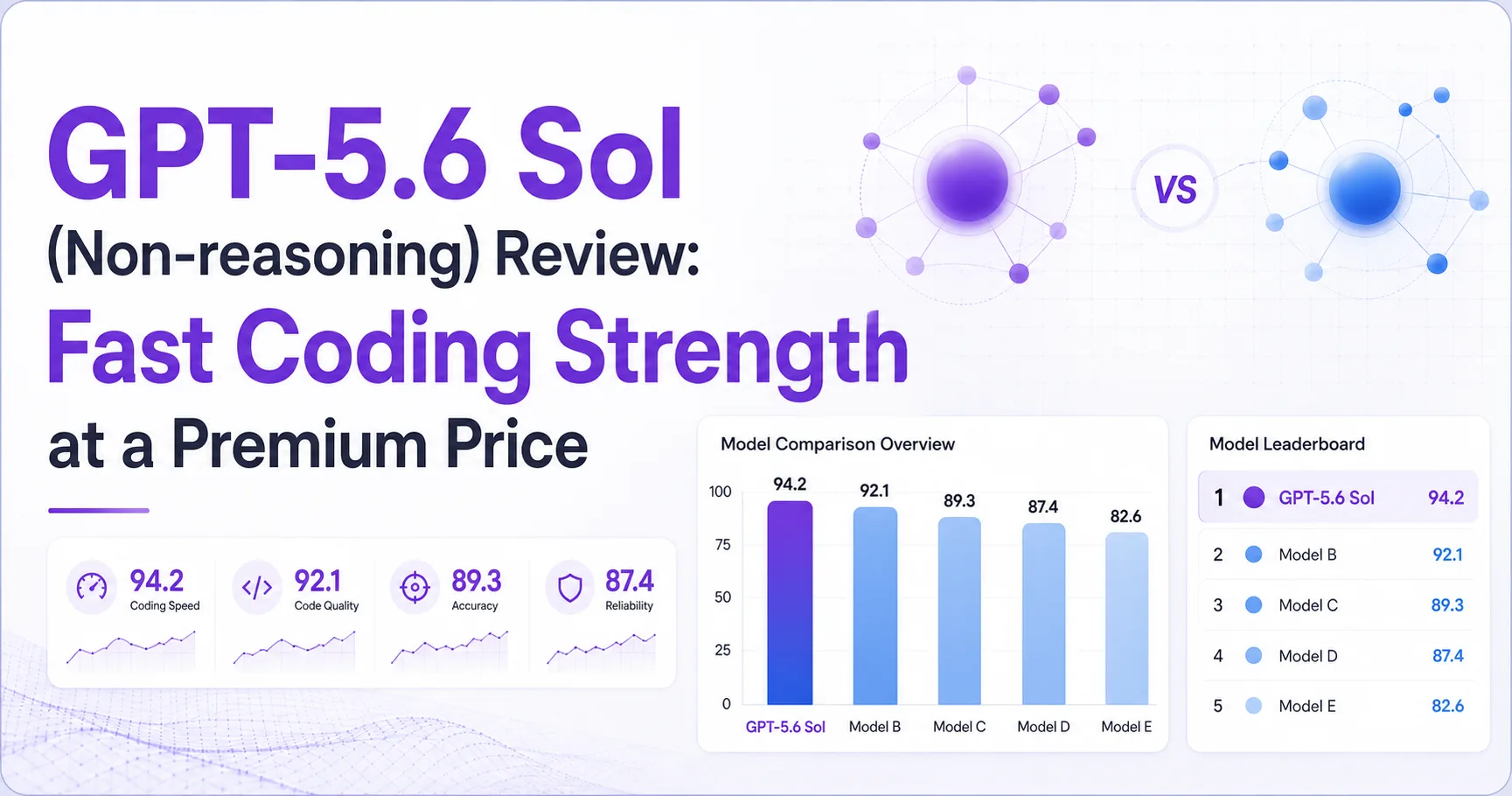
- **Where it stands:** GPT-5.6 Sol (Non-reasoning) ranks 52 of 578 on the Artificial Analysis Intelligence Index at 41.2, and 35 of 202 on the Artificial Analysis Coding Index at 65.1 - **Price:** $11.25 per 1M blended tokens - **Speed:** 69.306 output tokens per second, 0.3s to first token - **Pick it when:** You need fast, high-quality coding assistance and can justify OpenAI’s premium output pricing - **Watch out:** The public evidence does not confirm whether this non-reasoning slug is a directly callable, separately documented API model
GPT-5.6 Sol is a fast coding-oriented model with unresolved API identity
GPT-5.6 Sol (Non-reasoning) looks most attractive to developers who value coding quality, fast responses, and OpenAI’s production ecosystem, but its public API status remains uncertain.
OpenAI positions the GPT-5.6 Sol family as a flagship option for complex reasoning and coding. The official Models page describes the broader model family, rather than clearly documenting gpt-5.6-sol-non-reasoning as a distinct public model. The same page describes current models as supporting text and image input, text output, multilingual use, the Responses API, and official Client SDKs, but it does not assign those capabilities specifically to this non-reasoning slug.
That distinction matters for implementation. A developer can treat the benchmark record as evidence of observed model performance, but should not assume that the exact slug has the same lifecycle, context limits, parameters, or availability as the documented family name. The research brief found no dedicated official page for the non-reasoning variant, no published model-specific context window, and no confirmed maximum output limit.
The practical verdict is therefore conditional: GPT-5.6 Sol (Non-reasoning) is a promising candidate for coding workflows, yet it needs an API availability check before it becomes a safe production dependency.
The model’s main trade-off is coding rank versus operating cost
GPT-5.6 Sol (Non-reasoning) earns a stronger relative position in coding than in the broader intelligence ranking, while nearby alternatives offer similar general scores at much lower prices.
The ranking context supports a specific interpretation. A position of 35 out of 202 on the Artificial Analysis Coding Index places the model near the stronger end of that measured coding set. Its position of 52 out of 578 on the Artificial Analysis Intelligence Index is also competitive, but the gap between the two rankings suggests that coding is the clearer reason to select it.
| Decision factor | GPT-5.6 Sol (Non-reasoning) | Nearby alternative signal |
|---|---|---|
| Coding priority | Strongest documented reason to consider it | Claude Sonnet 5 scores higher on the coding index in the supplied comparison set |
| General intelligence | Competitive, but not dominant | Hy3 has the same intelligence score, while Claude Sonnet 5 is slightly higher |
| Speed | Fast enough for interactive developer tools | Nex-N2-Pro is materially faster in the supplied measurements |
| Spend discipline | Difficult to justify for cost-sensitive volume | Hy3, Nex-N2-Pro, and Claude Sonnet 5 all have lower blended prices |
| API confidence | Requires verification for the exact non-reasoning slug | The research brief does not establish equivalent uncertainty for the alternatives |
This is not a universal quality verdict. The supplied evidence does not include user studies, repository-level coding trials, tool-call success rates, or reliable community reports. It shows where the model stands in one intelligence index and one coding index, then leaves the workflow-level explanation open.
GPT-5.6 Sol should suit interactive coding, but the ranking does not prove end-to-end reliability
GPT-5.6 Sol (Non-reasoning) is best treated as a strong interactive coding candidate whose speed can support tight developer feedback loops.
The model produces a median 69.306 output tokens per second and reaches the first token in 0.3 seconds. Those measurements make it plausible for code explanation, inline generation, test drafting, and iterative debugging where users repeatedly inspect and refine responses. The speed is also close to Hy3 in the supplied comparison set, while Nex-N2-Pro is faster. Speed therefore supports the model’s usability, but it is not a unique advantage.
The coding ranking is more informative than raw throughput. GPT-5.6 Sol (Non-reasoning) ranks 35 of 202 on the Artificial Analysis Coding Index with a score of 65.1. That result supports choosing it for coding-heavy work over use cases where the model’s only selling point would be latency. It does not prove that the model will edit a repository safely, preserve project conventions, or complete multi-step implementation tasks without supervision.
OpenAI’s Models page gives the family a broad flagship positioning for reasoning and coding, but the research brief found no model-specific official benchmark results, failure-mode documentation, parameter guide, or context-window confirmation. No reliable community posts were found for this exact model variant either.
Developers should validate repository edits, structured output, tool use, long prompts, and refusal behavior in their own workload. Evidence is insufficient to claim that the coding-index position predicts production pass rates, autonomous task completion, or performance on unfamiliar codebases.
GPT-5.6 Sol is expensive unless its coding advantage reduces review work
GPT-5.6 Sol (Non-reasoning) is poor value for undifferentiated high-volume generation because its blended price is far above every nearby model in the supplied comparison set.
The data brief lists a blended price of $11.25 per 1M tokens, with input priced at $5 and output priced at $30 per 1M tokens. The output side is the important constraint for developer products that generate long explanations, patches, tests, or documentation. A workflow that produces verbose responses can therefore spend more than expected even when input prompts are modest.
The price may still be rational when response quality reduces human review. For example, a team could use the model for difficult bug diagnosis, sensitive refactoring, or code changes where a stronger first draft saves engineer time. That business case depends on measured review effort, not on the model’s name or flagship positioning.
The supplied nearby models make the opportunity cost clear. Claude Sonnet 5 has a lower blended price and a slightly higher coding score in the comparison data. Nex-N2-Pro and Hy3 are much cheaper and provide similar broad intelligence scores, although their coding scores differ. This makes GPT-5.6 Sol hard to defend as a default model for autocomplete, routine classification, bulk test generation, or inexpensive documentation pipelines.
OpenAI’s Pricing page lists pricing for gpt-5.6-sol, not separately for gpt-5.6-sol-non-reasoning. The page gives Standard short-context input and output prices of $5.00 and $30.00 per 1M tokens, plus lower Batch and Flex prices, but the research brief does not confirm that the exact non-reasoning slug inherits those terms. Verify both model availability and billing behavior before committing to an architecture.
Data provided by https://artificialanalysis.ai/
Choose GPT-5.6 Sol for high-value coding tasks, not as an untested default
GPT-5.6 Sol (Non-reasoning) is worth piloting for high-value coding assistance when response quality matters more than token cost and the exact API identifier is confirmed.
The strongest selection case combines three facts from the supplied data: a 35 of 202 coding rank, 69.306 median output tokens per second, and 0.3 seconds to first token. Together, they describe a model that could fit interactive engineering tools where users need capable answers without a visibly slow first response.
The case weakens for broad model substitution. Claude Sonnet 5 has a higher supplied coding score and a lower blended price. Hy3 matches the supplied intelligence score at a fraction of the cost. Nex-N2-Pro is faster and cheaper, though its coding score is lower. These alternatives show that GPT-5.6 Sol needs to win on actual task outcomes, not merely on brand or family positioning.
| Use case | Recommendation | Reason |
|---|---|---|
| Complex debugging and code review | Pilot GPT-5.6 Sol | Coding rank and response speed support a quality-first trial |
| Interactive developer assistant | Pilot with strict measurement | Latency is suitable, but repository behavior is unverified |
| Autocomplete at large volume | Prefer a cheaper candidate first | The output price creates immediate cost pressure |
| Batch documentation or test drafting | Compare Batch pricing and quality | The supplied evidence does not show whether quality offsets spend |
| Production API dependency | Block until slug availability is confirmed | Official pages document the family name, not this exact variant |
The evaluation should track accepted patch rate, reviewer edits, test pass rate, tool-call completion, latency under real prompts, and cost per accepted change. The research brief does not provide those measurements, so any stronger recommendation would exceed the evidence.
Questions developers should answer before adopting GPT-5.6 Sol
GPT-5.6 Sol (Non-reasoning) requires a verification step before developers treat the benchmark entry as a stable production integration.
The public material supports a cautious pilot, not a fully specified deployment decision. The following questions address the gaps most likely to affect implementation.
Frequently asked questions
Is GPT-5.6 Sol (Non-reasoning) a clearly documented public API model?
No, the research brief does not establish that gpt-5.6-sol-non-reasoning is a separately documented public API model. OpenAI’s Models page lists the family name gpt-5.6-sol, while the exact non-reasoning slug is not independently explained. Developers should verify model listing, access permissions, request behavior, and retirement policy before production use.
Is GPT-5.6 Sol (Non-reasoning) good for coding?
GPT-5.6 Sol (Non-reasoning) is a strong coding candidate based on its supplied position of 35 out of 202 on the Artificial Analysis Coding Index. That ranking supports a quality-focused pilot for debugging, code review, and implementation assistance. It does not prove repository-level reliability, tool-use success, or autonomous completion because the brief contains no direct workflow tests.
Is GPT-5.6 Sol (Non-reasoning) worth its price?
GPT-5.6 Sol (Non-reasoning) is worth its price only when better coding output reduces review time enough to offset its $11.25 per 1M blended-token cost. The supplied alternatives are cheaper, and Claude Sonnet 5 has a higher coding score in the comparison set. Cost-sensitive teams should measure accepted changes and reviewer effort before standardizing on it.
How fast is GPT-5.6 Sol (Non-reasoning) for developer tools?
GPT-5.6 Sol (Non-reasoning) is fast enough for interactive use, with 0.3 seconds to first token and 69.306 median output tokens per second in the supplied data. That profile can support iterative explanations and code generation. Nex-N2-Pro is faster in the comparison set, so latency alone is not a sufficient reason to choose GPT-5.6 Sol.
What are the known limitations of GPT-5.6 Sol (Non-reasoning)?
The best-supported limitation is incomplete public documentation for the exact variant, rather than a confirmed behavioral failure. The research brief found no dedicated context-window value, maximum output limit, parameter guide, official benchmark page, or reliable community testing for this slug. Developers should validate long prompts, tool calls, structured responses, and failure handling in a controlled pilot.
Sources
- ModelsOpenAI’s family-level positioning, general capabilities, API interfaces, and the absence of separate public documentation for the exact non-reasoning slug.
- PricingPricing for gpt-5.6-sol, including Standard, Batch, and Flex prices, and the absence of separate pricing for the exact non-reasoning slug.
- Artificial AnalysisAttribution for the supplied benchmark rankings, speed measurements, latency, and pricing snapshot.
Published: