
GPT-5.6 Terra (low)
AvailableOpenAI · 2026-07-09 · 400,000 tokens
An AI model from OpenAI, suited to a broad range of AI workloads.
Supported modalities:textvideocode
Quick Overview
Text Generation4/10
Code Generation6/10
Reasoning6/10
Multimodal3/10
Benchmark Results
Scores from leading benchmark suites.
artificial analysis intelligence41.3
artificial analysis coding58.1
Performance Metrics
Latency and throughput performance.
Dive Deeper
AI model analysis
GPT-5.6 Terra (low) Review: Strong Coding Rank, Unclear Product Identity
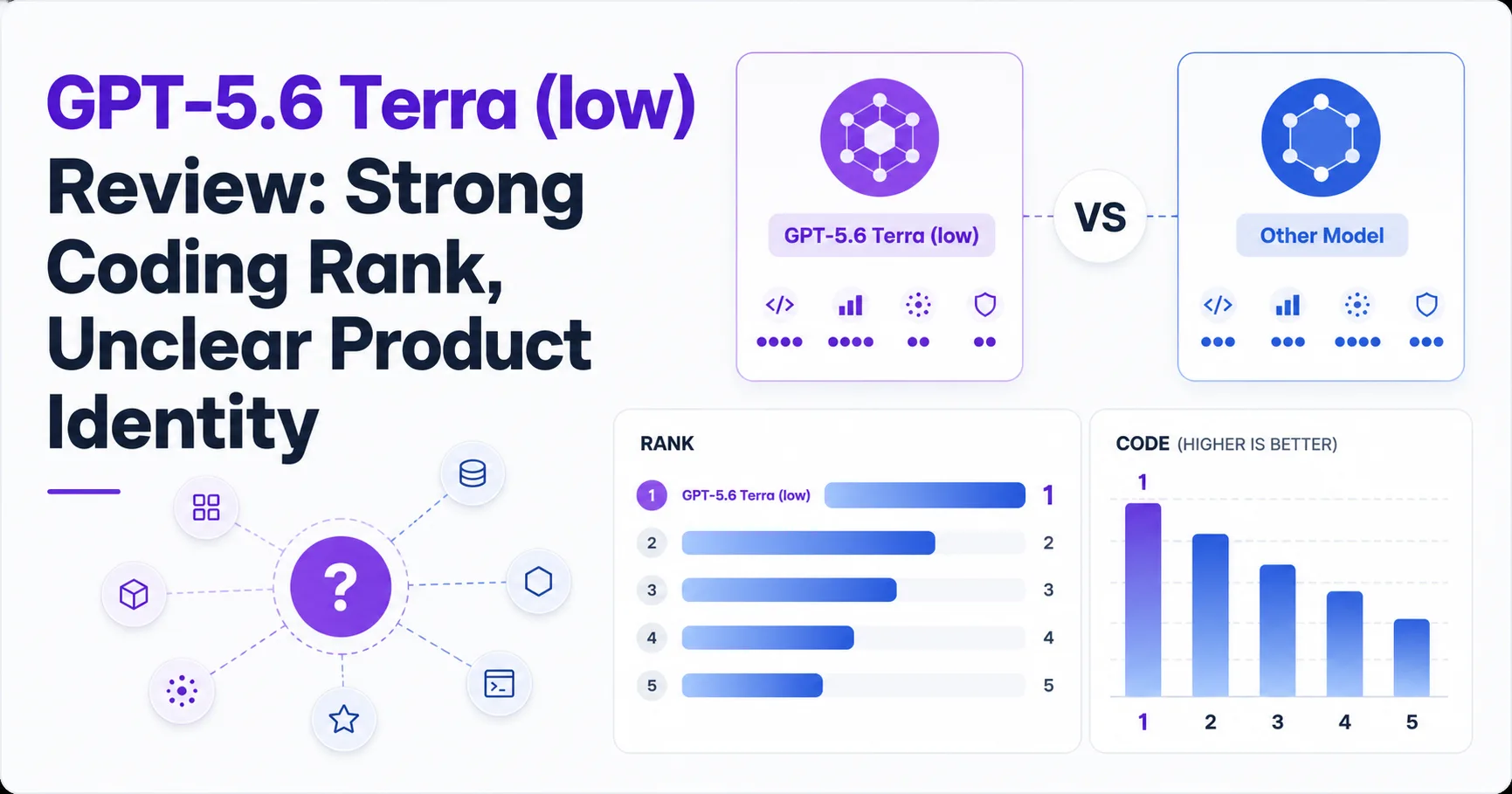
- **Where it stands:** GPT-5.6 Terra (low) ranks 57 of 578 on the Artificial Analysis Intelligence Index at 40.5 - **Price:** $4.500000000000001 per 1M blended tokens - **Speed:** 123.223 output tokens per second, 0.3s to first token - **Pick it when:** You need a fast OpenAI model for coding-heavy applications and can validate the exact API identity before shipping - **Watch out:** Official OpenAI materials do not document this low variant as a distinct public model
GPT-5.6 Terra (low) is a fast, capable coding candidate with an unresolved identity problem
GPT-5.6 Terra (low) looks attractive for developer workloads, but its undocumented variant status makes production adoption conditional.
The available evaluation data places GPT-5.6 Terra (low) at position 52 of 202 on the Artificial Analysis Coding Index, with a score of 58.1. That is the clearest positive signal in the brief. The model also reports 123.223 median output tokens per second and 0.3 seconds to first token. Together, those results suggest a model suited to interactive coding assistance, code transformation, and agent steps where responsiveness matters.
The evidence has an important qualification. OpenAI’s model documentation lists GPT-5.6 Terra as a model positioned around balancing intelligence and cost, but it does not list GPT-5.6 Terra (low) or the stable alias gpt-5-6-terra-low. The same page does not provide a dedicated context window, output limit, API parameter set, or benchmark profile for this variant.
This review therefore evaluates the measured entry as a real data point while treating its public API status as unconfirmed. Data provided by https://artificialanalysis.ai/ supplies the benchmark, speed, latency, and pricing snapshot. The practical recommendation is straightforward: test the exact identifier in the target account, pin the behavior with regression prompts, and avoid assuming that documentation for the base Terra model automatically applies to the low variant.
The main trade-off is reliable speed and coding rank versus incomplete documentation
GPT-5.6 Terra (low) offers a credible middle position for coding, but the surrounding models make its value depend heavily on provider and workload priorities.
GPT-5.6 Terra (low) ranks 52 of 202 for coding and 57 of 578 for general intelligence. Those positions do not make it the universal leader, yet they place it among serious options rather than niche experiments. Its coding position is stronger than its broader intelligence position, which supports choosing it for software tasks before choosing it for open-ended reasoning.
The closest-model data reinforces that interpretation. DeepSeek V4 Flash (Reasoning, Max Effort) has an intelligence score of 40.3 and a coding score of 56.2, while GLM-5.1 (Reasoning) has an intelligence score of 40.2 and a coding score of 55.8. GPT-5.6 Terra (low) therefore has a modest benchmark edge over those nearby references in the available coding data. Inkling (xhigh) scores 52.1 for coding and 40.7 for intelligence, another nearby comparison with a different balance.
Cost changes the decision. DeepSeek V4 Flash (Reasoning, Max Effort), Inkling (xhigh), and GLM-5.1 (Reasoning) all have lower blended prices in the supplied data. Claude Opus 4.5 (Reasoning) has a higher blended price, while its intelligence score is 40.8 and its available math score is 91.3. MiMo-V2-Pro is also more expensive and has an intelligence score of 40.3.
| Choice | What GPT-5.6 Terra (low) appears to offer | What remains uncertain |
|---|---|---|
| GPT-5.6 Terra (low) | Stronger nearby coding position and high measured output speed | Whether the low variant is an officially supported public identifier |
| Lower-cost references | Lower spend for many high-volume workloads | Whether their latency, output quality, and coding behavior fit the application |
| Higher-cost reasoning reference | A different quality profile for demanding reasoning tasks | Whether the extra spend improves the target developer workflow |
The comparison supports a workload-specific decision, not a blanket ranking claim.
Performance should feel responsive in coding loops, but benchmark rank does not prove agent reliability
GPT-5.6 Terra (low) is best interpreted as a responsive coding model whose measured rank supports interactive use, not as proof of dependable autonomous engineering.
The strongest practical signal is the combination of a coding rank at position 52 of 202, 123.223 median output tokens per second, and 0.3 seconds to first token. For an IDE assistant, these characteristics can reduce the waiting cost of repeated edits, explanations, and test-driven iterations. They are also relevant to tool-using agents, where the model may need to produce a short decision before another tool call begins.
The ranking still leaves several questions unanswered. The brief does not say how the coding index weights repository navigation, patch correctness, test behavior, instruction following, or long-horizon planning. It also does not provide a failure taxonomy for GPT-5.6 Terra (low). A position near the front of a broad leaderboard can justify testing, but it cannot establish that the model will preserve architectural constraints or recover well after a failed tool call.
The official documentation gap matters here. OpenAI’s model page describes the documented Terra model as supporting text and image input, text output, multilingual capability, and vision through the Responses API and official SDKs. Those capabilities are described for the official model entry, not specifically for the low variant. Applying them to gpt-5-6-terra-low would exceed the evidence.
Developers should test four behaviors before adoption: patch accuracy, respect for repository instructions, recovery after failed commands, and consistency across repeated prompts. The supplied materials do not provide those results. They also do not establish the context window or maximum output length for this variant. Large-repository agents, long documents, and tasks requiring durable multi-step plans therefore remain evidence gaps.
A useful interpretation is that speed makes GPT-5.6 Terra (low) easy to place inside a tight feedback loop. The coding rank makes it worth serious evaluation. Neither signal removes the need for repository-level acceptance tests.
GPT-5.6 Terra (low) is not the obvious value choice when cheaper models are close in the supplied rankings
GPT-5.6 Terra (low) becomes expensive for routine volume if a cheaper nearby model delivers acceptable coding quality.
The data brief lists a blended price of $4.500000000000001 per 1M tokens, with input priced at $2 and output priced at $12 per 1M tokens. The output rate is especially important for developer products that generate full patches, explanations, test plans, or long agent traces. A fast response can improve user experience, but speed does not by itself offset a higher bill.
The closest-model set includes substantially cheaper alternatives. DeepSeek V4 Flash (Reasoning, Max Effort) is listed at $0.17125 blended, with an intelligence score of 40.3 and a coding score of 56.2. GLM-5.1 (Reasoning) is listed at $2.135 blended, with an intelligence score of 40.2 and a coding score of 55.8. Inkling (xhigh) is listed at $2.5725000000000002 blended, with an intelligence score of 40.7 and a coding score of 52.1.
These comparisons do not prove that the cheaper models are better purchases. The brief does not provide their output speed in every case, their tool-use reliability, their ecosystem fit, or their production availability. It does show that GPT-5.6 Terra (low) needs to earn its premium through higher task success, lower supervision, better integration, or materially better user experience.
The official pricing evidence adds another complication. OpenAI’s pricing page lists prices for gpt-5.6-terra, including Standard, Batch, Flex, and Fast mode schedules. It does not list GPT-5.6 Terra (low) as a separate priced model. The supplied data can describe the measured price snapshot, but it cannot confirm how that price maps to an official billing SKU.
Use GPT-5.6 Terra (low) for tasks where fast, high-quality coding output has clear product value. Use a cheaper reference first for predictable transformations, bulk classification, routine documentation, or other workloads where small quality differences are easy to catch. The cost conclusion reverses if evaluation shows that GPT-5.6 Terra (low) substantially reduces retries or human review.
Choose GPT-5.6 Terra (low) after an API identity check and a task-level quality trial
GPT-5.6 Terra (low) is a reasonable shortlist choice for interactive coding products, but it is not ready for blind production selection.
Choose it when the application values quick responses, OpenAI-compatible tooling, and coding performance more than the lowest token cost. The available data supports that use case through the coding position at 52 of 202, the measured output speed of 123.223 tokens per second, and the 0.3-second first-token latency. These signals fit code review assistants, IDE copilots, migration helpers, and supervised engineering agents.
Do not choose it solely because the name suggests a lower reasoning setting. The research brief cannot confirm whether (low) identifies a distinct model, an inference-strength configuration, or another provider-side alias. OpenAI’s model documentation does not list the low variant, and OpenAI’s pricing documentation does not give it a separate official price. This is a product and operations risk, not merely a documentation detail.
A sensible evaluation gate has three parts:
- Confirm that the exact model identifier is callable in the target API account.
- Run repository tasks covering edits, tests, refactors, and instruction compliance.
- Compare successful task completion and review effort against one cheaper nearby model.
The brief does not provide direct evidence for failure modes, community experience, context limits, or maximum output length. Those unknowns should be treated as acceptance-test items. They are especially important for long-running agents and workflows that depend on stable API contracts.
The final verdict is favorable but qualified. GPT-5.6 Terra (low) appears fast and competitive for coding. Its price is defensible only if the quality or workflow gains are visible in the developer’s own tasks. Its undocumented identity means procurement, fallback routing, and version pinning deserve attention before launch.
Questions developers should answer before adopting GPT-5.6 Terra (low)
GPT-5.6 Terra (low) requires verification of availability, behavior, and billing before a production commitment.
The supplied research does not include reliable Reddit, Hacker News, or X discussions tied specifically to this variant. It also does not include official failure examples or independent workflow studies. The FAQ below separates what the data supports from what remains unverified.
Frequently asked questions
Is GPT-5.6 Terra (low) an officially documented OpenAI model?
GPT-5.6 Terra (low) is not confirmed as a distinct officially documented model because OpenAI’s available model catalog lists GPT-5.6 Terra but not this low variant or its reported stable alias.
Is GPT-5.6 Terra (low) good for coding?
GPT-5.6 Terra (low) is a credible coding candidate because it ranks 52 of 202 on the supplied coding index, although that benchmark does not prove repository-level reliability.
Is GPT-5.6 Terra (low) good value for money?
GPT-5.6 Terra (low) can be good value for interactive coding if its speed and task success reduce supervision, but cheaper nearby models make routine high-volume use difficult to justify without testing.
What should developers verify before using this model in production?
Developers should verify that the exact identifier is callable, confirm the billing behavior, measure patch correctness, test tool recovery, and establish context and output limits because the brief leaves those points unresolved.
Does GPT-5.6 Terra (low) support vision and image input?
The official Terra model page describes text and image input plus vision capabilities, but the supplied evidence does not establish that those capabilities apply specifically to GPT-5.6 Terra (low).
Sources
- OpenAI ModelsOfficial model positioning, documented Terra alias, supported modalities, API availability, and the absence of a dedicated low-variant entry.
- OpenAI API PricingOfficial Terra pricing schedules and the absence of a separately documented GPT-5.6 Terra (low) price.
- Artificial AnalysisData attribution for benchmark scores, rankings, latency, output speed, pricing snapshot, and nearby-model references.
Published: