
Grok 4.3 (high)
AvailableOther · 2026-04-30 · 32,000 tokens
An AI model from Other, suited to a broad range of AI workloads.
Supported modalities:textcode
Quick Overview
Text Generation4/10
Code Generation4/10
Reasoning6/10
Multimodal3/10
Benchmark Results
Scores from leading benchmark suites.
artificial analysis intelligence37.9
artificial analysis coding42.2
Performance Metrics
Latency and throughput performance.
Dive Deeper
AI model analysis
Grok 4.3 (high) Review: A Mid-Ranking Model With an Unclear Developer Case
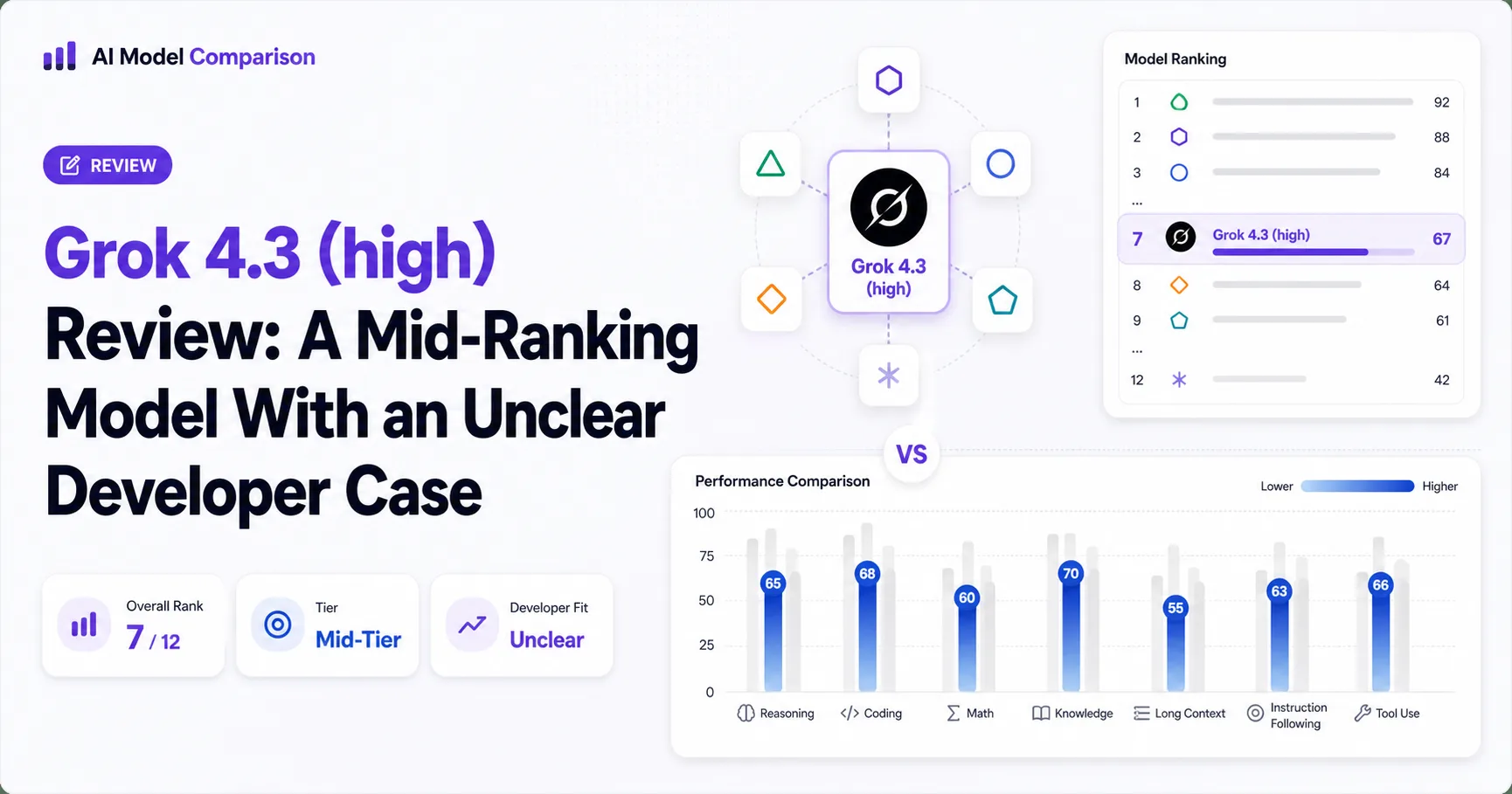
- **Where it stands:** Grok 4.3 (high) ranks 81 of 578 on the Artificial Analysis Intelligence Index at 37.6 - **Price:** $1.5625 per 1M blended tokens - **Speed:** unreported output tokens per second, 0.3s to first token - **Pick it when:** you need a moderately priced model for general experimentation and can validate behavior yourself - **Watch out:** public evidence does not confirm availability, API limits, context size, multimodal support, or failure patterns
Grok 4.3 (high) is a benchmarked option, not yet a well-documented platform
Grok 4.3 (high) is difficult to recommend as a production dependency because its public documentation and availability remain unverified. The available research found no verifiable vendor announcement, developer documentation, pricing page, or reliable community discussion for this model. The benchmark record therefore provides the clearest evidence, while important operational questions remain unanswered. Artificial Analysis reports the model’s evaluation data and pricing snapshot, but that dataset does not establish whether Grok 4.3 (high) still has a stable API name, a supported endpoint, or a maintained release path.
For developers, this distinction matters. A model can occupy a respectable position in an evaluation dataset and still be a poor engineering choice if access is unstable or the interface is undocumented. The research brief cannot confirm the context window, output limit, API parameters, multimodal capabilities, or official benchmark methodology for this specific model. It also cannot confirm whether the listed price is current outside the captured data snapshot.
Grok 4.3 (high) is therefore best treated as a candidate for controlled testing. It is not yet supported by enough first-party or community evidence to justify assuming predictable behavior in a customer-facing workflow. The strongest defensible conclusion is narrow: the model has measurable benchmark results and a recorded price, but its developer experience is materially underdocumented.
The benchmark position makes Grok 4.3 (high) credible, but not distinctive
Grok 4.3 (high) sits in the upper part of the general intelligence ranking, yet its nearby alternatives make the choice harder to justify on benchmark position alone. Grok 4.3 (high) ranks 81 of 578 on the Artificial Analysis Intelligence Index with a score of 37.6, and ranks 92 of 202 on the Artificial Analysis Coding Index with a score of 42.2. Those positions indicate a capable general-purpose candidate, but they do not show category leadership.
The closest-model data creates a useful decision frame. DeepSeek V4 Flash has nearly the same intelligence score and a higher coding score, while its listed blended price is much lower. Claude Opus 4.6, Gemini 3 Flash Preview, Nemotron 3 Ultra, and GPT-5.2 occupy a similar intelligence neighborhood in the supplied comparison set, but each changes the trade-off through price or specialist benchmark coverage. The data does not establish that Grok 4.3 (high) is better for a particular programming language, agent pattern, or production workload.
| Choice | What the data suggests | What remains unknown |
|---|---|---|
| Grok 4.3 (high) | Balanced general score with a recorded blended price | Access, limits, behavior, and support |
| DeepSeek V4 Flash | Stronger coding result and much lower listed cost | Whether its behavior fits your workload |
| Claude Opus 4.6 | Similar intelligence position | Whether its higher price buys relevant gains |
| Gemini 3 Flash Preview | Similar intelligence position and a high math result | Preview stability and broader task behavior |
Grok 4.3 (high) makes sense when you value a measured middle position and can run your own acceptance tests. It is harder to select when a neighboring model offers a clearer specialist advantage or a better documented platform.
Grok 4.3 (high) should handle broad evaluation work, but coding confidence is limited
Grok 4.3 (high) is more defensible for broad reasoning trials than for unvalidated coding-critical deployments. Its Intelligence Index position, 81 of 578 at 37.6, places it well above the long tail of evaluated models. That is enough to justify testing it on summarization, structured analysis, drafting, and general question answering. It is not enough to predict reliability on your own domain, especially where small factual or formatting errors create downstream costs.
The coding result is weaker as a selection signal. Grok 4.3 (high) ranks 92 of 202 on the Artificial Analysis Coding Index at 42.2. The supplied closest-model data lists DeepSeek V4 Flash at 52 on the same coding index and Nemotron 3 Ultra at 49.3. This does not prove that either neighboring model will produce better patches in your repository, because benchmark scores do not describe your toolchain, codebase, tests, or review process. It does show that Grok 4.3 (high) has no obvious coding-rank advantage in the provided comparison.
A major evidence gap changes how these results should be used. The research brief found no reliable community reports describing coding experience, speed perception, model quirks, or failure cases. It also found no verifiable documentation for context size, output limits, API controls, or multimodal support. Developers should therefore test repository navigation, multi-file changes, test repair, refusal behavior, structured output, and long-context degradation directly before adoption.
Grok 4.3 (high) is a reasonable benchmark candidate for general work. Its evidence does not support assuming superior coding performance, robust agent behavior, or predictable handling of large inputs.
Grok 4.3 (high) is affordable only if its unverified operational value holds
Grok 4.3 (high) has a moderate recorded token price, but cost efficiency depends on task quality and access reliability that the research cannot verify. The data snapshot lists $1.5625 per 1M blended tokens, with separate input and output prices of $1.25 and $2.5. Those figures make the model less expensive than Claude Opus 4.6 and GPT-5.2 in the supplied neighboring set, while DeepSeek V4 Flash and Gemini 3 Flash Preview have lower listed blended prices.
The practical question is not whether Grok 4.3 (high) is cheap in isolation. The question is whether its output reduces total engineering work. A lower token bill can lose its advantage if developers need more retries, stronger validation, manual correction, or a second model for coding tasks. The coding comparison raises that concern because DeepSeek V4 Flash has a higher supplied coding score, while the model’s own operational behavior remains unverified.
The recorded latency is 0.3 seconds to first token. Output throughput is not reported in the data brief, so total completion time cannot be assessed from the supplied evidence. The research brief also found no verifiable current pricing page or official access documentation. That means developers should treat the listed price as a snapshot for comparison, not as a confirmed purchasing commitment.
| Cost case | Likely implication |
|---|---|
| High-volume general text | The recorded price may be attractive if quality is sufficient |
| Coding agents with retries | A cheaper token rate may not mean lower total cost |
| Latency-sensitive workflows | First-token latency is known, but output speed is not |
| Production procurement | Availability and current pricing require direct verification |
Grok 4.3 (high) is financially plausible for experiments and moderate-volume workloads. Its value becomes uncertain when validation, retries, or platform risk dominate token spend.
Choose Grok 4.3 (high) for testable general workloads, not undocumented critical paths
Grok 4.3 (high) is worth piloting when your team can verify access, behavior, and total task cost before committing. The model has a respectable general intelligence position and a recorded blended price, but the research found no verifiable official materials or dependable community evidence. That combination supports a gated evaluation, not an assumption of production readiness.
The best initial use cases are workloads where human review already exists and model replacement is reversible. Examples include internal drafting, exploratory analysis, classification prototypes, and non-critical developer assistance. These tasks let you measure answer quality against your own data without making undocumented model behavior a single point of failure.
Avoid making Grok 4.3 (high) the sole dependency for a coding agent, a long-context workflow, a multimodal product, or a customer-facing system until direct tests answer the missing questions. The available research cannot confirm the context window, output cap, API parameters, multimodal support, stable alias, or failure modes. Those are not minor omissions for software architecture. They determine whether an integration can be designed, monitored, and maintained.
| Recommendation | Decision |
|---|---|
| Pilot candidate | Yes, for reversible workloads with local evaluation |
| Default coding model | No clear evidence supports that choice |
| Sole production dependency | No, until availability and interface are verified |
| Cost-sensitive experiment | Potentially, if output quality passes acceptance tests |
Use a short evaluation gate: confirm the endpoint and model identifier, run representative prompts, test structured outputs and code changes, record retries, and compare total task completion cost with at least one neighboring model. Promote Grok 4.3 (high) only if it wins on your workload, not because its benchmark position looks respectable.
Questions developers should answer before adopting Grok 4.3 (high)
Grok 4.3 (high) requires direct verification before any developer can make a confident production decision. The available research does not provide official documentation, reliable community reports, or confirmed access details. The following answers separate what the data supports from what remains unknown.
Frequently asked questions
Is Grok 4.3 (high) a strong model for developers?
Grok 4.3 (high) is a credible model to test, but the supplied evidence does not establish that it is a strong default for developers. Its coding ranking is 92 of 202 at 42.2, and nearby models have higher coding scores. The research also provides no verified coding reports, failure analysis, or developer documentation.
Is Grok 4.3 (high) good value for money?
Grok 4.3 (high) may offer reasonable value at $1.5625 per 1M blended tokens, but value depends on output quality, retries, and access stability. The listed price is lower than some nearby alternatives and higher than others. Because no verified current pricing page was found, procurement teams should confirm the actual commercial terms.
How fast is Grok 4.3 (high)?
Grok 4.3 (high) has a recorded latency of 0.3 seconds to first token, while output throughput is not reported in the supplied data. That means the initial response signal can be compared, but total generation time cannot. The research also found no reliable community evidence describing perceived speed under realistic workloads.
Does Grok 4.3 (high) support long context or multimodal input?
Grok 4.3 (high) has no confirmed context-window size or multimodal capability in the supplied research. The official documentation search found no verifiable developer materials that establish those features. Teams should not design around long-context retrieval, image input, or other modality assumptions until the actual endpoint documentation confirms them.
Should Grok 4.3 (high) be used in production?
Grok 4.3 (high) should enter production only after direct verification of availability, API behavior, limits, pricing, and workload quality. The benchmark record supports a controlled pilot, not an unconditional production recommendation. A reversible deployment with monitoring and a fallback model is the safer adoption path while the evidence remains incomplete.
Sources
- Artificial AnalysisBenchmark rankings, evaluation scores, pricing snapshot, latency data, neighboring-model comparison, and data attribution.
Published: