
Grok Build 0.1 0616
AvailableOther · 2026-06-16 · 32,000 tokens
An AI model from Other, suited to a broad range of AI workloads.
Supported modalities:textcode
Quick Overview
Text Generation4/10
Code Generation5/10
Reasoning6/10
Multimodal3/10
Benchmark Results
Scores from leading benchmark suites.
artificial analysis intelligence40.7
artificial analysis coding51.5
Performance Metrics
Latency and throughput performance.
Dive Deeper
AI model analysis
Grok Build 0.1 0616 Review: A Low-Cost Model with Mid-Tier Evaluation Results
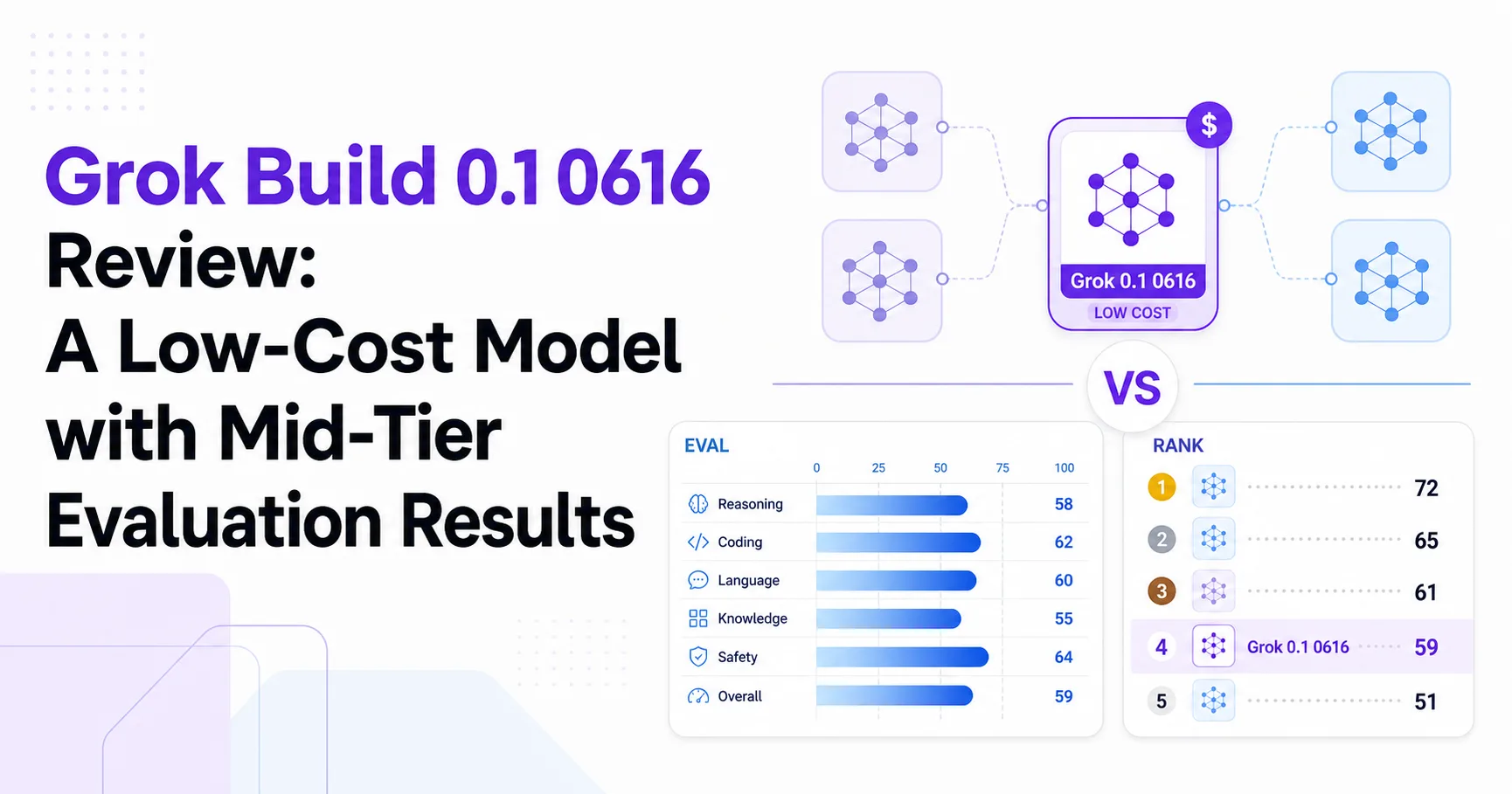
- **Where it stands:** Grok Build 0.1 0616 ranks 65 of 578 on the Artificial Analysis Intelligence Index at 39.8 - **Price:** $1.25 per 1M blended tokens - **Speed:** output tokens per second is not reported, 0.3s to first token - **Pick it when:** you need a low-cost general model for routine development assistance and can validate important outputs - **Watch out:** official documentation, availability, context limits, and real-world failure patterns are not verified
Grok Build 0.1 0616 is a budget-priced model with respectable but non-leading benchmark placement
Grok Build 0.1 0616 looks most useful as a cost-conscious option for developers who want moderate general and coding capability without paying premium-model rates. Its Artificial Analysis Intelligence Index position is 65 of 578, while its Coding Index position is 69 of 202. Those positions place the model in the stronger part of the measured field, but they do not establish it as a frontier choice. The available data supports a practical shortlist position, not a default recommendation for high-risk engineering work.
The model’s blended price is $1.25 per 1M tokens, with input priced at $1 and output priced at $2. Its reported time to first token is 0.3 seconds, but median output speed is not available. Data provided by Artificial Analysis.
The main case for Grok Build 0.1 0616 is cost discipline, while the main case against it is missing product evidence
Grok Build 0.1 0616 offers a credible value case when a workload needs ordinary coding help, structured text generation, or general reasoning at controlled token cost. Its Intelligence Index rank of 65 of 578 and Coding Index rank of 69 of 202 show that the model is not near the bottom of the evaluated population. The rankings also leave substantial distance from the leading models, so buyers should treat the model as a capable mid-tier candidate.
The closest models make the trade-off clearer. Gemini 3 Pro Preview (high) has an almost identical Intelligence Index score, but its blended price is $4.500000000000001 per 1M tokens. Qwen3.6 Plus is slightly cheaper at $1.125 per 1M blended tokens and has a Coding Index score of 54.5, compared with Grok Build 0.1 0616 at 51.5. GPT-5.4 mini (xhigh) scores 56.1 on the Coding Index, but costs $1.6875 per 1M blended tokens. These comparisons suggest that Grok Build 0.1 0616 occupies a reasonable middle ground, rather than dominating every nearby alternative. The comparison data comes from Artificial Analysis.
A developer should also account for the evidence gap. No verifiable official announcement, developer documentation, pricing page, model directory entry, community discussion, or official limitation record was found in the research brief. Therefore, this review cannot confirm the model’s context window, output ceiling, API parameters, multimodal support, stable alias, continued availability, or replacement path.
Grok Build 0.1 0616 is better suited to screened production tasks than unsupervised critical workflows
Grok Build 0.1 0616 should be considered a capable general-purpose candidate, but its benchmark position does not justify removing human or automated verification from important workflows. The model ranks 65 of 578 on the Intelligence Index and 69 of 202 on the Coding Index. In percentile terms, those positions indicate a result above most measured models, while still leaving a meaningful group ahead of it. The raw ranking is therefore more useful as a screening signal than as proof of reliability on a particular application.
For developers, the Coding Index result matters most when the workload includes code generation, code transformation, debugging, or repository-level reasoning. A rank of 69 of 202 suggests that Grok Build 0.1 0616 may be worth testing for these tasks. It does not reveal how the model handles hidden tests, unfamiliar frameworks, long dependency chains, security-sensitive code, or ambiguous requirements. The research brief contains no verified community reports about coding experience, speed perception, or recurring failure modes. Those missing observations prevent a confident claim about day-to-day developer ergonomics.
The model’s 0.3-second time to first token supports interactive use in principle. However, median output tokens per second is not reported. That missing value matters for long answers, large patches, agent loops, and streaming user interfaces. A fast first token can still coexist with slow completion. Teams should measure complete-task latency, not only initial response time, before choosing Grok Build 0.1 0616 for interactive coding agents.
The evidence also does not establish whether the model can process large repositories or extended conversations. Its context window is listed as null, and the research brief found no documentation that resolves this limitation. Developers should test prompt size, truncation behavior, tool-call handling, and output limits directly before building workflows that depend on them. Data provided by Artificial Analysis.
Grok Build 0.1 0616 is inexpensive enough for broad experimentation, but its value depends on output quality and routing discipline
Grok Build 0.1 0616 is financially attractive for workloads where moderate benchmark performance is sufficient and token volume is high. Its blended price is $1.25 per 1M tokens, with a $1 input rate and a $2 output rate. That pricing makes the model cheaper than GPT-5.4 mini (xhigh), whose blended rate is $1.6875, and far cheaper than Gemini 3 Pro Preview (high), whose blended rate is $4.500000000000001. The comparison figures are reported by Artificial Analysis.
Price alone does not prove lower total cost. A cheaper model can become expensive if it requires retries, manual correction, additional review, or escalation to another model. Grok Build 0.1 0616’s Coding Index score of 51.5 trails Qwen3.6 Plus at 54.5 and GPT-5.4 mini (xhigh) at 56.1. For coding tasks where correctness reduces downstream engineering time, the lower token price may not compensate for additional validation work. The available data does not measure correction rates or task success costs, so the economic conclusion remains conditional.
The strongest cost case is likely a routing tier for drafts, routine transformations, low-risk explanations, test scaffolding, and first-pass analysis. A stronger model can handle escalation cases involving security, production migrations, novel architecture, or complex debugging. This approach preserves Grok Build 0.1 0616’s price advantage while limiting the impact of uncertain quality. The evidence does not show whether the model is available through a stable endpoint, so procurement and operational cost still require direct verification.
Grok Build 0.1 0616 is worth a controlled pilot, not an unverified platform commitment
Grok Build 0.1 0616 is worth piloting when token cost matters, the application can validate outputs, and the team can tolerate uncertainty about the serving interface. Its benchmark positions are strong enough to justify hands-on testing. Its $1.25 blended price creates a clear reason to test it against more expensive nearby models. The available evidence does not justify selecting it as the sole model for critical engineering workflows.
A sensible pilot should use the team’s own tasks. Include code review, bug diagnosis, unit-test generation, documentation drafting, structured extraction, and short agent loops. Record acceptance rate, correction time, retry frequency, full completion latency, and escalation rate. The data brief provides no model-specific failure cases, so local evaluation is especially important. Developers should also verify authentication, endpoint stability, model naming, context limits, output limits, tool support, and retention terms before production integration.
| Choose Grok Build 0.1 0616 when | Choose another model when |
|---|---|
| Token price and broad experimentation matter | Verified platform support and documentation are mandatory |
| Human review or automated tests are already in place | Outputs must be trusted with minimal validation |
| The workload is routine, reversible, or easy to route | The task involves high-impact security or production changes |
| You can benchmark the real endpoint before launch | You need confirmed context, multimodal, or tool-use capabilities |
The recommendation is therefore conditional: test Grok Build 0.1 0616 as a lower-cost tier, retain a stronger fallback, and make the final decision from task-level results. Data provided by Artificial Analysis.
What developers still need to verify before adoption
Grok Build 0.1 0616 has enough benchmark and pricing evidence to justify a pilot, but not enough product evidence to justify an irreversible dependency. The research brief found no verifiable official source for the model’s API behavior, context window, output limits, multimodal support, availability, or failure patterns. The Artificial Analysis snapshot supplies the available ranking, latency, and pricing data at Artificial Analysis, while the missing operational details must be confirmed through direct provider testing or documentation.
Frequently asked questions
Is Grok Build 0.1 0616 a good model for coding?
Grok Build 0.1 0616 is a reasonable coding candidate for a controlled pilot because it ranks 69 of 202 on the Artificial Analysis Coding Index, but the brief provides no task-level failure or developer-experience evidence.
Is Grok Build 0.1 0616 cheap to use?
Grok Build 0.1 0616 is relatively inexpensive at $1.25 per 1M blended tokens, although retries, review time, and escalation could reduce the practical savings on difficult coding tasks.
Can developers rely on Grok Build 0.1 0616 for production agents?
Developers should not assume production-agent readiness because the research brief does not verify context limits, output limits, API parameters, tool support, endpoint stability, or the model’s availability.
How fast is Grok Build 0.1 0616?
Grok Build 0.1 0616 reports 0.3 seconds to first token, but median output tokens per second is unavailable, so complete-response speed remains unverified for long outputs.
Should Grok Build 0.1 0616 replace a stronger model?
Grok Build 0.1 0616 should generally serve as a lower-cost routing tier rather than a universal replacement, because nearby models show higher coding scores and the operational evidence is incomplete.
Sources
- Artificial AnalysisBenchmark rankings, model scores, pricing, latency, and comparisons with adjacent models.
Published: