
Inkling (xhigh)
AvailableOther · 2026-07-15 · 32,000 tokens
An AI model from Other, suited to a broad range of AI workloads.
Supported modalities:textcode
Quick Overview
Text Generation4/10
Code Generation5/10
Reasoning6/10
Multimodal4/10
Benchmark Results
Scores from leading benchmark suites.
artificial analysis intelligence42.3
artificial analysis coding52.1
Performance Metrics
Latency and throughput performance.
Dive Deeper
AI model analysis
Inkling (xhigh) Review: A Mid-Pack Model With Strong Speed and Unclear Product Risk
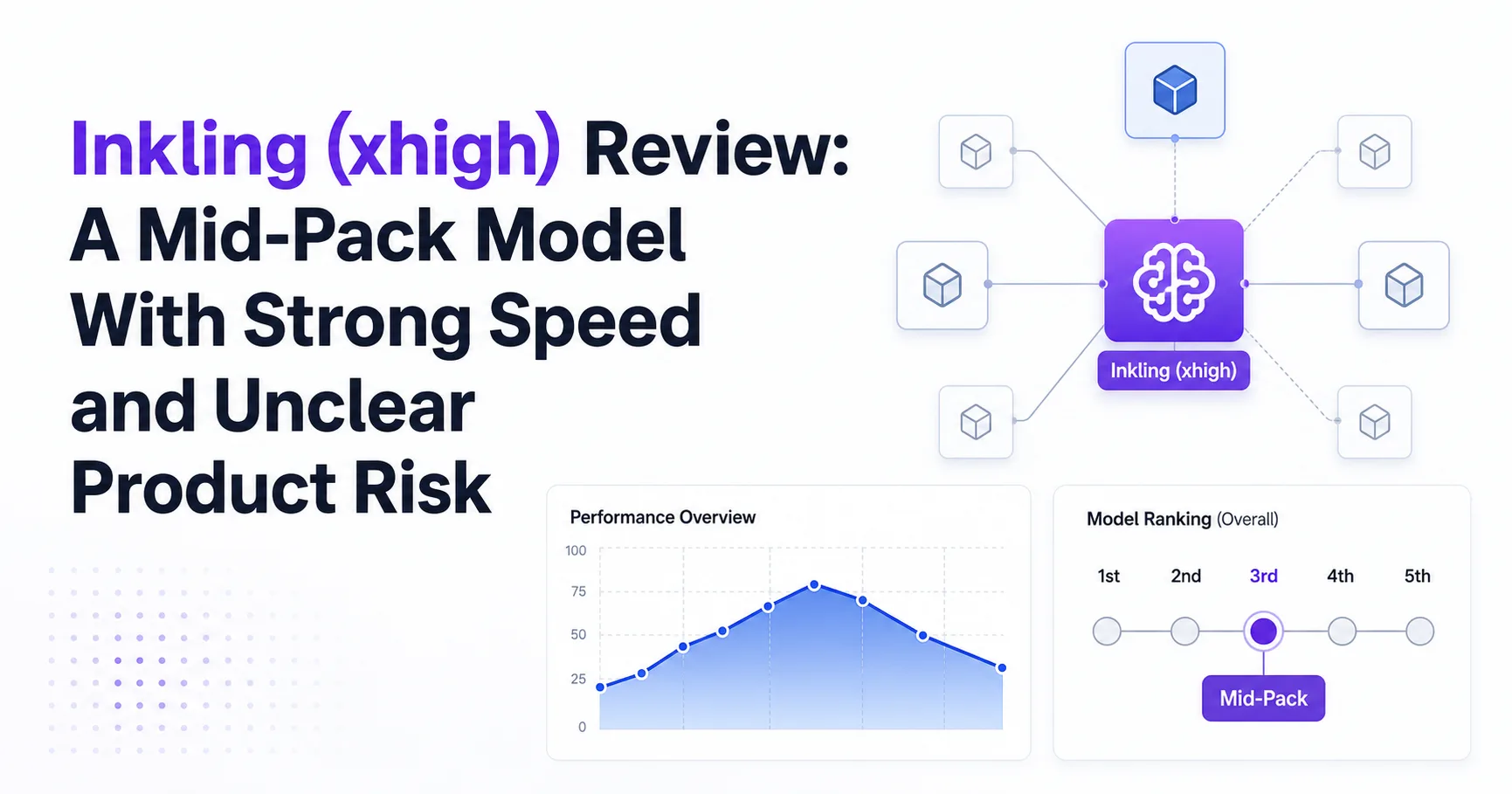
- **Where it stands:** Inkling (xhigh) ranks 56 of 578 on the Artificial Analysis Intelligence Index at 40.7 - **Price:** $2.5725000000000002 per 1M blended tokens - **Speed:** 84.899 output tokens per second, 0.3s to first token - **Pick it when:** You need a reasonably capable general model with low first-token latency and a moderate blended cost - **Watch out:** Public evidence does not confirm Inkling's provider, API contract, context window, or failure modes
Inkling (xhigh) in brief
Inkling (xhigh) is a fast, mid-pack model whose benchmark position is more convincing than its product documentation. The model ranks 56 of 578 on the Artificial Analysis Intelligence Index with a score of 40.7. That places it near the upper part of a broad model field, but it does not establish leadership in any specific developer workflow. Its coding position is weaker in relative terms, at 66 of 202 with a score of 52.1. The available dataset also reports 84.899 output tokens per second and 0.3 seconds to first token, giving Inkling a responsive profile for interactive applications. Data provided by Artificial Analysis
The central selection issue is not raw capability alone. Inkling has no verified official page, developer documentation, pricing page, or public benchmark report in the supplied research. That evidence gap prevents confirmation of its context window, output limit, API parameters, multimodal support, availability, stable alias, or current commercial status. Developers can therefore treat the benchmark record as useful evidence of measured performance, while treating the surrounding product as unverified. Inkling looks worth testing, but the current evidence does not support making it a default production dependency without an independent integration check.
The practical verdict
Inkling (xhigh) is a reasonable candidate for evaluation, but its measured position does not justify choosing it without a deployment trial. The intelligence ranking suggests useful general capability. The coding ranking suggests that software work may be acceptable, yet less differentiated than the general score alone implies. Inkling is therefore best understood as a testable middle option rather than a proven specialist.
The closest models provide a useful reference frame. Claude Opus 4.5 (Reasoning) has nearly the same intelligence score, while GPT-5.6 Terra (low), Nex-N2-Pro, and DeepSeek V4 Flash (Reasoning, Max Effort) sit close to Inkling on that index. Several of those reference models also have stronger coding scores in the supplied data, while Nex-N2-Pro and DeepSeek V4 Flash (Reasoning, Max Effort) have lower blended prices. Those comparisons weaken the case for Inkling as the obvious value leader.
| Decision area | Inkling (xhigh) | What the nearby models imply |
|---|---|---|
| General capability | Competitive middle-to-upper placement | Similar intelligence scores are available elsewhere |
| Coding choice | Respectable, but not clearly leading | Some nearby models score higher on coding |
| Operating profile | Fast response and moderate blended cost | Faster or cheaper alternatives may exist |
| Product confidence | Unverified beyond the dataset | Documentation and availability require checking |
The strongest case for Inkling is a workflow where responsiveness matters and benchmark performance is sufficient. The weakest case is a regulated, long-lived integration that depends on stable documentation or predictable model behavior.
What the rankings mean for real developer work
Inkling (xhigh) should handle broad developer experiments credibly, but its rankings do not prove consistent performance on difficult production tasks. A position of 56 of 578 on the Artificial Analysis Intelligence Index indicates that Inkling is not an obscure low-capability entry in the measured population. It belongs in a serious evaluation set for chat, structured reasoning, extraction, drafting, and ordinary assistant workflows. The ranking alone cannot reveal whether its answers are reliable enough for autonomous actions.
The coding result needs a more cautious reading. Inkling ranks 66 of 202 on the Artificial Analysis Coding Index at 52.1. That is a solid enough signal to test code generation, debugging, repository questions, and routine implementation assistance. It is not evidence that Inkling will outperform models with higher coding scores. For a developer choosing a primary coding model, the result supports trial placement rather than immediate commitment.
The reported speed changes how those scores may feel in an application. Inkling produces 84.899 output tokens per second and reaches the first token in 0.3 seconds. That combination should favor interactive interfaces, streamed explanations, coding assistants, and agent steps where users notice waiting. Speed does not compensate for wrong tool calls, weak instruction following, or poor long-context behavior. Those dimensions remain unverified because the research found no official documentation or community testing.
A sensible evaluation should therefore measure task completion, edit acceptance, tool-call accuracy, refusal behavior, and output stability on the developer’s own prompts. The supplied evidence cannot say whether Inkling is strong at any of those specific tasks. The ranking shows where to start testing, not where testing can stop.
When the price is attractive, and when it is not
Inkling (xhigh) is moderately priced for a model with a respectable intelligence ranking, but its cost advantage disappears when cheaper nearby models meet the same quality bar. The reported blended price is $2.5725000000000002 per 1M tokens. That makes Inkling easier to trial than premium-priced options such as MiMo-V2-Pro, while keeping it materially above the lowest-cost reference models in the dataset.
The relevant question is not whether the price looks reasonable in isolation. It is whether Inkling reduces total task cost after retries, validation, human review, and failed tool calls. A model that answers correctly on the first attempt can justify a higher token price. A model that requires repeated prompts or manual correction can become expensive even when its headline rate looks moderate. The supplied research does not provide failure rates, so this break-even question remains unresolved.
Inkling also has a speed-based cost argument. Its 84.899 output tokens per second and 0.3-second first-token latency can reduce perceived waiting and may improve user completion rates in interactive products. That benefit matters more for live assistants than for offline batch jobs. Batch workloads should place greater weight on answer quality, cache behavior, and total tokens consumed.
Nex-N2-Pro and DeepSeek V4 Flash (Reasoning, Max Effort) are important counterexamples in the supplied comparison set because their blended prices are lower. GPT-5.6 Terra (low) is more expensive, while Claude Opus 4.5 (Reasoning) and MiMo-V2-Pro are substantially more expensive. Inkling’s value case therefore depends on proving that its quality and operational behavior justify the middle price. No public pricing page was found, so current availability and billing terms require direct verification.
Who should choose Inkling (xhigh)
Inkling (xhigh) is worth a controlled pilot for teams that prioritize interactive speed and need capability above a basic baseline. Its intelligence ranking gives it a credible starting point for general-purpose developer tooling. Its coding ranking supports experiments with code assistance, but does not make it the strongest coding choice in the supplied comparison set. The model is most defensible when the application can route difficult requests elsewhere and can tolerate uncertainty around the provider and API.
Use Inkling as a candidate for streamed chat, internal developer assistants, lightweight agent steps, and workloads where fast visible responses matter. Keep the model behind an adapter if the integration is approved. Confirm the endpoint, authentication method, model name, context behavior, output limits, error handling, and billing before treating it as a stable dependency. The research brief confirms none of these product details.
Avoid selecting Inkling as the sole model for a critical coding pipeline, a long-context system, or a system that requires documented multimodal behavior. The dataset does not report a context window, and the research found no official or community material describing these capabilities. Do not infer support from the model’s name or benchmark placement.
| Choose Inkling for | Prefer another option when |
|---|---|
| Fast interactive prototypes | Stable public documentation is mandatory |
| General assistant evaluations | Coding quality is the primary scorecard |
| A routed, multi-model architecture | One model must handle every task |
| A pilot with local validation | Failure modes must already be known |
The final recommendation is conditional: test Inkling with representative traffic, retain a fallback, and promote it only after product details and task-level quality are verified.
Questions to answer before adoption
Inkling (xhigh) should enter production only after the unanswered product questions are resolved. The benchmark record is sufficient to justify a pilot, but it is not sufficient to establish a dependable API relationship. Developers should confirm availability, endpoint ownership, version stability, context behavior, output limits, supported parameters, and billing directly before implementation.
The absence of public evidence is itself relevant selection information. No verified vendor page, developer documentation, pricing page, benchmark report, or community discussion was found in the supplied research. That does not prove Inkling lacks these properties. It means the provided material cannot verify them. Any team that needs auditability, incident support, or predictable model migration should treat this uncertainty as a launch criterion.
Inkling’s measured speed also deserves validation in the intended environment. The dataset reports 0.3 seconds to first token and 84.899 output tokens per second, but those measurements may not represent the team’s network path, provider queue, prompt size, streaming implementation, or concurrency level. A short acceptance test can reveal whether the reported operating profile survives real traffic.
The cleanest adoption path is reversible. Run a narrow pilot, compare accepted outputs against the team’s current model, log retries and tool errors, and keep routing control outside the model-specific code. The supplied evidence does not identify a single best use case, so the team’s own task sample must supply that missing evidence.
Frequently asked questions
Is Inkling (xhigh) a strong general-purpose model for developers?
Inkling (xhigh) is a credible general-purpose candidate because it ranks 56 of 578 on the Artificial Analysis Intelligence Index, but that ranking does not prove reliability on your specific production tasks.
Is Inkling (xhigh) a good coding model?
Inkling (xhigh) is worth testing for coding assistance because it ranks 66 of 202 on the Artificial Analysis Coding Index, although the supplied comparison includes nearby models with higher coding scores.
Does Inkling (xhigh) offer good value for money?
Inkling (xhigh) offers a plausible middle-ground price at $2.5725000000000002 per 1M blended tokens, but cheaper nearby models mean its value depends on lower retry and review costs.
Is Inkling (xhigh) suitable for production use today?
Inkling (xhigh) is suitable for a controlled pilot, but production adoption remains conditional because the supplied research cannot verify its provider, API contract, availability, context window, or failure modes.
Sources
- Artificial AnalysisBenchmark rankings, model scores, pricing, latency, throughput, and comparison data
Published: