
Inkling Small
AvailableOther · 2026-07-30 · 32,000 tokens
An AI model from Other, suited to a broad range of AI workloads.
Supported modalities:textcode
Quick Overview
Text Generation4/10
Code Generation5/10
Reasoning6/10
Multimodal3/10
Benchmark Results
Scores from leading benchmark suites.
artificial analysis intelligence41.2
artificial analysis coding52.9
Performance Metrics
Latency and throughput performance.
Dive Deeper
AI model analysis
Inkling Small Review: Fast, Cheap, and Difficult to Trust Without More Evidence
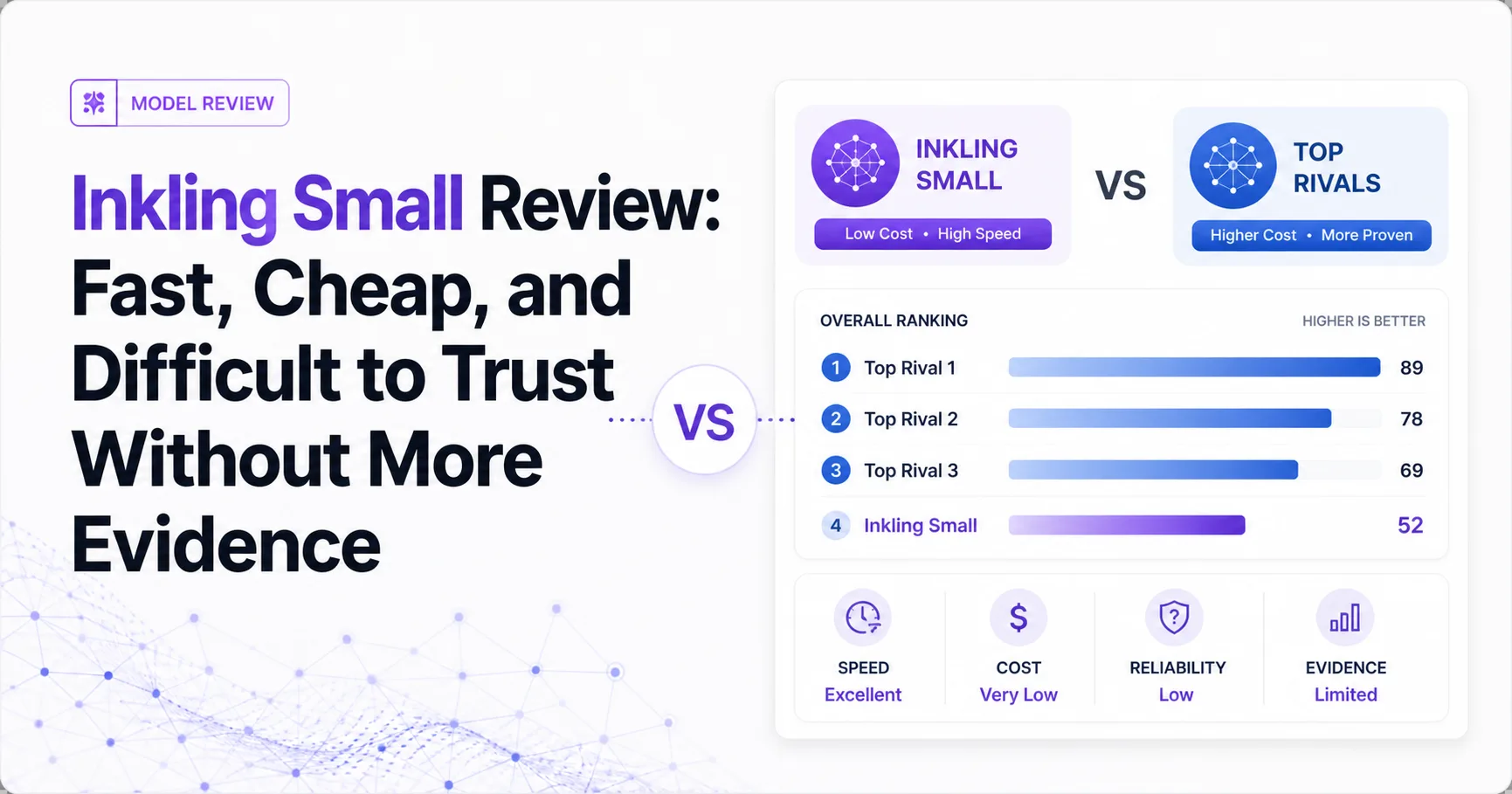
- **Where it stands:** Inkling Small ranks 60 of 578 on the Artificial Analysis Intelligence Index at 40.2 - **Price:** $0.525 per 1M blended tokens - **Speed:** 123.278 output tokens per second, 0.3s to first token - **Pick it when:** You need a fast, low-cost model for routine generation and can validate outputs independently - **Watch out:** No verifiable official documentation, product page, community discussion, or limitation report was found
Inkling Small is a fast budget model with a mid-to-strong benchmark position
Inkling Small offers an unusual combination for developers: a low blended price, fast measured output, and a ranking near the stronger end of a large evaluation set. The Artificial Analysis snapshot places Inkling Small at 60 of 578 on the Artificial Analysis Intelligence Index, with a score of 40.2. The model also ranks 62 of 202 on the Artificial Analysis Coding Index, with a score of 52.9. These positions make Inkling Small a credible candidate for evaluation, but they do not establish production readiness.
The main issue is evidence quality outside the benchmark record. No verifiable vendor announcement, developer documentation, product page, API directory entry, pricing page, community discussion, or limitation report was found in the research brief. That means developers cannot confidently confirm the model’s context window, output limit, API parameters, multimodal support, stable alias, availability, or replacement path. Artificial Analysis provides the measured model data used in this review.
Inkling Small therefore deserves a narrow recommendation. It may be attractive for workloads where speed and token cost dominate, especially if the integration can tolerate uncertainty. It should not become a default dependency until access, behavior, and operational guarantees are verified directly.
The benchmark position is promising, but the model has less usable evidence than its peers
Inkling Small looks strongest as a low-cost general-purpose option whose benchmark position exceeds what its price might suggest. Its intelligence ranking places it ahead of most models in the supplied comparison set, while its coding ranking remains competitive without reaching the top of that local group. The data supports testing. It does not support assuming that Inkling Small is broadly better.
| Decision factor | Inkling Small | Nearby reference models |
|---|---|---|
| General capability | Stronger than most of the indexed field by ranking | Several nearby models have almost the same intelligence score |
| Coding position | Competitive, but behind the closest coding-focused references | GLM-5.1 (Reasoning), DeepSeek V4 Flash (Reasoning, Max Effort), and GPT-5.4 mini (xhigh) score higher on the supplied coding index |
| Cost posture | Clearly positioned as a budget choice | DeepSeek V4 Flash is cheaper, while the other nearby references cost more |
| Operational evidence | Not established in the research brief | The supplied brief also does not provide verified product evidence for Inkling Small |
The comparison suggests that Inkling Small’s value depends on the task mix. A developer choosing primarily for coding accuracy may prefer a nearby model with a higher coding score. A developer handling high-volume, latency-sensitive requests may value Inkling Small’s speed and lower cost more. A developer requiring documented limits, stable access, or clear support has an unresolved diligence problem.
The ranking itself is useful because it shows that Inkling Small is not a bottom-tier experiment. The missing product evidence is equally important because benchmark strength cannot answer whether the model can be integrated reliably. The Artificial Analysis source supplies the ranking and comparison data.
Inkling Small should handle responsive routine work better than demanding engineering tasks
Inkling Small’s measured speed makes it a plausible choice for interactive workloads, but its coding rank says developers should keep verification in the loop. The snapshot reports 123.278 output tokens per second and 0.3s to first token. Those measurements support a responsive user experience for short answers, iterative drafting, classification, lightweight extraction, and other tasks where users notice waiting time.
The coding result is more qualified. Inkling Small ranks 62 of 202 on the Artificial Analysis Coding Index at 52.9. That is a meaningful position in the supplied field, yet nearby references such as DeepSeek V4 Flash and GPT-5.4 mini have higher coding scores in the same data. The practical implication is not that Inkling Small cannot write code. It is that developers should not infer reliable repository-scale reasoning, debugging depth, or test quality from the speed profile alone.
Inkling Small is best evaluated with task-specific tests. Include exact-format generation, structured output, short code edits, error correction, and repeated prompts. Check whether fast responses remain correct when the request includes ambiguous requirements or multiple constraints. The brief contains no verified community reports about coding experience, speed perception, or recurring failure modes, so there is no external qualitative evidence to fill that gap.
The available measurements also do not establish context-window behavior, maximum output length, tool calling, multimodal input, or API controls. Those unknowns can reverse the recommendation for agents, long-document analysis, or complex coding workflows. Artificial Analysis is the cited source for Inkling Small’s speed and evaluation data.
Inkling Small is inexpensive enough for high-volume experiments, but price alone does not make it economical
Inkling Small’s $0.525 per 1M blended tokens creates a strong cost case only when its output quality is sufficient for the job. The supplied pricing data lists $0.3 per 1M input tokens and $1.2 per 1M output tokens. This structure favors workloads with substantial input relative to output, provided the model does not require frequent retries, repair prompts, or human review.
The cost advantage becomes less clear for tasks where a small quality gap creates downstream work. A cheaper model can lose its advantage if it produces invalid structured data, weak code patches, incomplete explanations, or answers that require another model to check. The data brief does not include task-level accuracy, retry rates, reliability measurements, or user-reported failure patterns. Developers should therefore treat the listed price as an input to a cost test, not as a complete total-cost estimate.
Inkling Small is also not the cheapest nearby option in the supplied comparison. DeepSeek V4 Flash has a lower listed blended price and higher coding and intelligence scores in the provided data. That reference weakens a simple claim that Inkling Small is the best bargain. Inkling Small’s more defensible cost argument is its combination of budget pricing and measured responsiveness.
For an evaluation, compare completed tasks rather than tokens alone. Track successful outputs, correction passes, escalation frequency, and end-to-end response time. Confirm whether access is stable before building financial assumptions around the model. The research brief found no verifiable current product page or pricing page, so the listed benchmark data should not be treated as proof of a public, durable offer. The source for the listed pricing and comparison values is Artificial Analysis.
Choose Inkling Small for controlled, latency-sensitive workloads, and avoid making it a critical dependency yet
Inkling Small is worth a focused pilot when fast responses and low token spend matter more than documented platform guarantees. Good candidates include internal assistants, first-draft generation, short-form transformation, lightweight classification, and applications with deterministic validation or human review. Its benchmark position gives the pilot a reasonable starting point, while its speed makes interactive testing practical.
Inkling Small is a weaker choice for autonomous software agents, safety-sensitive decisions, long-context workflows, and systems that require a documented support path. The research brief does not verify the context window, output limit, API behavior, multimodal capability, availability, stable naming, or model replacement relationship. Those are not minor omissions. They affect architecture, testing, monitoring, and the ability to recover from a service change.
The recommendation changes if direct access confirms strong documentation and if task tests show acceptable coding and structured-output quality. It also changes if the application produces mostly long outputs or needs high reasoning accuracy. In those cases, the nearby coding references in the supplied data deserve a direct comparison, especially because some score higher on coding while others offer a different cost tradeoff.
A sensible decision rule is simple: use Inkling Small in a reversible path first. Put schema validation, retries, logging, and a fallback model around it. Promote it only after the deployment team verifies access and measures real task success. The benchmark evidence supports experimentation. It does not yet support an unconditional production recommendation. Artificial Analysis remains the only verifiable source supplied for this evaluation.
The most important unanswered questions concern access and operational behavior
Inkling Small cannot yet be evaluated as a complete developer product because the research brief contains no verifiable qualitative source about how the model is offered or used. No official release announcement, developer guide, API catalog entry, pricing page, Reddit discussion, Hacker News thread, X discussion, or other community report was found. The absence of evidence is not evidence that the model is unavailable or unreliable. It means those properties remain unconfirmed.
Developers should verify the following before integration: the callable model identifier, authentication method, context window, maximum output, supported parameters, streaming behavior, tool support, multimodal support, rate limits, service status, data handling, and deprecation policy. The brief also does not identify known failure scenarios. A local test suite is therefore necessary for prompt following, structured output, code editing, refusal behavior, and recovery from malformed responses.
This evidence gap is the central qualification in the review. The benchmark snapshot can establish relative position, pricing values, and measured latency. It cannot establish the contractual or operational conditions required by a production system. Artificial Analysis is linked here because it is the only accessible URL represented in the supplied data and the only source used for quantitative claims.
Frequently asked questions
Is Inkling Small a good model for developers?
Inkling Small is a reasonable candidate for a controlled developer pilot because its benchmark position, low blended price, and measured speed are attractive. The available evidence does not prove production reliability, coding depth, or stable API access.
Is Inkling Small suitable for coding tasks?
Inkling Small can be tested for coding tasks, but its coding rank is competitive rather than dominant in the supplied comparison. Developers should validate edits, run tests, and compare it with higher-scoring nearby coding models before adoption.
Does Inkling Small offer good value for money?
Inkling Small offers potentially strong value for high-volume workloads that need responsive output and can validate results. Its value weakens when retries, repair prompts, review time, or uncertain access create costs beyond the listed token price.
Should Inkling Small be used in production?
Inkling Small should begin in a reversible production experiment or internal workflow, not as an irreplaceable dependency. The research brief leaves access, limits, API behavior, support, and failure modes unverified, so additional diligence is required.
What is the main risk of choosing Inkling Small?
The main risk is not its benchmark position or listed price, but the lack of verifiable product evidence. Developers cannot confirm key integration and operations details from the supplied research, which can create avoidable migration and reliability risk.
Sources
- Artificial AnalysisBenchmark rankings, evaluation scores, pricing data, output speed, time to first token, and nearby-model comparison values.
Published: