
JT-4.1 Flash 236B A21B
AvailableOther · 2026-07-09 · 32,000 tokens
An AI model from Other, suited to a broad range of AI workloads.
Supported modalities:textcode
Quick Overview
Text Generation4/10
Code Generation5/10
Reasoning6/10
Multimodal3/10
Benchmark Results
Scores from leading benchmark suites.
artificial analysis intelligence39.9
artificial analysis coding52.4
Performance Metrics
Latency and throughput performance.
Dive Deeper
AI model analysis
JT-4.1 Flash 236B A21B Review: Strong Coding Position, Weak Value Signal
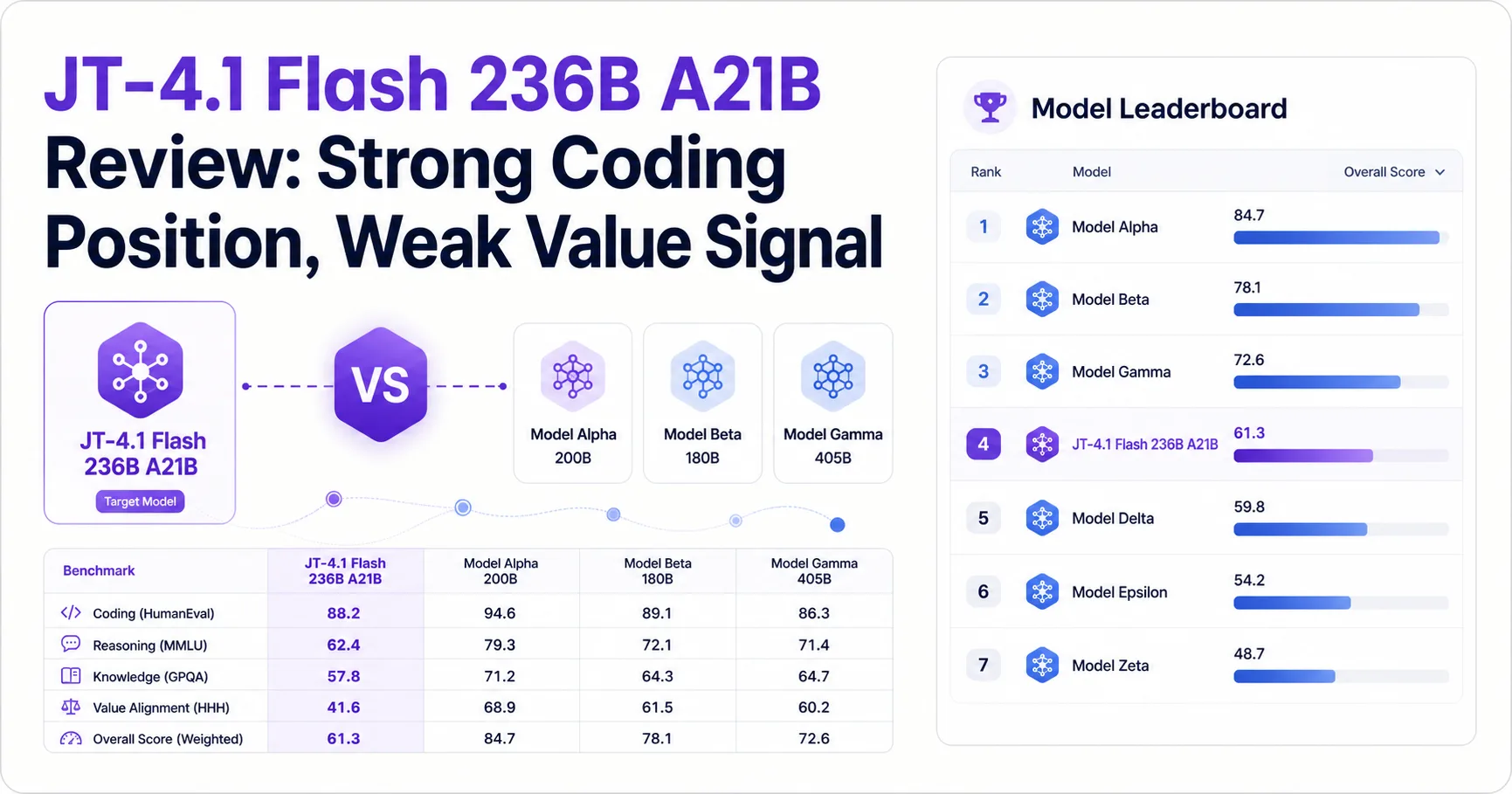
- **Where it stands:** JT-4.1 Flash 236B A21B ranks 71 of 578 on the Artificial Analysis Intelligence Index at 38.8 - **Price:** $15 per 1M blended tokens - **Speed:** No median output speed reported, 0.3s to first token - **Pick it when:** You need a model with a strong measured coding position and can validate its API behavior independently - **Watch out:** Public evidence does not establish its context limit, provider stability, coding workflow quality, or failure modes
JT-4.1 Flash 236B A21B is a promising benchmark candidate, not yet a low-risk production default
JT-4.1 Flash 236B A21B has a credible measured position, but public evidence is too thin to support an unqualified production recommendation. The model ranks 71 of 578 on the Artificial Analysis Intelligence Index with a score of 38.8, and ranks 64 of 202 on the Artificial Analysis Coding Index with a score of 52.4, according to Artificial Analysis.
That profile gives developers one clear signal: coding performance appears to be the model’s strongest measured area. The coding ranking is better than its overall intelligence ranking, so teams evaluating software tasks should pay closer attention to repository-level tests, tool use, debugging, and structured output behavior than to a general benchmark label.
The same data leaves several operational questions unanswered. No context-window value is available. No median output token rate is reported. The research brief found no verifiable vendor announcement, developer documentation, pricing page, model card, stable alias, replacement version, or community discussion. Those omissions matter because model selection depends on deployment mechanics as much as benchmark position.
JT-4.1 Flash 236B A21B therefore fits an evaluation-first posture. It may deserve a place in a controlled bake-off, especially for coding workloads. It does not yet have enough independently verifiable product evidence to become the only model behind a critical workflow. Artificial Analysis provides the measurable comparison data, while the available research provides no additional public source confirming how the model behaves outside that measurement environment.
The model’s main advantage is its coding position, while its main weakness is uncertainty around everything outside the scorecard
JT-4.1 Flash 236B A21B offers a better coding signal than general intelligence signal, but the evidence does not show whether that advantage survives real developer workflows. The benchmark data places the model at 64 of 202 on coding and 71 of 578 on intelligence, with the figures reported by Artificial Analysis.
The closest reference models sharpen the trade-off. Agnes 2.5 Pro Alpha has the same intelligence score of 38.8 and a coding score of 58.8, while Qwen3.7 Plus has an intelligence score of 39 and a coding score of 55.9. GPT-5.4 (low) has an intelligence score of 39.1. These nearby models show that JT-4.1 Flash 236B A21B is not standing alone in its general capability range. Its case depends on how much weight a buyer places on the coding result and on whether the deployment experience is acceptable. Artificial Analysis
| Decision question | JT-4.1 Flash 236B A21B implication |
|---|---|
| Is coding the primary workload? | The measured position is more encouraging than the general intelligence position. |
| Is the lowest cost the priority? | The listed blended price is much higher than the nearby alternatives shown in the data. |
| Is production reliability essential? | Evidence is insufficient because no stable provider or model documentation was verified. |
| Is fast first response important? | The reported first-token latency is useful, but output throughput is not reported. |
The practical summary is conditional: developers should test JT-4.1 Flash 236B A21B when coding quality matters, but should require independent validation before accepting its cost or operational uncertainty.
JT-4.1 Flash 236B A21B looks more attractive for coding evaluation than for untested general-purpose deployment
JT-4.1 Flash 236B A21B has its strongest evidence in coding benchmarks, but the available data cannot prove consistent performance across an actual software engineering loop. The model ranks 64 of 202 on the Artificial Analysis Coding Index at 52.4, compared with 71 of 578 on the Artificial Analysis Intelligence Index at 38.8, according to Artificial Analysis.
That difference supports a focused hypothesis. The model may be worth testing for code generation, code transformation, bug explanation, test authoring, and other tasks where coding competence is the central requirement. It does not establish that the model can reliably inspect a large repository, maintain architectural context, follow local conventions, or recover from failed tool calls. The research brief found no reliable community reports that could confirm or challenge those behaviors.
The reported latency is 0.3 seconds to first token. That is a useful responsiveness signal for interactive applications, but it is not a complete speed profile. No median output token rate is reported. A model can begin responding quickly and still take too long to finish a large patch, test suite explanation, or multi-step answer. Teams should measure completion time, interruption behavior, and output stability on their own workload before making a user-experience decision. Artificial Analysis
The missing context-window value is another important limitation. Developers cannot infer safe prompt size, repository chunking requirements, or long-document behavior from the benchmark ranks alone. A short-context coding assistant and a long-context repository analyst may need entirely different architectures.
The right performance test should therefore include representative repositories, failing tests, ambiguous tickets, tool calls, structured patches, and follow-up corrections. The current evidence justifies testing that hypothesis. It does not justify assuming the hypothesis is true.
JT-4.1 Flash 236B A21B is difficult to justify on price unless its coding quality materially reduces downstream work
JT-4.1 Flash 236B A21B carries a $15 price per 1M blended tokens, so its value depends on delivered engineering quality rather than raw response volume. The price and token rates are reported in the Artificial Analysis data brief.
The nearby reference set makes the cost question sharper. Agnes 2.5 Pro Alpha is listed at $0.5625000000000001 per 1M blended tokens, Qwen3.7 Plus at $0.7000000000000001, GPT-5.4 (low) at $5.625, and GPT-5.4 nano (xhigh) at $0.4625. JT-4.1 Flash 236B A21B therefore needs a concrete quality or workflow advantage to offset its position in this comparison. The data does not provide that advantage by itself. Artificial Analysis
A higher price can still be rational when a model produces fewer incorrect patches, needs fewer review cycles, or resolves harder issues without escalation. None of those outcomes appears in the research brief. No reliable community evidence was found for coding experience, speed perception, or failure behavior. Developers should avoid treating the coding rank as a direct estimate of engineering savings.
The input and output rates also matter differently. The listed input price is $10 per 1M input tokens, while the listed output price is $30 per 1M output tokens. Workloads that repeatedly send large repository context or generate long explanations may expose different cost pressure than short interactive requests. The data brief provides these rates, but it does not provide usage patterns or billing conditions for a specific provider. Artificial Analysis
JT-4.1 Flash 236B A21B becomes more defensible when a controlled evaluation shows that its outputs reduce human correction. Without that result, cheaper nearby models deserve a serious baseline comparison.
Developers should trial JT-4.1 Flash 236B A21B for coding, but keep a documented fallback until product evidence improves
JT-4.1 Flash 236B A21B is worth a controlled coding trial, but the available evidence is not sufficient for an unconditional production choice. Its coding position is stronger than its general intelligence position, and its reported first-token latency is 0.3 seconds, based on Artificial Analysis.
Choose JT-4.1 Flash 236B A21B when the workload is code-centered, the team can run representative acceptance tests, and the organization can tolerate uncertainty around provider details. Good candidates include internal coding assistants, patch drafting, test generation, and bounded automation where every change can be reviewed before release.
Avoid making it the sole model for critical production workflows when context size, output throughput, API stability, or failure recovery are hard requirements. The research brief found no verifiable official documentation or stable model alias. It also found no reliable community evidence about coding quality, latency in practice, or recurring failure cases. Those gaps are not proof of poor behavior. They are evidence that the buyer must supply the missing validation.
| Recommendation | Reason |
|---|---|
| Run a coding bake-off | The coding ranking gives the model a meaningful reason to test it. |
| Keep a cheaper baseline | Nearby models have substantially lower listed blended prices in the comparison data. |
| Measure completed-task cost | Token price alone cannot show whether review and repair effort fall. |
| Verify deployment details | The research brief does not confirm a stable API, context limit, or replacement path. |
| Use human approval for code changes | No reliable public failure analysis is available. |
The final decision should follow task-level evidence. If JT-4.1 Flash 236B A21B produces materially better accepted patches in the team’s own evaluation, its price may be defensible. If results are merely comparable, the cheaper reference models create the stronger economic case. Artificial Analysis
Questions developers should answer before adopting JT-4.1 Flash 236B A21B
JT-4.1 Flash 236B A21B requires deployment validation before adoption because benchmark data does not answer several operational questions. The available comparison comes from Artificial Analysis, while the research brief found no verifiable official product documentation or dependable community reporting.
The questions below focus on the gaps most likely to affect a developer’s decision. Each answer separates what the data shows from what remains unknown.
Frequently asked questions
Is JT-4.1 Flash 236B A21B good for coding?
JT-4.1 Flash 236B A21B is promising for coding because it ranks 64 of 202 on the Artificial Analysis Coding Index, but public evidence does not confirm repository-scale reliability, tool use, patch accuracy, or debugging behavior.
Is JT-4.1 Flash 236B A21B worth its price?
JT-4.1 Flash 236B A21B is worth its price only if its coding outputs reduce review and repair work, because the listed $15 blended price is higher than the nearby alternatives in the comparison data.
Is JT-4.1 Flash 236B A21B fast enough for interactive use?
JT-4.1 Flash 236B A21B reports 0.3 seconds to first token, which supports a responsive start, but no median output token rate is available to confirm total completion speed.
What is the context window of JT-4.1 Flash 236B A21B?
The context window of JT-4.1 Flash 236B A21B is not available in the supplied data, so developers should verify prompt limits directly before designing repository, document, or long-conversation workflows.
Should developers use JT-4.1 Flash 236B A21B in production?
Developers should use JT-4.1 Flash 236B A21B in production only after a controlled workload evaluation, because no verifiable official documentation, stable alias, provider status, or public failure analysis was found.
Sources
- Artificial AnalysisBenchmark rankings, intelligence and coding scores, pricing, latency, and comparison-model data.
Published: