
Kimi K2.7 Code
AvailableOther · 2026-06-12 · 32,000 tokens
An AI model from Other, suited to a broad range of AI workloads.
Supported modalities:textcode
Quick Overview
Text Generation4/10
Code Generation6/10
Reasoning6/10
Multimodal4/10
Benchmark Results
Scores from leading benchmark suites.
artificial analysis intelligence43.0
artificial analysis coding60.8
Performance Metrics
Latency and throughput performance.
Dive Deeper
AI model analysis
Kimi K2.7 Code Review: Strong Coding Rank, Unclear Product Fit
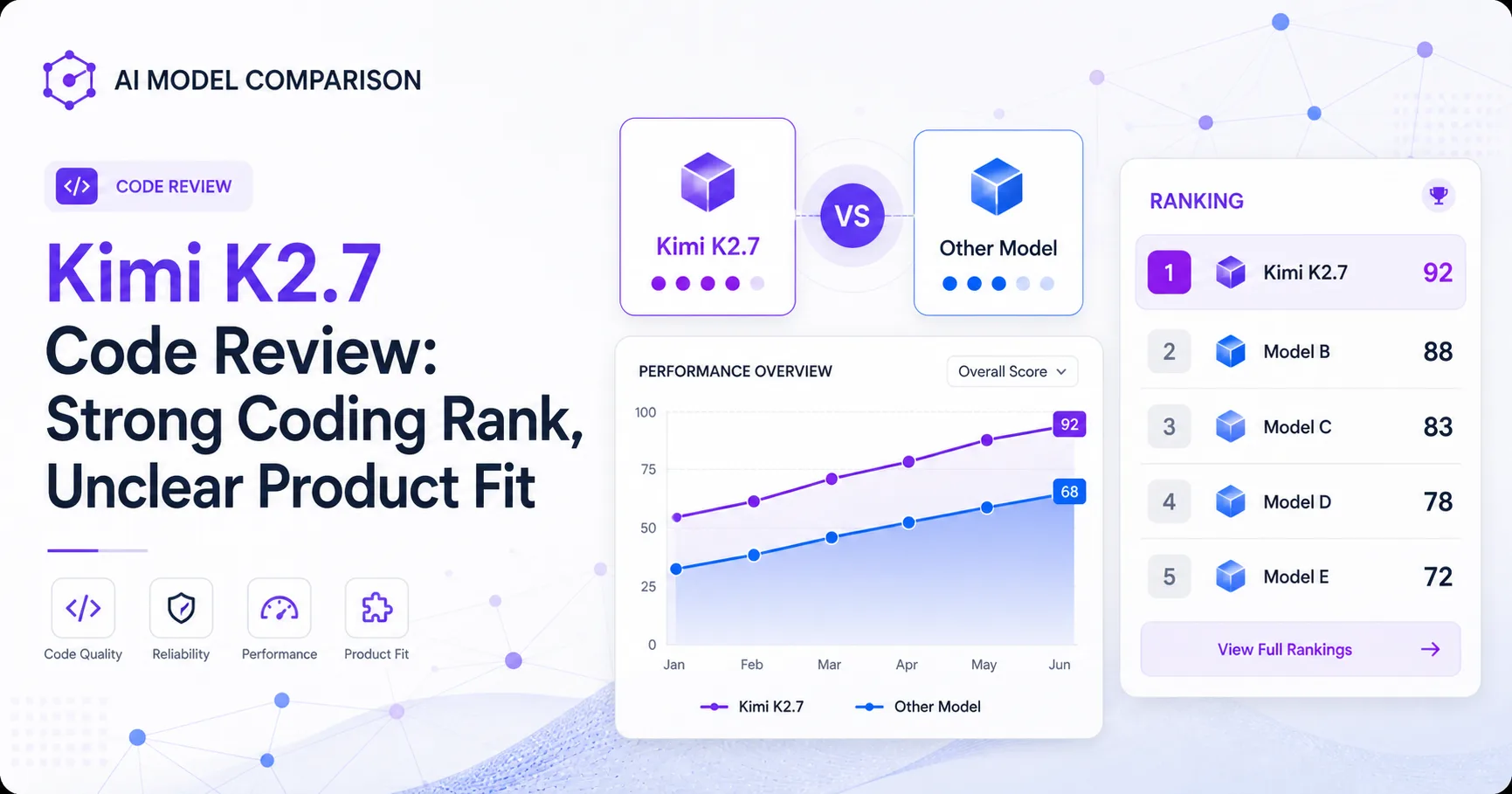
- **Where it stands:** Kimi K2.7 Code ranks 42 of 202 on the Artificial Analysis Coding Index at 60.8 - **Price:** $1.7125000000000001 per 1M blended tokens - **Speed:** 39.167 output tokens per second, 0.3s to first token - **Pick it when:** you need a coding-focused model with a strong measured rank and can validate access, behavior, and integration risk yourself - **Watch out:** public evidence does not confirm the model’s API availability, context window, limitations, or stable product identity
Kimi K2.7 Code is promising on coding benchmarks, but not yet a low-risk default
Kimi K2.7 Code combines a strong coding-index position with incomplete product evidence, so developers should treat it as a candidate for validation rather than an automatic production choice. The model ranks 42 of 202 on the Artificial Analysis Coding Index with a score of 60.8, according to Artificial Analysis. That position gives Kimi K2.7 Code a credible benchmark case for coding work. It does not establish how the model behaves inside a repository, how reliably it edits multiple files, or whether its tool-use behavior is suitable for an engineering workflow.
The research brief found no verifiable vendor announcement, developer documentation, pricing page, or reliable community testing for Kimi K2.7 Code. As a result, the evaluation can support a measured performance and cost judgment, but it cannot confirm the surrounding product contract. Developers should verify access, model naming, context behavior, output limits, and operational stability before committing application architecture to it.
Kimi K2.7 Code therefore has an attractive upside for teams willing to run their own acceptance tests. Its benchmark placement is meaningful, but the absence of independent qualitative evidence leaves important selection questions unanswered.
The main trade-off is measurable coding strength versus unverified usability
Kimi K2.7 Code is easiest to justify when coding rank matters more than documentation maturity and procurement certainty. The available data places its coding score above MiMo-V2.5-Pro at 60.2, while Claude Sonnet 5 (Non-reasoning, High Effort) scores 66.4 and GPT-5.6 Sol (Non-reasoning) scores 65.1 on the same coding index, as reported by Artificial Analysis. These nearby models create a clear decision boundary: Kimi K2.7 Code is competitive, but it is not the strongest measured coding option in the supplied comparison set.
Its general intelligence score is 41.9, placing it 50 of 578 on the Artificial Analysis Intelligence Index. That result suggests the model’s coding position is more useful for selection than its broader intelligence placement. The evidence does not show whether that distinction reflects specialization, benchmark composition, or real-world engineering behavior.
| Selection question | Kimi K2.7 Code implication |
|---|---|
| Is coding performance the primary filter? | Kimi K2.7 Code has a strong reason to enter the shortlist. |
| Is the lowest operating cost the primary filter? | MiMo-V2.5-Pro and Hy3 are materially cheaper in the supplied data. |
| Is documented production behavior essential? | Evidence is insufficient, so independent validation is required. |
| Is broad reasoning more important than coding rank? | The available intelligence-index position does not make Kimi K2.7 Code an obvious leader. |
The practical summary is narrow but useful. Kimi K2.7 Code deserves testing because its coding rank is credible. It should not be selected solely from that rank because the research brief verifies no public product details or community experience.
The coding rank supports serious testing, not a blanket claim of coding superiority
Kimi K2.7 Code’s coding-index rank indicates that coding quality is its strongest evidence-backed reason for consideration. Ranking 42 of 202 with a score of 60.8 gives the model a substantially clearer case for software tasks than its general intelligence result gives for unrestricted use, based on Artificial Analysis. For developers, that means Kimi K2.7 Code should enter evaluations involving code generation, code transformation, debugging, and repository-level assistance.
The rank still leaves several important questions open. A benchmark position does not reveal whether Kimi K2.7 Code follows local project conventions, preserves unrelated behavior, explains patches accurately, or handles ambiguous requirements. The research brief contains no reliable community reports that could answer those questions. It also contains no verified documentation describing tool calls, multimodal input, output limits, or context handling. Those omissions matter because an engineering assistant is judged by its workflow behavior as much as by isolated answer quality.
The comparison set also limits the strength of the conclusion. Claude Sonnet 5 (Non-reasoning, High Effort) and GPT-5.6 Sol (Non-reasoning) have higher supplied coding scores, while MiMo-V2.5-Pro is close at 60.2. Kimi K2.7 Code is therefore best described as a strong measured contender, not the clear coding winner. Hy3 has a lower coding score of 58.8, but its lower price and higher output speed could change the choice for workloads where throughput and cost dominate.
Kimi K2.7 Code’s measured latency is 0.3 seconds and its median output speed is 39.167 output tokens per second, according to Artificial Analysis. Those values support interactive use in principle. They do not prove that end-to-end developer workflows will feel fast, because queueing, tool execution, streaming behavior, and application overhead are not described in the brief.
A sensible performance test should therefore focus on task outcomes rather than benchmark imitation. Measure patch correctness, test preservation, instruction following, recovery after failed edits, and the amount of human review required. The supplied evidence supports running that test. It does not support skipping it.
Kimi K2.7 Code is affordable beside premium models, but not the cost leader
Kimi K2.7 Code’s price is defensible for quality-sensitive coding workloads, but its economics weaken when a cheaper nearby model meets the same acceptance bar. The supplied blended-token price is $1.7125000000000001 per 1M tokens, compared with $0.54375 for MiMo-V2.5-Pro and $0.24125000000000005 for Hy3, according to Artificial Analysis. This makes Kimi K2.7 Code a middle-cost option in the provided comparison set.
That position can be reasonable if its higher coding rank produces fewer retries, cleaner patches, or less review time. The data brief does not measure any of those outcomes. It only provides benchmark scores, token prices, latency, and output speed. Developers should avoid treating the blended price as a complete cost model, especially when a workflow sends large prompts, requests long outputs, or repeatedly retries failed changes.
The price also looks more attractive against premium alternatives. Claude Sonnet 5 (Non-reasoning, High Effort) has a blended price of $4, and GPT-5.2 (xhigh) has a blended price of $4.8125 in the supplied data. Kimi K2.7 Code can therefore occupy a practical middle ground for teams that want a stronger measured coding position than the cheapest options without paying the highest comparison-set prices.
The conclusion flips if MiMo-V2.5-Pro or Hy3 delivers acceptable repository results. MiMo-V2.5-Pro is close on the supplied coding index, while Hy3 is faster at 71.711 output tokens per second. Those facts make a direct workflow trial important. Kimi K2.7 Code is worth its price only if its quality advantage, reliability, or review savings appear in the team’s own tasks. No supplied evidence proves that advantage yet.
Choose Kimi K2.7 Code for a measured coding trial, not an unverified platform dependency
Kimi K2.7 Code is a good shortlist candidate for developers who can validate the model in their own codebase before production adoption. Its coding rank of 42 of 202 and score of 60.8 provide enough evidence to justify a focused trial, as shown by Artificial Analysis. The trial should compare it with at least one cheaper nearby option and one higher-scoring premium option from the supplied data.
Kimi K2.7 Code fits best when the workload values code quality, interactive response, and a price below the premium comparison models. Typical candidates include assisted implementation, bug-fix proposals, test generation, refactoring suggestions, and code review drafts. These are recommendations for validation based on the coding result, not verified claims about the model’s documented capabilities. The research brief does not confirm any official feature set or known failure pattern.
Developers should delay adoption when the application requires a confirmed API contract, a documented context window, stable model aliases, or vendor-backed operational guarantees. The brief could not verify those details. The same caution applies to multimodal workflows, specialized tool calling, and long-context repository tasks. Evidence is insufficient to recommend Kimi K2.7 Code for those requirements.
| Decision | Recommendation |
|---|---|
| Build a prototype with measured acceptance tests | Proceed. |
| Make Kimi K2.7 Code the only production provider | Do not proceed without verification. |
| Optimize primarily for token cost | Test MiMo-V2.5-Pro and Hy3 first. |
| Optimize primarily for measured coding rank | Include Kimi K2.7 Code, Claude Sonnet 5, and GPT-5.6 Sol in the trial. |
The final judgment is conditional. Kimi K2.7 Code appears valuable as a benchmark-backed coding contender. Its missing documentation and unverified availability prevent a confident recommendation as a production default.
Questions developers should answer before adopting Kimi K2.7 Code
Kimi K2.7 Code should pass an operational verification check before any team treats its benchmark result as a deployment decision. The supplied research found no reliable public source confirming its API, context window, output limit, multimodal support, or stable availability. Artificial Analysis supplies the comparison data, but that data does not replace vendor documentation or an internal acceptance test.
A useful review should ask whether the model can be called consistently, whether its name and endpoint remain stable, whether prompts fit the intended repository workflow, and whether generated changes meet the project’s tests. It should also compare total engineering effort, not only token spend. Kimi K2.7 Code has a credible measured coding position, but its product fit remains an open question.
Frequently asked questions
Is Kimi K2.7 Code good for software development?
Kimi K2.7 Code is a credible software-development candidate because it ranks 42 of 202 on the supplied coding index, but available evidence does not confirm repository behavior, tool support, or production reliability.
Is Kimi K2.7 Code worth its price?
Kimi K2.7 Code may be worth its price when stronger coding results reduce retries or review effort, but the supplied data does not measure those savings, so teams must validate value on real tasks.
Is Kimi K2.7 Code faster than competing models?
Kimi K2.7 Code delivers 39.167 median output tokens per second with 0.3 seconds to first token, but the supplied comparison includes faster models and does not establish end-to-end workflow speed.
What is the biggest risk of adopting Kimi K2.7 Code?
The biggest risk is incomplete product evidence: the research brief could not verify API availability, stable naming, context limits, output limits, multimodal support, or documented failure modes.
Should developers choose Kimi K2.7 Code over MiMo-V2.5-Pro?
Developers should compare both on their own repository tasks because Kimi K2.7 Code has a slightly higher supplied coding score, while MiMo-V2.5-Pro has a much lower blended token price.
Sources
- Artificial AnalysisBenchmark rankings, evaluation scores, pricing data, latency, and output-speed data
Published: