
MiMo-V2.5-Pro
AvailableOther · 2026-04-22 · 32,000 tokens
An AI model from Other, suited to a broad range of AI workloads.
Supported modalities:textcode
Quick Overview
Text Generation4/10
Code Generation6/10
Reasoning6/10
Multimodal4/10
Benchmark Results
Scores from leading benchmark suites.
artificial analysis intelligence42.9
artificial analysis coding60.2
Performance Metrics
Latency and throughput performance.
Dive Deeper
AI model analysis
MiMo-V2.5-Pro Review: Strong Coding Results at a Very Low Listed Cost
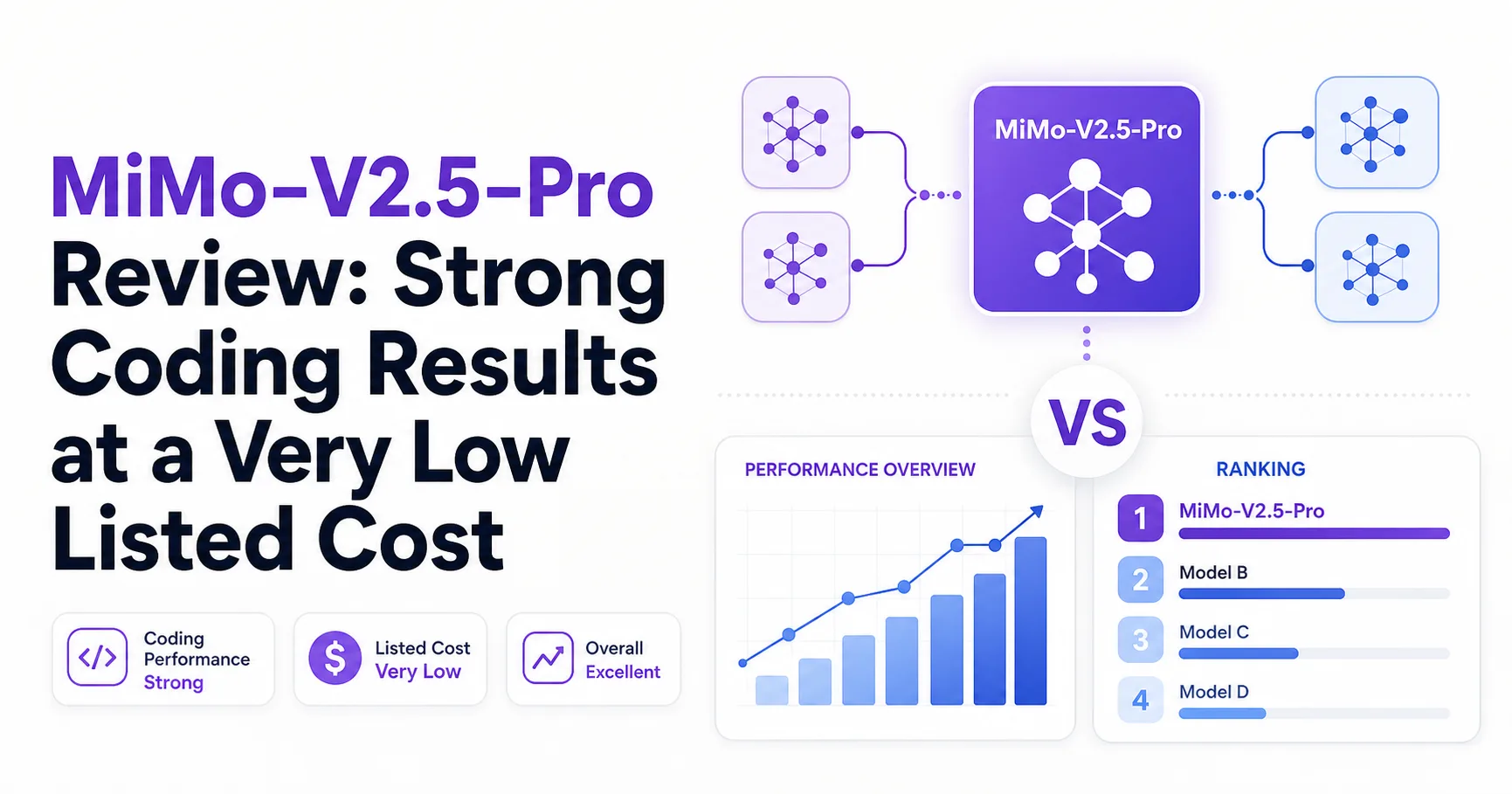
- **Where it stands:** MiMo-V2.5-Pro ranks 48 of 578 on the Artificial Analysis Intelligence Index at 42.2 - **Price:** $0.54375 per 1M blended tokens - **Speed:** 40.904 output tokens per second, 0.3s to first token - **Pick it when:** You need a low-cost model for coding-heavy workloads and can validate its undocumented behavior yourself - **Watch out:** No verifiable official documentation or community testing was found, so production limits and failure modes remain uncertain
MiMo-V2.5-Pro is a high-ranking, low-cost candidate with unusually limited public evidence
MiMo-V2.5-Pro looks attractive for developers who prioritize coding benchmarks and operating cost, but its undocumented deployment profile creates meaningful adoption risk. The model ranks 48 of 578 on the Artificial Analysis Intelligence Index and 43 of 202 on the Artificial Analysis Coding Index, placing it near the top of both available comparison sets. Data provided by https://artificialanalysis.ai/ supports those rankings, pricing figures, speed measurements, and latency data.
The central evaluation problem is not benchmark weakness. It is missing product evidence. The research brief found no verifiable vendor announcement, developer documentation, pricing page, Reddit discussion, Hacker News thread, or X discussion for MiMo-V2.5-Pro. As a result, developers cannot confirm the model’s context window, output limit, API parameters, multimodal support, stable alias, replacement policy, or documented failure patterns from the supplied research.
That combination produces a clear but qualified verdict. MiMo-V2.5-Pro deserves a controlled technical trial when coding quality and low token cost matter. It does not yet deserve an automatic role as a default production model. The benchmark position supplies a reason to test the model. The evidence gap supplies a reason to keep deployment reversible.
The best case for MiMo-V2.5-Pro is efficient coding evaluation, not broad platform confidence
MiMo-V2.5-Pro is most compelling as a cost-sensitive coding model whose benchmark results justify hands-on validation. Its Coding Index position, 43 of 202, is stronger than its general Intelligence Index position, 48 of 578. That difference is not large enough to prove a specialized behavior, but it does make coding workloads the most defensible starting point.
The adjacent models clarify the trade-off without changing the main conclusion. Kimi K2.7 Code has a slightly higher Coding Index score at 60.8, while MiMo-V2.5-Pro has the same listed blended price as DeepSeek V4 Pro High and a lower listed blended price than Kimi K2.7 Code. Claude Sonnet 5 has a higher Coding Index score at 66.4, but its listed blended price is much higher. These comparisons suggest that MiMo-V2.5-Pro occupies a value-oriented position rather than a clear quality leadership position.
| Selection question | MiMo-V2.5-Pro implication |
|---|---|
| Is coding a central workload? | Yes, benchmark evidence makes coding the strongest test case. |
| Is the budget strict? | Yes, the listed blended price supports a low-cost trial. |
| Is documented operability mandatory? | Unclear, because the research found no verifiable official documentation. |
| Is maximum coding quality the only priority? | Not established, because a nearby model scores higher on the Coding Index. |
Developers should therefore treat MiMo-V2.5-Pro as a promising candidate, not a fully characterized service.
MiMo-V2.5-Pro should be tested on real repository tasks because ranking alone cannot establish reliability
MiMo-V2.5-Pro has enough benchmark strength to justify repository-level testing, but the available evidence cannot show how consistently it completes real software tasks. A Coding Index rank of 43 of 202 indicates a strong relative result within the supplied dataset. It does not establish patch correctness, test discipline, instruction following, tool use, or performance on unfamiliar codebases.
The measured response profile is also practical for interactive experiments. MiMo-V2.5-Pro records 40.904 median output tokens per second and 0.3 seconds to first token. Those figures support responsive development sessions and make the model plausible for code explanation, test generation, debugging drafts, and iterative patch proposals. They do not prove that the model will finish tasks faster overall. A model can stream quickly while producing more rework, longer answers, or less reliable edits.
The evidence gap matters most here. The research brief found no reliable community material confirming coding experience, speed perception, or behavioral characteristics. It also found no verified material describing failure scenarios. Developers should measure the things the benchmark cannot answer: compile success, test pass rate, regression frequency, clarification rate, and the number of edits required after review.
A sensible trial should compare MiMo-V2.5-Pro with the team’s current model on the same repository tasks. Keep the evaluation narrow and reversible. Use representative tickets, require tests, inspect diffs manually, and record failures. The model’s benchmark position earns that trial. It does not replace it.
MiMo-V2.5-Pro is economically attractive when its first-pass quality is high enough to avoid rework
MiMo-V2.5-Pro is unusually easy to justify on token economics, but its low listed cost becomes less valuable if undocumented behavior increases engineering rework. The model’s blended price is $0.54375 per 1M tokens, with input priced at $0.435 and output priced at $0.87 per 1M tokens. Artificial Analysis is the supplied source for these figures.
The relevant purchasing question is not whether the token rate is low. It is whether the model can complete useful work with an acceptable review burden. A cheap model that needs repeated prompts, extensive correction, or manual recovery can cost more in developer time than its invoice suggests. The brief provides no verified evidence about those failure modes, so the total-cost conclusion remains conditional.
MiMo-V2.5-Pro is a good fit for workloads with bounded risk and measurable outputs. Examples include draft code, unit-test suggestions, code search assistance, routine transformations, and internal tools where human review is already required. It is less suitable as an unreviewed decision-maker for migrations, security-sensitive changes, or production actions until the missing operational evidence is filled.
The price advantage is clearest against the adjacent premium models. GPT-5.2 xhigh, Claude Opus 4.7, and Claude Sonnet 5 have higher listed blended prices in the supplied snapshot. DeepSeek V4 Pro High shares MiMo-V2.5-Pro’s listed blended price, so the decision between them should depend on task evaluations rather than cost alone. MiMo-V2.5-Pro wins the affordability argument. It has not yet won the total-cost argument.
MiMo-V2.5-Pro is worth a staged pilot, but not a blind production commitment
MiMo-V2.5-Pro is worth piloting for coding-heavy, cost-sensitive applications that can tolerate human review and provider uncertainty. The recommendation follows directly from the available evidence: the model ranks 43 of 202 on the Coding Index, responds at 40.904 median output tokens per second, reaches first token in 0.3 seconds, and carries a listed blended price of $0.54375 per 1M tokens. Data provided by https://artificialanalysis.ai/ provides the quantitative snapshot.
The pilot should answer four practical questions. Can MiMo-V2.5-Pro produce correct patches on representative repositories? Does its speed reduce waiting time without increasing review time? Does its low token price remain advantageous after retries and corrections? Can the team obtain stable access, predictable limits, and sufficient operational documentation?
| Recommendation | Decision |
|---|---|
| Start a limited coding pilot | Recommended |
| Route reviewed internal tasks to it | Recommended after baseline testing |
| Use it for high-risk autonomous changes | Not recommended from current evidence |
| Make it the sole model dependency | Not recommended until documentation improves |
The recommendation may change in either direction. Strong first-party documentation and successful repository tests would support wider adoption. Poor patch reliability, unstable access, or restrictive undocumented limits would erase much of the price advantage. The current evidence supports experimentation, not certainty.
Questions developers should answer before adopting MiMo-V2.5-Pro
MiMo-V2.5-Pro should enter evaluation through a small, observable workflow because the supplied research does not establish its production behavior. The benchmark data supports testing, while the missing official and community evidence limits confident claims about deployment.
Developers should document the model endpoint, limits, retry behavior, supported parameters, context handling, and output constraints during the pilot. The research brief could not verify any of those details. Teams should also preserve a fallback model so a change in access or behavior does not interrupt development work.
The most useful acceptance criteria are concrete. Measure successful patches, test outcomes, review corrections, response latency, retries, and effective cost per accepted change. This approach converts the current uncertainty into evidence that belongs to the developer’s own workload.
MiMo-V2.5-Pro has a credible case for inclusion in a model shortlist. It does not have enough supplied evidence for unconditional approval.
Frequently asked questions
Is MiMo-V2.5-Pro good for coding?
MiMo-V2.5-Pro is a credible coding candidate because it ranks 43 of 202 on the Artificial Analysis Coding Index, but repository testing is still required because no reliable coding experience reports or failure analyses were found.
Is MiMo-V2.5-Pro cheap enough for production use?
MiMo-V2.5-Pro has a listed blended price of $0.54375 per 1M tokens, making it attractive for production experiments, although retries, review effort, and undocumented limits could change its total operating cost.
How fast is MiMo-V2.5-Pro?
MiMo-V2.5-Pro records 40.904 median output tokens per second and 0.3 seconds to first token, which supports interactive testing, but the supplied research does not verify real-world speed perception or throughput stability.
Should developers use MiMo-V2.5-Pro as their default model?
Developers should pilot MiMo-V2.5-Pro before making it a default because benchmark results and price are promising, while official documentation, stable access details, context limits, and known failure modes remain unverified.
What are the main risks of adopting MiMo-V2.5-Pro?
The main risks are evidence gaps rather than a documented benchmark weakness: the research found no verifiable official release material, developer documentation, pricing page, community testing, or confirmed failure scenarios.
Sources
- Artificial AnalysisBenchmark scores, rankings, pricing snapshot, output speed, and time to first token.
Published: