
Muse Spark
AvailableMeta · 2026-04-08 · 32,000 tokens
An AI model from Meta, suited to a broad range of AI workloads.
Supported modalities:textcode
Quick Overview
Text Generation4/10
Code Generation6/10
Reasoning6/10
Multimodal4/10
Benchmark Results
Scores from leading benchmark suites.
artificial analysis intelligence44.3
artificial analysis coding58.6
Performance Metrics
Latency and throughput performance.
Dive Deeper
AI model analysis
Muse Spark Review: Strong Benchmark Placement, Weak Proof for Production Use
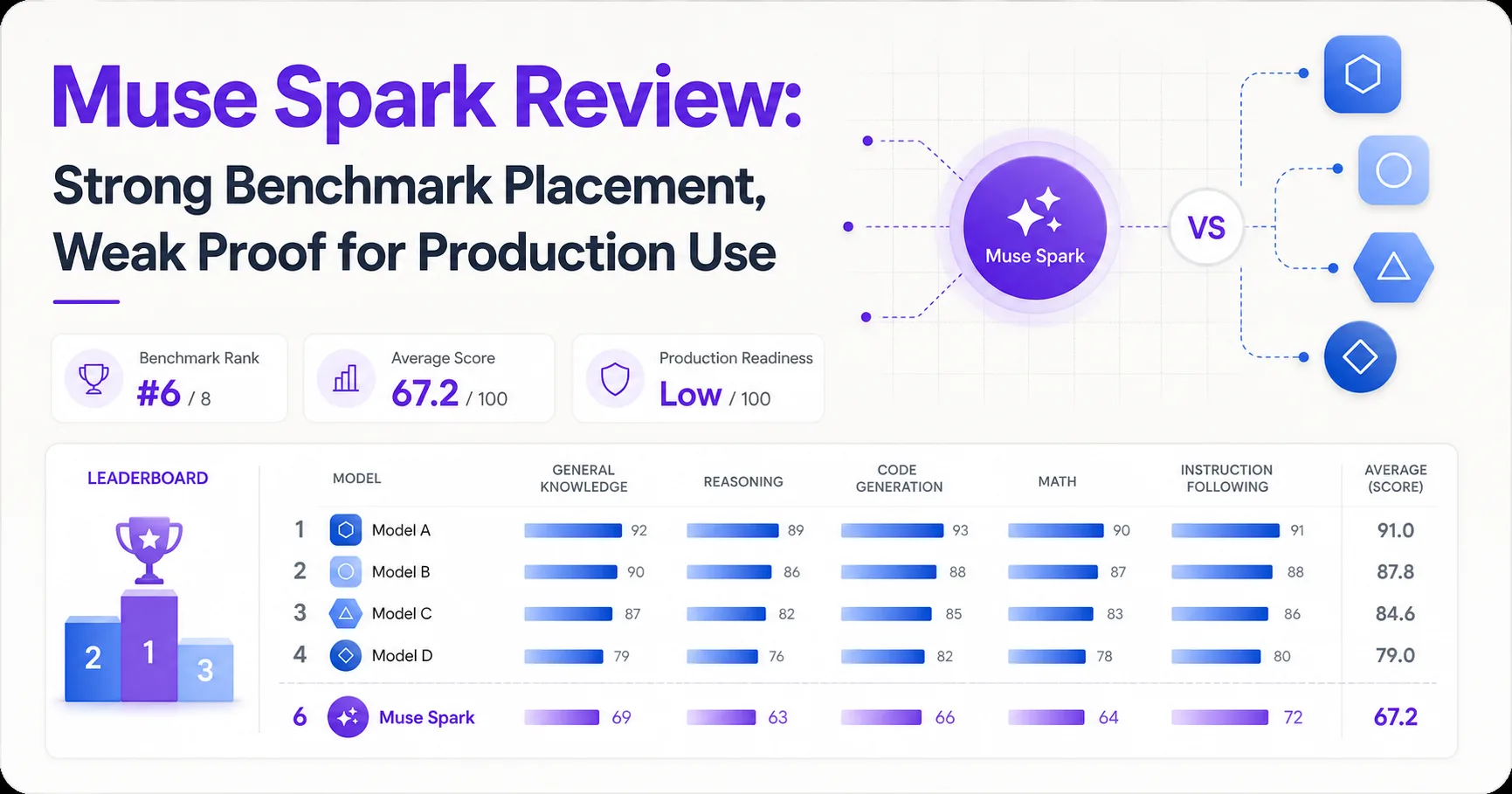
- **Where it stands:** Muse Spark ranks 45 of 578 on the Artificial Analysis Intelligence Index at 43.1 - **Price:** $15 per 1M blended tokens - **Speed:** output speed is not reported, 0.3s to first token - **Pick it when:** benchmark standing matters more than documented API access or proven production behavior - **Watch out:** Meta has not publicly documented Muse Spark, so availability, limits, and failure modes remain unverified Data provided by https://artificialanalysis.ai/
Muse Spark looks capable on paper, but public evidence is incomplete
Muse Spark has a strong measured position, yet developers cannot currently verify the model’s product status, interface, or operating limits from public Meta documentation. The available benchmark snapshot places Muse Spark at 45 of 578 on the Artificial Analysis Intelligence Index, with a score of 43.1, and at 50 of 202 on the Artificial Analysis Coding Index, with a score of 58.6. Those positions suggest a serious general-purpose model rather than an untested low-tier system.
The qualification matters because benchmark strength is the clearest evidence available, while basic deployment facts are missing. Meta’s public developer overview lists Llama 4 Scout, Llama 4 Maverick, and Llama Guard 4, but does not mention Muse Spark: Meta’s developer overview. The same page describes access through Meta, Hugging Face, Kaggle, Edge partners, and Cloud partners, without identifying Muse Spark as an available model.
For an evaluator, the result is a split decision. Muse Spark deserves attention if the benchmark profile matches the intended workload. It does not yet deserve an unconditional production recommendation because public evidence does not establish stable access, context limits, output limits, API parameters, multimodal support, or a documented replacement path. Data provided by Artificial Analysis supplies the measured comparison data used here.
The ranking signals broad competence, not a proven developer experience
Muse Spark’s ranking indicates that its measured capability is competitive with several well-known models, but the ranking alone cannot answer whether it is the right engineering choice. On broad intelligence, Muse Spark sits near models such as DeepSeek V4 Pro (Reasoning, High Effort), Claude Opus 4.7 (Non-reasoning, High Effort), GPT-5.5 (low), Claude Opus 4.6 (Adaptive Reasoning, Max Effort), and GPT-5.2 (xhigh). The adjacent set is useful as a decision frame, not as proof that Muse Spark behaves similarly in an application.
| Decision factor | Muse Spark | What the adjacent models imply |
|---|---|---|
| General capability | High measured placement | Several nearby systems occupy a similar evaluation band |
| Coding capability | Strong measured placement | GPT-5.5 (low) is higher on the listed coding score, while DeepSeek V4 Pro is nearly level |
| Access confidence | Unclear | The comparison data cannot replace an official access path |
| Operational evidence | Output speed is not reported | Comparable first-token latency does not establish equal throughput or stability |
This distinction is important for developers building agents, code assistants, or evaluation pipelines. A good index position can support a shortlist, but it cannot confirm tool calling behavior, structured output reliability, refusal patterns, repository-scale coding quality, or regression behavior. The research brief found no reliable Reddit, Hacker News, or X discussion that confirms coding experience, perceived speed, or model behavior. That evidence gap means the practical interpretation should remain conditional: Muse Spark appears promising in capability terms, while its developer experience is unverified.
Muse Spark is most attractive for capability-sensitive tasks with controlled validation
Muse Spark’s performance profile supports a capability-first evaluation, but insufficient operational evidence makes task-specific testing essential before adoption. The model ranks 50 of 202 on the Artificial Analysis Coding Index at 58.6, placing it in a strong portion of the listed coding field. That result supports experiments involving code generation, debugging, refactoring, and technical explanation, especially when the application can review or retry outputs.
The broad intelligence result tells a similar story. A position of 45 of 578 at 43.1 suggests that Muse Spark can be considered for mixed workloads where reasoning, instruction following, and general knowledge all matter. The result is not a guarantee of consistent quality across every prompt type. Ranking data compresses many task outcomes into one score, so developers still need representative tests for their own languages, frameworks, repository structure, and tool protocols.
The first-token latency is listed as 0.3s, which makes interactive response initiation look favorable. Output speed is not reported, however. That missing value prevents a confident judgment about long answers, streaming completion time, batch throughput, or agent loops that generate multiple tool calls. A fast first token can still coexist with slow completion behavior, but the supplied evidence does not establish either outcome.
The research brief also found no official or community documentation describing failure modes, context limits, output caps, multimodal support, or API parameters. Meta’s public overview does not list Muse Spark: Meta’s developer overview. Developers should therefore treat performance claims as benchmark-based rather than deployment-proven. Data provided by Artificial Analysis supports the ranking and latency observations.
Muse Spark's price is difficult to defend without access and quality advantages
Muse Spark’s listed price makes it a premium choice, so the business case depends on quality that the current public evidence cannot fully verify. The blended price is $15 per 1M tokens, with input priced at $10 per 1M tokens and output priced at $30 per 1M tokens. Those figures matter because output-heavy workloads expose the higher output rate more directly, while prompt-heavy workloads still pay a meaningful input premium.
The adjacent models provide a clear opportunity-cost signal. DeepSeek V4 Pro (Reasoning, High Effort) is listed at $0.54375 per 1M blended tokens, Claude Opus 4.7 (Non-reasoning, High Effort) at $10, GPT-5.5 (low) at $11.25, Claude Opus 4.6 (Adaptive Reasoning, Max Effort) at $10, and GPT-5.2 (xhigh) at $4.8125. Muse Spark therefore needs a concrete advantage in quality, access, governance, or workload fit to justify its position on a shortlist.
The price could still be rational for a narrow task. If Muse Spark produces materially better accepted outputs for a particular codebase, the reduced review burden could outweigh token spend. The supplied material does not provide acceptance rates, task-level quality, throughput, or reliability evidence, so that case remains unproven. If the model is unavailable through a stable route, its listed price has no practical value. If quality is merely similar to nearby models, cheaper alternatives deserve priority.
The pricing and benchmark values come from Artificial Analysis. Meta’s public documentation does not provide a confirmed Muse Spark product or pricing page: Meta’s developer overview.
Choose Muse Spark for a measured trial, not as an assumed default
Muse Spark is worth a controlled evaluation when its benchmark placement fits the workload and the team can confirm a dependable access path independently. The model’s intelligence and coding rankings are strong enough to justify testing, particularly for developers who prioritize capability over minimum token cost. The listed 0.3s first-token latency also supports an interactive prototype, although missing output-speed data limits confidence about complete responses.
A sensible trial should focus on decision evidence that the current briefs do not contain: real repository tasks, structured-output checks, tool calls, long responses, error recovery, and repeated runs. The goal is to determine whether the model’s measured advantage appears in accepted developer output. Teams should also verify model naming, endpoint stability, quotas, context behavior, and billing directly through the actual provider route before committing application architecture.
| Recommendation | Fit |
|---|---|
| Use for a benchmark-led pilot | Good fit, if access can be verified |
| Use as a default production model | Weak fit, because documentation and operational evidence are missing |
| Use for cost-sensitive high-volume generation | Weak fit, given the listed premium price |
| Use for coding experiments | Reasonable fit, supported by the coding-index placement |
| Use where failure behavior must be documented | Poor fit until reliable technical evidence exists |
The strongest current conclusion is provisional. Muse Spark looks capable enough to earn a place in a developer evaluation queue, but not documented enough to become the unquestioned foundation of a production system. Data provided by Artificial Analysis supports the capability and cost comparison, while Meta’s developer overview supports the documentation gap.
Questions developers should resolve before adoption
Muse Spark requires direct verification before deployment because public material confirms benchmark placement more clearly than product availability or technical behavior. The following questions separate what the data supports from what remains unknown.
Frequently asked questions
Is Muse Spark a good model for developers?
Muse Spark appears promising for developers because its measured coding and intelligence rankings are strong, but public documentation does not verify access, limits, API behavior, or production reliability.
Is Muse Spark worth its price?
Muse Spark may be worth its price for tasks where it produces clearly better accepted outputs, but the supplied evidence does not establish a quality advantage over cheaper adjacent models.
Is Muse Spark fast enough for interactive applications?
Muse Spark has a listed first-token latency of 0.3s, which supports responsive starts, but output speed is not reported, so full-response and streaming performance remain uncertain.
Should teams use Muse Spark in production today?
Muse Spark should begin with a controlled pilot rather than immediate production adoption, because Meta’s public developer documentation does not identify the model or document its operational constraints.
What is the biggest risk of choosing Muse Spark?
Muse Spark’s biggest risk is not its measured capability, but the absence of verified public information about availability, API stability, context limits, failure modes, and long-term support.
Sources
- Meta, Get started with LlamaVerifying Meta's publicly documented model list, access routes, and the absence of Muse Spark from the referenced overview.
- Artificial AnalysisProviding the benchmark rankings, scores, latency, pricing, adjacent-model comparisons, and data attribution used in this review.
Published: