
Qwen3.6 Max Preview
AvailableOther · 2026-04-20 · 32,000 tokens
An AI model from Other, suited to a broad range of AI workloads.
Supported modalities:textcode
Quick Overview
Text Generation4/10
Code Generation6/10
Reasoning6/10
Multimodal3/10
Benchmark Results
Scores from leading benchmark suites.
artificial analysis intelligence41.1
Performance Metrics
Latency and throughput performance.
Dive Deeper
AI model analysis
Qwen3.6 Max Preview Review: Strong Ranking, Unclear Developer Fit
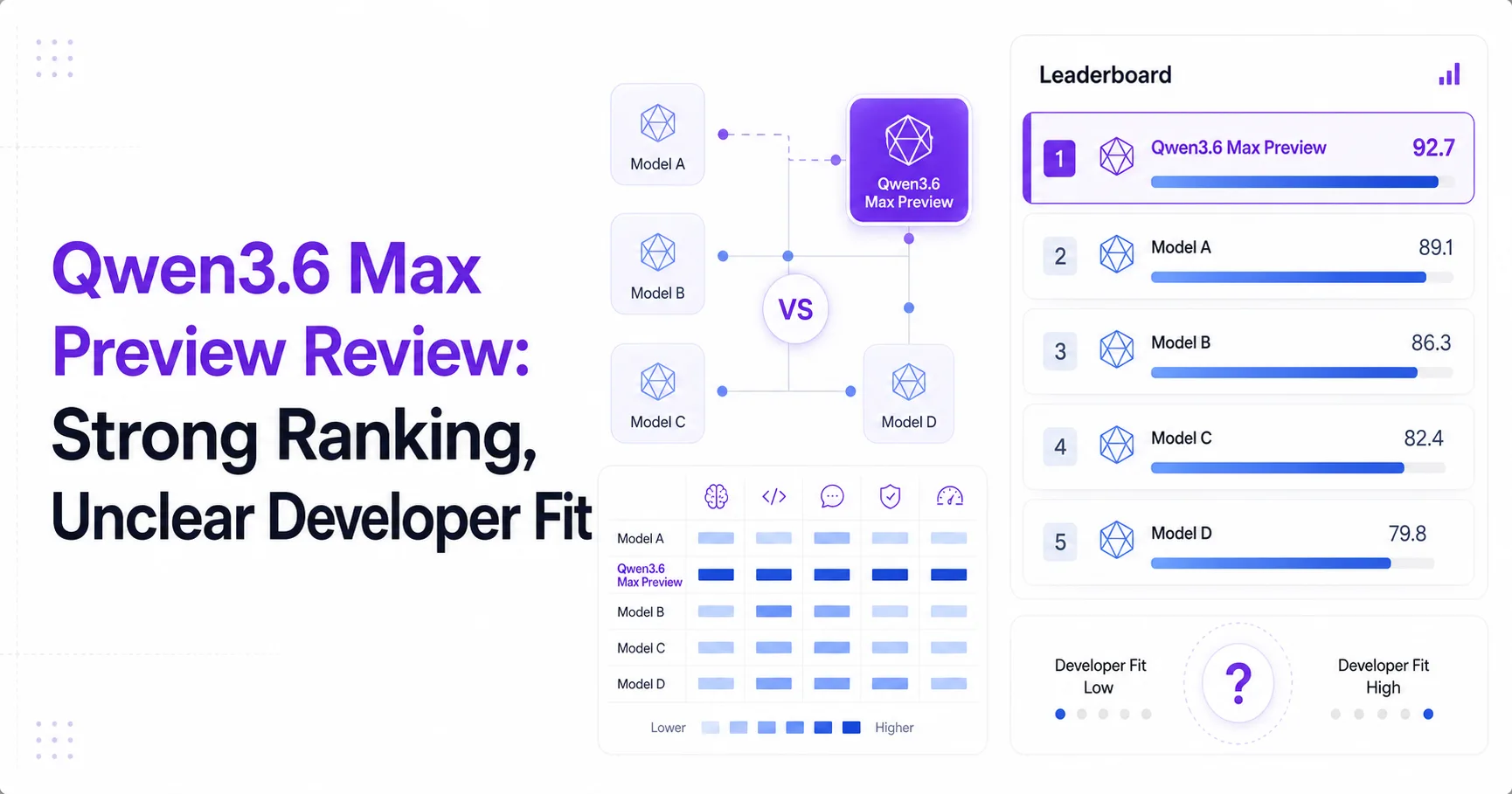
- **Where it stands:** Qwen3.6 Max Preview ranks 63 of 578 on the Artificial Analysis Intelligence Index at 40 - **Price:** $2.925 per 1M blended tokens - **Speed:** output tokens per second not reported, 0.3s to first token - **Pick it when:** you need a broadly capable model near the top of a large model pool and can validate behavior in your own workload - **Watch out:** no verified official documentation, stable model alias, community testing, or failure reports were found
Qwen3.6 Max Preview is a high-ranking but poorly documented model
Qwen3.6 Max Preview is a promising candidate for developers who value broad benchmark standing but need to tolerate substantial uncertainty around deployment details.
The available evidence places Qwen3.6 Max Preview at position 63 of 578 on the Artificial Analysis Intelligence Index, with a score of 40. That position makes the model meaningfully stronger than most models in the comparison pool, but it does not establish that Qwen3.6 Max Preview is the best choice for coding, tool use, long-context work, or production reliability.
The central selection problem is evidence quality. The research brief found no verifiable vendor announcement, developer documentation, model directory, stable alias, replacement relationship, current listed price, Reddit discussion, Hacker News discussion, X discussion, official limitation statement, or independently documented failure case. Developers therefore have a ranking signal, but not a complete product profile. Artificial Analysis supplies the measured comparison data, while the research brief supplies no independent qualitative evidence about how the model behaves in practice.
That gap matters more for a preview model than for an established production model. A strong index position can justify a controlled evaluation. It cannot, by itself, justify making the model a default dependency for a critical application.
The main trade-off is measured capability versus missing operational evidence
Qwen3.6 Max Preview offers a stronger measured position than its sparse documentation would suggest, but developers must supply the missing operational validation themselves.
The closest listed models create a useful reference frame. GPT-5.4 mini (xhigh) has the same Artificial Analysis Intelligence Index score of 40, while GLM-5.1 (Reasoning) and Inkling Small are listed at 40.2. GPT-5.2 Codex (xhigh) is listed at 40.1. These neighboring results show that Qwen3.6 Max Preview sits in a tightly packed band, rather than separating clearly from every nearby alternative.
| Decision factor | Qwen3.6 Max Preview | What the nearby models suggest |
|---|---|---|
| Broad measured standing | Strong, with position 63 of 578 | Several nearby models sit at similar index scores |
| Coding evidence | Not provided for Qwen3.6 Max Preview | GPT-5.4 mini (xhigh) is listed at 56.1, GLM-5.1 (Reasoning) at 55.8, and Inkling Small at 52.9 on the coding index |
| Cost position | Higher than some nearby options | GPT-5.4 mini (xhigh), GLM-5.1 (Reasoning), Grok Build 0.1 0616, and Inkling Small have lower blended prices |
| Operational confidence | Low from the supplied research | No verified documentation or community evidence was found |
The comparison does not prove that any neighboring model will perform better in a particular application. It does show that Qwen3.6 Max Preview needs a workload-specific reason to win. A generic assumption that a high intelligence score guarantees superior developer experience would go beyond the evidence. Artificial Analysis provides the comparison values used here.
Qwen3.6 Max Preview is best treated as a benchmark-qualified experiment
Qwen3.6 Max Preview’s ranking supports serious testing, but it does not reveal which real developer tasks will benefit most.
A position of 63 of 578 places Qwen3.6 Max Preview in the upper part of the measured pool. That is a useful screening result. It suggests the model deserves consideration before lower-ranked candidates, especially for general reasoning workloads where the Artificial Analysis Intelligence Index is relevant. The score alone does not identify the source of that strength, however.
The available data does not report Qwen3.6 Max Preview’s coding index, output-token speed, context window, or documented tool behavior. Those omissions prevent a confident recommendation for repository-scale coding, interactive agents, long documents, or latency-sensitive user interfaces. The first-token latency is listed as 0.3s, but the absence of reported output speed means developers cannot infer the complete response-time profile from the supplied data.
The coding comparison makes the uncertainty sharper. Nearby models have coding-index values of 56.1, 55.8, 51.5, and 52.9, but Qwen3.6 Max Preview has no corresponding coding value in the brief. That is evidence of an information gap, not evidence that Qwen3.6 Max Preview is weak at coding.
A sensible performance test should therefore focus on the tasks that determine product value: code modification, test repair, structured extraction, tool selection, refusal behavior, and recovery after ambiguous instructions. The research brief found no reliable community reports that could answer those questions. Artificial Analysis supports the ranking and latency claims, but it does not fill the missing qualitative evidence.
Qwen3.6 Max Preview is not the obvious value choice at its price
Qwen3.6 Max Preview’s $2.925 blended-token price is defensible for a strong model, but nearby alternatives make the value case conditional.
The price becomes attractive when the model’s task quality reduces retries, review time, or routing complexity. The price becomes difficult to justify when the workload is mostly routine, when output volume is high, or when a lower-priced neighbor reaches the required quality. The data brief lists GPT-5.4 mini (xhigh) at $1.6875 blended tokens, GLM-5.1 (Reasoning) at $2.135, Grok Build 0.1 0616 at $1.25, and Inkling Small at $0.525. These comparisons place Qwen3.6 Max Preview above every listed nearby model except GPT-5.2 Codex (xhigh), which is listed at $4.8125.
The input and output prices also matter differently by workload. Qwen3.6 Max Preview is listed at $1.3 per 1M input tokens and $7.8 per 1M output tokens. Applications that produce long answers will feel the output rate more strongly than applications that send large prompts and request compact results. A routing policy that reserves Qwen3.6 Max Preview for difficult requests could improve its economic case, but the supplied evidence does not show whether its quality advantage exists on those requests.
The missing context-window value is another cost risk. Developers cannot estimate how often prompts will need trimming, summarization, retrieval, or multi-pass processing from the brief alone. Those extra operations can change the practical cost of a model whose listed blended price appears acceptable.
Artificial Analysis is the source for the pricing comparisons. No verified current vendor pricing page was found in the research brief, so availability and billing conditions require confirmation before deployment.
Qwen3.6 Max Preview belongs in a gated shortlist, not an untested default
Qwen3.6 Max Preview is worth piloting for broad reasoning tasks, but the evidence is insufficient for an unconditional production recommendation.
Choose Qwen3.6 Max Preview when a team wants a high-ranking general model, can run its own evaluations, and values the possibility of consolidating several task types behind one endpoint. The model’s position of 63 of 578 gives that pilot a credible starting point. The listed 0.3s first-token latency also supports testing in interactive workflows, although missing output-speed data limits the conclusion.
Avoid making Qwen3.6 Max Preview the default choice when coding quality, predictable throughput, stable documentation, or known failure modes are mandatory on day one. The research brief found no verifiable official materials or reliable community reports for those dimensions. That absence is especially important for teams that need contractual clarity, migration guidance, or established debugging patterns.
A practical decision rule is simple: let Qwen3.6 Max Preview compete against the nearest alternatives on the team’s own task set. Include coding tasks because the model’s coding-index result is not supplied. Include long-context tests because the context-window value is unavailable. Include cost tracking because the output price is materially different from the input price. Promote the model only if its task success offsets its higher listed blended price and its operational uncertainties are acceptable.
| Use case | Recommendation |
|---|---|
| General reasoning pilot | Strong candidate for controlled testing |
| Production coding default | Wait for direct coding evaluation |
| Cost-sensitive routine generation | Compare lower-priced neighbors first |
| Latency-sensitive interaction | Test end-to-end output speed before choosing |
| High-compliance deployment | Require verified documentation and service terms |
The strongest conclusion supported by the evidence is therefore conditional: Qwen3.6 Max Preview merits evaluation, not automatic adoption. Artificial Analysis supports the quantitative shortlist position, while the research brief leaves the qualitative production case unresolved.
Questions developers should answer before adopting Qwen3.6 Max Preview
Qwen3.6 Max Preview requires workload-specific validation because the available evidence covers ranking, price, and first-token latency more clearly than product behavior.
The following questions target the gaps most likely to affect an implementation decision.
Frequently asked questions
Is Qwen3.6 Max Preview a strong model?
Qwen3.6 Max Preview appears strong on broad measured capability, ranking 63 of 578 with an Artificial Analysis Intelligence Index score of 40. That result supports serious evaluation, but it does not establish coding quality, tool reliability, or production stability.
Is Qwen3.6 Max Preview good for coding?
Qwen3.6 Max Preview cannot be confidently recommended for coding from the supplied evidence because no coding-index value or reliable coding experience report is available. Developers should test code generation, repository changes, debugging, and test repair directly.
Is Qwen3.6 Max Preview cost-effective?
Qwen3.6 Max Preview can be cost-effective when higher task quality reduces retries or human review, but its $2.925 blended-token price is above several nearby models. The value decision depends on measured success rates in the target workload.
Does Qwen3.6 Max Preview respond quickly?
Qwen3.6 Max Preview has a listed first-token latency of 0.3s, which is useful for interactive testing. Output-token speed is not reported, so complete response time and streaming experience remain uncertain until developers measure them.
Should Qwen3.6 Max Preview be used in production?
Qwen3.6 Max Preview should enter production only after a controlled evaluation confirms task quality, throughput, cost, and operational support. No verified official documentation, stable alias, or independent failure reports were found in the research brief.
Sources
- Artificial AnalysisArtificial Analysis Intelligence Index score and ranking, neighboring-model comparisons, pricing values, and first-token latency.
Published: