
Qwen3.7 Max
AvailableOther · 2026-05-19 · 32,000 tokens
An AI model from Other, suited to a broad range of AI workloads.
Supported modalities:textcode
Quick Overview
Text Generation5/10
Code Generation7/10
Reasoning6/10
Multimodal4/10
Benchmark Results
Scores from leading benchmark suites.
artificial analysis intelligence46.7
artificial analysis coding66.0
Performance Metrics
Latency and throughput performance.
Dive Deeper
AI model analysis
Qwen3.7 Max Review: Strong Coding Ranking, Unclear Product Readiness
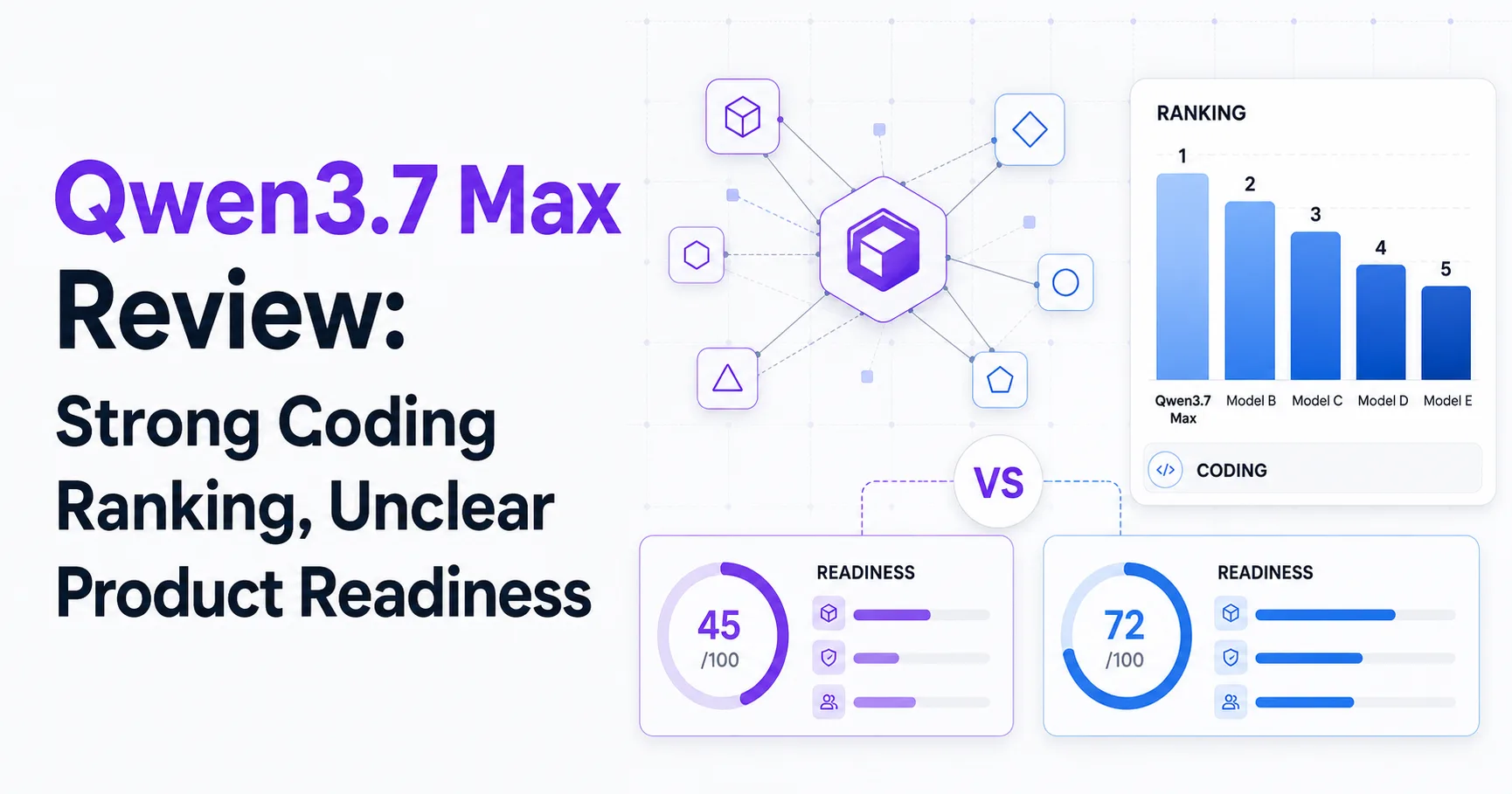
- **Where it stands:** Qwen3.7 Max ranks 35 of 578 on the Artificial Analysis Intelligence Index at 46 - **Price:** $3.75 per 1M blended tokens - **Speed:** 204.156 output tokens per second, 0.3s to first token - **Pick it when:** You want a comparatively strong coding benchmark position and can validate provider availability independently - **Watch out:** No reliable public source confirms Qwen3.7 Max’s product availability, coding experience, limitations, or current listing status
Qwen3.7 Max is a strong benchmark candidate with major deployment unknowns
Qwen3.7 Max looks most attractive to developers who prioritize coding performance, but its public product evidence is too thin for an automatic production recommendation. The model ranks 34 of 202 on the Artificial Analysis Coding Index at 66, placing it near the top of the supplied coding comparison set. It also ranks 35 of 578 on the Artificial Analysis Intelligence Index at 46. Those positions suggest broad capability and coding ability that deserve evaluation.
The evidence has an important boundary. The research brief found no verifiable official release announcement, developer documentation, pricing page, stable alias, callable status, replacement relationship, or current listed price. It also found no reliable Reddit, Hacker News, or X discussion that could establish coding ergonomics, response consistency, speed perception, or recurring model habits. The benchmark data supplies a useful performance signal, but it does not establish API readiness or operational fit.
This review therefore treats Qwen3.7 Max as a promising evaluated model, not as a fully documented product. The supplied measurements come from Artificial Analysis. Developers should confirm access, terms, safety behavior, context limits, and support directly with the intended provider before committing to an integration.
The model’s main case is coding rank, not proven ecosystem maturity
Qwen3.7 Max’s clearest advantage is its coding position, while its clearest weakness is the absence of verified product context. The coding rank is materially stronger than the general intelligence rank within their respective supplied leaderboards. That pattern supports a coding-first trial, especially for code generation, debugging, refactoring, and repository assistance. It does not prove success on a specific codebase.
The closest supplied models show why the decision is not one-dimensional. Qwen3.7 Max sits near models with similar intelligence scores, while some neighboring models offer lower blended pricing, faster output, or stronger coding scores. The comparison below frames those tradeoffs without treating the neighboring models as the subject.
| Decision factor | Qwen3.7 Max | Nearby reference point | Practical reading |
|---|---|---|---|
| Coding signal | Strong supplied ranking | Kimi K3 (low) has a higher coding score | Qwen3.7 Max is credible, but not the coding leader in the supplied set |
| Broad intelligence | Strong supplied ranking | Several nearby models have similar intelligence scores | The general capability gap appears narrow in this neighborhood |
| Cost position | $3.75 blended | GPT-5.6 Luna (high) is cheaper; Kimi K3 (low) is more expensive | Price alone does not make Qwen3.7 Max the obvious choice |
| Responsiveness | 204.156 output tokens per second and 0.3s latency | Gemini 3.5 Flash (medium) is faster | Qwen3.7 Max favors a balanced response profile rather than maximum speed |
| Product evidence | Limited public verification | Research brief contains no validated product sources | Deployment confidence remains an open question |
The supplied benchmark data is useful for narrowing a shortlist. It cannot answer whether the model has dependable tools, stable behavior, or acceptable enterprise controls.
Qwen3.7 Max’s coding rank supports serious testing, but not task-level certainty
Qwen3.7 Max’s coding ranking supports serious developer testing because it places 34 of 202 on the supplied Artificial Analysis Coding Index. A position near the front of that set indicates a meaningful coding signal. The score should guide prioritization, not replace task-specific evaluation.
For a developer, the practical implication is straightforward. Qwen3.7 Max deserves a place in evaluations for code completion, test writing, bug localization, API usage, and multi-file changes. The available evidence does not show which of those tasks drives the ranking. It also does not reveal whether the model performs consistently across languages, frameworks, repository sizes, or instruction styles. Those are evidence gaps, not hidden strengths.
The response profile adds a useful operational clue. Qwen3.7 Max records 204.156 median output tokens per second and 0.3 seconds of latency in the data brief. That combination suggests a model that may feel responsive during interactive development. The speed figure is a median, so it should not be treated as a guarantee for every provider, request, or output length. The research brief found no reliable community evidence about perceived speed or coding workflow quality.
The coding conclusion can also flip under different requirements. If your workload rewards the highest coding score in this supplied neighborhood, Kimi K3 (low) provides a stronger reference point. If interactive throughput matters more than benchmark rank, Gemini 3.5 Flash (medium) provides a faster reference point. If consistent tool use, repository navigation, or documented API behavior is mandatory, the current evidence is insufficient to rank Qwen3.7 Max confidently.
A sensible evaluation should compare accepted patches, test pass rates, correction cycles, and developer review time on representative tasks. Those measurements are not supplied here, so this article does not assign task-level success rates.
Qwen3.7 Max is reasonably positioned, but its price needs workload justification
Qwen3.7 Max costs $3.75 per 1M blended tokens, which makes it a middle-ground option rather than an obvious budget choice. The price can be justified if its coding performance reduces retries, review effort, or the number of model calls needed for a task. The supplied brief does not provide those workflow measurements, so the economic case remains conditional.
The neighboring models clarify the tradeoff. GPT-5.6 Luna (high) has a much lower blended price in the supplied data, while Gemini 3.5 Flash (medium) is also priced below Qwen3.7 Max and has higher measured output speed. Kimi K3 (low) costs more while offering a higher coding score. Qwen3.7 Max therefore occupies an uncomfortable decision point: developers pay more than some nearby alternatives without receiving the strongest supplied coding signal.
That does not make Qwen3.7 Max poor value. A model’s effective cost depends on the whole interaction pattern. A lower price can lose its advantage if the model needs repeated corrections. A higher coding score can lose its advantage if the model produces verbose or difficult-to-review changes. Neither correction burden nor output quality at the repository level is documented in the research brief.
Input and output pricing also create different risks. The supplied input price is $2.5 per 1M tokens, and the output price is $7.5 per 1M tokens. Code agents that send large repositories or generate long patches should model both sides of usage. The data brief does not include a context window, so large-context economics and long-file behavior cannot be assessed reliably.
Use Qwen3.7 Max when its coding signal is valuable enough to offset the price difference, and verify that assumption with a representative pilot. Without that pilot, the available data does not show that Qwen3.7 Max is cheaper in practice than the nearby alternatives.
Choose Qwen3.7 Max for a coding-focused trial, not an unverified default
Qwen3.7 Max is worth shortlisting for coding-heavy evaluation, but the available evidence does not support making it the default production model. Its strongest case comes from the 34 of 202 coding position and the 66 coding score. Its case weakens when documented availability, provider stability, context behavior, or ecosystem support becomes a release requirement.
| Use case | Recommendation | Reason |
|---|---|---|
| Coding assistant pilot | Choose for testing | The supplied coding ranking is strong enough to justify evaluation |
| Interactive code generation | Consider | The measured latency is 0.3 seconds and output speed is 204.156 tokens per second |
| Lowest-cost high-volume routing | Compare first | Nearby supplied models have lower blended prices |
| Maximum coding benchmark position | Compare first | Kimi K3 (low) has the higher supplied coding score |
| Production API adoption | Wait for verification | The research brief found no validated callable status, documentation, or current product listing |
| Compliance-sensitive deployment | Evidence insufficient | No reliable official limitations or governance material was found |
The best selection process is a gated pilot. First, verify that the exact model can be called through the intended provider. Next, test representative repository tasks. Then compare patch acceptance, test outcomes, latency under realistic prompts, and total token use. Finally, review failure handling and provider commitments.
Qwen3.7 Max should move forward if it produces better accepted work at an acceptable total cost. It should not move forward solely because its leaderboard position looks strong. The research brief provides no confirmed official source for product identity, limitations, or support. That missing evidence is central to the recommendation, not a minor documentation issue.
Questions developers should answer before adopting Qwen3.7 Max
Qwen3.7 Max requires provider verification before developers treat benchmark strength as deployment readiness. The supplied research brief found no reliable official documentation or community evidence for product behavior, so the questions below separate what the data supports from what remains unknown.
Is Qwen3.7 Max a good choice for coding?
Qwen3.7 Max is a credible coding candidate because it ranks 34 of 202 on the supplied Artificial Analysis Coding Index at 66, but task-level repository performance remains unverified.
Is Qwen3.7 Max good value for money?
Qwen3.7 Max may offer reasonable value for coding workloads if its stronger coding signal reduces retries and review effort, but the supplied data does not measure those savings against lower-priced alternatives.
Is Qwen3.7 Max fast enough for interactive development?
Qwen3.7 Max appears suitable for interactive testing because the supplied data records 0.3 seconds of latency and 204.156 median output tokens per second, although provider behavior may differ.
Should developers use Qwen3.7 Max in production?
Qwen3.7 Max should enter production only after access, documentation, context limits, operational support, and failure behavior are verified because the research brief confirms none of those details.
What is the biggest unknown about Qwen3.7 Max?
Qwen3.7 Max’s biggest unknown is product readiness: no reliable source in the research brief confirms a stable alias, callable status, current listing, official limits, or community usage pattern.
Which nearby model should developers compare with it?
Qwen3.7 Max should be compared with GPT-5.6 Luna (high) for cost, Gemini 3.5 Flash (medium) for speed, and Kimi K3 (low) for the stronger supplied coding signal.
Frequently asked questions
Is Qwen3.7 Max a good choice for coding?
Qwen3.7 Max is a credible coding candidate because it ranks 34 of 202 on the supplied Artificial Analysis Coding Index at 66, but task-level repository performance remains unverified.
Is Qwen3.7 Max good value for money?
Qwen3.7 Max may offer reasonable value for coding workloads if its stronger coding signal reduces retries and review effort, but the supplied data does not measure those savings against lower-priced alternatives.
Is Qwen3.7 Max fast enough for interactive development?
Qwen3.7 Max appears suitable for interactive testing because the supplied data records 0.3 seconds of latency and 204.156 median output tokens per second, although provider behavior may differ.
Should developers use Qwen3.7 Max in production?
Qwen3.7 Max should enter production only after access, documentation, context limits, operational support, and failure behavior are verified because the research brief confirms none of those details.
What is the biggest unknown about Qwen3.7 Max?
Qwen3.7 Max’s biggest unknown is product readiness: no reliable source in the research brief confirms a stable alias, callable status, current listing, official limits, or community usage pattern.
Sources
- Artificial AnalysisBenchmark rankings, evaluation scores, pricing, latency, and output speed supplied in the data brief.
Published: