
AI model analysis
Agnes 2.5 Pro Alpha vs GPT-5 (high): Which Model Should Developers Choose?
A developer-focused comparison of Agnes 2.5 Pro Alpha and GPT-5 (high), covering coding performance, cost, latency, API maturity, evidence quality, and deployment risk.
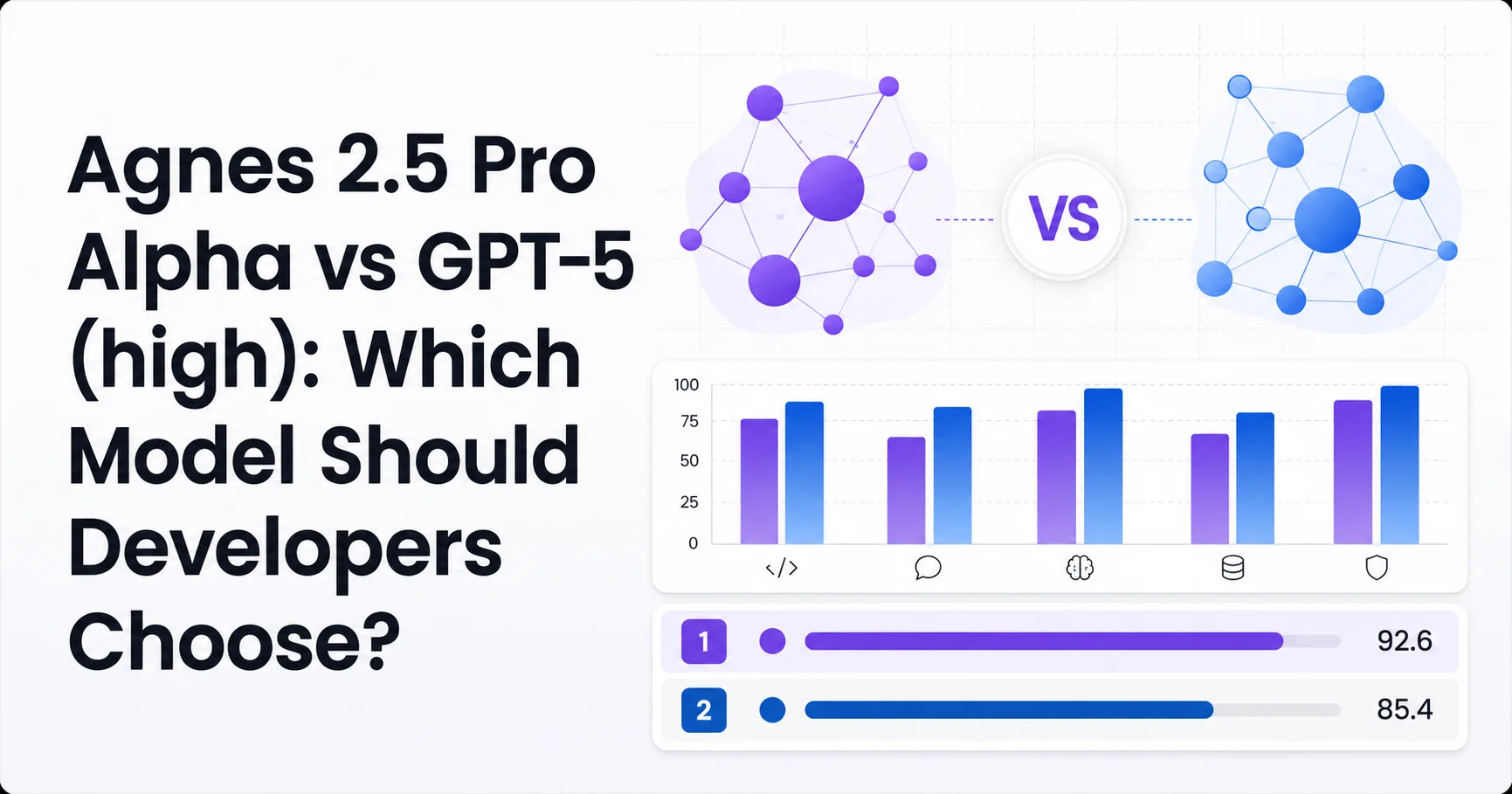
- **Winner overall:** Agnes 2.5 Pro Alpha, with a 58.8 coding index versus GPT-5 (high) at 37.8 and a lower blended price - **Cheaper:** Agnes 2.5 Pro Alpha at $0.5625000000000001 vs $3.4375 per 1M blended tokens - **Faster:** Agnes 2.5 Pro Alpha at 115.763 (median output tokens per second) - **Pick GPT-5 (high) when:** you need documented API behavior, structured tool use, image input, and a published math index of 94.3 - **Watch out:** Agnes 2.5 Pro Alpha has no verified official documentation or community testing in the supplied research brief
Agnes 2.5 Pro Alpha vs GPT-5 (high)
Agnes 2.5 Pro Alpha is the stronger measured value for coding workloads, while GPT-5 (high) is the safer documented integration choice. The supplied data brief gives Agnes 2.5 Pro Alpha a coding index of 58.8, compared with 37.8 for GPT-5 (high), and a blended price of $0.5625000000000001 per 1M tokens, compared with $3.4375. Agnes also has a measured median output speed of 115.763 tokens per second, while GPT-5 (high) has no corresponding value in the data brief. Both models show a latency value of 0.3 seconds. Data provided by https://artificialanalysis.ai/ The main qualification is evidence quality. The research brief contains no verifiable official product page, API documentation, pricing page, community discussion, or failure report for Agnes 2.5 Pro Alpha. GPT-5 has public documentation and developer-facing material, including its API alias, reasoning controls, tool capabilities, and model lifecycle status. That difference changes the decision. Agnes may be the better candidate for controlled experiments and cost-sensitive coding traffic. GPT-5 is easier to audit, integrate, and govern when production reliability depends on documented behavior.
Executive summary for developers
Agnes 2.5 Pro Alpha leads the supplied coding and general intelligence indices, but GPT-5 (high) leads the evidence and capability-documentation case. The comparison is not a simple quality ranking because the two briefs measure different kinds of confidence. Agnes has an Artificial Analysis coding index of 58.8 and intelligence index of 38.8. GPT-5 (high) has corresponding values of 37.8 and 34.7, plus a math index of 94.3 that Agnes does not have. The missing Agnes math value is not evidence of weakness. It means the supplied material cannot establish a direct comparison for mathematical reasoning. The same limitation applies to context windows, because both entries show no context-window value in the data brief. | Decision factor | Agnes 2.5 Pro Alpha | GPT-5 (high) | |—|—:|—:| | Coding index | 58.8 | 37.8 | | Intelligence index | 38.8 | 34.7 | | Math index | Not provided | 94.3 | | Latency | 0.3 seconds | 0.3 seconds | | Blended price | $0.5625000000000001 | $3.4375 |
GPT-5 is documented by GPT-5 for developers and GPT-5 model documentation. Those sources describe a reasoning model for coding, reasoning, and agentic tasks. They also document function calling, structured outputs, streaming, and custom tools. Agnes has no comparable verified source in the supplied research brief. The practical summary is clear: Agnes wins the measured economics and coding signal; GPT-5 wins integration confidence and documented breadth.
Performance: what the chart does not show
Agnes 2.5 Pro Alpha offers the stronger measured coding signal, but GPT-5 (high) remains the better-documented choice for tasks where correctness depends on explicit reasoning controls. The coding index gap is 21 points, with Agnes at 58.8 and GPT-5 (high) at 37.8. For developers, that gap suggests Agnes deserves a serious trial for code generation, bug fixing, refactoring, and repository-level assistance. It does not prove that Agnes will produce better patches in a specific stack. The brief provides no Agnes benchmark method, evaluation protocol, API documentation, or user testing record. GPT-5 has published developer benchmarks, but those results cannot be treated as a direct apples-to-apples comparison with the Artificial Analysis indices. GPT-5 for developers reports results on coding and agent-oriented evaluations, while the supplied data brief uses Artificial Analysis indices. The measurement systems therefore answer different questions. GPT-5 also supports configurable reasoning effort and verbosity, which gives developers a documented way to trade response depth against runtime and cost. GPT-5 model documentation documents text and image input, text output, function calling, structured outputs, streaming, and custom tools. Agnes has no verified evidence for equivalent features. The practical interpretation is that Agnes looks attractive for measured coding throughput, while GPT-5 offers more known control surfaces for production workflows. The 0.3-second latency value is equal for both entries, but GPT-5 has no supplied output-speed value, so speed superiority is not established.
Cost: when the cheaper model can still cost more
Agnes 2.5 Pro Alpha is dramatically cheaper in the supplied pricing snapshot, but GPT-5 (high) can still be cheaper at the application level if it reduces retries, review time, or failed tool actions. Agnes costs $0.5625000000000001 per 1M blended tokens, compared with $3.4375 for GPT-5 (high). Its input price is $0.45 per 1M tokens, and its output price is $0.9. GPT-5 is listed at $1.25 for input and $10 for output. Those numbers make Agnes the natural first candidate for high-volume coding assistance, batch transformations, and workloads with predictable prompts. The chart cannot show the operational cost of uncertainty. Agnes has no verified official pricing page, API alias, availability statement, or replacement policy in the research brief. Artificial Analysis data can identify the supplied price snapshot, but it cannot establish contract terms, quota behavior, or future availability. Data provided by https://artificialanalysis.ai/ GPT-5 has a documented API model alias and endpoint coverage in GPT-5 model documentation, which can reduce integration effort and migration risk. A model that needs fewer manual checks may justify a higher token price for critical code changes. The supplied research also reports one Reddit user finding GPT-5 useful for small debugging tasks, while warning about hallucinations or incorrect modifications in complex existing repositories. Tried GPT-5 Here Are My First Impressions That account is subjective and not a cost benchmark. Developers should therefore treat Agnes as the lower token-cost option, not automatically the lower total-cost option.
Recommendation by workload
Agnes 2.5 Pro Alpha is the better experimental pick for cost-sensitive coding traffic, while GPT-5 (high) is the better operational pick when documentation and control matter more than token price. Choose Agnes first when your workload is dominated by code generation, routine debugging, or large-volume transformations and you can run acceptance tests around every change. Its coding index of 58.8 and median output speed of 115.763 tokens per second make it worth validating in a private evaluation. The research brief does not establish whether Agnes supports structured outputs, function calling, image input, streaming, or stable API semantics. Those unknowns are material for agent systems. Choose GPT-5 when your application needs documented reasoning effort, verbosity controls, structured tool use, or image input. GPT-5 for developers and GPT-5 model documentation provide the relevant public capability evidence. GPT-5 is also the better fit when your team needs a known vendor, a named API alias, and documented endpoint support. Do not interpret the GPT-5 (high) label as a separate API model. The research brief found no official gpt-5-high model ID. Instead, high refers to the reasoning_effort=high parameter on gpt-5. The fixed snapshot gpt-5-2025-08-07 is marked Deprecated in the model documentation, creating a lifecycle concern for applications that pin that snapshot. This leaves a split recommendation: Agnes for measured value under strong local validation, GPT-5 for documented production integration with migration planning.
Evidence boundaries and version risk
GPT-5 has the clearer public evidence base, while Agnes 2.5 Pro Alpha cannot yet be evaluated for documentation quality from the supplied sources. The Agnes brief contains no verifiable official announcement, developer documentation, pricing page, community discussion, test method, or failure report. That absence prevents confident conclusions about reliability, availability, support, and compatibility. It also prevents a fair comparison of context limits, tool behavior, and real-world failure modes. GPT-5 has stronger public evidence, but its evidence is not uniformly favorable. OpenAI documents the gpt-5 alias and describes the model as a previous generation, while recommending GPT-5.6. The fixed snapshot gpt-5-2025-08-07 is marked Deprecated. GPT-5 model documentation Developers choosing GPT-5 should distinguish the stable alias from the deprecated snapshot and test migration behavior before pinning a production dependency. Community evidence also remains limited. One Reddit post describes faster small-bug work but less complete application and UI generation, with possible hallucinations or incorrect edits in complex existing repositories. Tried GPT-5 Here Are My First Impressions The post reflects one uncontrolled experience and cannot establish a general failure rate. No comparable community evidence exists for Agnes in the supplied material. The most important unresolved question is whether Agnes’s measured advantage survives a controlled test using the developer’s own repositories, prompts, review rules, and tool loop.
Frequently asked questions
GPT-5 (high) is the safer default for teams that require documented APIs, explicit reasoning controls, and known tool-calling behavior. Agnes 2.5 Pro Alpha is the more attractive candidate for teams willing to validate an undocumented model through controlled testing.
Frequently asked questions
Which model should a developer choose for coding?
Agnes 2.5 Pro Alpha is the stronger measured coding candidate because its coding index is 58.8 versus 37.8 for GPT-5 (high), but developers should validate patch quality on their own repositories before adoption.
Which model is cheaper for production API usage?
Agnes 2.5 Pro Alpha is cheaper in the supplied snapshot, at $0.5625000000000001 per 1M blended tokens versus $3.4375 for GPT-5 (high), although operational review and retry costs remain unknown.
Is GPT-5 (high) a separate API model?
GPT-5 (high) is not established as a separate official API model ID in the supplied research; high refers to the reasoning_effort=high parameter used with the gpt-5 model alias.
Does either model have a clear advantage in latency?
Neither model has a measured latency advantage in the supplied data because both entries show 0.3 seconds; Agnes has a median output speed of 115.763 tokens per second, while GPT-5 has no supplied value.
Which model is safer for a documented production integration?
GPT-5 (high) is safer for a documented production integration because OpenAI publishes model documentation, API aliases, endpoint coverage, reasoning controls, and tool capabilities, while Agnes has no verified documentation in the research brief.
Can the supplied evidence prove Agnes is better overall?
The supplied evidence cannot prove Agnes 2.5 Pro Alpha is better overall because its coding and intelligence indices are stronger, but it lacks comparable evidence for math, API behavior, availability, support, and failure modes.
Sources
- Artificial AnalysisData attribution for pricing, latency, output speed, and evaluation values in the supplied data brief.
- GPT-5 for developersGPT-5 API positioning, reasoning controls, tool capabilities, and official benchmark context.
- GPT-5 model documentationGPT-5 model alias, endpoint availability, modality, lifecycle status, pricing, and documented API capabilities.
- Tried GPT-5 Here Are My First ImpressionsUncontrolled community evidence about debugging, application generation, hallucinations, and incorrect modifications.
Published: