
AI model analysis
Claude 4.5 Sonnet (Reasoning) vs GPT-5 (high): Which Model Should Developers Choose?
A developer-focused comparison of Claude 4.5 Sonnet (Reasoning) and GPT-5 (high), covering coding, mathematics, latency, pricing, API stability, and evidence gaps.
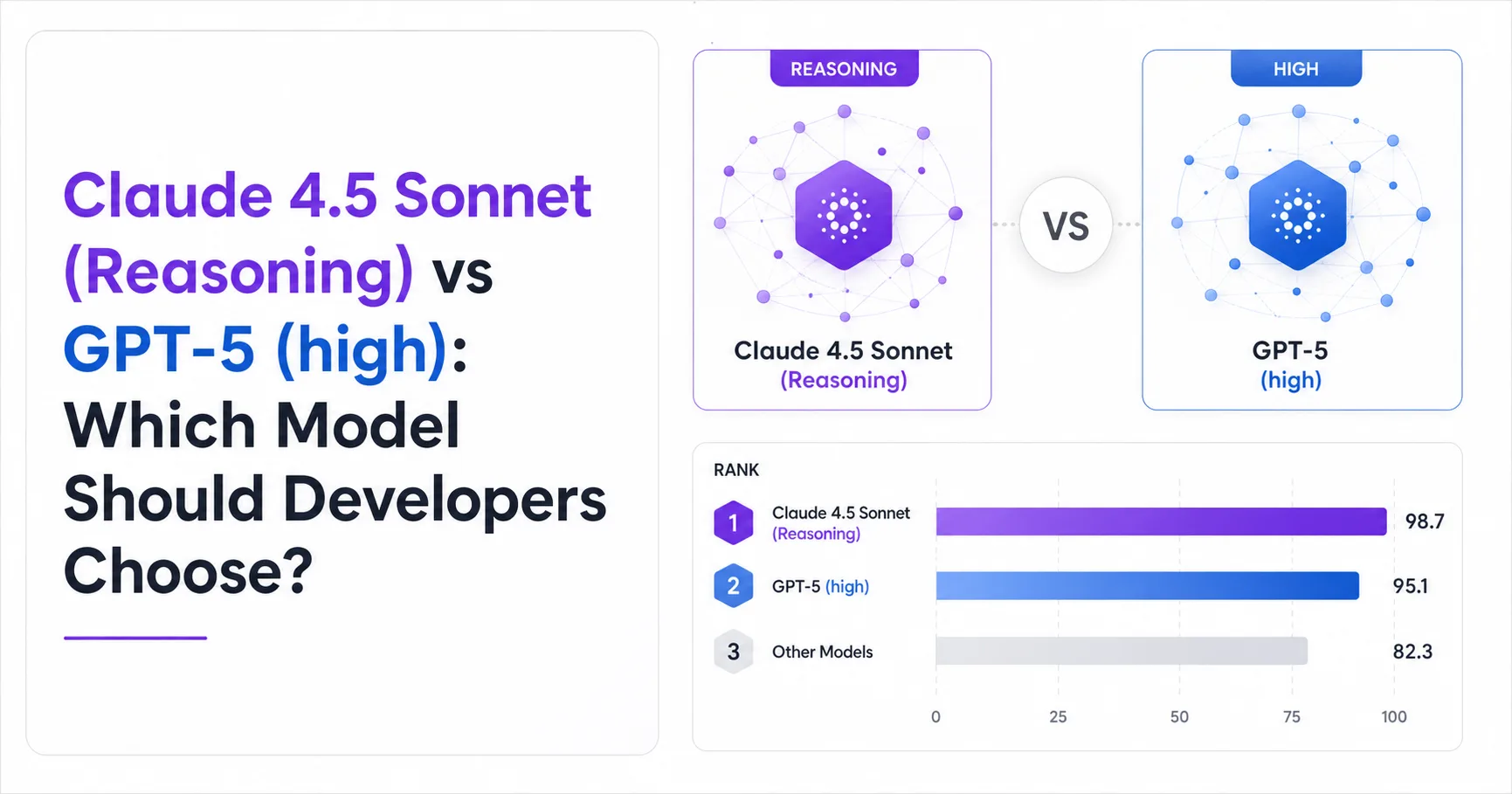
- **Winner overall:** Claude 4.5 Sonnet (Reasoning), with a 52.1 coding index and a 36.4 intelligence index - **Cheaper:** GPT-5 (high) at $3.4375 vs $6 per 1M blended tokens - **Faster:** Claude 4.5 Sonnet (Reasoning) and GPT-5 (high) tied at 0.3 seconds latency - **Pick Claude 4.5 Sonnet (Reasoning) when:** coding quality and complex software work matter more than lowest cost - **Watch out:** Reliable community evidence is missing for Claude 4.5 Sonnet (Reasoning), while GPT-5 feedback comes from one uncontrolled test
Claude 4.5 Sonnet (Reasoning) vs GPT-5 (high)
Claude 4.5 Sonnet (Reasoning) is the stronger coding choice, while GPT-5 (high) is the cheaper and stronger mathematics choice. The Artificial Analysis snapshot gives Claude a coding index of 52.1 versus 37.8 for GPT-5, while GPT-5 leads mathematics at 94.3 versus 88. Claude costs $6 per 1M blended tokens, compared with $3.4375 for GPT-5. Both models show 0.3 seconds latency in the supplied data. Data provided by https://artificialanalysis.ai/.
Executive summary for model selection
Claude 4.5 Sonnet (Reasoning) offers the clearer case for coding-heavy workloads, but GPT-5 (high) offers better economics and mathematics performance. The coding gap is substantial in the supplied index, while the overall intelligence gap is narrow. That combination suggests workload fit matters more than a universal ranking.
| Decision factor | Better choice | Evidence and implication |
|---|---|---|
| Coding-oriented work | Claude 4.5 Sonnet (Reasoning) | The coding index is 52.1 versus 37.8, so Claude has the stronger measured position for software tasks. |
| Mathematics-heavy work | GPT-5 (high) | The mathematics index is 94.3 versus 88, giving GPT-5 the stronger measured result. |
| Blended token cost | GPT-5 (high) | The supplied 3-to-1 blended price is $3.4375 versus $6. |
| Latency | Tie | Both models are listed at 0.3 seconds. |
| API documentation | GPT-5 (high) | OpenAI documents the gpt-5 alias, model parameters, tools, endpoints, and limits at GPT-5 model documentation. |
Anthropic’s current model overview describes Claude models as supporting text and image input, text output, multilingual capability, and vision, but it does not provide a complete Claude Sonnet 4.5-specific capability record. See Model overview. OpenAI documents GPT-5 as a reasoning model for coding, reasoning, and agentic tasks, with text and image input and text output. See GPT-5 for developers.
The evidence is not symmetrical. GPT-5 has published model limits and one documented community test, while reliable community testing for Claude 4.5 Sonnet (Reasoning) was not found. The supplied materials therefore support a workload recommendation, not a complete production reliability verdict.
Performance: coding, mathematics, and real task behavior
Claude 4.5 Sonnet (Reasoning) is the better measured option for coding workflows, while GPT-5 (high) is stronger on the supplied mathematics index. Claude’s coding index is 52.1, compared with 37.8 for GPT-5. In practical selection terms, that gap favors Claude for code generation, repository changes, refactoring, and debugging where software-specific performance dominates the decision.
GPT-5’s mathematics index is 94.3, compared with 88 for Claude. That result favors GPT-5 for workloads with substantial symbolic reasoning, quantitative verification, or mathematical subproblems. It does not prove that GPT-5 is better for every engineering task, because software work also depends on repository context, tool use, instruction following, and the quality of generated changes.
The intelligence indices are close, at 36.4 for Claude and 34.7 for GPT-5. A narrow overall gap alongside a larger coding gap means aggregate scores should not replace task-specific evaluation. Developers should test representative prompts, tool schemas, repository conventions, and failure recovery before switching production traffic.
Both models are listed at 0.3 seconds latency, so the supplied data does not establish a speed winner. Output speed is unavailable for both models. A developer choosing on interactive responsiveness therefore has insufficient evidence to rank them from this snapshot alone.
OpenAI publishes SWE-bench Verified, Aider polyglot, and tool-use benchmark results for GPT-5, including a 74.9% SWE-bench Verified result and an 88% Aider polyglot result, at GPT-5 for developers. Anthropic’s overview does not provide comparable Claude Sonnet 4.5-specific official benchmark entries, so cross-source benchmark comparisons remain incomplete.
Cost: the cheaper model can still cost more in practice
GPT-5 (high) is cheaper on every supplied token-price measure, but Claude 4.5 Sonnet (Reasoning) may still be preferable when better coding output reduces review and rework. GPT-5 costs $1.25 per 1M input tokens and $10 per 1M output tokens. Claude costs $3 per 1M input tokens and $15 per 1M output tokens. The supplied 3-to-1 blended prices are $3.4375 for GPT-5 and $6 for Claude.
The price difference matters most for high-volume workloads, long-running agents, and applications with substantial generated output. It matters less when engineering time, failed patches, or manual review dominate the total cost. Claude’s higher coding index may justify its price for teams whose primary expense is correcting weak code rather than serving tokens.
Prompt caching changes the calculation for repeated context. Anthropic lists a 5-minute cache write at $3.75 per 1M tokens, a 1-hour cache write at $6, and cache reads and refreshes at $0.30. These rates mean caching is a paid mechanism with its own break-even assumptions, not a free reduction in context cost. The details appear in Pricing.
Anthropic also states that regional and multi-region endpoints carry a 10% premium for Claude Sonnet 4.5 and later models, while the global endpoint is the default. That premium can reverse part of the apparent savings from an architectural decision about data residency or routing. The supplied materials do not provide equivalent GPT-5 endpoint premiums, so the complete deployment-cost comparison is evidence-limited.
Cost tests should therefore measure successful task completion, review time, retries, and output volume. A token-only comparison correctly identifies GPT-5 as cheaper, but it does not establish the lower total cost of ownership for every development workflow.
Recommendation by developer workload
Claude 4.5 Sonnet (Reasoning) is the default pick for coding-first teams, while GPT-5 (high) is the default pick for cost-sensitive or mathematics-heavy systems. Choose Claude when the primary work involves repository edits, implementation detail, debugging, or code review and the measured coding advantage is relevant to your traffic. Choose GPT-5 when mathematics performance, lower token prices, documented controls, or broad tool-oriented API behavior matter more.
GPT-5 has a clearer documented API surface in the supplied materials. OpenAI documents the gpt-5 alias, the gpt-5-2025-08-07 snapshot, reasoning_effort, verbosity, function calling, structured outputs, streaming, custom tools, and endpoint availability at GPT-5 for developers and GPT-5 model documentation. The same model documentation states that fine-tuning and predicted outputs are unsupported.
Claude remains listed in Anthropic’s current pricing table and is not marked retired, but the same page lists Claude Sonnet 4.6 and Claude Sonnet 5. The supplied materials do not state that Claude Sonnet 4.5 has been replaced or stopped. GPT-5 presents the opposite version signal: the stable gpt-5 alias remains documented, while the fixed gpt-5-2025-08-07 snapshot is marked Deprecated and the page recommends GPT-5.6. These statuses make version pinning and migration planning important for both choices, though the risks differ.
Community evidence does not settle the decision. A Reddit author reports that GPT-5 was useful for small bug fixes but less complete for full applications and UI generation, with possible hallucinations or incorrect changes in complex existing codebases. The report is subjective and uncontrolled, as described in Tried GPT-5 Here Are My First Impressions. No reliable comparable community test was found for Claude 4.5 Sonnet (Reasoning). Teams should run a private bake-off before committing production traffic.
Evidence gaps and migration risks
GPT-5 (high) has clearer published boundaries, while Claude 4.5 Sonnet (Reasoning) has larger model-specific documentation gaps. OpenAI explicitly documents GPT-5’s 400,000-token context window, 128,000-token maximum output, 2024-09-30 knowledge cutoff, and lack of audio or video input and output at GPT-5 model documentation. Anthropic’s supplied model overview does not clearly state Claude Sonnet 4.5’s context window, maximum output, extended-thinking parameters, visual restrictions, or model-specific official benchmark results.
That documentation asymmetry should not be mistaken for a capability deficit. It means developers have less verified information for designing limits, estimating prompt capacity, or writing portability assumptions around Claude 4.5 Sonnet (Reasoning). The available materials also do not provide reliable Claude-specific community tests, while GPT-5’s community evidence is limited to one uncontrolled Reddit discussion.
A further naming issue affects implementation. Anthropic’s materials describe dated model identifiers and convenience aliases for models before 4.6, but the supplied page does not give a complete Claude Sonnet 4.5 alias. OpenAI’s materials clarify that “high” is a reasoning_effort value for gpt-5, not an independent gpt-5-high model ID. Teams should verify the exact callable identifier in their target provider before deployment.
The evidence is insufficient to claim a definitive winner for reliability, output quality across all domains, or production incident behavior. Those questions require controlled tests using the team’s own repositories, prompts, tool calls, and acceptance checks.
Frequently asked questions
Which model should developers choose for coding?
Claude 4.5 Sonnet (Reasoning) is the stronger first choice for coding because the supplied coding index is 52.1 versus 37.8 for GPT-5, although teams should validate their own repositories and tool workflows.
Which model is cheaper for API usage?
GPT-5 (high) is cheaper on the supplied blended price at $3.4375 per 1M tokens versus $6 for Claude 4.5 Sonnet (Reasoning), with lower input and output prices as well.
Which model is better for mathematics?
GPT-5 (high) is better on the supplied mathematics index at 94.3 versus 88 for Claude 4.5 Sonnet (Reasoning), making it the stronger measured option for mathematics-heavy workloads.
Is GPT-5 (high) a separate API model?
GPT-5 (high) is not a separate API model in the supplied OpenAI documentation; “high” refers to the reasoning_effort=high parameter for the gpt-5 model.
Are the two models equally fast?
The supplied data lists both Claude 4.5 Sonnet (Reasoning) and GPT-5 (high) at 0.3 seconds latency, so it does not establish a speed winner or provide output-speed data.
Should teams pin a fixed model version?
Teams should pin and monitor versions carefully because the GPT-5 fixed snapshot gpt-5-2025-08-07 is marked Deprecated, while Claude Sonnet 4.5 remains listed but has later versions shown in pricing documentation.
Sources
- Artificial AnalysisSupplied benchmark, latency, release-date, and pricing snapshot.
- Model overviewClaude model capabilities, version identifiers, aliases, and platform availability.
- PricingClaude Sonnet 4.5 availability, token prices, prompt caching, and regional endpoint premium.
- GPT-5 for developersGPT-5 positioning, reasoning parameters, tool support, and official benchmark context.
- GPT-5 model documentationGPT-5 alias, snapshot status, context and output limits, modalities, pricing, endpoints, and unsupported features.
- Tried GPT-5 Here Are My First ImpressionsUncontrolled community observations about GPT-5 debugging, application generation, and complex codebase behavior.
Published: