
AI model analysis
Claude Fable 5 vs Claude Opus 5: Which Model Should Developers Choose?
A source-linked comparison of Claude Fable 5 and Claude Opus 5 for coding agents, production APIs, cost-sensitive workloads, and long-running automation.
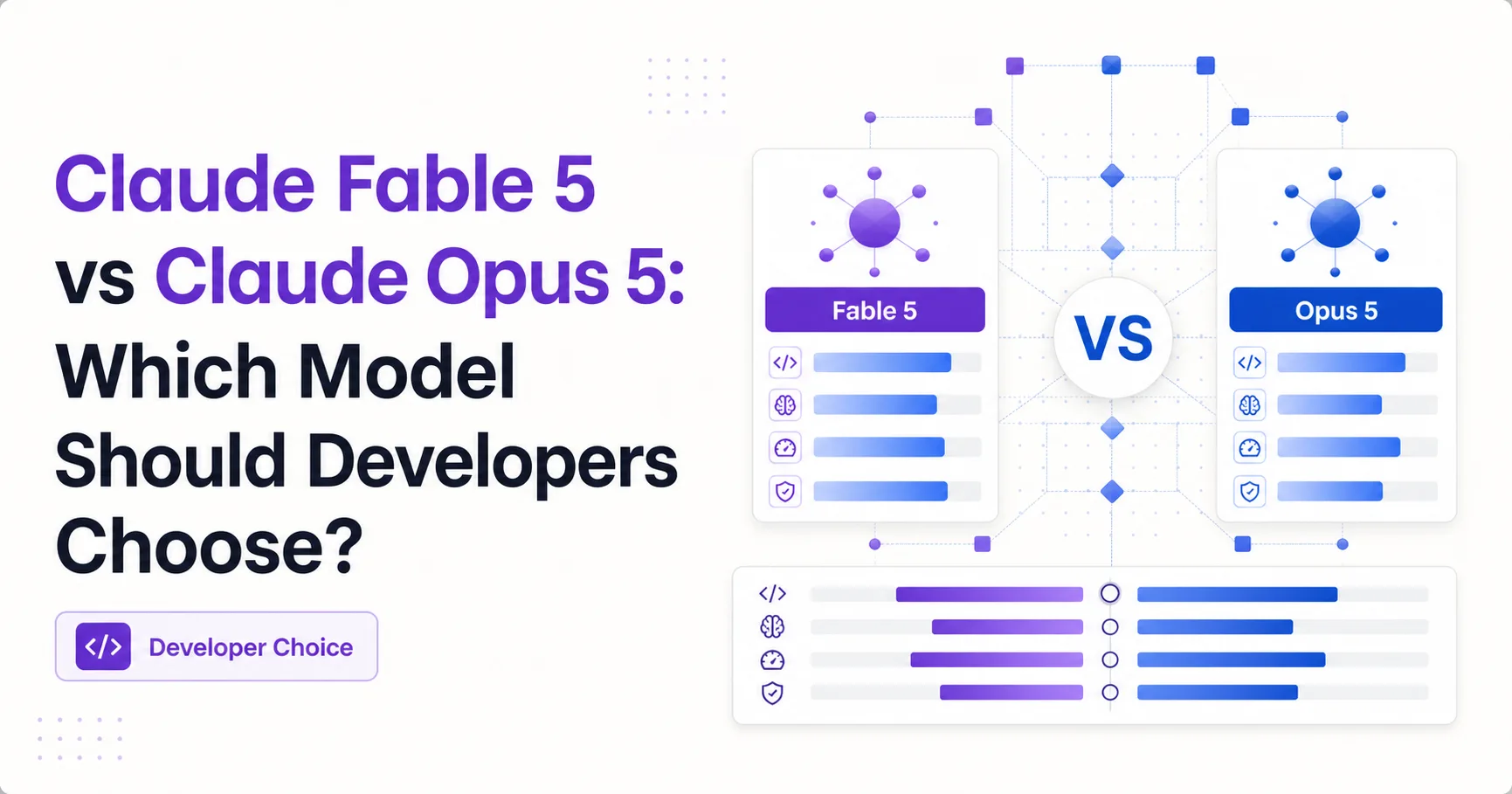
- **Winner overall:** Claude Opus 5, matched Claude Fable 5's 76.5 Coding Index while costing $10 vs $20 per 1M blended tokens - **Cheaper:** Claude Opus 5 at $10 vs $20 per 1M blended tokens - **Faster:** Claude Fable 5 at 70.509 median output tokens per second vs Claude Opus 5 at 54.599 - **Pick Claude Fable 5 when:** you value its 59.9 Intelligence Index and faster streaming for autonomous workflows - **Watch out:** Coding Index is tied at 76.5, and community evidence lacks a standardized test method
Claude Fable 5 vs Claude Opus 5
Claude Opus 5 is the stronger default for most developers because it matches Claude Fable 5 on coding while costing less. Artificial Analysis data shows a coding index tie at 76.5, a lower blended price of $10 versus $20 per 1M tokens, and equal latency at 0.3 seconds. Claude Fable 5 answers faster at 70.509 median output tokens per second, and its intelligence index reaches 59.9 versus 58.9 for Claude Opus 5.
The practical choice depends on whether the main bottleneck is token generation or total operating cost. Anthropic documents Claude Fable 5 for long-running agents, multimodal input, memory, code execution, programmatic tool calling, context editing, compaction, and vision in its model documentation. Anthropic positions Claude Opus 5 around complex agentic coding and enterprise work in its launch announcement.
Executive summary
Claude Opus 5 offers the better value baseline, while Claude Fable 5 wins on speed and the general intelligence index. Artificial Analysis data reports the following decision signals:
| Signal | Claude Fable 5 | Claude Opus 5 | Selection meaning |
|---|---|---|---|
| Coding Index | 76.5 | 76.5 | Measured tie |
| Intelligence Index | 59.9 | 58.9 | Fable leads by the reported difference of 1 |
| Median output speed | 70.509 | 54.599 | Fable produces visible output faster |
| Latency | 0.3 | 0.3 | Measured tie |
| Blended price | $20 | $10 | Opus has the lower listed rate |
The coding tie matters more than broad launch language. Anthropic says Claude Fable 5 leads across many tested capabilities, including software engineering, visual work, science, long context, and memory in its announcement. Anthropic makes a similar leading-performance claim for Claude Opus 5 across agentic coding, research, office work, vision, and multi-agent collaboration in its announcement. Neither announcement supplies a complete numeric table that resolves the close comparison.
The models also differ at the API-contract level. Claude Fable 5 keeps adaptive thinking enabled and uses effort to control depth. Claude Opus 5 defaults to adaptive thinking but exposes more configuration choices through the effort documentation. Fable’s fallback wording refers to refusal handling, not a separate API model as Anthropic explains.
Availability evidence requires context. The supplied research reports that Fable access was paused and later restored in Anthropic’s restoration notice. Opus also has a recorded elevated-errors service event on Anthropic’s status page. These records describe operational history, not a lasting capability difference. The current model overview remains the correct place to verify availability for either model.
Data provided by https://artificialanalysis.ai/
Performance in real developer workflows
Claude Fable 5 is the faster responder, but Claude Opus 5 is not behind on the measured coding index. Artificial Analysis data places Fable at 70.509 median output tokens per second and Opus at 54.599, while measured latency is equal at 0.3 seconds.
That combination changes how the difference feels in an application. Equal latency suggests that initial request delay is not the main separator in the supplied measurement. Fable’s higher output rate should matter more during long responses, streamed code reviews, multi-step explanations, and agent transcripts. Opus may feel less different on short responses where generation ends quickly. The speed advantage therefore matters most when users watch output continuously or when an agent must produce substantial visible text.
The coding tie at 76.5 means developers should avoid treating speed as a proxy for coding quality. The supplied benchmark does not show a coding winner. A slower model can still be the better choice if it produces fewer revisions, clearer tool decisions, or more suitable plans for a specific repository. The research brief does not provide a standardized success rate, average number of iterations, or reproducible task suite for either model.
Fable’s behavior can favor autonomous workflows. One Hacker News report describes Fable handling a complex engineering problem involving micropython-wasm and producing a wheel for complete Python WASM support in the reported task. Another report describes Fable opening a browser, inspecting a window, taking screenshots, and validating a frontend change in a separate account. Those examples show useful initiative, but they also show why tool-call volume must be measured separately from model output speed.
Opus feedback points in the opposite direction for some workflows. Developers report that Opus can be slow, verbose, overly analytical on simple tasks, or willing to make broad changes before confirming scope in a Reddit discussion. Fable users report fast planning alongside rapid quota consumption, long pauses, and insufficient clarification in their discussion. These reports conflict because they describe different prompts and workflows without repeatable methods.
Thinking configuration adds another performance tradeoff. Anthropic documents that Opus thinking contributes to the output budget and can increase latency and cost on long tasks in the Opus update. Fable cannot disable adaptive thinking, so effort tuning is the main control in Anthropic’s thinking documentation.
Cost beyond the price chart
Claude Opus 5 is the safer cost choice because its listed input, output, and blended rates are lower. Artificial Analysis data reports a blended price of $10 for Opus versus $20 for Fable per 1M blended tokens. Anthropic’s official pricing documentation confirms that each model has separate input, output, and prompt-caching rates on the pricing page.
The blended figure is useful for a first screen, but it is not a production invoice. The data field describes a 3:1 input-to-output comparison convention. Real agent traffic can have a very different shape. A workflow that sends large repository context, generates short tool arguments, and repeats cached instructions may behave differently from a workflow that produces long explanations and code patches.
Fable can become more expensive than its listed rate suggests when autonomy creates extra work. The reported browser-validation case includes additional inspection, screenshots, and verification steps in the Hacker News account. Those actions may improve correctness, but they also increase tool calls, review surface, and the amount of state that the application must retain. The report is a useful warning, not a controlled cost benchmark.
Opus has a different cost risk. Anthropic explains that adaptive thinking consumes part of the output budget, and effort is a behavior signal rather than a strict token budget in the effort documentation. Community users also describe long answers and over-analysis on simple tasks in the Opus discussion. A lower unit price does not guarantee a lower request cost if prompts encourage unnecessary reasoning or oversized responses.
Teams should therefore record input tokens, output tokens, thinking usage, tool calls, retries, cache behavior, and human review time. The supplied comparison includes price, latency, speed, and evaluation indices, but it does not measure these workload-level costs. The evidence supports Opus as the economical starting point, while leaving the final cost decision dependent on observed agent behavior.
Recommendation by workload
Claude Opus 5 should be the default production pick, while Claude Fable 5 fits speed-sensitive autonomous workflows. Artificial Analysis data gives Opus the lower blended price and a coding tie, while Fable has the faster output rate and higher Intelligence Index.
| Developer need | Recommended model | Reason |
|---|---|---|
| General production default | Claude Opus 5 | Coding Index tie at 76.5 with the lower $10 blended rate |
| Fast streamed interaction | Claude Fable 5 | Higher median output speed at 70.509 |
| Long-running autonomous work | Claude Fable 5, after tool-cost testing | Anthropic documents long-running agent capabilities, and community reports show proactive validation in the model documentation |
| Cost-sensitive high-volume traffic | Claude Opus 5 | Lower listed pricing, subject to reasoning and output monitoring |
| Strict tool-protocol integration | Claude Opus 5 with thinking enabled, or Fable with careful refusal handling | Opus can expose malformed tool-call text when thinking is disabled according to Anthropic |
Use Claude Fable 5 when visible response speed, autonomous checking, or the reported Intelligence Index lead matters more than unit economics. Fable is especially plausible for developer tools where users watch a model work and value rapid feedback. Its proactive behavior must be bounded with tool permissions, call budgets, and approval gates. The community evidence supports that risk, but does not show how often it occurs in the reported discussion.
Use Claude Opus 5 when the application needs a lower-cost default, complex coding, or a workflow where human review happens after a longer reasoning phase. Anthropic’s launch material positions Opus for complex agentic coding and enterprise work in the official announcement. Developers should still test verbosity, scope control, and long pauses because user reports describe these failure modes in the community discussion.
Use the official API IDs during implementation. Anthropic documents claude-fable-5 and claude-opus-5 as model identifiers, while interface slugs and fallback labels should not be treated as separate API models in its versioning documentation. Both models support multiple Anthropic and cloud-provider channels according to the current overview available here.
Before rollout, evaluate repository changes, visual tasks, long-context retrieval, tool use, refusal paths, and clarification behavior with the same prompts. Official announcements lack complete numeric tables, and community reports lack standardized test methods. A workload-specific evaluation remains necessary. The supplied evidence is strong enough to choose a default, but not strong enough to claim a universal winner.
Questions to answer before production
Claude Fable 5 and Claude Opus 5 require different safeguards for thinking, refusals, tool calls, and data retention. Anthropic documents Fable’s refusal and fallback behavior, including the possibility of conservative safety blocking in the refusal guidance. Anthropic also states that Fable is not available with Zero Data Retention in the Fable model documentation.
Teams should decide whether adaptive thinking must remain enabled, whether the application can tolerate longer autonomous runs, and whether every refusal must enter a fallback path. Opus offers more thinking configuration flexibility, but Anthropic warns that disabling thinking can affect tool-call formatting in the Opus update. Fable offers a documented fallback mechanism, but its fallback wording does not represent another callable model.
Availability should also be checked immediately before deployment. The supplied records include a restored Fable access event and an Opus elevated-errors incident. Neither source establishes a service-level guarantee. Developers need their own retry, fallback, timeout, and observability policies rather than relying on model names alone.
Frequently asked questions
Which model should a developer choose by default?
Claude Opus 5 is the default pick for most production developers because its coding index matches Claude Fable 5 at 76.5, while its blended price is $10 versus $20. Choose Fable when faster generation at 70.509 matters more than the lower operating rate. Artificial Analysis data
Does Fable's Max Effort mean a separate model?
Claude Fable 5 Max Effort is an effort setting, not a separate API model ID. Anthropic documents claude-fable-5 as the API model and describes effort as a control for adaptive thinking depth. The fallback label describes refusal handling, not another callable Fable model. Fable model documentation
Can either model turn thinking off?
Claude Opus 5 offers more thinking configuration flexibility, while Claude Fable 5 keeps adaptive thinking enabled. Opus can disable thinking only under compatible lower effort settings, and Anthropic warns that disabled thinking can produce malformed tool-call text. Fable requires effort tuning instead. Opus update Fable thinking documentation
Are the benchmark and community differences conclusive?
Claude Fable 5 has a small measured intelligence lead, but neither model has a conclusive universal win. The supplied data ties coding at 76.5, official announcements omit complete score tables, and community reports lack standardized repeatable methods. Treat the ranking as workload-dependent. Artificial Analysis data Fable announcement Opus announcement
What should teams verify before production?
Claude Opus 5 and Claude Fable 5 both need application-level monitoring for reasoning length, tool-call volume, refusals, and output quality. Fable also requires a data-retention review because the supplied notes exclude Zero Data Retention, while Opus needs migration tests for thinking and tool behavior. Fable documentation Opus update
Sources
- Artificial AnalysisBenchmark, latency, output speed, and pricing comparison values.
- Claude models overviewCurrent model availability, model capabilities, API channels, and identifiers.
- Introducing Claude Fable 5 and Claude Mythos 5Fable positioning, adaptive thinking, capabilities, fallback behavior, and data retention.
- Claude Fable 5 and Claude Mythos 5Fable launch claims, benchmark positioning, safety boundaries, and official test examples.
- Claude Fable 5 access restoredFable availability history and access restoration.
- Anthropic pricingOfficial pricing structure and prompt-caching context.
- EffortEffort behavior, reasoning depth, and token-budget limitations.
- ThinkingAdaptive thinking, output limits, and tool-call behavior.
- Refusals and fallbackRefusal handling and application fallback behavior.
- Claude Fable 5 on Hacker NewsCommunity report about a complex long-running engineering task.
- Claude Fable is relentlessly proactiveCommunity report about browser checks, screenshots, validation, and tool-call expansion.
- What's everyone's take on Claude Fable 5?Fable community reports about speed, quota consumption, pauses, and clarification behavior.
- Introducing Claude Opus 5Opus positioning, official capability claims, and benchmark statements.
- What's new in Claude Opus 5Opus thinking behavior, effort configuration, tool-call limitations, and migration risks.
- Model IDs and versioningOfficial API model IDs, stable aliases, and versioning rules.
- Is Opus 5 actually that bad, or is it just Reddit hype?Opus community reports about verbosity, speed, over-analysis, and autonomous scope changes.
- Elevated errors on Claude Opus 5Opus service availability history.
Published: