
AI model analysis
Claude Fable 5 vs Claude Opus 5 Medium: Which Model Should Developers Choose?
A developer-focused comparison of Claude Fable 5 and Claude Opus 5 Medium across coding quality, output speed, pricing, agent behavior, integration risks, and production fit.
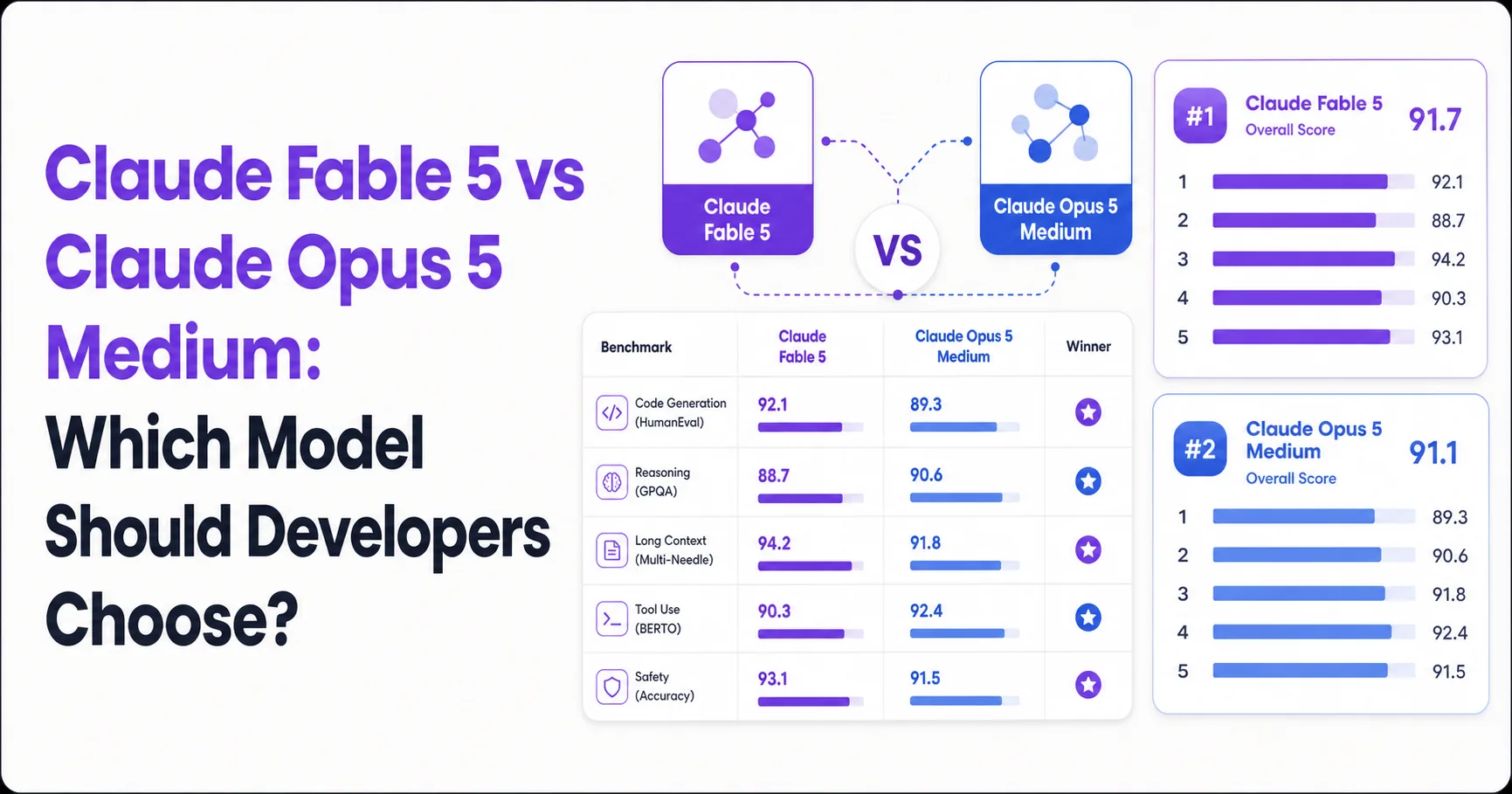
- **Winner overall:** Claude Fable 5, it leads the coding index at 76.5 versus 74.3 and the intelligence index at 59.9 versus 56.3 - **Cheaper:** Claude Opus 5 at $10 vs $20 per 1M blended tokens - **Faster:** Claude Fable 5 at 70.509 (median output tokens per second), with both models at 0.3 seconds latency - **Pick Claude Fable 5 when:** autonomous coding quality and fast output justify the $20 blended price - **Watch out:** the measured latency is tied at 0.3 seconds, while community evidence on tool use, pacing, and token consumption is not controlled
The short answer
Claude Fable 5 is the stronger overall choice for developers who prioritize coding quality, general intelligence, and faster generated output. The supplied Artificial Analysis snapshot places Fable ahead on the coding index, intelligence index, and output rate, while latency is tied. That lead matters most for interactive engineering work, but it does not prove that every complete agent run finishes sooner. Tool calls, retries, and hidden reasoning can dominate wall-clock time.
Claude Opus 5 remains the rational value choice. Its measured blended price is $10 per 1M blended tokens versus $20 for Fable, which creates a meaningful advantage for high-volume or budget-capped systems. The labels also need careful reading: Fable’s Max Effort and Opus’s Medium Effort are control settings, not separate API models, according to Fable’s model documentation and Opus’s update notes.
Use Fable for difficult autonomous coding where extra quality and output speed can repay higher spend. Use Opus for production workloads where token economics and explicit medium effort matter more. Official announcements make broad capability claims without publishing complete, reproducible benchmark tables Fable announcement Opus announcement. Data provided by https://artificialanalysis.ai/.
What the comparison actually says
Claude Fable 5 wins the measured comparison, but Claude Opus 5 creates the stronger default for cost-sensitive scale. The snapshot records Fable on 2026-06-09 and Opus on 2026-07-24, so Opus is newer in this comparison. Newer does not equal replacement: the supplied research says the official overview still lists Fable as current, while a separate restoration notice documents recovered access. The same model overview lists Opus as available, so the practical choice is between two callable products, not current versus retired.
| Dimension | Claude Fable 5 | Claude Opus 5 Medium | Selection meaning |
|---|---|---|---|
| Coding index | 76.5 | 74.3 | Fable has the measured lead |
| Intelligence index | 59.9 | 56.3 | Fable has the broader measured lead |
| Median output tokens per second | 70.509 | 54.838 | Fable streams generated text faster |
| Latency | 0.3 seconds | 0.3 seconds | The snapshot shows a tie |
| Blended price per 1M tokens | $20 | $10 | Opus has the lower token cost |
Fable’s official positioning emphasizes long-running agents, visual work, memory, code execution, and programmatic tools Fable documentation. Opus’s materials emphasize agentic coding, multi-file changes, code review, long-context work, and delegation Opus update notes. The overlap is large, so the decision turns on operating behavior and unit economics rather than a simple capability category.
The evidence also has different levels of strength. The Artificial Analysis values are directly comparable within one snapshot. Official announcements provide positioning and selected test cases, but not full experimental configurations. Community reports provide useful failure hypotheses, yet the Fable and Opus discussions lack controlled, repeatable protocols Fable community discussion Opus feedback thread.
Performance: what the lead means in real work
Claude Fable 5 is the stronger performance choice because its coding result leads and its generated output rate is higher. Fable’s coding index is 76.5 versus Opus’s 74.3, so Fable deserves first testing for code-generation and code-editing workflows. The gap is meaningful enough to influence a pilot, but not large enough to remove repository-specific tests, review gates, or acceptance checks.
Fable’s output rate of 70.509 tokens per second versus Opus’s 54.838 matters most in streaming interfaces and interactive development sessions. Users receive visible progress faster, and long responses may feel more responsive. Both models show 0.3 seconds latency in the supplied snapshot, so initial response delay does not separate them. A faster token stream can still lose at whole-task completion if the model spends longer reasoning, launches more tools, or repeats validation.
The qualitative evidence supports that caution. An Hacker News engineering report describes Fable handling a complex, long-running software problem. Another Hacker News report describes Fable opening a browser, inspecting a window, taking screenshots, and checking a frontend fix. Those actions suggest strong initiative, but they can extend a task beyond the visible generation stream.
Opus feedback points in the opposite direction. One user describes hours of persistent editing, testing, and rework long-task report, while other users report overplanning or slower execution overplanning report slow-speed report alongside faster experiences fast-speed report. Evidence is insufficient to name a universal autonomy or completion-time winner.
Cost: why the cheaper model can still cost more
Claude Opus 5 is the safer default for cost-sensitive workloads because its blended price is $10 versus Fable’s $20 per 1M blended tokens. Under the snapshot’s 3:1 blended basis, Opus is $10 cheaper for comparable token usage. That advantage is especially relevant to high-volume assistants, background processing, and systems with strict spend limits.
The price chart does not show the operational work surrounding each response. Fable’s documented tool support and adaptive reasoning can encourage broader task execution, while the browser-verification example describes extra inspection and screenshot steps Fable API behavior browser-verification report. Opus users report a different cost risk: overplanning, repeated testing, and work beyond the requested scope Opus overplanning report. Neither pattern has a controlled frequency estimate.
Opus can therefore be cheaper on token-for-token usage while becoming more expensive in workflows that require repeated review or corrective turns. Fable can justify its higher rate if stronger first-pass results reduce retries, human rework, or failed deployments. The supplied evidence does not establish a break-even point, so any total-cost claim beyond the listed prices would be speculation.
A sound cost pilot should measure complete task traces rather than response prices alone. Capture generated tokens, tool calls, retries, human correction time, and successful task completion under the same instructions. The available snapshot answers which model has the lower listed rate. It does not answer which model has the lower cost per accepted change for a particular codebase.
Recommendation by developer workload
Claude Fable 5 is the better first pilot for autonomous software agents, while Claude Opus 5 is the better first pilot for high-volume production. The right choice depends on whether your main constraint is accepted task quality, visible generation speed, or controlled token spend.
| Developer scenario | First model to pilot | Why | Required guardrail |
|---|---|---|---|
| Long-running coding agent with browser or vision work | Claude Fable 5 | Official materials emphasize agents, vision, memory, and tool execution, and community reports show proactive verification Fable capabilities Fable tool-use report | Limit tools, review file changes, and record retries |
| High-volume or budget-capped production | Claude Opus 5 | The blended price is $10 versus Fable’s $20 | Track total cost per accepted task |
| User-facing streaming development assistant | Claude Fable 5 | Its median output rate is 70.509 versus Opus’s 54.838, while measured latency is tied at 0.3 seconds | Test whole-session completion time |
| Workflows needing an explicit medium reasoning setting | Claude Opus 5 | Medium Effort is an effort configuration on the real Opus API model Opus update notes | Set effort explicitly and inspect output length |
| Strict data-retention requirements | Neither without compliance review | Fable is documented as unavailable for Zero Data Retention, while the supplied Opus evidence does not establish an equivalent policy Fable documentation | Obtain provider-specific approval before production use |
Do not choose on release recency alone. Opus is newer in the supplied snapshot, but Fable remains documented as available after its access restoration model overview restoration notice. The official announcements also use broad leadership language without complete public benchmark tables Fable announcement Opus announcement.
Integration details can change the result. Fable’s adaptive thinking cannot be disabled, so effort is the main control for reasoning depth thinking documentation effort documentation. Fable refusals can appear in a successful HTTP response with stop_reason: "refusal", so middleware must inspect response fields and support the documented fallback path refusals and fallback. The phrase Opus 4.8 Fallback describes that mechanism, not a separate Fable API alias.
What to validate before committing
Claude Fable 5 and Claude Opus 5 require different validation gates because quality, cost, execution style, and API behavior can change the winner. A short benchmark is not enough for an agent that edits files, invokes tools, or runs across many turns.
Use the same prompts, repository state, tool permissions, acceptance tests, and effort settings for both models. Record successful task completion, human rework, generated tokens, tool calls, retries, refusals, and end-to-end elapsed time. Keep the model names and effort settings explicit in logs, because Max Effort and Medium Effort describe configuration rather than separate model IDs Fable documentation Opus update notes.
Fable needs a guardrail test for proactive execution, refusal handling, and retention requirements. Opus needs a guardrail test for overplanning, response length, tool discipline, and instruction adherence Opus update notes Opus feedback. Community evidence is useful for forming these hypotheses, but it cannot establish failure rates because the reports lack controlled methods Fable community discussion Opus feedback thread.
The evidence is insufficient to claim that either model has universally better reliability, lower total engineering cost, or better instruction following. Developers should make the final choice from accepted-task traces in their own workload.
Frequently asked questions
Is Claude Opus 5 Medium a separate API model?
Claude Opus 5 Medium is an evaluation label, not a separate API model, so production calls should use claude-opus-5 and set effort to medium. Model overview Opus update notes.
Which model is better for coding agents?
Claude Fable 5 is the better first choice for autonomous coding agents because its measured coding score and output rate lead, while official materials emphasize long-running agent work and tool use. Artificial Analysis Fable documentation.
Which model is cheaper to operate?
Claude Opus 5 is cheaper on the supplied blended measure, at $10 versus Fable’s $20 per 1M blended tokens, but planning, retries, or extra tool calls can change total spend. Artificial Analysis Opus overplanning report.
Is Claude Fable 5 faster?
Claude Fable 5 is faster at generating tokens, at 70.509 versus Opus’s 54.838, but both models show 0.3 seconds latency, so end-to-end speed still requires a task-level test. Artificial Analysis.
Can developers rely on community reports to choose a model?
Neither model has a universal reliability verdict from the supplied evidence because community reports conflict and lack controlled protocols; treat them as hypotheses for your own pilot. Fable community discussion Opus feedback thread.
Sources
- Artificial AnalysisMeasured indices, prices, latency, and output speed
- Claude models overviewAPI model IDs, aliases, availability, platforms, and current model status
- Introducing Claude Fable 5 and Claude Mythos 5Fable positioning, adaptive reasoning, tools, refusals, fallback, and retention
- What's new in Claude Opus 5Opus effort settings, adaptive thinking, API behavior, and integration caveats
- EffortEffort configuration semantics
- ThinkingAdaptive thinking behavior and control limitations
- Refusals and fallbackRefusal response handling and fallback integration
- Claude Fable 5 and Claude Mythos 5Official Fable positioning, benchmark claims, test cases, and safety caveats
- Introducing Claude Opus 5Official Opus positioning, benchmark claims, and research limitations
- Claude Fable 5 access restoredFable availability restoration
- Claude Fable 5 on Hacker NewsLong-running complex engineering task experience
- Claude Fable is relentlessly proactiveProactive browser verification, screenshots, and tool-use behavior
- What's everyone's take on Claude Fable 5?Fable community reports about speed, planning, and token consumption
- Opus 5 feedback megathreadOpus community feedback and evidence limitations
- Opus 5 long-task experienceLong-running coding task experience
- Opus 5 overplanning feedbackOverplanning, repeated testing, and scope expansion reports
- Opus 5 slow-speed feedbackReports of slower complex-task execution
- Opus 5 fast-speed feedbackReports of faster execution and conflicting community impressions
Published: