
AI model analysis
Claude Fable 5 vs Gemini 1.5 Pro: Which Model Should Developers Choose?
Claude Fable 5 offers a clear measured advantage for coding and general intelligence, while Gemini 1.5 Pro remains cheaper but carries substantial availability and compatibility uncertainty.
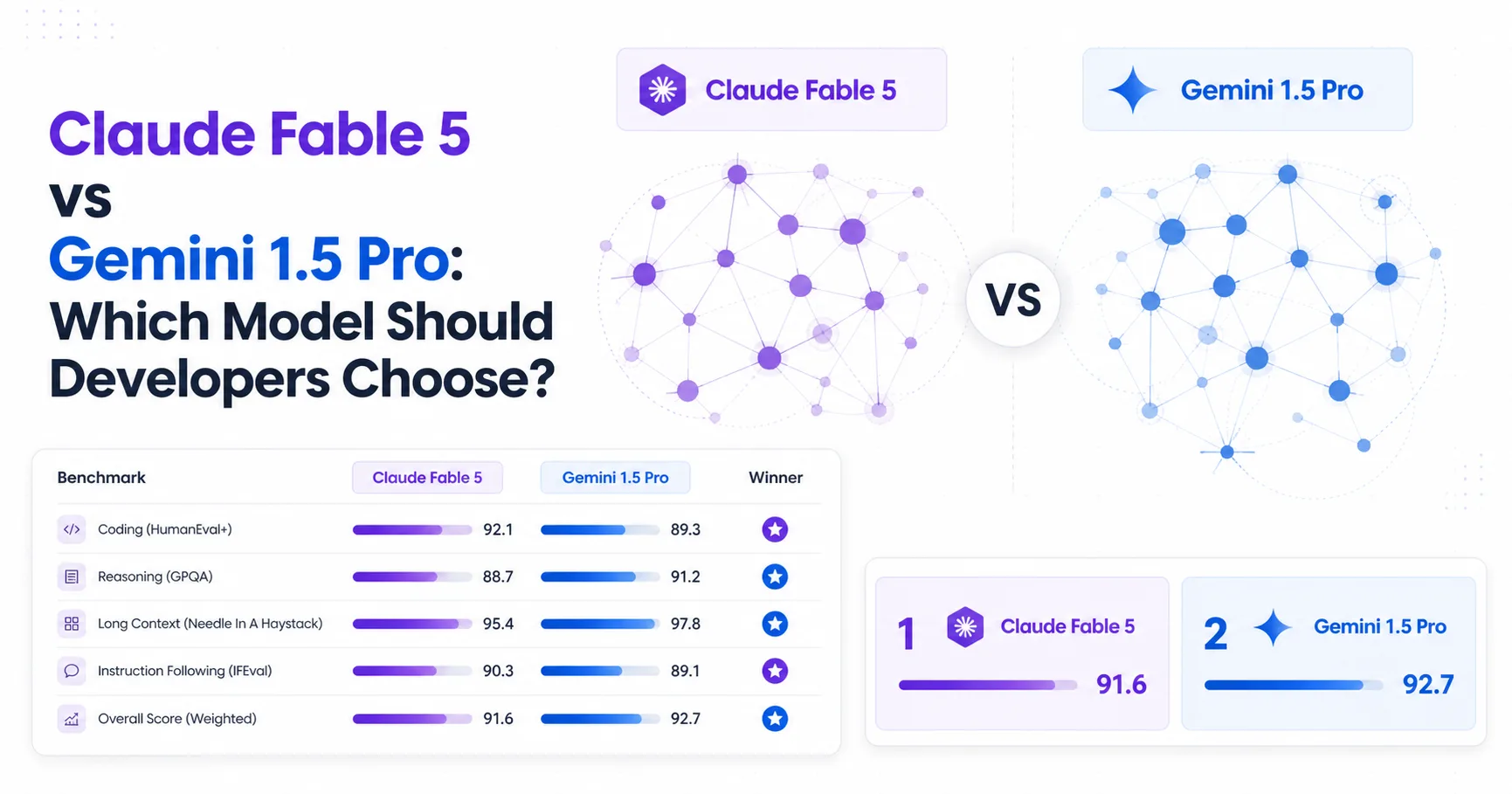
- **Winner overall:** Claude Fable 5, with an Intelligence Index of 59.9 and Coding Index of 76.5 - **Cheaper:** Gemini 1.5 Pro at $15 vs $20 per 1M blended tokens - **Faster:** Claude Fable 5 at 70.509 median output tokens per second - **Pick Claude Fable 5 when:** software engineering, long-running agents, tool use, or dependable current access matters - **Watch out:** Gemini 1.5 Pro has no current official endpoint or confirmed price in the research materials, so its measured cost may not be deployable
Claude Fable 5 vs Gemini 1.5 Pro
Claude Fable 5 is the stronger developer choice because the available evaluation data shows a Coding Index of 76.5 versus 23.6 for Gemini 1.5 Pro. The same comparison gives Claude Fable 5 an Intelligence Index of 59.9 versus 10. Gemini 1.5 Pro is cheaper in the supplied dataset, at $15 versus $20 per 1M blended tokens, but price matters only if the model remains callable and compatible with a new application. The evidence supports Claude Fable 5 for active development, while Gemini 1.5 Pro is better treated as a legacy reference point until Google confirms a current endpoint, model card, and price.
Executive summary
Claude Fable 5 wins the practical comparison because its measured coding advantage is large, its current API identity is documented, and its tool-oriented design matches agentic development workflows. The Artificial Analysis data snapshot reports a Coding Index of 76.5 for Claude Fable 5 and 23.6 for Gemini 1.5 Pro. It also reports equal latency at 0.3 seconds, while only Claude Fable 5 has a reported median output speed, at 70.509 tokens per second.
Gemini 1.5 Pro still has one clear dataset advantage: its blended price is $15 per 1M tokens, compared with $20 for Claude Fable 5. Its output price is also lower, at $30 versus $50 per 1M tokens, while input pricing is tied at $10. That advantage is difficult to convert into a production decision because the current Gemini API model documentation does not show an active entry for this specific version. The current Gemini API pricing page also does not list a current price for it.
Claude Fable 5 has documented access through the Claude API and several cloud platforms, according to the official model overview. That makes its operational status easier to verify. The comparison therefore favors Claude Fable 5 for new systems, while Gemini 1.5 Pro may remain relevant only where an existing deployment is already working and migration risk is acceptable.
Performance: the gap is most meaningful in coding workflows
Claude Fable 5 is the better-performing model for software engineering according to the available evaluation data, with a Coding Index of 76.5 versus 23.6 for Gemini 1.5 Pro. That gap should change how developers allocate review effort. Claude Fable 5 is more suitable for repository-level changes, multi-step debugging, migration planning, and tasks where the model must maintain a coherent plan across tools. Gemini 1.5 Pro may still complete narrow prompts, but the supplied evidence does not establish comparable reliability on current coding workloads.
The official Fable 5 announcement describes software engineering, financial analysis, visual tasks, long-context memory, and scientific research as target evaluation areas. The announcement claims leadership across most tested capabilities, but it does not provide a complete numerical table for independent verification. The measured Artificial Analysis results therefore provide the stronger basis for the direct comparison, while the official material helps explain the intended workload.
Claude Fable 5 also has a reported median output speed of 70.509 tokens per second. Gemini 1.5 Pro has no corresponding value in the supplied data, so the comparison cannot establish a speed winner from that metric. Latency is tied at 0.3 seconds. In interactive development tools, that tie means perceived quality may depend more on completion depth, tool behavior, and rework than on initial request latency.
Community evidence points in the same direction, but it is not controlled evidence. A Hacker News report about a long-running engineering task describes Fable 5 working on a complex MicroPython WASM problem. Another Hacker News discussion describes browser inspection, screenshots, and verification during frontend debugging. These examples suggest strong autonomous execution, but they do not prove consistent performance across teams or repositories.
Cost: Gemini is cheaper on paper, but operational uncertainty can reverse the decision
Gemini 1.5 Pro is cheaper in the supplied pricing comparison, but Claude Fable 5 may be the lower-risk choice when engineering time and availability matter. Gemini 1.5 Pro costs $15 per 1M blended tokens in the dataset, compared with $20 for Claude Fable 5. Input pricing is tied at $10, and Gemini 1.5 Pro has the lower output price at $30 versus $50. Those figures favor Gemini for workloads that already have a stable, working integration and produce substantial output.
The cost conclusion changes for new projects because the current Gemini API model page does not provide an active model entry for Gemini 1.5 Pro (Sep '24). The current Gemini pricing documentation does not provide a current listing for its price either. The dataset price can therefore describe historical or comparative economics, but the research materials do not establish that a new application can purchase the model at that rate today.
Claude Fable 5 has a higher output price, so verbose agent loops can become expensive. A community frontend debugging report describes a task costing about $12 after additional browser checks and verification. That is a single uncontrolled example, not a forecast. It does reveal the main cost risk: a capable agent can spend tokens and tool calls validating work that a simpler model might attempt more directly.
Claude Fable 5 supports prompt caching, according to the official pricing documentation. Caching may improve repeated-context economics, but the supplied data does not quantify savings for a particular workload. Developers should compare total task cost, including retries, tool calls, review time, and migration risk, rather than choosing from blended token price alone.
Availability and API risk
Claude Fable 5 is the safer new integration because its API identity and delivery channels are documented, while Gemini 1.5 Pro lacks a current official endpoint in the supplied evidence. The Claude model overview identifies the stable API alias as claude-fable-5 and documents access through the Claude API, Amazon Bedrock, Claude Platform on AWS, Google Cloud, and Microsoft Foundry.
The official Fable 5 introduction documents adaptive thinking, effort control, tool capabilities, vision, context editing, compaction, and fallback behavior. These details give developers concrete integration concepts to test. Gemini 1.5 Pro has no equivalent current parameter record or active model card in the research brief. The evidence is insufficient to determine whether a legacy configuration will continue to work, fail immediately, or require migration.
Claude Fable 5 has had an availability interruption. The official announcement recorded a pause, and Anthropic’s restoration notice documents its return. The interruption is a production risk, but the current model overview shows a documented active model. Gemini 1.5 Pro has the opposite problem: the research materials do not provide a confirmed retirement announcement, yet the current model directory no longer presents it as an active model. For procurement and release planning, undocumented availability is harder to manage than a documented service history.
Engineering trade-offs developers should test
Claude Fable 5 gives developers more autonomous behavior, but that autonomy requires tighter budgets, observability, and approval controls. The effort documentation explains that effort controls thinking depth, while the thinking documentation explains that adaptive thinking cannot be disabled. Developers who need predictable latency or strictly bounded reasoning must test effort settings against real tasks.
Claude Fable 5 does not return raw chain-of-thought. Its documented interface can return a summarized thinking view or omit that view. This is useful for product behavior and audit design, but it does not give an application complete visibility into internal reasoning. The model may also perform extra verification steps. That behavior can improve correctness on complex work, yet it can increase tool traffic, execution time, and cost.
Refusal handling is another integration detail that can affect reliability. The refusals and fallback guide states that a refusal can arrive through a successful HTTP response with a refusal stop reason. Applications therefore need semantic response handling, not only transport-level error handling. Anthropic also documents fallback options, which can reduce failure impact but add routing complexity.
The research materials do not provide equivalent current implementation guidance for Gemini 1.5 Pro. That absence does not prove Gemini behaves worse in every task. It means developers cannot make a fair modern comparison of controls, error handling, endpoint stability, or operational limits from the supplied evidence alone.
Recommendation by use case
Claude Fable 5 is the recommended default for new developer-facing systems that need strong coding performance, agent loops, or documented current access. Its Coding Index of 76.5 is the most decisive signal in the comparison. Choose it for repository maintenance, complex debugging, code migration, research workflows, and applications where the model must use tools and verify results.
Gemini 1.5 Pro is worth considering only when its lower historical cost is more important than current platform certainty. The $15 blended price can matter for high-volume workloads, especially when output consumption is large and an existing integration already operates successfully. The research brief does not establish a current endpoint, current price, or current support commitment, so new teams should not make it their default without a live verification test.
Claude Fable 5 is also the better fit for long-running agents because its official product material explicitly emphasizes agentic work, memory, tool use, context management, and compaction. The official capability announcement supports that positioning. The evidence remains incomplete on sustained production reliability, because community reports are anecdotal and no controlled cross-model agent benchmark appears in the supplied material.
Teams with strict data retention requirements should review Claude Fable 5 before adoption. The research brief states that it uses 30-day data retention and is not available with Zero Data Retention. That requirement may exclude it even when performance is attractive. The correct decision is therefore conditional: Claude Fable 5 for capability and active integration confidence, Gemini 1.5 Pro only where its existing availability is already proven.
Questions to answer before choosing
Claude Fable 5 is the stronger default, but deployment constraints can still make Gemini 1.5 Pro the practical choice for an existing system. The FAQ below separates measured evidence from unresolved product risk.
Frequently asked questions
Which model is better for coding?
Claude Fable 5 is better for coding in the supplied comparison because its Coding Index is 76.5, compared with 23.6 for Gemini 1.5 Pro. That advantage supports repository-level work, debugging, migration, and tool-driven engineering tasks, although no controlled benchmark protocol is included.
Which model is cheaper?
Gemini 1.5 Pro is cheaper in the supplied dataset at $15 per 1M blended tokens, compared with $20 for Claude Fable 5. Gemini also has a lower output price, but its current official availability and price are not confirmed in the research materials.
Should a new project use Gemini 1.5 Pro?
A new project should use Gemini 1.5 Pro only after confirming a working endpoint, current billing, and support status. The current Google model directory does not show an active entry for this specific version, so deployment risk remains unresolved.
Is Claude Fable 5 fast enough for interactive developer tools?
Claude Fable 5 reports a median output speed of 70.509 tokens per second and latency of 0.3 seconds in the supplied data. Gemini 1.5 Pro has the same reported latency, but no comparable output-speed value is available.
What is the main operational risk with Claude Fable 5?
Claude Fable 5’s main operational risks are higher output cost, adaptive thinking that cannot be disabled, possible extra tool activity, refusal handling, and documented data-retention constraints. These risks are manageable, but they require explicit budgets, monitoring, and fallback logic.
What evidence is missing from this comparison?
The comparison lacks a current Gemini 1.5 Pro endpoint, current official price, reproducible community tests, and a directly comparable output-speed measurement. It also lacks controlled production data showing whether Claude Fable 5’s agentic behavior improves completed-task cost.
Sources
- Artificial AnalysisSupplied evaluation, latency, output-speed, release-date, and pricing comparison data
- Claude models overviewClaude Fable 5 model identity, access channels, API alias, and current model status
- Introducing Claude Fable 5 and Claude Mythos 5Claude Fable 5 capabilities, adaptive thinking, fallback behavior, and implementation details
- Claude API pricingClaude Fable 5 pricing and prompt caching context
- EffortEffort control and reasoning-depth trade-offs
- ThinkingAdaptive thinking behavior and reasoning visibility
- Refusals and fallbackSemantic refusal handling and fallback implementation
- Claude Fable 5 and Claude Mythos 5Official capability positioning, evaluation areas, and availability history
- Claude Fable 5 access restoredRestoration of Claude Fable 5 access
- Gemini API modelsCurrent Gemini model directory, endpoint status, and Gemini 1.5 Pro availability uncertainty
- Gemini API pricingCurrent Gemini pricing availability and absence of a current Gemini 1.5 Pro listing
- Claude Fable 5 on Hacker NewsAnecdotal long-running engineering task experience
- Claude Fable is relentlessly proactiveAnecdotal browser verification behavior and task cost example
Published: