
AI model analysis
Claude Fable 5 vs GPT-4: Which Model Should Developers Choose?
A developer-focused comparison of Claude Fable 5 and GPT-4 covering capability evidence, operational risk, speed, pricing, availability, and model-selection trade-offs.
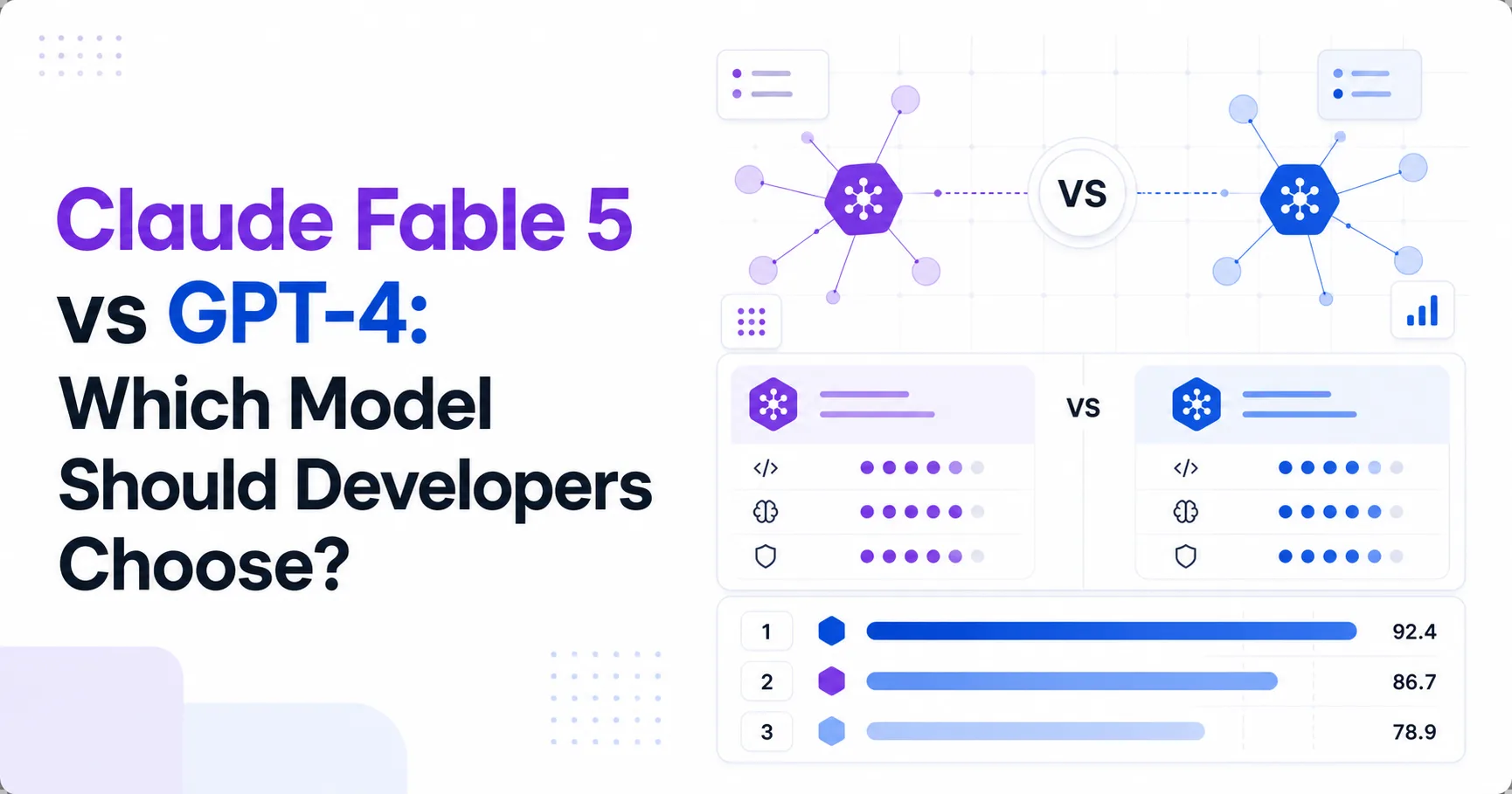
- **Winner overall:** Claude Fable 5, with a 76.5 coding index vs 13.1 for GPT-4 - **Cheaper:** Claude Fable 5 at $20 vs $37.5 per 1M blended tokens - **Faster:** Claude Fable 5 at 70.509 median output tokens per second, while GPT-4 has no reported value - **Pick Claude Fable 5 when:** you need long-running agents, complex software work, or autonomous tool use - **Watch out:** GPT-4’s current availability, version mapping, context limits, and official pricing are not confirmed by the current OpenAI pages
Claude Fable 5 vs GPT-4: The Short Answer
Claude Fable 5 is the stronger practical choice for new developer projects because the available evidence supports higher coding capability, lower blended cost, and clearer current availability. The data brief gives Claude Fable 5 an Artificial Analysis Coding Index of 76.5, compared with 13.1 for GPT-4, and an Intelligence Index of 59.9, compared with 7. The same brief reports a blended price of $20 per 1M tokens for Claude Fable 5 and $37.5 for GPT-4. Claude Fable 5 also has a reported median output speed of 70.509 tokens per second, while GPT-4 has no reported value.
The comparison has an important asymmetry. Claude Fable 5 has current model documentation, a stable API alias, published pricing, and documented agent features in Anthropic’s model overview. GPT-4 appears in neither the current OpenAI model directory nor the current OpenAI pricing page. That absence does not prove that every GPT-4 deployment has stopped working, but it does make GPT-4 a poor default for a new integration.
Developers should therefore treat Claude Fable 5 as the default candidate and GPT-4 as a legacy compatibility question. The evidence does not establish a reliable GPT-4 migration path, current endpoint behavior, or current service-level commitment.
Executive Summary for Model Selection
Claude Fable 5 wins the available capability and cost comparison, while GPT-4 retains no verified current-platform advantage in the supplied evidence.
| Decision factor | Claude Fable 5 | GPT-4 | Selection meaning |
|---|---|---|---|
| Coding evaluation | 76.5 | 13.1 | The measured gap favors Claude Fable 5 for software tasks. |
| Intelligence evaluation | 59.9 | 7 | The measured general capability gap also favors Claude Fable 5. |
| Blended price per 1M tokens | $20 | $37.5 | Claude Fable 5 has the lower listed blended cost. |
| Reported median output speed | 70.509 tokens per second | Not reported | Claude Fable 5 has measurable speed evidence; GPT-4 does not. |
| Reported latency | 0.3 seconds | 0.3 seconds | The supplied latency result is tied. |
| Current official listing | Listed in Anthropic’s current overview | Not listed in OpenAI’s current model page | Claude Fable 5 has clearer current status. |
Claude Fable 5 is documented as a model for long-running agents, with text and image input, text output, multilingual support, and vision capability in the official model overview. Its official launch material also describes software engineering, financial analysis, visual tasks, long-context memory, and scientific research cases in Anthropic’s announcement.
GPT-4 has a major evidence deficit. The current OpenAI documentation does not provide a verified context window, output limit, benchmark result, or current multimodal API boundary for the original model. It also does not identify whether a stable alias still points to a specific GPT-4 version. Developers choosing GPT-4 today would be accepting unknown platform conditions rather than selecting a fully documented current product.
Performance: What the Chart Does Not Tell You
Claude Fable 5 is the better-supported performance choice for complex engineering workflows, but its advantage does not guarantee lower latency or lower cost on every task.
The evaluation gap is large enough to change architecture decisions. Claude Fable 5’s coding index is 76.5, while GPT-4’s is 13.1. That result supports using Claude Fable 5 for repository-level changes, migration work, debugging, and tasks that require sustained reasoning. It does not prove that every short completion will be better, because the supplied benchmark does not disclose task distribution, prompt design, variance, or production error rates.
Claude Fable 5’s reported median output speed is 70.509 tokens per second. GPT-4 has no corresponding value in the data brief, so a direct speed comparison is unavailable. The latency result is 0.3 seconds for each model, which means the chart does not support a latency winner. Developers building interactive tools should separate first-response latency from sustained generation speed, because the two measurements answer different product questions.
The model’s operating behavior may also affect real performance. Anthropic documents adaptive thinking, effort controls, task budgets, memory, code execution, programmatic tool calling, context editing, compaction, and vision in its Fable 5 introduction. Adaptive thinking is always enabled, and the effort documentation explains that developers can control depth through the effort parameter. This can improve difficult-task quality, but it can also make latency and token use less predictable.
The evidence is insufficient to determine which model has the better production reliability, tool-call success rate, or quality on a developer’s private codebase. A short pilot with representative tasks remains necessary.
Cost: Lower Listed Price Does Not Mean Lower System Cost
Claude Fable 5 is the lower-cost option in the supplied price comparison, but autonomous behavior can make its total workflow cost harder to predict.
The data brief lists Claude Fable 5 at $20 per 1M blended tokens and GPT-4 at $37.5. It also lists Claude Fable 5 at $10 per 1M input tokens and $50 per 1M output tokens, compared with $30 input and $60 output for GPT-4. Those figures make Claude Fable 5 the clear listed price winner for the provided blended-token mix and for each listed token direction.
The practical cost question is workload shape. A model that solves a task in fewer attempts can be cheaper even if it produces longer responses. A model that launches extra browser checks, screenshots, or helper scripts can consume more tool calls and more surrounding application resources. A Hacker News report describes Claude Fable 5 taking those kinds of verification steps during a frontend repair, with the task costing about $12; the discussion is an individual account, not a controlled cost test.
Claude Fable 5 also supports prompt caching, with official pricing for 5-minute writes, 1-hour writes, and cache hits described on Anthropic’s pricing page. Caching may matter for agents that repeatedly send stable repository context, but the supplied evidence does not quantify the savings for a specific application.
GPT-4 has no directly listed current API price in OpenAI’s pricing documentation. That makes a current cost comparison for an existing GPT-4 deployment impossible beyond the data brief. Developers should verify the actual endpoint and billing record before estimating migration savings.
Recommendation by Developer Scenario
Claude Fable 5 is the recommended default for new agentic development, while GPT-4 should be retained only when an existing system proves it still depends on that exact model.
Choose Claude Fable 5 for repository maintenance, code migration, multi-step debugging, visual interface checks, and workflows that benefit from persistent context. Anthropic positions it for long-running agents and documents a 1M-token context window with a 128k-token maximum Messages API output in the current model overview. The available community evidence is consistent with that positioning: one Hacker News user describes using the model on a long-running micropython-wasm engineering problem in a project-specific report. That report is useful as a concrete example, but it is not a repeatable benchmark.
Choose Claude Fable 5 with safeguards when the application allows autonomous tool use. Its proactive behavior can be valuable for verification, yet it can also increase tool-call volume and operational review. Set an appropriate effort level, impose task budgets, log tool calls, and cap retries. Do not assume adaptive thinking can be disabled. Anthropic states that raw chain-of-thought is not returned, while summarized or omitted thinking display is configurable in the official introduction.
Treat GPT-4 as a migration and compatibility case. The supplied sources do not confirm its current API availability, stable alias behavior, context window, output limit, failure modes, or current price. The current OpenAI model page simply focuses on newer product lines and does not provide those GPT-4 details in its model documentation.
Before production rollout, test representative prompts, tool loops, refusal handling, data retention, and budget limits. Claude Fable 5 is documented as using 30-day data retention and not qualifying for Zero Data Retention, which may disqualify it for some regulated workloads. Anthropic also documents refusal responses that can return HTTP 200 with stop_reason set to refusal, so applications should follow the refusal and fallback guidance.
Questions to Resolve Before You Commit
Claude Fable 5 is easier to evaluate from public documentation, but production approval still depends on workload-specific testing and compliance review.
The largest unresolved issue is not the headline benchmark gap. It is whether the application needs predictable execution more than maximum capability. Claude Fable 5’s adaptive reasoning and tool support may improve difficult tasks, while the same behavior can produce more steps than a tightly constrained request requires. GPT-4’s current documentation gap creates a different risk: the team may be depending on a legacy endpoint whose exact contract is no longer clear.
Availability also deserves an explicit check. Anthropic reported that Fable 5 access was paused and later restored, with restoration described in the redeployment announcement. The current overview lists it as available. This supports current availability, but it does not establish future capacity, regional access, or an SLA for a particular provider channel.
Evidence remains incomplete for several questions developers may ask: private-codebase performance, long-context retrieval accuracy, refusal rates by application category, exact GPT-4 endpoint behavior, and total cost per completed task. The community reports disagree about speed, clarification behavior, and quota consumption, and the Reddit discussion provides no unified test method. Those reports should shape test cases, not determine the final decision.
A sensible evaluation gate is simple: prove task completion quality, measure end-to-end cost, inspect tool-call traces, test refusal recovery, and confirm data-handling requirements. If GPT-4 cannot pass the same verification because its current contract is unclear, that uncertainty is itself a selection cost.
Frequently asked questions
Is Claude Fable 5 better than GPT-4 for coding?
Yes, Claude Fable 5 is the stronger documented coding choice in the supplied evidence, with a 76.5 coding index compared with 13.1 for GPT-4, although private-codebase results still require testing.
Which model is cheaper for API use?
Claude Fable 5 is cheaper in the supplied comparison, costing $20 per 1M blended tokens versus $37.5 for GPT-4, while current GPT-4 pricing is not listed on OpenAI’s pricing page.
Is GPT-4 still available through the current OpenAI API?
The supplied evidence does not confirm current GPT-4 availability, stable alias behavior, or replacement status, because OpenAI’s current model documentation does not provide those details.
Does Claude Fable 5 always respond faster?
No, the supplied latency result is 0.3 seconds for each model, while only Claude Fable 5 has a reported median output speed of 70.509 tokens per second.
Can developers disable Claude Fable 5 reasoning?
No, Claude Fable 5 keeps adaptive thinking enabled, but developers can control reasoning depth with the effort parameter and choose whether summarized thinking is displayed.
What is the main operational risk with Claude Fable 5?
The main operational risks are unpredictable tool activity, possible refusals, and data-retention constraints, so applications should budget tool calls, inspect stop_reason, and review compliance requirements.
Sources
- Claude Models OverviewCurrent availability, model identity, provider channels, context window, output limit, and model positioning
- Introducing Claude Fable 5 and Claude Mythos 5Adaptive thinking, effort behavior, tool capabilities, reasoning display, refusal behavior, and data retention
- EffortHow developers control Claude Fable 5 reasoning depth
- Claude PricingClaude Fable 5 input, output, blended, and prompt-caching pricing
- Refusals and FallbackHTTP 200 refusal handling, stop reasons, and fallback implementation
- Claude Fable 5 and Claude Mythos 5Official capability claims, testing examples, safety boundary, and access history
- Claude Fable 5 Access RestoredRestored availability after the reported access pause
- OpenAI ModelsCurrent OpenAI model directory and the absence of current GPT-4 capability details
- OpenAI API PricingCurrent OpenAI pricing catalog and the absence of a directly listed GPT-4 price
- Claude Fable 5 on Hacker NewsConcrete but uncontrolled long-running engineering task report
- Claude Fable Is Relentlessly ProactiveIndividual report about proactive browser verification, extra tool activity, and task cost
- What’s Everyone’s Take on Claude Fable 5?Uncontrolled community reports about speed, planning, quota consumption, clarification, and stagnation
Published: