
AI model analysis
Claude Fable 5 vs GPT-4o (Nov '24): Which Model Should Developers Choose?
A developer-focused comparison of Claude Fable 5 and GPT-4o (Nov '24), covering capability evidence, speed, pricing, operational risk, and model availability.
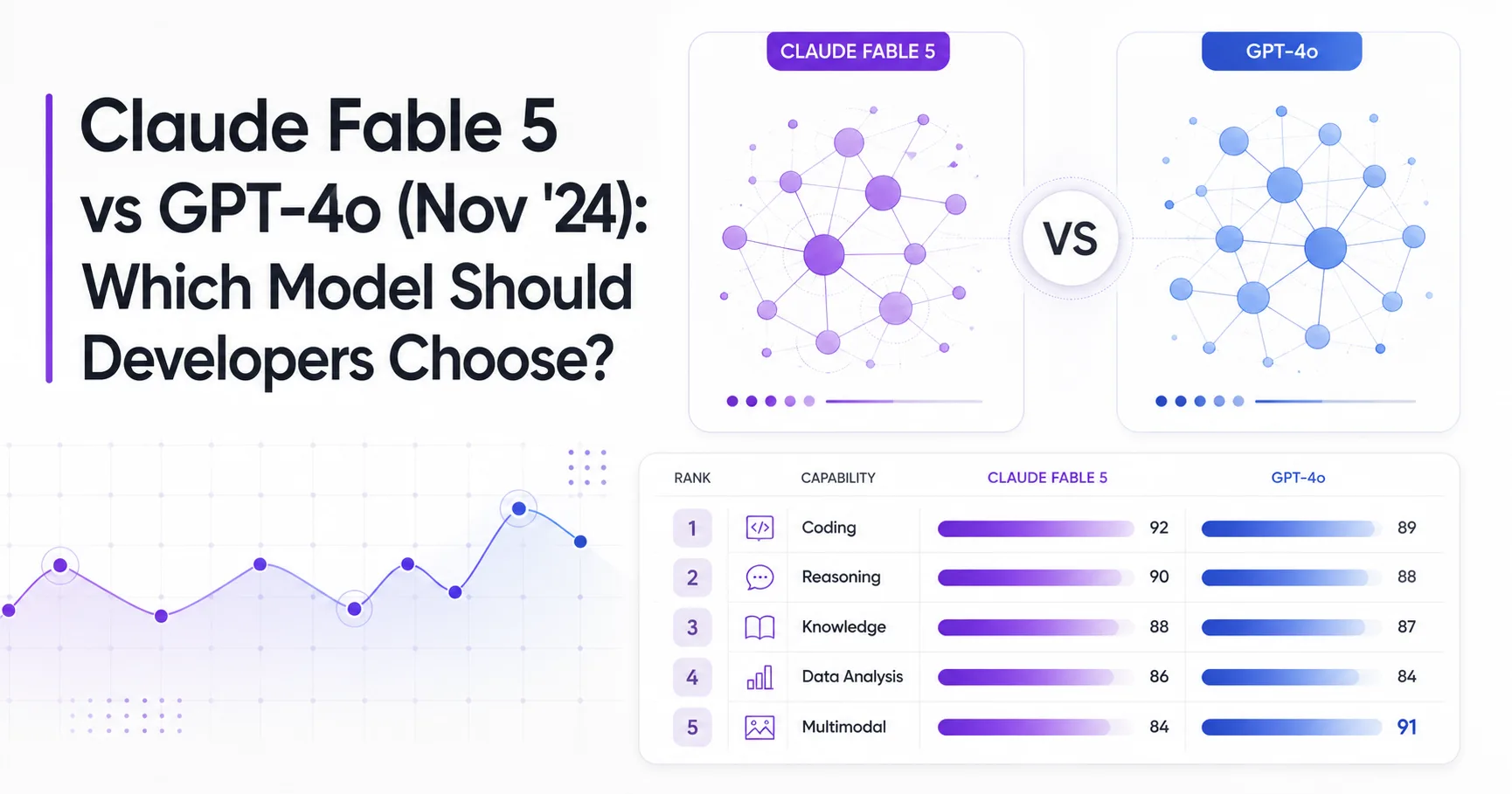
- **Winner overall:** Claude Fable 5, with an Artificial Analysis Intelligence Index of 59.9 vs 11.2 for GPT-4o (Nov '24) - **Cheaper:** GPT-4o (Nov '24) at $4.375 vs $20 per 1M blended tokens - **Faster:** Claude Fable 5 at 70.509 median output tokens per second - **Pick Claude Fable 5 when:** your application needs autonomous engineering work and higher measured general capability, including a 76.5 coding index - **Watch out:** GPT-4o (Nov '24) has no listed current API price or output-speed value in the supplied official sources, while Claude Fable 5 has a documented 30-day retention policy
Claude Fable 5 vs GPT-4o (Nov '24)
Claude Fable 5 is the stronger documented choice for demanding developer workflows, while GPT-4o (Nov '24) remains the lower-cost option with a major evidence gap around its current API status. The available Artificial Analysis data gives Claude Fable 5 an Intelligence Index of 59.9, compared with 11.2 for GPT-4o (Nov '24), while the blended token prices are $20 and $4.375 respectively. Data provided by https://artificialanalysis.ai/.\n\nThe comparison is asymmetric. Anthropic provides current documentation for Claude Fable 5, including its API identifier, fallback behavior, reasoning controls, and deployment channels. OpenAI’s supplied current model directory does not list GPT-4o, and its supplied pricing directory does not list a current price for that model. Those omissions do not prove that GPT-4o is unavailable, but they make it difficult to approve a new production dependency without additional verification.\n\nFor a developer choosing today, the practical decision is straightforward: select Claude Fable 5 for complex agentic work where capability and autonomous execution matter more than token cost. Select GPT-4o only when its existing integration is already working and its actual endpoint, pricing, and service terms have been confirmed.
Executive summary
Claude Fable 5 wins on the available comparable intelligence evidence, while GPT-4o (Nov '24) wins decisively on the supplied token-cost comparison.\n\n| Decision factor | Claude Fable 5 | GPT-4o (Nov '24) | What it means for developers | |—|—:|—:|—| | Artificial Analysis Intelligence Index | 59.9 | 11.2 | Claude Fable 5 has the stronger measured general-capability signal | | Artificial Analysis Coding Index | 76.5 | Not provided | Claude Fable 5 has a positive coding signal, but there is no matched GPT-4o value | | Artificial Analysis Math Index | Not provided | 6 | The supplied data cannot establish a math winner | | Blended price per 1M tokens | $20 | $4.375 | GPT-4o is cheaper if its endpoint remains available at the expected price | | Input price per 1M tokens | $10 | $2.5 | GPT-4o is cheaper for input-heavy workloads | | Output price per 1M tokens | $50 | $10 | Long generated answers cost substantially more on Claude Fable 5 | | Median output speed | 70.509 tokens per second | Not provided | Claude Fable 5 has the only supplied speed measurement | | Latency | 0.3 seconds | 0.3 seconds | The supplied latency measurement is tied | \nAnthropic positions Claude Fable 5 as a model for long-running agents, with text and image input, vision, memory, code execution, context editing, compaction, and programmatic tool calling. The official model overview also documents a stable API identifier, cloud deployment options, and current model status.\n\nThe supplied OpenAI evidence is narrower. The OpenAI Models directory gives general information about current models but does not document GPT-4o (Nov '24) as a current listed model. The OpenAI Pricing directory likewise does not list its current input, cached-input, or output price. This is the central selection risk, because a low benchmark cost is less useful if the model’s current access path is uncertain.
Performance: capability matters more than raw response speed
Claude Fable 5 is the better-supported performance choice for complex engineering agents, although the supplied evidence does not provide a fair benchmark match for every task category.\n\nThe Artificial Analysis comparison shows a 59.9 Intelligence Index for Claude Fable 5 and 11.2 for GPT-4o (Nov '24). That gap suggests a materially different ceiling for tasks that require planning, synthesis, tool selection, and multi-step completion. It does not mean every prompt will produce a proportionally better result. A narrow classification or short transformation may not justify the stronger model.\n\nClaude Fable 5 also has a 76.5 Coding Index, but GPT-4o has no corresponding coding value in the supplied data. The correct conclusion is therefore directional, not absolute: Claude has measured coding evidence, while the comparison cannot quantify the coding gap. The same limitation applies to mathematics. GPT-4o has a Math Index of 6, but Claude Fable 5 has no supplied math value, so no math winner can be established.\n\nThe practical distinction appears in the qualitative evidence. Anthropic describes complex codebase migration, long-chain analysis, screenshot-based application reconstruction, and visual game interaction in its release announcement. A Hacker News report on a micropython-wasm task describes sustained work on a complicated engineering problem, but it is a single user account without a repeated test protocol.\n\nClaude Fable 5 records 70.509 median output tokens per second and 0.3 seconds of latency. GPT-4o shares the supplied 0.3-second latency value, but its output-speed value is missing. Therefore, Claude has the only measurable throughput advantage in this dataset, not a proven universal speed advantage.
Cost: GPT-4o is cheaper, but price alone can mislead
GPT-4o (Nov '24) is the clear token-price winner, while Claude Fable 5 can become economically preferable when failed attempts, supervision, or extra orchestration dominate the bill.\n\nThe supplied blended comparison prices GPT-4o at $4.375 per 1M tokens and Claude Fable 5 at $20. That difference favors GPT-4o for high-volume workloads with predictable prompts, short outputs, and low failure costs. GPT-4o also has lower supplied input and output prices, at $2.5 and $10 per 1M tokens, compared with Claude’s $10 and $50.\n\nThe chart cannot show the cost of completing the task successfully. A weaker model may need more retries, more application-side validation, or more human intervention. Claude Fable 5’s autonomous behavior can create the opposite risk: a Hacker News report describes browser checks, screenshots, and supporting scripts during a frontend fix, with the task producing about $12 in cost. That is a concrete example, not a controlled estimate for normal usage.\n\nClaude’s pricing model also includes prompt caching. The Anthropic pricing documentation lists separate cache-write and cache-hit prices. Repeated system instructions, large repositories, or stable tool definitions may change the effective economics. GPT-4o could still be cheaper in a simple request-response service, while Claude could be cheaper per completed engineering outcome if its stronger planning reduces rework. The supplied material does not include task-success rates, retry counts, or total-cost benchmarks, so that reversal cannot be proven here.
Recommendation for developer teams
Claude Fable 5 is the recommended default for new complex agent workflows, while GPT-4o (Nov '24) is best treated as a cost-sensitive incumbent pending availability verification.\n\nChoose Claude Fable 5 when the application must investigate a codebase, operate tools, maintain context across a long task, or perform visual verification. Anthropic documents adaptive thinking, effort controls, task budgets, memory, code execution, programmatic tool calling, context editing, compaction, and vision in its Fable 5 introduction. These controls make the model suitable for workloads where the model’s process is part of the product, not just the final text.\n\nUse the effort parameter to control reasoning depth. Anthropic’s effort documentation explains that Max Effort is a setting, not a separate API model ID. Adaptive thinking remains enabled, so teams that require a hard disable switch or strict control over reasoning behavior should test the integration carefully against the thinking documentation.\n\nTreat refusal handling as application logic. Claude Fable 5 can return an HTTP 200 response with stop_reason: "refusal", so an HTTP-only error path is insufficient. The refusal and fallback guide documents fallback options. Anthropic also says the model’s safety tuning can over-refuse harmless requests, and the release announcement reports that fewer than 5% of sessions trigger related safeguards.\n\nGPT-4o is reasonable when an existing product already depends on it, the lower price is decisive, and the team can confirm the endpoint and commercial terms. The supplied OpenAI sources do not establish a current stable alias, current listing, or current price. That uncertainty is the main blocker for selecting it as a fresh dependency.\n\nTeams with strict retention requirements should review Claude’s documented 30-day data retention because the supplied Anthropic material says the model is not available with Zero Data Retention. The access restoration announcement confirms that access was restored after a prior pause, but teams should still monitor service status and maintain a fallback path.
Questions to resolve before production adoption
Claude Fable 5 has the clearer production contract in the supplied material, while GPT-4o (Nov '24) requires additional verification before a new deployment.\n\nThe most important unanswered question is not which model has the lower listed token price. It is whether the cheaper model can be called reliably under the exact account, endpoint, region, and contract that the application will use. The supplied OpenAI pages do not answer that question for GPT-4o (Nov '24).\n\nThe second unresolved issue is task-level economics. Claude Fable 5 has stronger available capability evidence and a measured output speed, but the sources do not provide matched success rates, retry rates, or controlled cost-per-completed-task data. Community reports show useful behavior and real concerns, yet the Reddit discussion contains conflicting experiences about planning speed, quota consumption, clarification behavior, and periods of stagnation.\n\nTeams should run a small production-shaped evaluation before committing. Include representative repository tasks, tool calls, refusal cases, visual checks, prompt-cache behavior, and retention requirements. The supplied evidence supports a strong default recommendation for Claude Fable 5, but it does not replace an evaluation using the application’s own workload.
Frequently asked questions
Which model should developers choose for complex coding agents?
Claude Fable 5 is the stronger choice for complex coding agents because it has a 76.5 Coding Index, documented agent features, and qualitative evidence covering long-running engineering work. GPT-4o lacks a supplied comparable coding score.
Is GPT-4o (Nov '24) the better choice for a cost-sensitive application?
GPT-4o (Nov '24) is the better listed-price choice at $4.375 per 1M blended tokens, provided the team verifies that the required endpoint, price, and access terms are currently valid.
Does Claude Fable 5 have a proven speed advantage?
Claude Fable 5 has the only supplied output-speed measurement, at 70.509 median output tokens per second, while both models have 0.3 seconds of supplied latency. The evidence does not prove a universal speed advantage.
Can Claude Fable 5 adaptive thinking be disabled?
Claude Fable 5 adaptive thinking cannot be disabled through the documented setting, so teams must use the effort parameter to control reasoning depth and should test latency and cost behavior before production.
Is Claude Fable 5 safe for strict data-retention requirements?
Claude Fable 5 may not fit strict retention requirements because the supplied Anthropic documentation describes 30-day data retention and says the model is not available with Zero Data Retention. Compliance review is required.
Does the evidence establish a mathematics winner?
The evidence does not establish a mathematics winner because GPT-4o has a Math Index of 6, while the supplied data provides no corresponding Claude Fable 5 mathematics value.
Sources
- Artificial Analysis数据简报中的模型能力、速度、延迟和价格数据归属
- Claude models overviewClaude Fable 5 的定位、模型 ID、渠道、上下文与当前状态
- Introducing Claude Fable 5 and Claude Mythos 5Adaptive thinking、effort、工具能力、拒答、回退和数据保留说明
- Anthropic pricingClaude Fable 5 的输入、输出和 Prompt Caching 价格
- Efforteffort 参数与 Max Effort 设置说明
- ThinkingAdaptive thinking 的控制边界
- Refusals and fallback拒答响应格式和 fallback 处理方式
- Claude Fable 5 and Claude Mythos 5官方基准声明、测试案例、安全边界与发布信息
- Claude Fable 5 access restored访问恢复状态
- Claude Fable 5, Hacker News复杂工程任务的社区案例
- Claude Fable is relentlessly proactive, Hacker News主动工具调用和任务成本案例
- What’s everyone’s take on Claude Fable 5?社区对规划、额度消耗、澄清行为和停滞问题的分歧反馈
- OpenAI Models核查 GPT-4o 是否出现在当前模型目录及官方通用模型说明
- OpenAI Pricing核查 GPT-4o 是否出现在当前定价目录
Published: