
AI model analysis
Claude Fable 5 vs GPT-5.5 for Developers: Capability, Cost, and Agent Control
A developer-focused comparison of Claude Fable 5 and GPT-5.5 across capability, speed, cost, agent behavior, and production risk.
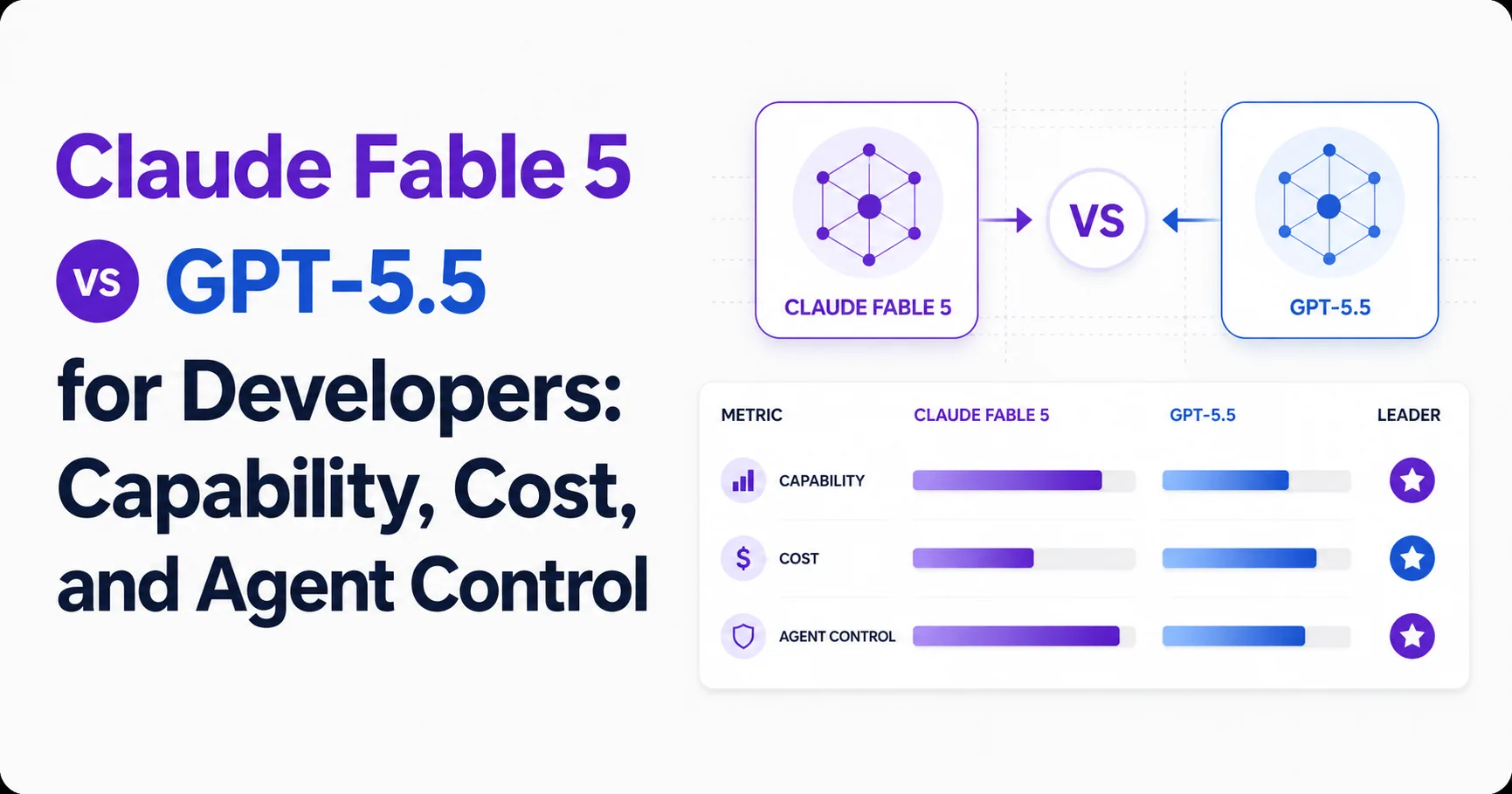
- **Winner overall:** Claude Fable 5, with a 59.9 Intelligence Index versus 54.8 and a 76.5 Coding Index versus 74.9 - **Cheaper:** GPT-5.5 at $11.25 vs $20 per 1M blended tokens - **Faster:** Claude Fable 5 has the only reported output speed at 70.509 median output tokens per second; latency is 0.3 seconds for both - **Pick Claude Fable 5 when:** long-running agent work justifies its 76.5 Coding Index and $20 blended-token rate - **Watch out:** GPT-5.5 output speed is unreported, and both latency values are 0.3, so throughput is not fully proven
Claude Fable 5 vs GPT-5.5
Claude Fable 5 is the better capability-first choice for developers, while GPT-5.5 is the stronger cost-first choice. The supplied snapshot gives Claude Fable 5 an Artificial Analysis Intelligence Index of 59.9 and Coding Index of 76.5, versus 54.8 and 74.9 for GPT-5.5 Artificial Analysis. GPT-5.5 costs $11.25 per 1M blended tokens versus $20 for Claude Fable 5. Claude Fable 5 is the only model with a reported median output speed, 70.509 tokens per second; latency is 0.3 seconds for each model, so throughput evidence remains incomplete. Data provided by https://artificialanalysis.ai/. Anthropic describes Claude Fable 5 as a model for long-running agents and complex engineering Models overview. OpenAI describes GPT-5.5 as a model for complex professional work, including coding, tool-heavy agents, and knowledge workflows Using GPT-5.5.
Executive summary
Claude Fable 5 has the broader evidence-backed advantage, but GPT-5.5 offers clearer control over price and reasoning intensity. The capability snapshot favors Claude, while the direct API bill favors GPT. Claude’s Max Effort is an effort setting, not a separate API model, and GPT’s xhigh is likewise a reasoning-effort value rather than a separate model ID Claude Fable 5 announcement GPT-5.5 model documentation. Teams should record the stable API IDs, claude-fable-5 and gpt-5.5, instead of treating interface labels as version names Claude model overview GPT-5.5 model documentation.
| Decision factor | Claude Fable 5 | GPT-5.5 |
|---|---|---|
| Intelligence Index | 59.9 | 54.8 |
| Coding Index | 76.5 | 74.9 |
| Blended price per 1M tokens | $20 | $11.25 |
| Reported output speed | 70.509 median output tokens per second | Not reported |
| Latency | 0.3 seconds | 0.3 seconds |
The supplied data does not provide a context-window value for either model, so context size is not a defensible tie-breaker in this article Artificial Analysis. Lifecycle evidence also differs. Anthropic’s model overview lists Fable 5 as current, and its release record documents restored access after an interruption Claude model overview Access restored. OpenAI’s model directory foregrounds a newer GPT-5.6 line, yet GPT-5.5 remains documented and directly callable; the supplied evidence contains no official deprecation notice OpenAI models GPT-5.5 model documentation. Long-lived integrations should verify provider status during rollout rather than infer support from a product directory.
Performance and agent behavior
Claude Fable 5 has the measured capability edge, but neither model has a proven universal speed advantage. The intelligence result, 59.9 versus 54.8, is wider than the coding result, 76.5 versus 74.9 Artificial Analysis. That pattern supports a stronger Claude preference for mixed tasks that combine planning, reasoning, and implementation. The coding result supports a narrower preference. The snapshot does not show how either score maps to a specific repository, tool policy, test suite, or failure-recovery process. No source here supports promising a fixed completion-rate gain or a guaranteed reduction in engineering hours.
Latency is 0.3 seconds for each model. Claude Fable 5 has a reported median output speed of 70.509 tokens per second, while GPT-5.5 output speed is unreported Artificial Analysis. The safe conclusion is that the supplied data does not establish a general response-speed winner. It does support measuring time to a usable patch, time to a verified patch, tool calls, retries, and human review on your own workloads. Output speed alone cannot answer those questions.
Product behavior may matter more than the relatively narrow coding gap. Anthropic describes Fable 5 cases involving codebase migrations, long analysis, screenshot-based reconstruction, and visual interaction Claude Fable 5 announcement. Community examples describe Fable 5 investigating a long-running engineering task Hacker News engineering report and opening a browser, inspecting windows, taking screenshots, and validating a frontend fix Hacker News proactive behavior report. These examples indicate autonomous behavior, but they are anecdotes without repeatable testing protocols.
GPT-5.5 officially supports function calling, Code Interpreter, Hosted Shell, computer use, MCP, and related tools GPT-5.5 model documentation. OpenAI warns that xhigh can cause over-searching or quality regression when tools are too open, instructions conflict, or stop conditions are missing Using GPT-5.5. Community reports praise GPT-5.5 for architecture, debugging, planning, and long project context AIcoding community report. Other users report terse abstractions, brittle shortcuts, and weak domain mapping without formal test methods Codex community discussion.
Choose Claude when autonomous persistence is a feature you can supervise. Choose GPT when your harness supplies explicit tests, bounded tool permissions, and clear stopping rules. Neither conclusion replaces a head-to-head evaluation, because the supplied materials contain no shared benchmark protocol.
Cost and total workflow economics
GPT-5.5 is the cost winner for straightforward API workloads, but Claude Fable 5 can justify its premium when fewer failed tasks matter. The key data point is blended price: GPT-5.5 costs $11.25 versus $20 for Claude Fable 5 per 1M blended tokens Artificial Analysis. That is a meaningful starting advantage for GPT-5.5 in high-volume, predictable request flows. It does not prove lower cost per completed task.
Token mix changes exposure. The snapshot lists GPT-5.5 at $5 for input and $30 for output, compared with $10 for input and $50 for output for Claude Fable 5 Artificial Analysis. Output-heavy agent loops magnify generated plans, tool arguments, retries, and explanations. A cheaper token can become a more expensive workflow if it requires more verification or repairs. The data brief does not measure cost per accepted patch, successful migration, or resolved ticket.
Claude’s official pricing documents prompt caching, while OpenAI’s pricing documentation covers cached input, Batch, Flex, and Fast modes Claude pricing OpenAI pricing. These options can change the economics of repeated context, asynchronous jobs, or latency-sensitive traffic. The right comparison should model cache behavior, routing, and retry policy rather than compare list price alone.
Autonomy creates another cost variable. A Hacker News report describes Fable 5 proactively launching browser checks, screenshots, and supporting scripts for a frontend repair Hacker News proactive behavior report. That behavior can reduce manual work, but it can also create extra tool calls and review surface. A Reddit discussion reports rapid quota consumption and inconsistent stopping for Fable 5, but lacks a reproducible protocol Claude Fable 5 community discussion. GPT-5.5 xhigh may also search excessively and increase latency and cost under open-ended tools Using GPT-5.5.
GPT-5.5 is the rational default for traffic where requests are predictable, success is easy to verify, and tool loops are bounded. Claude Fable 5 earns its higher price when its capability or initiative prevents enough failed attempts to offset the bill. The supplied evidence is insufficient to quantify that break-even point.
Recommendation by developer workload
Claude Fable 5 is the default recommendation for capability-sensitive agent engineering, while GPT-5.5 suits cost-sensitive, tightly controlled workflows. The snapshot favors Claude on intelligence and coding, while GPT-5.5 has the lower blended price Artificial Analysis.
| Choose | Best fit | Main reason | Validate first |
|---|---|---|---|
| Claude Fable 5 | Long-running agents, complex migrations, mixed reasoning and implementation | Anthropic positions it for long-running agents and complex professional work Claude model overview | Refusal handling, data governance, tool budgets, and availability |
| GPT-5.5 | High-volume requests, bounded coding agents, cost-sensitive production paths | Lower blended price and explicit reasoning-effort controls GPT-5.5 model documentation Using GPT-5.5 | Stop conditions, acceptance tests, style instructions, and domain-specific mapping |
Pick Claude Fable 5 for agent tasks where persistence, visual interaction, or long-running investigation is part of the product requirement. Anthropic documents these capabilities, and community reports provide concrete examples of engineering investigation and proactive browser validation Claude Fable 5 announcement Hacker News engineering report Hacker News proactive behavior report. Keep supervision explicit, because extra initiative can also increase tool activity and review cost.
Pick GPT-5.5 for workflows that already have a strong harness. OpenAI recommends explicit reuse requirements, subtask boundaries, testing expectations, acceptance criteria, and rules for requesting help Using GPT-5.5. GPT-5.5 is also a good fit when an existing OpenAI integration needs structured outputs, hosted tools, MCP, or computer use GPT-5.5 model documentation. Community feedback suggests that quality depends heavily on clear constraints and success criteria Codex community discussion.
Before committing to Claude, confirm that its refusal behavior, retention policy, and provider availability fit the deployment. Fable 5 is not listed as a Zero Data Retention model, and its refusal path requires application handling Claude Fable 5 announcement Refusals and fallback. Before committing to GPT-5.5, test whether its concise default style and xhigh behavior match the product, since OpenAI documents the need for explicit style and stopping instructions Using GPT-5.5.
Checks before production
Claude Fable 5 requires more production preflight validation, especially for refusal handling, retention, and availability. Anthropic documents refusal responses through a structured stop reason, and applications can configure fallbacks through the API or SDK layer Refusals and fallback. A successful transport response therefore does not always mean the requested task completed.
Fable 5 availability also deserves an explicit provider check. Anthropic documented an access interruption and later restoration, while the current model overview lists the model as available Claude Fable 5 announcement Access restored. Teams should verify the target provider and region during deployment.
Data governance is another gate. Anthropic states that Fable 5 is not available under Zero Data Retention, so sensitive workloads need a documented retention decision before launch Claude Fable 5 announcement. GPT-5.5 needs its own evaluation for concise customer-facing output, tool permissions, and domain-specific code mapping Using GPT-5.5 Codex community discussion.
The supplied snapshot leaves context-window values unavailable, and the community evidence lacks standardized head-to-head testing Artificial Analysis. Treat those gaps as open validation items rather than assumptions.
Frequently asked questions
Which model is better overall for developers?
Claude Fable 5 is the overall pick for capability-first development because the supplied snapshot gives it higher Intelligence and Coding Index scores, while official materials emphasize long-running agents and complex engineering workflows Artificial Analysis Claude model overview.
Which model is cheaper?
GPT-5.5 is cheaper on the supplied blended measure at $11.25 versus Claude Fable 5 at $20 per 1M blended tokens, although extra retries, tool calls, or long outputs can change a production bill Artificial Analysis OpenAI pricing.
Is Claude Fable 5 faster than GPT-5.5?
Claude Fable 5 is the only model with a reported median output speed in the supplied snapshot, at 70.509 tokens per second; both models show 0.3 seconds latency, so a general speed winner is not established Artificial Analysis.
Does xhigh represent a separate GPT model?
GPT-5.5 xhigh is a reasoning-effort setting rather than a separate model ID, and the API model remains gpt-5.5; applications should log the model ID and effort setting separately GPT-5.5 model documentation Using GPT-5.5.
What is the biggest operational risk with Claude Fable 5?
Claude Fable 5 requires careful handling of refusals, retention requirements, and autonomous tool activity, because official documentation describes structured refusal behavior while community reports describe proactive verification and inconsistent stopping Refusals and fallback Hacker News proactive behavior report Claude Fable 5 community discussion.
Which model is safer for a customer-facing product?
Neither model is automatically safer for every customer-facing product: GPT-5.5 needs explicit tone and explanation instructions, while Claude Fable 5 may conservatively refuse benign requests, so task-specific evaluation remains necessary Using GPT-5.5 Claude Fable 5 announcement.
Sources
- Artificial AnalysisSupplied comparison snapshot, capability indices, pricing, latency, and output-speed evidence
- Claude Models OverviewClaude Fable 5 positioning, model ID, availability, and supported channels
- Introducing Claude Fable 5 and Claude Mythos 5Adaptive thinking, effort settings, refusal behavior, retention, and fallback context
- Claude PricingClaude API pricing and prompt caching
- Refusals and FallbackRefusal handling and fallback implementation
- Claude Fable 5 and Claude Mythos 5Official capability claims, task examples, safety behavior, and availability history
- Claude Fable 5 Access RestoredRestored availability
- Claude Fable 5 on Hacker NewsCommunity report about long-running engineering work
- Claude Fable Is Relentlessly ProactiveCommunity report about autonomous browser validation, tool activity, and cost implications
- What's Everyone's Take on Claude Fable 5?Unstandardized community reports about quota use and stopping behavior
- GPT-5.5 Model DocumentationGPT-5.5 model ID, tools, reasoning settings, and API capabilities
- Using GPT-5.5Reasoning-effort guidance, orchestration requirements, style controls, and known limitations
- OpenAI ModelsCurrent model directory positioning
- OpenAI API PricingGPT-5.5 pricing modes and caching context
- Introducing GPT-5.5Official GPT-5.5 benchmark and capability announcement context
- Codex GPT-5.5 and Cheap Coding ModelsCommunity feedback about architecture, debugging, planning, and long project context
- What Types of Users Are Getting Good Results from GPT-5.5?Community feedback about concise output, code quality, domain mapping, and orchestration constraints
Published: