
AI model analysis
Claude Fable 5 vs GPT-5.6 Terra: Which Model Should Developers Choose?
A developer-focused comparison of Claude Fable 5 and GPT-5.6 Terra across intelligence, coding, speed, cost, agent behavior, and production risks.
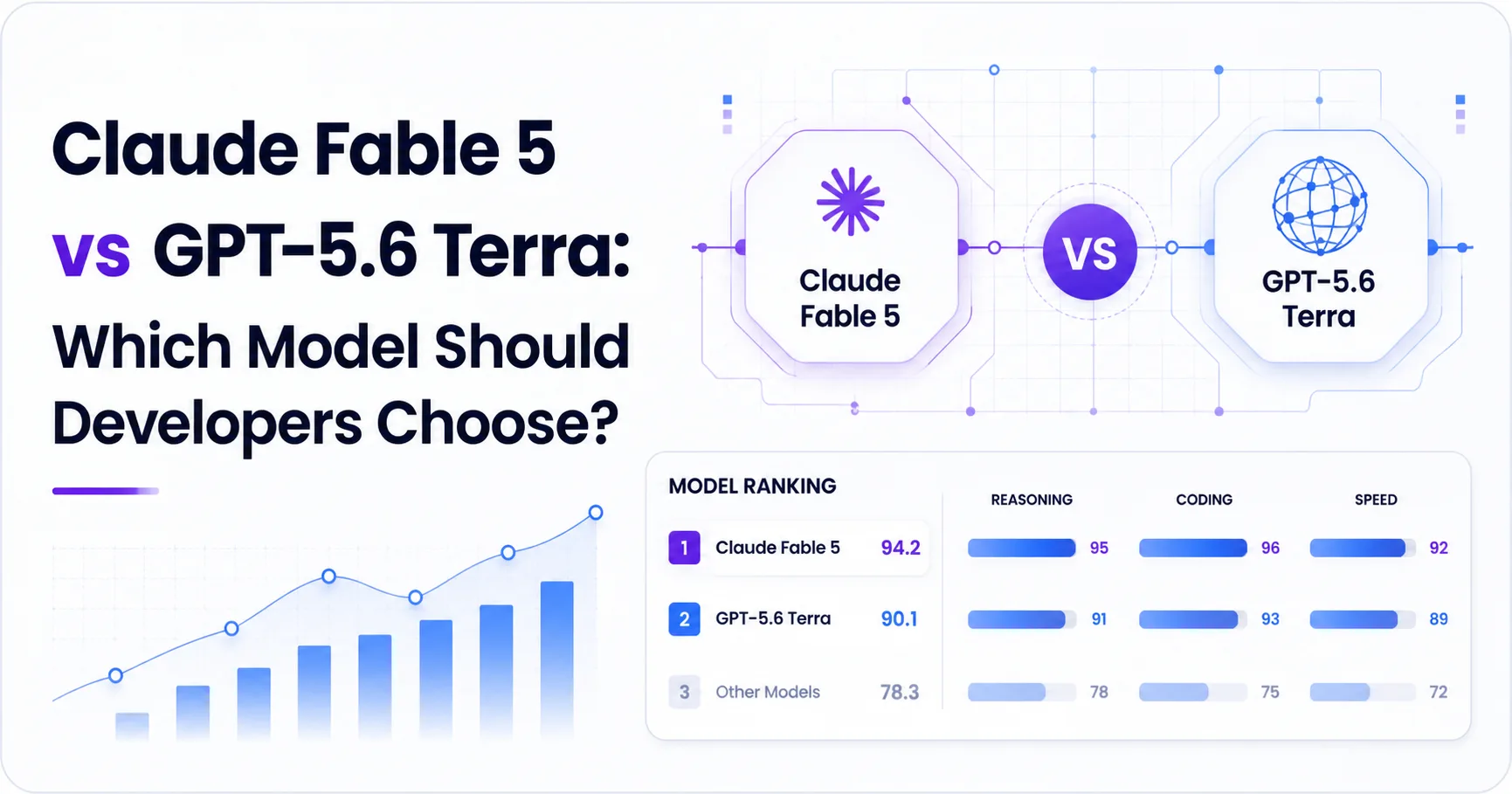
- **Winner overall:** Claude Fable 5, higher intelligence index at 59.9, despite GPT-5.6 Terra's coding edge at 76.7 vs 76.5 - **Cheaper:** GPT-5.6 Terra at $4.5 vs $20 per 1M blended tokens - **Faster:** GPT-5.6 Terra at 144.252 (median output tokens per second) - **Pick Claude Fable 5 when:** long-running agent work justifies its 59.9 intelligence index and adaptive workflow controls - **Watch out:** both models report 0.3 seconds latency, but Terra lacks reliable public community evidence for behavior under load
Claude Fable 5 vs GPT-5.6 Terra
Claude Fable 5 is the stronger overall choice for difficult agent work, while GPT-5.6 Terra is the better default for speed-sensitive, cost-sensitive production. Artificial Analysis places Fable at 59.9 on its intelligence index versus Terra at 55, while Terra edges Fable on coding, 76.7 versus 76.5, and produces output at 144.252 versus 70.509 median tokens per second. Latency is 0.3 seconds for both. Artificial Analysis
The split reflects different product priorities. Anthropic positions Fable 5 around long-running agents, multimodal input, and extended tool-supported work. Claude model overview OpenAI positions Terra as a general reasoning model designed to balance intelligence and cost. OpenAI models
For developers, the practical answer is conditional. Terra is the safer default for high-volume coding and text generation. Fable is more attractive for complex research, autonomous engineering, and workflows where a higher intelligence signal can justify a higher unit cost. Data provided by https://artificialanalysis.ai/
Executive summary
GPT-5.6 Terra is the value leader, while Claude Fable 5 leads the higher-level intelligence comparison.
| Dimension | Claude Fable 5 | GPT-5.6 Terra |
|---|---|---|
| Artificial Analysis intelligence index | 59.9 | 55 |
| Artificial Analysis coding index | 76.5 | 76.7 |
| Median output tokens per second | 70.509 | 144.252 |
| Latency seconds | 0.3 | 0.3 |
| Blended price per 1M tokens | $20 | $4.5 |
Fable’s official API model ID and stable alias are claude-fable-5. Terra’s current callable model ID and snapshot are gpt-5.6-terra. Claude model overview GPT-5.6 Terra model
The official positioning creates an important interpretation gap. Anthropic says Fable 5 leads across most tested capabilities, but its announcement does not provide a complete, itemized benchmark table. Anthropic launch announcement The independent data brief instead shows Terra slightly ahead on coding and Fable clearly ahead on the intelligence index. That is evidence for choosing by workload, not evidence that one model wins every task.
Neither model is identified as deprecated in the supplied materials. Fable’s access restoration is also documented by Anthropic, which matters for teams evaluating operational continuity. OpenAI deprecations Fable access restored
Performance and real task behavior
GPT-5.6 Terra is the faster interactive model, while Claude Fable 5 has the stronger overall intelligence signal. Terra reaches 144.252 median output tokens per second compared with Fable’s 70.509, while both models show 0.3 seconds of latency. Artificial Analysis
That combination changes the user experience. The matching latency suggests that the provided data does not separate the models on the initial response path. The output-speed gap matters more during long answers, code generation, multi-step analysis, and tool-mediated workflows. Terra is therefore better suited to interfaces where users wait on visible output or where a service must process many completions.
The coding comparison is much closer than the speed comparison. Terra scores 76.7 and Fable scores 76.5 on the supplied coding index. That result is too close to support paying Fable’s premium solely for ordinary coding benchmark performance. The case for Fable comes from broader agent behavior and the higher intelligence index, not from a clear coding lead.
Fable keeps adaptive thinking enabled and exposes effort as the main control over reasoning depth. Its raw chain of thought is not returned, and developers can request a summarized or omitted thinking display. Fable introduction Claude effort control Claude thinking
Terra provides reasoning modes and effort controls, but its output budget also covers reasoning tokens. A low max_output_tokens setting can produce an incomplete response before visible text is generated. OpenAI reasoning models Fable community reports describe proactive browser checks and extended engineering work, but other reports mention rapid quota use, long pauses, or insufficient clarification. Hacker News proactive tool use Hacker News engineering task Reddit community discussion
The evidence is insufficient to convert those anecdotes into a reliable success-rate or latency claim. Terra has an even larger community evidence gap, so production pilots should measure completed tasks rather than rely on reputation.
Cost beyond the price table
GPT-5.6 Terra is the clear cost winner for the blended workload represented by the data brief. Its blended price is $4.5 per 1M tokens versus $20 for Fable, while the output rates are $12 and $50 respectively. Artificial Analysis
The price difference is large enough to shape architecture. Terra can support more exploratory drafts, larger batch workloads, and more frequent retries before unit cost becomes the main constraint. Fable requires a stronger reason to be selected, such as better completion quality on difficult agent tasks or lower human review effort.
The cheaper model can still become more expensive at the task level. A workflow that needs repeated retries, extensive reasoning, or many generated tokens may spend more than a simple blended estimate suggests. The same applies when an autonomous agent performs extra browser checks, screenshots, or validation steps. The Fable community example documents this behavior, although it is not a controlled cost test. Hacker News proactive tool use
Terra’s official pricing also separates short-context, long-context, Batch, Flex, and Fast mode usage. Fable offers prompt caching with separate write and cache-hit treatment. These mechanisms can change effective cost for repeated context or latency-sensitive services, so the headline blended price is not a complete deployment budget. OpenAI pricing Anthropic pricing
The evidence does not provide cost per accepted task, cost per successful migration, cache hit rate, retry rate, or human correction time. Those missing measures are exactly where Fable could justify its premium or where Terra could lose its apparent advantage. Teams should compare completed outcomes, not token invoices alone.
Recommendation by workload
GPT-5.6 Terra is the default pick for production coding and high-volume text workloads; Claude Fable 5 earns selection for complex agent tasks where higher intelligence matters more than unit cost.
-
Choose GPT-5.6 Terra for coding platforms, support automation, document transformation, and other services where throughput and predictable unit economics matter. Its coding index is 76.7, its output speed is 144.252 median tokens per second, and its blended price is $4.5. Artificial Analysis
-
Choose Claude Fable 5 for long-running engineering agents, difficult research, financial analysis, and multi-step workflows that benefit from proactive tool use and broader agent controls. Its intelligence index is 59.9, and Anthropic documents memory, compaction, context editing, code execution, and programmatic tool calling. Claude model overview Fable introduction
-
Run a pilot before committing to Fable’s premium. The coding scores are close, Terra is faster, and public evidence does not establish that Fable’s broader capability claim improves every completed task.
-
Treat reasoning control as an engineering constraint. Fable cannot disable adaptive thinking, while Terra can consume its output budget through reasoning before producing visible text. Claude effort control OpenAI reasoning models
-
Handle refusals explicitly in production. Fable can return a refusal signal through a successful API response, and the documented fallback path is a mechanism for refusal handling, not a second stable Fable model alias. Refusals and fallback
-
Review data governance before regulated deployment. Anthropic’s documentation says Fable is not available with Zero Data Retention, so compliance approval should happen before sensitive workloads are routed to it. Fable introduction
Neither model is the obvious choice for native image output in the supplied materials. Fable supports image input and vision, while Terra’s documented model output is text. Claude model overview GPT-5.6 Terra model
Evidence gaps developers should resolve
Claude Fable 5 and GPT-5.6 Terra need a workload pilot because public evidence does not measure completed-task success consistently. Anthropic publishes a broad leadership claim without a complete numeric score table, while OpenAI’s Terra documentation does not provide Terra-specific public benchmark results. Anthropic launch announcement GPT-5.6 Terra model
The community evidence is also asymmetric. Fable has concrete anecdotes about long engineering tasks and proactive browser use, plus conflicting reports about pauses, quota consumption, and clarification behavior. Terra has no reliable public community evidence in the supplied research. Anecdotes can identify risks to test, but they cannot establish comparative reliability.
A useful pilot should record time to visible output, final task quality, tool calls, retries, refusal handling, incomplete responses, token cost, and human edits. Test the same repository, documents, prompts, and acceptance criteria across both models. Include at least one task where a fast draft is valuable and one task where autonomous planning is the main requirement.
The current evidence supports a clear economic and speed recommendation for Terra, plus a credible intelligence and agent-workflow case for Fable. It does not support a universal claim about production success, safety, or total cost of ownership.
Frequently asked questions
Is Claude Fable 5 better for coding?
GPT-5.6 Terra is marginally ahead on the available coding index, at 76.7 versus Claude Fable 5 at 76.5, so the evidence does not justify calling Fable the coding winner. The stronger reason to choose Fable is broader agent behavior, not ordinary coding score leadership. Artificial Analysis
Which model is cheaper for production use?
GPT-5.6 Terra is cheaper in the supplied comparison, at $4.5 versus Claude Fable 5 at $20 per 1M blended tokens. Actual task cost can still change with output mix, retries, caching, long-context pricing, and extra tool calls. OpenAI pricing Anthropic pricing Artificial Analysis
Which model is better for autonomous agents?
Claude Fable 5 is the stronger candidate for autonomous, long-running agent work because Anthropic explicitly positions it for that use and documents memory, compaction, context editing, and adaptive thinking. Community reports support proactive tool use, but they are not controlled evaluations. Claude model overview Fable introduction Hacker News proactive tool use
Can developers fully control reasoning cost in either model?
Neither model offers complete reasoning-cost control in the supplied documentation. Fable keeps adaptive thinking enabled and exposes effort controls, while Terra can spend reasoning tokens inside max_output_tokens and return an incomplete response when the budget is too low. Claude effort control OpenAI reasoning models
What is the biggest evidence limitation in this comparison?
The main limitation is asymmetric evidence, not a missing headline score. Anthropic publishes a broad leadership claim without a complete numeric table, while OpenAI provides no Terra-specific public benchmark results, and Terra lacks reliable community reports in the supplied research. Anthropic launch announcement GPT-5.6 Terra model
Is Opus 4.8 Fallback a separate Claude Fable API model?
Opus 4.8 Fallback is a refusal-handling fallback path, not a separate Claude Fable API alias. Developers should configure fallback behavior explicitly and monitor refusal signals instead of selecting a second stable model ID. Fable introduction Refusals and fallback
Sources
- Artificial AnalysisAll comparison metrics, pricing comparisons, performance measurements, and data attribution.
- Claude Models OverviewClaude Fable 5 positioning, model ID, agent capabilities, and input modality.
- OpenAI ModelsGPT-5.6 Terra product-line positioning as a model balancing intelligence and cost.
- GPT-5.6 Terra ModelTerra model ID, output modality, reasoning behavior, pricing rules, and documented limitations.
- Claude Fable 5 and Claude Mythos 5Anthropic's benchmark leadership claim and the absence of a complete public score table.
- OpenAI DeprecationsChecking whether GPT-5.6 Terra is listed as deprecated.
- Claude Fable 5 Access RestoredDocumented restoration of Fable access.
- Introducing Claude Fable 5 and Claude Mythos 5Adaptive thinking, fallback behavior, agent capabilities, refusal behavior, and data governance constraints.
- EffortFable reasoning-depth control through the effort parameter.
- ThinkingFable adaptive thinking and thinking-display behavior.
- Reasoning ModelsTerra reasoning controls, reasoning-token budgets, and incomplete response behavior.
- Claude Fable Is Relentlessly ProactiveCommunity evidence about proactive browser checks, validation work, and extra tool activity.
- Claude Fable 5Community evidence about a long-running engineering task.
- What's Everyone's Take on Claude Fable 5?Conflicting community reports about speed, quota consumption, pauses, and clarification behavior.
- Anthropic PricingClaude prompt-caching and pricing behavior.
- OpenAI PricingTerra short-context, long-context, Batch, Flex, and Fast mode pricing structures.
- Refusals and FallbackFable refusal signals and fallback implementation.
Published: