
AI model analysis
Claude Fable 5 vs GPT-5 nano: Which Model Should Developers Choose?
A developer-focused comparison of Claude Fable 5 and GPT-5 nano covering capability evidence, speed, cost, availability, reliability, and practical model selection.
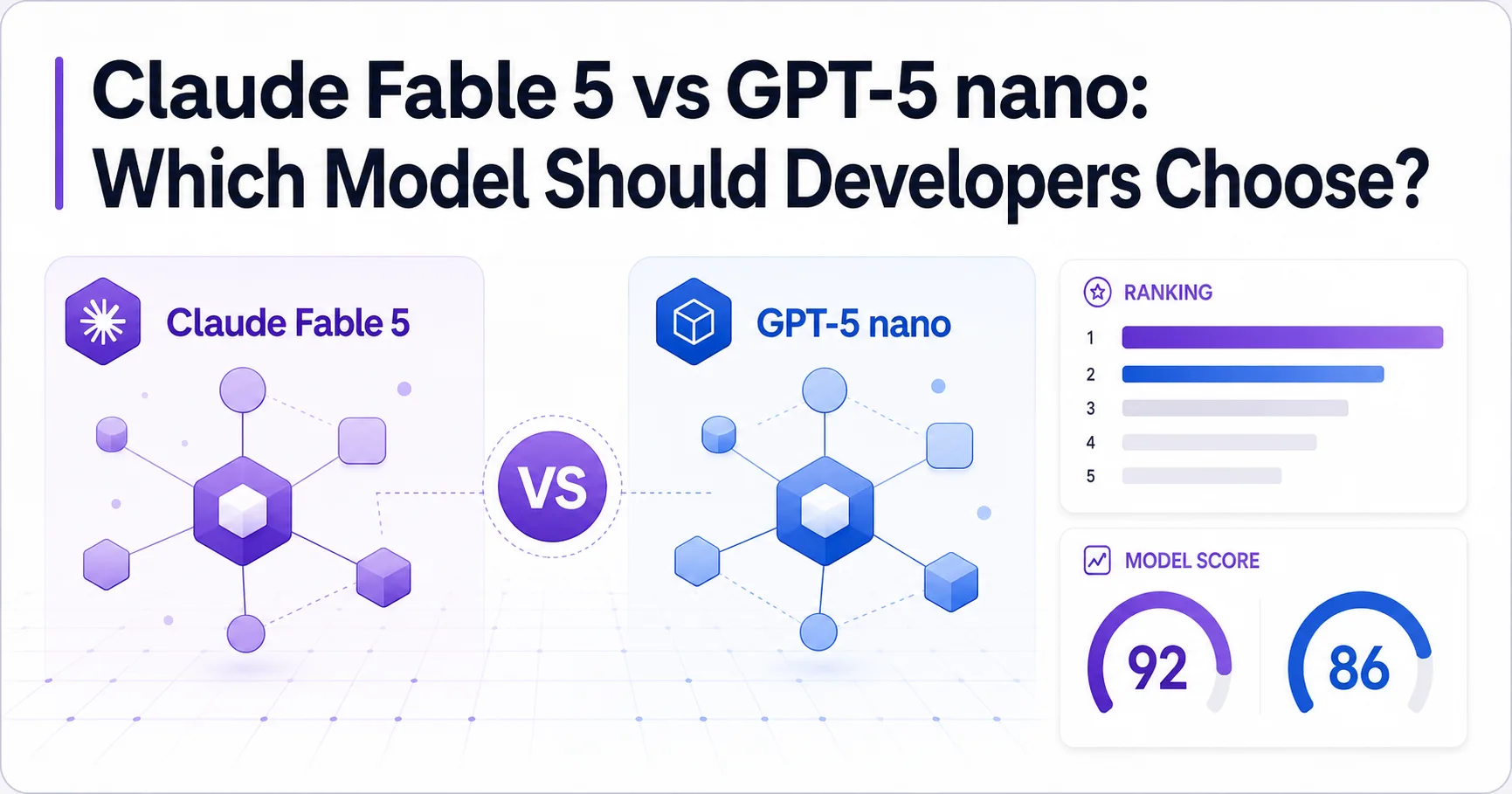
- **Winner overall:** Claude Fable 5, with an Artificial Analysis Intelligence Index of 59.9 vs 19.9 - **Cheaper:** GPT-5 nano at $0.1375 vs $20 per 1M blended tokens - **Faster:** Claude Fable 5 at 70.509 median output tokens per second, while GPT-5 nano has no reported value - **Pick GPT-5 nano when:** low cost and the available 83.7 math index matter more than broad capability evidence - **Watch out:** GPT-5 nano is absent from the current official model and pricing pages, so its current API status and limits are unverified
Claude Fable 5 vs GPT-5 nano
Claude Fable 5 is the safer overall choice for developers who need evidence of broad capability, while GPT-5 nano is the price-first option with major verification gaps. The available data gives Claude Fable 5 an Artificial Analysis Intelligence Index of 59.9, compared with 19.9 for GPT-5 nano. GPT-5 nano has a reported math index of 83.7, but the comparison does not provide a directly comparable Claude math result. Claude Fable 5 also reports a median output speed of 70.509 tokens per second. GPT-5 nano has no reported output-speed value.
The cost difference is substantial. The blended price is $20 per 1M tokens for Claude Fable 5 and $0.1375 for GPT-5 nano. That gap can dominate decisions for high-volume classification, extraction, or simple routing. It does not automatically make GPT-5 nano cheaper in production, because the research brief does not verify its current availability, context limits, output limits, or API behavior.
The data is provided by Artificial Analysis.
Executive summary for developers
Claude Fable 5 offers the stronger documented general-purpose profile, but GPT-5 nano remains attractive for narrow workloads where cost is the dominant constraint. Anthropic describes Claude Fable 5 as a model for long-running agents with text and image input, text output, multilingual support, and vision capabilities. The model supports adaptive thinking, effort controls, task budgets, memory, code execution, programmatic tool calling, context editing, compaction, and vision, according to Anthropic’s model introduction.
GPT-5 nano has a much thinner evidence base in the supplied material. The current OpenAI model directory does not list GPT-5 nano, gpt-5-nano, or gpt-5-nano-2025-08-07. The directory therefore does not confirm its current API access, stable alias, context window, maximum output, or supported parameters. The OpenAI pricing page also does not list gpt-5-nano.
That creates an unusual comparison. Claude Fable 5 has higher documented breadth and measurable general capability. GPT-5 nano has lower listed cost and a strong reported math index, but its current product status is uncertain. Developers should treat GPT-5 nano as a candidate requiring validation, not as a fully verified production target.
Performance: capability breadth matters more than a single score
Claude Fable 5 is the stronger documented choice for mixed engineering and agent workloads, with a 59.9 Intelligence Index and a 76.5 Coding Index. The Coding Index is not directly comparable with a GPT-5 nano coding result, because the supplied data does not include one. GPT-5 nano instead has an 83.7 Math Index, which may make it worth testing for bounded numerical or symbolic tasks. That score does not establish broad software engineering performance.
The practical difference is task uncertainty. Claude Fable 5 is positioned for long-running agents, complex codebase work, visual interaction, research, memory, and tool use. Community examples describe it investigating a complex WebAssembly engineering problem and proactively opening a browser, checking a window, taking screenshots, and validating a frontend fix. Those reports show useful behavior patterns, but the engineering report and the browser-validation discussion are not controlled evaluations.
Claude Fable 5 reports 70.509 median output tokens per second, while GPT-5 nano has no reported value. Latency is 0.3 seconds for each model in the data brief, so the available latency measure does not separate them. GPT-5 nano may still win on tasks that need little reasoning and high request volume, but the supplied material cannot verify that operational claim.
The central limitation is missing comparability. No direct coding comparison, context-window comparison, maximum-output comparison, or reproducible community test is available for GPT-5 nano. Developers should benchmark their own workload before treating the math result as a general performance signal.
Cost: GPT-5 nano wins the price chart, but production cost is not fully known
GPT-5 nano is the apparent cost winner at $0.1375 per 1M blended tokens, but its unverified product status can make the cheapest nominal model an expensive integration decision. Claude Fable 5 costs $20 per 1M blended tokens, with standard input pricing of $10 per 1M tokens and output pricing of $50 per 1M tokens. GPT-5 nano is listed in the data brief at $0.05 per 1M input tokens and $0.4 per 1M output tokens.
The price gap favors GPT-5 nano for simple, repetitive workloads. A classifier, metadata extractor, first-pass summarizer, or deterministic math helper may not need Claude Fable 5’s broader agent features. In those cases, paying for higher capability can be wasteful. The decision changes if the cheaper model needs more retries, external validation, manual review, or a second model for difficult cases. The supplied evidence does not quantify those rates, so no total-cost conclusion can be calculated.
Claude Fable 5 also offers prompt caching. Anthropic lists 5-minute writes at $12.50 per MTok, 1-hour writes at $20 per MTok, and cache hits and refreshes at $1 per MTok on its pricing page. Caching may improve the economics of repeated long instructions or shared agent context, but the brief does not provide workload volume or cache-hit rates.
The largest cost risk is uncertainty around GPT-5 nano. OpenAI’s current pricing directory lists gpt-5.4-nano, not gpt-5-nano, and explicitly provides no GPT-5 nano price. Developers should verify the callable model ID, billing behavior, limits, and service availability before using the data-brief price in a budget.
Recommendation: choose by workload risk, not sticker price
Claude Fable 5 is the recommended default for production agents and broad developer workflows, while GPT-5 nano should be tested as a low-cost specialist only after its current status is confirmed. Claude Fable 5 has a documented API ID and stable alias, claude-fable-5, and Anthropic lists access through the Claude API, Amazon Bedrock, Claude Platform on AWS, Google Cloud, and Microsoft Foundry in the model overview. The overview also describes a 1M-token context window and a 128k-token maximum output for the Messages API.
Choose Claude Fable 5 when the application must manage long-running work, inspect visual state, modify a codebase, call tools, or recover from complicated intermediate decisions. Adaptive thinking is always enabled. Developers can adjust depth with the effort parameter, but cannot disable thinking entirely, as documented in the effort guide and the thinking guide. That design favors difficult tasks, but it limits strict control over reasoning cost and latency.
Choose GPT-5 nano when the task is narrow, the low listed price is decisive, and a local evaluation confirms adequate quality. The 83.7 Math Index makes it a reasonable candidate for math-focused experiments. It is not evidence that GPT-5 nano is a good general coding or agent model. The official materials supplied here do not confirm its current model ID, limits, or failure behavior.
Before deployment, test refusal handling, retries, tool calls, and output consistency. Claude Fable 5 can return an HTTP 200 response with stop_reason: "refusal", so applications must inspect the response body and implement the documented refusal and fallback handling. Anthropic also states that Fable 5 uses 30-day data retention and is not available under Zero Data Retention, which may rule it out for some regulated workloads.
Questions to resolve before choosing
Claude Fable 5 is easier to validate today because Anthropic documents its identity, interfaces, capabilities, and deployment channels. GPT-5 nano has a lower data-brief price, but the supplied OpenAI pages do not confirm that the model remains directly callable. The official Anthropic announcement also describes software engineering, financial analysis, visual tasks, long-context memory, and scientific research cases, while noting that a complete numerical benchmark table was not provided in the launch announcement.
Availability history deserves attention. Anthropic reported that Fable 5 access was paused and later restored, and the restoration is documented in the redeployment notice. The research brief says the current model overview still lists Fable 5 as a current model. That supports present availability, but it does not guarantee future continuity.
Community evidence is mixed. Some Reddit users report fast delivery on complex planning and migration work, while others report rapid quota consumption, long pauses, or insufficient clarification. The discussion at Reddit’s Claude Fable 5 thread lacks a consistent testing method. No independently verifiable X evaluation or reliable GitHub discussion was found for GPT-5 nano.
The unanswered questions are therefore material. The supplied research does not establish GPT-5 nano’s current availability, context limits, output limits, or operational failure modes. It also does not establish whether Claude Fable 5’s broader capability produces better task-level economics for any specific application.
Frequently asked questions
Is Claude Fable 5 better than GPT-5 nano for coding?
Claude Fable 5 is the better-supported coding choice because it has a reported 76.5 Coding Index and documented code execution, tool use, long-running agent, and codebase migration capabilities. GPT-5 nano has no supplied coding score, so its coding quality remains unverified.
Which model is cheaper for production API traffic?
GPT-5 nano is cheaper on the supplied price snapshot at $0.1375 per 1M blended tokens versus $20 for Claude Fable 5. Developers must still verify GPT-5 nano’s current model ID, availability, limits, and billing before relying on that estimate.
Should developers trust GPT-5 nano's 83.7 math score?
Developers can treat the 83.7 Math Index as a useful screening signal, but not as proof of broad model quality. The supplied data has no directly comparable Claude math score and no verified GPT-5 nano production documentation.
Can Claude Fable 5 thinking be disabled to reduce cost?
Claude Fable 5 thinking cannot be disabled, because adaptive thinking is always enabled. Developers can use the effort parameter to control thinking depth, but the supplied documentation does not promise a fixed reasoning cost or output process.
Is Claude Fable 5 suitable for strict data-retention requirements?
Claude Fable 5 may be unsuitable when Zero Data Retention is mandatory, because Anthropic states that the model uses 30-day data retention. Teams should confirm their compliance requirements and deployment terms before sending sensitive data.
Sources
- Artificial AnalysisAll benchmark, price, latency, speed, release-date, and comparison values in the data snapshot.
- Claude models overviewClaude Fable 5 model identity, aliases, context window, output limit, availability, and deployment channels.
- Introducing Claude Fable 5 and Claude Mythos 5Adaptive thinking, tools, agent capabilities, refusals, fallback behavior, and data retention.
- Claude pricingClaude Fable 5 input, output, and prompt-caching pricing.
- EffortThe role and limits of the Claude effort parameter.
- ThinkingAdaptive thinking behavior and configuration limits.
- Refusals and fallbackHTTP 200 refusal handling and fallback implementation.
- OpenAI modelsVerification of GPT-5 nano's absence from the current official model directory and missing official limits.
- OpenAI API pricingVerification that gpt-5-nano is absent from current pricing and distinction from gpt-5.4-nano.
- Claude Fable 5 and Claude Mythos 5Official benchmark claims, test cases, safety boundary, and launch context.
- Claude Fable 5 access restoredEvidence that Fable 5 access was restored after an interruption.
- Claude Fable 5, Hacker NewsCommunity example involving a complex WebAssembly engineering task.
- Claude Fable is relentlessly proactive, Hacker NewsCommunity example involving browser checks, screenshots, validation, and additional tool activity.
- What's everyone's take on Claude Fable 5?Mixed community reports about planning speed, quota use, clarification, and pauses.
Published: