
AI model analysis
Claude Opus 4.5 (Reasoning) vs GPT-5 mini (high): Which Model Should Developers Choose?
A developer-focused comparison of Claude Opus 4.5 (Reasoning) and GPT-5 mini (high), covering measured quality, math, coding evidence, latency, pricing, API certainty, and selection risk.
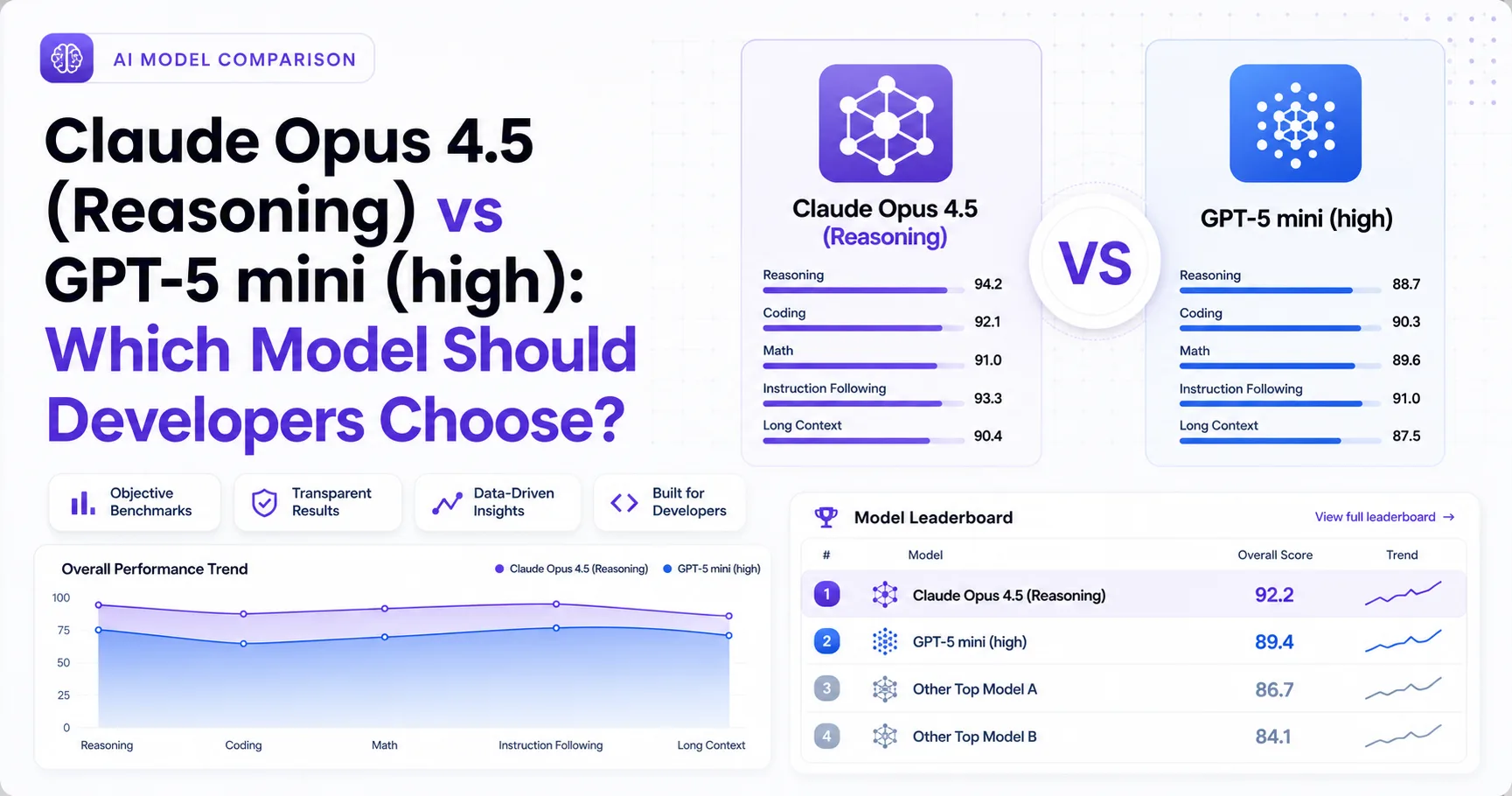
- **Winner overall:** Claude Opus 4.5 (Reasoning), with a 40.8 Artificial Analysis Intelligence Index and 91.3 Math Index - **Cheaper:** GPT-5 mini (high) at $0.6875 vs $10 per 1M blended tokens - **Faster:** Claude Opus 4.5 (Reasoning) and GPT-5 mini (high) tie at 0.3 seconds latency - **Pick GPT-5 mini (high) when:** low-cost, high-volume workloads matter more than the higher 40.8 intelligence score - **Watch out:** current official pages do not verify either model’s exact API availability, context window, or complete tool configuration
Claude Opus 4.5 (Reasoning) vs GPT-5 mini (high)
Claude Opus 4.5 (Reasoning) is the stronger measured general-intelligence choice, while GPT-5 mini (high) is the far cheaper option for production volume. Artificial Analysis reports intelligence scores of 40.8 for Claude Opus 4.5 (Reasoning) and 25.3 for GPT-5 mini (high). Math performance is close at 91.3 and 90.7. Latency is tied at 0.3 seconds, while output-speed data is unavailable for both models.\n\nThe practical decision is therefore not a simple quality ranking. Developers must weigh a meaningful intelligence-score advantage against a large price difference, incomplete official documentation, and uncertainty about current API identifiers. Anthropic documents Claude Opus 4.5 as a multimodal model with text and image input, text output, multilingual capability, and vision support through platforms including the Claude API, Amazon Bedrock, and Google Cloud (Claude models overview). OpenAI’s current model directory does not list GPT-5 mini as an independent entry (OpenAI Models).\n\nData provided by https://artificialanalysis.ai/.
Executive summary for developers
Claude Opus 4.5 (Reasoning) is the safer quality-first pick according to the available evaluation data, but GPT-5 mini (high) is the more compelling default for cost-sensitive applications. The data shows Claude ahead on the Artificial Analysis Intelligence Index, 40.8 versus 25.3, and slightly ahead on the Math Index, 91.3 versus 90.7. The coding comparison is incomplete because the dataset contains a 15.6 Coding Index score for GPT-5 mini (high) but no corresponding Claude value. That absence prevents a defensible coding winner.\n\nGPT-5 mini (high) changes the economics of repeated generation. Its blended price is $0.6875 per 1M tokens, compared with $10 for Claude Opus 4.5 (Reasoning). Its input price is $0.25 per 1M tokens, compared with $5, and its output price is $2, compared with $25. These figures make GPT-5 mini (high) attractive for classification, extraction, routing, lightweight coding assistance, and other workloads where quality requirements are bounded and request volume is high.\n\nClaude remains better suited to teams that prioritize the higher measured intelligence score, need documented multimodal positioning, or can justify higher output costs for difficult tasks. That conclusion is conditional. Neither brief establishes a complete, current API contract for the exact model labels being compared. Anthropic’s documentation confirms the model family but does not list a specific API ID, while OpenAI’s current directory does not independently verify GPT-5 mini (Claude models overview, OpenAI Models).
Performance: what the benchmark gap means
Claude Opus 4.5 (Reasoning) is the measured quality leader, but the evidence does not prove superiority across every developer task. The 40.8 versus 25.3 Intelligence Index result suggests Claude may be the better candidate for broad, ambiguous, or multi-step work. Such work often depends on maintaining a coherent solution strategy across several decisions. The source data supports the ranking, but it does not identify which individual tasks caused the gap.\n\nMath is a different story. Claude scores 91.3 and GPT-5 mini (high) scores 90.7, so the available math evidence shows near-parity rather than a decisive separation. A developer choosing between these models for structured mathematical workloads should therefore test answer verification, formatting, retries, and failure handling in the actual application. The briefs do not provide task-level examples, variance, sample sizes, or methodology for these indices.\n\nCoding evidence is insufficient for a direct comparison. GPT-5 mini (high) has a Coding Index value of 15.6 in the data brief, but Claude’s value is null. That missing value is not evidence that Claude performs worse, and it is not evidence that GPT-5 mini (high) wins coding tasks. The research brief also found no reliable community test with a disclosed methodology for either model.\n\nLatency is tied at 0.3 seconds for both models. Output tokens per second are unavailable for both models, so the data cannot establish which model streams longer answers faster. Anthropic documents text and image input plus vision support for Claude Opus 4.5 (Claude models overview). The OpenAI brief only confirms broad capabilities for current models and does not establish that those statements apply specifically to GPT-5 mini (OpenAI Models).
Cost: the cheaper model can still be the wrong choice
GPT-5 mini (high) is the clear price leader, but its lower token price only matters if its task quality and operational behavior meet the application’s threshold. The blended price is $0.6875 per 1M tokens versus $10 for Claude Opus 4.5 (Reasoning). The input and output prices also favor GPT-5 mini (high), at $0.25 and $2 versus Claude’s $5 and $25.\n\nThe chart makes the price difference visible, but it cannot show the cost of a failed answer. A cheaper model can become more expensive in practice if it requires extra retries, human review, validation calls, or a second model for difficult cases. The supplied research does not provide retry rates, task success rates, or production-quality measurements, so no total-cost conclusion can be proven from the token prices alone. Developers should treat the listed prices as direct usage prices, not as a complete application cost model.\n\nClaude’s pricing has an additional deployment condition. Anthropic lists prompt-cache write prices of $6.25 per MTok for 5 minutes and $10 per MTok for 1 hour, with cache hits at $0.50 per MTok (Claude pricing). Regional and multi-region endpoints cost 10% more than global endpoints. That premium may matter for compliance or routing requirements, but it is a deployment constraint rather than a capability weakness.\n\nOpenAI’s current pricing page does not list GPT-5 mini’s standard, Batch, Flex, or Fast mode prices (OpenAI Pricing). This creates an important procurement risk: the data brief supplies comparison prices, while the current official page does not independently confirm the model’s present pricing or availability.
Recommendation by workload
GPT-5 mini (high) is the best first candidate for high-volume applications, while Claude Opus 4.5 (Reasoning) is the better candidate when broad reasoning quality justifies higher spend. Choose GPT-5 mini (high) for workloads such as request classification, metadata extraction, simple transformations, automated routing, and bounded coding assistance. Its $0.6875 blended price gives teams more room for repeated calls, fallback logic, and evaluation traffic. The recommendation remains provisional because the current OpenAI documentation does not verify the exact model label or a stable API identifier (OpenAI Models, OpenAI Pricing).\n\nChoose Claude Opus 4.5 (Reasoning) for difficult analysis, open-ended problem solving, and workflows where a higher general-intelligence score is more valuable than token cost. The available data gives it a 40.8 Intelligence Index score, compared with 25.3 for GPT-5 mini (high). Anthropic also explicitly documents Claude Opus 4.5’s text and image input, text output, multilingual capability, vision support, and availability across several platforms (Claude models overview).\n\nUse a controlled bake-off before committing either model to coding-heavy or agentic production work. The provided coding data is one-sided, with only a 15.6 GPT-5 mini (high) score, and neither brief supplies verified tool parameters, context limits, or failure cases. Test the exact prompts, tool schemas, structured-output requirements, retry policy, and review process used by the product.\n\nThe largest unresolved selection risk is model identity. The research brief does not confirm a current API ID for Claude Opus 4.5 or for GPT-5 mini (high). Anthropic’s pricing page still lists Claude Opus 4.5 at $5 input and $25 output per MTok, but the documentation does not establish a stable callable alias (Claude pricing). Treat API availability, version pinning, and sunset policy as launch blockers to verify manually.
What to verify before production
Claude Opus 4.5 (Reasoning) is the model that requires the clearest deployment verification because the official material confirms its family and pricing but not a concrete API ID. GPT-5 mini (high) has a similar documentation gap because the current OpenAI model directory and pricing page do not list it as an independent current product.\n\nBefore production, verify the exact callable model string, context window, maximum output, reasoning controls, tool-calling behavior, structured-output support, regional availability, and retirement policy. The supplied research found no reliable community test with a disclosed methodology, so community reputation cannot fill those documentation gaps. Run tests against the exact endpoint and account configuration that the application will use.
Frequently asked questions
Which model is better overall for developers?
Claude Opus 4.5 (Reasoning) is the better quality-first choice because its Artificial Analysis Intelligence Index is 40.8 versus 25.3 for GPT-5 mini (high). That result does not prove superiority for every coding or production workflow, because the coding comparison is incomplete and official API details remain uncertain.
Which model is cheaper for production workloads?
GPT-5 mini (high) is cheaper on every listed token-price measure, with a blended price of $0.6875 per 1M tokens, input pricing of $0.25, and output pricing of $2. Claude Opus 4.5 (Reasoning) is listed at $10 blended, $5 input, and $25 output.
Is Claude better at math than GPT-5 mini?
Claude Opus 4.5 (Reasoning) has the higher listed Math Index at 91.3 versus 90.7 for GPT-5 mini (high). The difference is small in the supplied data, and the brief does not include task-level results, variance, or methodology that would show whether the distinction matters in a specific application.
Which model is faster?
Neither model wins on the available latency data because Claude Opus 4.5 (Reasoning) and GPT-5 mini (high) are both listed at 0.3 seconds. Output speed in tokens per second is unavailable for both models, so the evidence cannot establish which model streams long responses faster.
Can developers trust the exact API names in this comparison?
Developers should verify the exact API names before implementation because the supplied official sources do not confirm a stable callable identifier for either comparison label. Anthropic documents the Claude Opus 4.5 family without listing its specific API ID, while OpenAI’s current directory does not list GPT-5 mini as an independent entry.
Sources
- Claude models overviewVerifying Claude Opus 4.5 capabilities, modality, platform support, and model documentation status.
- Claude pricingVerifying Claude Opus 4.5 token prices, prompt-cache prices, and regional endpoint pricing.
- OpenAI ModelsVerifying the current OpenAI model directory and the documentation status of GPT-5 mini.
- OpenAI PricingVerifying the current OpenAI pricing catalog and the absence of a listed GPT-5 mini price.
- Artificial AnalysisAttributing the supplied benchmark, latency, release-date, and pricing comparison data.
Published: