
AI model analysis
Claude Opus 4.5 (Reasoning) vs o3: Which Model Should Developers Choose?
A developer-focused comparison of Claude Opus 4.5 (Reasoning) and o3 across intelligence, mathematics, speed, pricing, availability, and deployment risk.
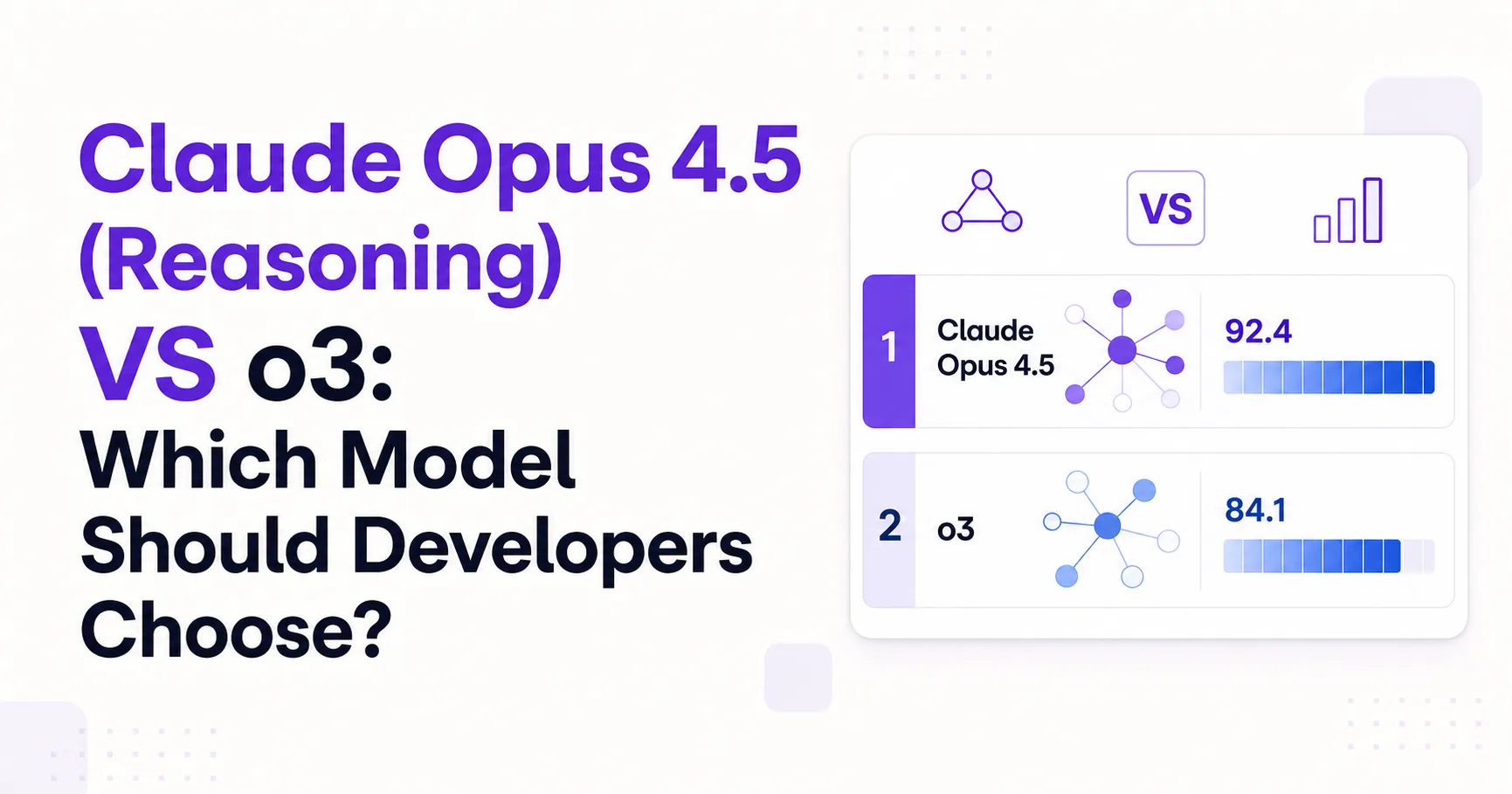
- **Winner overall:** Claude Opus 4.5 (Reasoning), with an Artificial Analysis Intelligence Index of 40.8 vs 30.4 - **Cheaper:** o3 at $3.5 vs $10 per 1M blended tokens - **Faster:** o3 at 128.056 (median output tokens per second) - **Pick Claude Opus 4.5 (Reasoning) when:** broader reasoning quality matters more than minimizing token spend - **Watch out:** Current official documentation does not clearly confirm the callable status, stable alias, or full configuration details for either model
Claude Opus 4.5 (Reasoning) vs o3: The Practical Choice
Claude Opus 4.5 (Reasoning) is the stronger measured choice, while o3 is the safer cost and throughput choice for developers with predictable workloads.
The supplied evaluation snapshot gives Claude Opus 4.5 (Reasoning) an Artificial Analysis Intelligence Index of 40.8, compared with 30.4 for o3. Its mathematics result is also higher, at 91.3 compared with 88.3. Those results support choosing Claude when task quality is the primary constraint.
o3 changes the economic picture. Its blended price is $3.5 per 1M tokens, compared with $10 for Claude Opus 4.5 (Reasoning). o3 also reports a median output speed of 128.056 tokens per second, while the snapshot provides no corresponding speed value for Claude.
The comparison has an important operational limitation. Anthropic’s model overview describes Claude Opus 4.5 as supporting text and image input, text output, multilingual use, and vision, but does not list a specific API ID in the supplied evidence. OpenAI’s current model directory does not list o3 in the supplied material. Developers should therefore treat availability and integration details as open verification tasks.
Data provided by https://artificialanalysis.ai/.
Executive Summary for Model Selection
Claude Opus 4.5 (Reasoning) offers the better measured quality profile, but o3 offers a substantially lower token cost and a documented output-speed advantage.
| Decision factor | Claude Opus 4.5 (Reasoning) | o3 | Selection meaning |
|---|---|---|---|
| Intelligence Index | 40.8 | 30.4 | Claude has the stronger overall measured result |
| Mathematics Index | 91.3 | 88.3 | Claude leads, although the gap is narrower than on intelligence |
| Blended price per 1M tokens | $10 | $3.5 | o3 is cheaper for the supplied workload mix |
| Input price per 1M tokens | $5 | $2 | o3 is cheaper before generation costs are added |
| Output price per 1M tokens | $25 | $8 | Long answers make Claude materially more expensive |
| Median output speed | Not provided | 128.056 tokens per second | o3 has the measurable throughput advantage |
| Latency | 0.3 seconds | 0.3 seconds | The supplied snapshot shows a tie |
The results point to a quality-versus-economics decision rather than a universal winner. Claude is the better candidate for difficult reasoning, synthesis, and tasks where a higher intelligence score can reduce retries or human review. o3 is the better candidate for high-volume workflows, interactive generation, and systems where output throughput affects user experience.
The official positioning is not fully symmetric. Anthropic’s documentation explicitly describes Claude’s multimodal and multilingual capabilities. The supplied OpenAI model documentation instead presents a current catalog centered on newer model families and does not provide the same o3 details. That difference does not prove that o3 lacks a capability. It proves that the supplied official evidence is insufficient for a confident capability comparison.
The most important unresolved question is whether either model remains directly callable under the exact identifiers used in the dataset. The research brief does not establish a stable alias, API ID, context window, maximum output length, or full parameter set for either model. Those missing facts can outweigh benchmark differences during production planning.
Performance: What the Scores Mean in Real Development Work
Claude Opus 4.5 (Reasoning) is the stronger measured performer, especially when a workflow rewards broad task quality rather than raw generation throughput.
The Intelligence Index result of 40.8 versus 30.4 suggests a meaningful difference in general problem-solving performance within the supplied evaluation. For developers, that kind of gap matters most in tasks with several interacting constraints. Examples include planning a change across a codebase, reconciling conflicting requirements, reviewing a design with hidden edge cases, or producing an answer that must combine technical and product context. The score does not guarantee success on a particular repository. It does support starting quality-sensitive evaluations with Claude.
The mathematics results are closer. Claude records 91.3, while o3 records 88.3. That pattern suggests o3 may remain competitive for structured quantitative work, even though Claude leads in the supplied mathematics evaluation. A developer choosing a model for formula-heavy analysis should therefore test representative tasks instead of assuming that the broader intelligence result predicts every narrow domain.
o3 has the only reported median output speed, at 128.056 tokens per second. That value makes o3 attractive for interactive coding assistants, streaming explanations, and workloads where users wait for generated text. However, the absence of a Claude speed value is not evidence that Claude is slower. It means the supplied snapshot cannot establish a speed ranking.
The latency result is 0.3 seconds for each model. That tie matters because a faster token stream does not automatically mean a faster first response. A system with short answers may feel responsive even when its total generation rate is lower. Conversely, long coding outputs may benefit strongly from o3’s measured throughput.
The official capability evidence also favors caution. Claude’s model overview supports text and image input, text output, multilingual use, and vision for the Claude Opus 4.5 family. The supplied OpenAI model catalog does not list o3 or document its current multimodal configuration in the provided material. The comparison therefore supports a quality decision, but not a complete feature matrix.
No reliable community evidence was supplied for coding behavior, speed perception, failure modes, or preference patterns. Developers should test repository navigation, tool use, structured output, refusal behavior, and recovery after incorrect intermediate steps before standardizing either model.
Cost: Why the Cheaper Model Can Still Cost More
o3 is the cheaper model in direct token pricing, but Claude Opus 4.5 (Reasoning) can still be economically rational when better answers reduce downstream work.
The supplied blended comparison prices o3 at $3.5 per 1M tokens and Claude at $10. Input pricing is $2 for o3 and $5 for Claude. Output pricing widens the gap further, at $8 for o3 and $25 for Claude. The chart below the section should carry the detailed price comparison. The practical question is how those prices interact with workload shape.
A workflow dominated by repeated classification, short transformations, routine extraction, or high-volume drafting will usually favor o3’s lower unit cost. The advantage becomes more important when the application generates large amounts of output, because output pricing is higher for both models and the gap is especially wide. In those cases, a quality improvement that users cannot detect may not justify Claude’s token spend.
A workflow dominated by difficult implementation plans, architectural reviews, debugging, or complex synthesis has another cost center: failure recovery. A weaker first answer can require another model call, additional context, manual review, or a developer’s correction time. The supplied scores show Claude ahead on both intelligence and mathematics, so Claude may be cheaper at the workflow level when its output prevents enough rework. The brief does not provide retry rates, task success rates, or labor costs, so that conclusion remains a hypothesis for local validation.
Caching can change the calculation for Claude. Anthropic’s pricing documentation lists cache writes at $6.25 per MTok for five minutes and $10 per MTok for one hour, with cache hits at $0.50 per MTok. These prices create a path for repeated large prompts, such as stable repository instructions or shared policy context, to reduce the cost of later requests. The supplied o3 pricing material does not provide comparable caching values.
Deployment geography also matters for Claude. Anthropic states that regional and multi-region endpoints charge a 10% premium over global endpoints. That surcharge is a deployment constraint, not a capability weakness. It can nevertheless reverse a cost decision when regional routing is mandatory.
The OpenAI pricing page does not list an o3 price in the supplied current material, despite the data snapshot providing o3 prices. This creates a documentation conflict. Use the dataset for the stated comparison, but verify the live commercial terms before committing budget or publishing an internal forecast.
Recommendation: Choose by Failure Cost, Not Benchmark Prestige
Claude Opus 4.5 (Reasoning) is the recommended default for quality-critical developer workflows, while o3 is the recommended default for cost-sensitive and throughput-sensitive workloads.
Choose Claude when the application must produce a strong first attempt across ambiguous requirements. Suitable examples include codebase-level planning, difficult debugging, technical synthesis, and review tasks where omissions create expensive follow-up work. The Intelligence Index result of 40.8 versus 30.4 supports that choice, and the mathematics result of 91.3 versus 88.3 adds evidence for quantitative reasoning.
Choose o3 when the workflow has high request volume, predictable inputs, short feedback cycles, or strict token budgets. Its blended price is $3.5 versus $10 for Claude, and its reported median output speed is 128.056 tokens per second. Those characteristics fit interactive assistants, repeated transformations, and workloads where a good answer arriving quickly is more valuable than the highest measured quality.
A tiered architecture may be the most defensible production design. Route routine requests to o3, then escalate ambiguous or high-impact requests to Claude. This approach requires a reliable difficulty classifier and a measurement loop. The research brief does not provide routing accuracy, task-level success rates, or evidence that one model’s failures are independent of the other’s failures. Developers should validate those assumptions with their own prompts and acceptance tests.
Do not finalize an integration based only on the names in the dataset. Anthropic’s model documentation does not establish the exact API ID for Claude Opus 4.5 in the supplied evidence. OpenAI’s model directory does not list o3 in the supplied current catalog. Confirm model availability, identifier stability, context limits, output limits, tool behavior, and retirement policy before launch.
The evidence is insufficient to name a universal winner for production. It is sufficient to say that Claude wins the supplied quality comparison, while o3 wins direct price and measured output-speed comparison.
Questions to Resolve Before Production
Claude Opus 4.5 (Reasoning) requires explicit production verification because the supplied official sources do not confirm every integration detail needed for a dependable deployment.
The highest-priority checks concern callable identifiers, context limits, maximum output, tool behavior, and current lifecycle status. The research brief found no reliable community testing that could fill those gaps. Treat local acceptance tests and live account verification as required steps before choosing a long-term default.
Frequently asked questions
Is Claude Opus 4.5 (Reasoning) better than o3 for developers?
Claude Opus 4.5 (Reasoning) is better on the supplied quality evidence, with higher Intelligence and Mathematics Index results, but o3 remains preferable when price and output throughput dominate the decision.
Which model is cheaper for API workloads?
o3 is cheaper on the supplied pricing snapshot, costing $3.5 per 1M blended tokens compared with $10 for Claude Opus 4.5 (Reasoning), with lower input and output prices as well.
Which model is faster?
o3 is the only model with a supplied median output-speed measurement, at 128.056 tokens per second, while Claude Opus 4.5 (Reasoning) has no comparable value in the snapshot.
Should developers use Claude for coding agents?
Claude Opus 4.5 (Reasoning) is a reasonable candidate for coding agents that prioritize difficult planning and first-attempt quality, but the supplied evidence does not verify its tool behavior or coding failure modes.
Should developers use o3 for high-volume generation?
o3 is the stronger candidate for high-volume generation because its supplied blended price is $3.5 per 1M tokens and its reported median output speed is 128.056 tokens per second.
Are these models confirmed to be currently callable?
Neither model’s exact current callable status is fully confirmed by the supplied official evidence, because the provided documentation does not establish stable aliases, complete API identifiers, or lifecycle details for both models.
Sources
- Claude models overviewClaude Opus 4.5 capabilities, platform support, multimodal and multilingual positioning, and model documentation gaps
- Claude pricingClaude Opus 4.5 input and output prices, prompt caching prices, and regional endpoint premium
- OpenAI ModelsCurrent OpenAI model catalog, o3 visibility, and official documentation gaps
- OpenAI API PricingCurrent OpenAI pricing page and the absence of o3 pricing in the supplied official material
- Artificial AnalysisAttribution for the supplied model evaluation, pricing, latency, and output-speed snapshot
Published: