
AI model analysis
Claude Opus 4.6 Adaptive vs GPT-5 High: Which Model Should Developers Choose?
A developer-focused comparison of Claude Opus 4.6 Adaptive and GPT-5 High across intelligence, coding evidence, latency, pricing, API readiness, and operational risk.
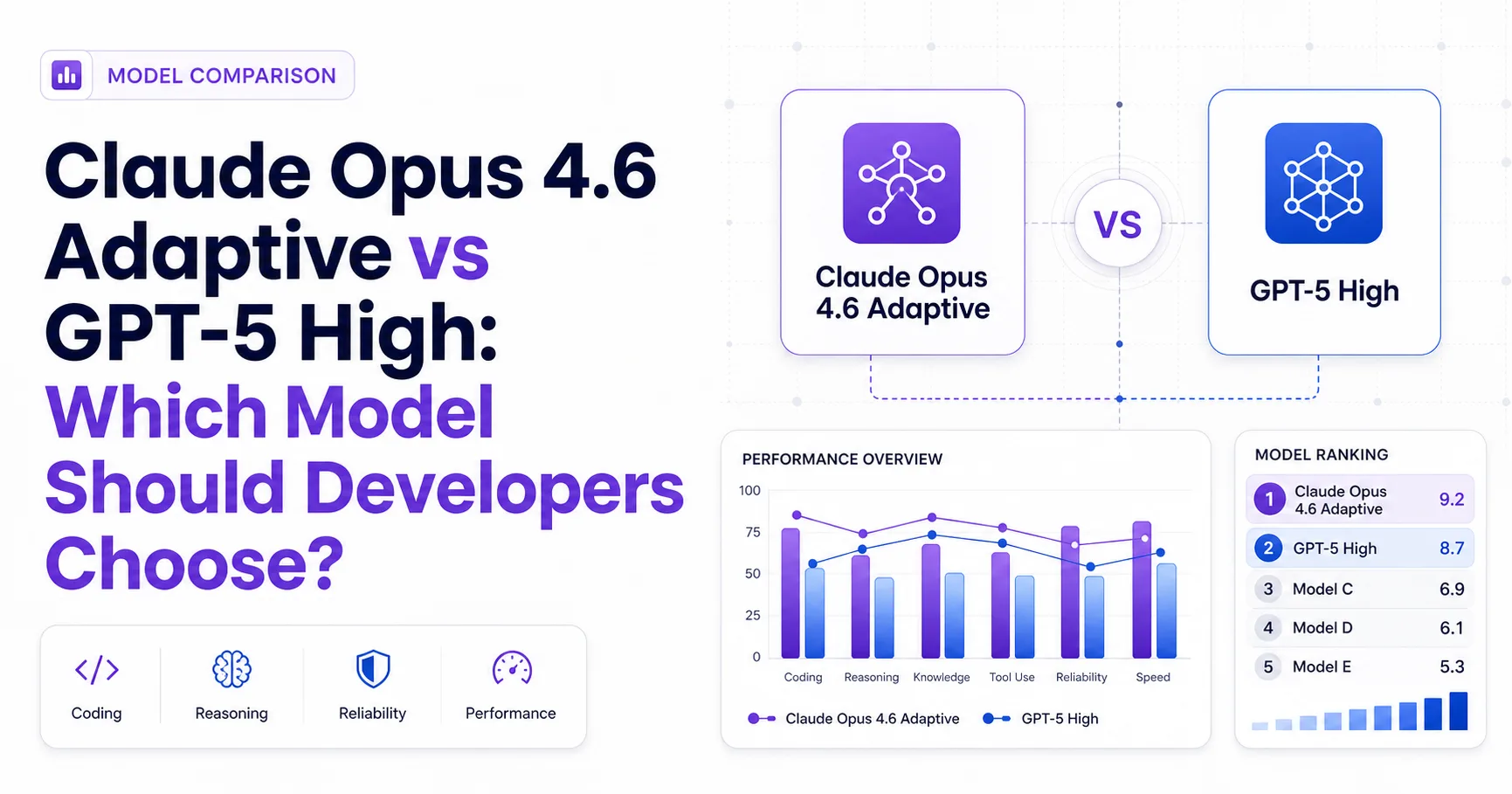
- **Winner overall:** Claude Opus 4.6 (Adaptive Reasoning, Max Effort), with an Artificial Analysis Intelligence Index of 43.7 vs 34.7 - **Cheaper:** GPT-5 (high) at $3.4375 vs $10 per 1M blended tokens - **Faster:** Tie, with both models at 0.3 seconds median latency - **Pick GPT-5 when:** cost control, documented API behavior, and coding or math workflows matter more than the highest overall intelligence score - **Watch out:** output speed is unreported for both models, so the shared 0.3-second latency does not establish a streaming-speed winner
Claude Opus 4.6 Adaptive vs GPT-5 High
Claude Opus 4.6 is the stronger overall choice on the available intelligence data, while GPT-5 is the more economical and better-documented default for many production teams. The Artificial Analysis comparison data gives Claude Opus 4.6 an Intelligence Index of 43.7, compared with 34.7 for GPT-5. GPT-5 costs $3.4375 per 1M blended tokens, compared with $10 for Claude Opus 4.6. Both models show 0.3 seconds of latency in the supplied snapshot. The evidence does not establish a reliable output-speed winner, a directly comparable coding winner, or a definitive answer for complex existing codebases. Claude’s official materials also leave the exact claude-opus-4-6-adaptive API slug unconfirmed, while OpenAI documents gpt-5 as a stable alias. Anthropic’s model overview and OpenAI’s GPT-5 developer documentation therefore point to different levels of API certainty.
Executive summary for model selection
Claude Opus 4.6 wins the supplied overall intelligence comparison, but GPT-5 offers the clearer value proposition for cost-sensitive applications. The available index comparison is narrow: Claude Opus 4.6 records 43.7 versus GPT-5 at 34.7, a 9-point advantage for Claude. GPT-5 is the only model with supplied Artificial Analysis coding and math scores, at 37.8 and 94.3 respectively. Those scores cannot prove that GPT-5 is better at coding or math because equivalent Claude values are absent. Artificial Analysis data supports the numerical comparison, but not a complete task-by-task ranking.
| Decision factor | Practical reading |
|---|---|
| Overall capability signal | Claude Opus 4.6 leads the available intelligence index at 43.7 vs 34.7. |
| Cost | GPT-5 is listed at $3.4375 vs $10 per 1M blended tokens. |
| Latency | The models tie at 0.3 seconds in the supplied snapshot. |
| API clarity | OpenAI documents gpt-5; Anthropic does not confirm the adaptive slug in the supplied materials. |
| Coding and math evidence | GPT-5 has supplied scores of 37.8 and 94.3; Claude has no matching values. |
Claude’s official positioning emphasizes complex agentic coding and enterprise workloads for newer Opus products, but the supplied materials do not define a precise replacement or retirement path for Opus 4.6. Anthropic’s overview leaves that relationship open. GPT-5 is documented for coding, reasoning, and agentic tasks, yet its fixed snapshot is marked Deprecated and the model page recommends GPT-5.6. OpenAI’s model documentation makes that lifecycle risk explicit.
Performance: what the available scores mean in practice
Claude Opus 4.6 has the stronger broad capability signal, but GPT-5 has more task-specific evidence for developers to inspect. Claude’s 43.7 Intelligence Index versus GPT-5’s 34.7 suggests an advantage on the broad evaluation represented by that index. A 9-point gap can matter in workflows that combine planning, reasoning, tool use, and ambiguous requirements. It does not identify which individual task caused the difference, and it does not guarantee better results for a particular repository or prompt. Artificial Analysis provides the comparison values, but the supplied data does not include a matching coding score for Claude.
GPT-5 has a coding index of 37.8 and a math index of 94.3 in the snapshot. Those entries give a developer more task-specific signals, but they cannot be compared directly against Claude because Claude’s corresponding values are null. The comparison therefore supports a capability asymmetry in the evidence, not a coding or math victory for GPT-5. OpenAI also reports GPT-5 results on SWE-bench Verified, Aider polyglot, τ²-bench telecom, and Scale MultiChallenge, while the supplied Anthropic materials do not provide equivalent Opus 4.6 benchmarks. GPT-5 for developers documents those results and their evaluation conditions.
Both models show 0.3 seconds of latency. That tie is useful for initial responsiveness, but output speed is unreported for both models. A team building a code assistant should therefore measure time to first useful patch, tool-call completion, correction rate, and total task duration in its own workload. Community evidence does not resolve the gap: one Reddit account reports quick small-bug work with GPT-5 but shorter, less complete application generation, and comments mention possible hallucinations in complex existing codebases. The post is a subjective, uncontrolled test, so it should guide test design rather than settle the decision. The Reddit report does not provide comparable evidence for Claude.
Cost: the cheaper model can still be the expensive choice
GPT-5 is the clear price winner, but Claude Opus 4.6 can still be rational when higher-quality outputs reduce downstream engineering work. The supplied blended price is $3.4375 per 1M tokens for GPT-5 and $10 for Claude Opus 4.6. GPT-5 is also listed at $1.25 input tokens and $10 output tokens, while Claude is listed at $5 input tokens and $25 output tokens. Artificial Analysis supplies the blended comparison, and OpenAI’s pricing documentation and Anthropic’s pricing page provide the official model pricing context.
The important cost variable is the amount of human correction each response creates. A cheaper model becomes more expensive operationally if it requires repeated retries, larger prompts, manual review, or repair commits. The supplied data does not measure correction rate, successful task completion, or tokens spent per finished feature, so it cannot establish cost per accepted change. Developers should compare complete workflows, not only token invoices.
Claude’s cache behavior and regional pricing also need attention. Anthropic lists cache write and cache hit prices separately, and Claude 4.6 and later models receive a 1.1 multiplier when inference_geo is set to us; global is the default pricing region. Anthropic’s pricing documentation supports that operational distinction. If regional routing is optional, the higher multiplier can change the effective cost. If long repeated context is central to the workload, cache behavior may matter more than the blended headline price. The supplied materials do not contain enough traffic data to determine which effect dominates.
Recommendation by developer workload
GPT-5 is the safer default for cost-sensitive production systems, while Claude Opus 4.6 is the better candidate for high-value tasks where broad reasoning quality matters most. Choose GPT-5 when the application processes substantial token volume, needs documented endpoints and parameters, or benefits from explicit reasoning controls. OpenAI documents the stable gpt-5 alias, reasoning_effort, verbosity, function calling, structured outputs, streaming, and custom tools. GPT-5 for developers and GPT-5 model documentation provide the relevant API evidence.
Choose Claude Opus 4.6 when the primary requirement is the highest available broad intelligence signal in this comparison and the team can validate API availability before committing. Claude leads the supplied Intelligence Index at 43.7, and Anthropic lists Opus 4.6 as active on its pricing page. Anthropic’s pricing page does not remove the integration uncertainty around the adaptive slug, so procurement and engineering should verify the exact callable model identifier and channel before implementation.
GPT-5’s main operational concern is lifecycle management. The fixed snapshot gpt-5-2025-08-07 is marked Deprecated, while the current model page recommends GPT-5.6. OpenAI’s model documentation supports that warning. Claude’s concern is different: the supplied materials do not confirm the adaptive API slug, the synchronous output limit, or a complete channel availability list. Anthropic’s model overview leaves those details unresolved.
A practical selection process should run both models on representative tickets, measure accepted changes, review burden, tool-call recovery, and total latency, then test the exact production endpoint. The current evidence supports a starting preference, not a universal winner.
What to validate before shipping
GPT-5 offers clearer documented integration points, but Claude Opus 4.6 still requires direct endpoint validation before a production decision. Confirm the exact model identifier, provider channel, authentication path, streaming behavior, and structured-output behavior for the selected deployment. OpenAI documents GPT-5 endpoints and capabilities in its model documentation. Anthropic’s supplied overview confirms broad Claude platform availability, including Claude API, Amazon Bedrock, Google Cloud, and Microsoft Foundry, but it does not confirm the specific adaptive slug. Anthropic’s model overview is the source for that distinction.
Run evaluation tasks that expose the tradeoff between broad reasoning and economical execution: ambiguous bug reports, multi-file refactors, test repair, tool orchestration, and long-context change requests. Record whether the model produces an accepted patch, how much review it needs, and whether it makes unrelated edits. The supplied community report associates GPT-5 with quick small-bug work and possible mistakes in complex existing codebases, but the evidence is uncontrolled. The Reddit discussion should inform test cases, not replace them.
Questions to answer before choosing
Claude Opus 4.6 is the model that requires the most clarification before procurement, while GPT-5 requires the most attention to snapshot lifecycle. The available sources leave important questions unanswered about Claude’s exact API slug, synchronous output behavior, and directly comparable coding performance. OpenAI’s documentation is more explicit about GPT-5 capabilities, but its fixed snapshot is marked Deprecated. Anthropic’s model overview and OpenAI’s model documentation support these different risk profiles.
Frequently asked questions
Which model is better overall for developers?
Claude Opus 4.6 is the better overall candidate on the supplied broad intelligence evidence, scoring 43.7 versus GPT-5 at 34.7, but the comparison does not prove superiority for every coding, math, or repository task.
Which model is cheaper for production workloads?
GPT-5 is cheaper at $3.4375 per 1M blended tokens versus Claude Opus 4.6 at $10, although retries, review effort, cache behavior, and regional routing can change the true cost of a completed feature.
Which model is faster?
Neither model wins on the supplied latency measure because Claude Opus 4.6 and GPT-5 both show 0.3 seconds, while output speed is unreported and therefore cannot identify a better streaming experience.
Should a team choose GPT-5 for coding?
Teams should choose GPT-5 for coding when its documented tooling and lower price fit the workflow, but they must validate complex repository edits because the supplied community evidence reports possible hallucinations and incorrect modifications.
Is Claude Opus 4.6 Adaptive ready to call through an API?
Claude Opus 4.6 is listed in Anthropic’s pricing materials, but the supplied official sources do not confirm claude-opus-4-6-adaptive as a stable callable API slug, so teams must verify the identifier directly.
Does GPT-5 High mean a separate model?
GPT-5 High is not established as a separate API model in the supplied sources; “high” refers to the reasoning_effort=high setting for GPT-5, whose documented stable alias is gpt-5.
Sources
- Artificial AnalysisComparison data for intelligence, coding, math, pricing, and latency values.
- Claude model overviewClaude model naming, broad capabilities, deployment channels, product positioning, and unresolved API details.
- Claude pricingClaude Opus 4.6 pricing, active listing, cache pricing, regional multiplier, and batch output qualification.
- GPT-5 for developersGPT-5 positioning, reasoning controls, tools, custom tools, and official benchmark context.
- GPT-5 model documentationGPT-5 alias, lifecycle status, API endpoints, capabilities, limitations, and pricing context.
- Tried GPT-5 Here Are My First ImpressionsUncontrolled community observations about small-bug fixes, application completeness, hallucinations, and complex codebase edits.
Published: