
AI model analysis
Claude Opus 4.6 vs GPT-5: Which Model Should Developers Choose?
A developer-focused comparison of Claude Opus 4.6 and GPT-5 across intelligence, coding evidence, latency, pricing, API stability, and production risk.
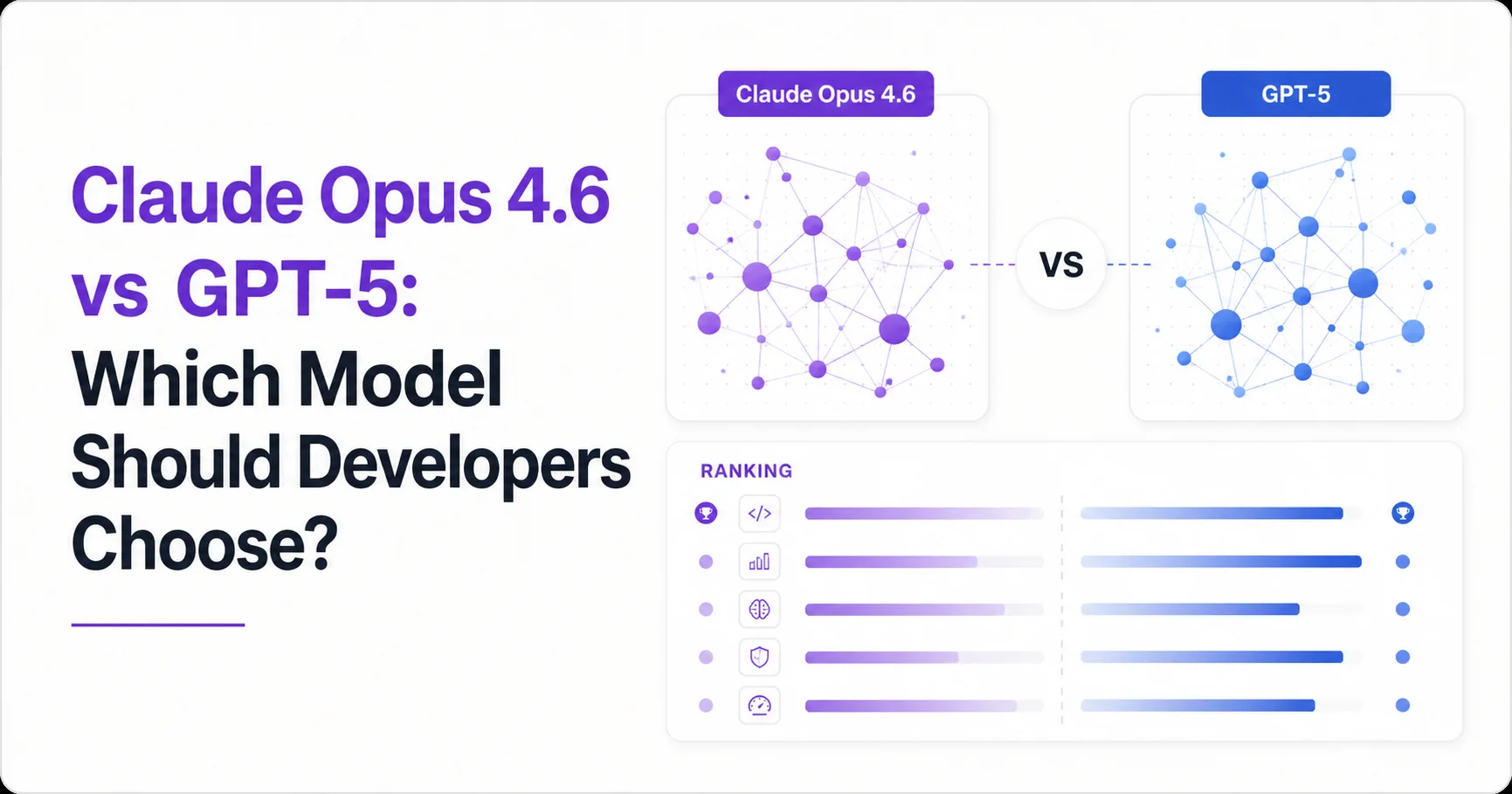
- **Winner overall:** Claude Opus 4.6, with an Artificial Analysis Intelligence Index of 37.8 vs GPT-5 at 34.7 - **Cheaper:** GPT-5 at $3.4375 vs $10 per 1M blended tokens - **Faster:** Claude Opus 4.6 and GPT-5 tie at 0.3 seconds latency - **Pick GPT-5 when:** cost control, documented coding benchmarks, structured tool use, or high-effort reasoning matter most - **Watch out:** No comparable coding, math, or output-speed data is available for Claude Opus 4.6 in this snapshot
Claude Opus 4.6 vs GPT-5 at a Glance
Claude Opus 4.6 leads the available intelligence comparison, while GPT-5 offers the stronger documented value proposition for many developer workloads. The Artificial Analysis Intelligence Index places Claude Opus 4.6 at 37.8 and GPT-5 at 34.7. The same dataset lists GPT-5 at $3.4375 per 1M blended tokens, compared with $10 for Claude Opus 4.6. Both models show 0.3 seconds of latency in the supplied snapshot.
That headline needs qualification. The dataset does not provide comparable coding or math scores for Claude Opus 4.6. GPT-5 has a coding index of 37.8 and a math index of 94.3, but those figures cannot establish a head-to-head win because Claude has no corresponding values here. The evidence supports a narrow conclusion: Claude has the higher overall intelligence index, while GPT-5 is less expensive and has broader published evidence for coding-oriented selection.
The model names also represent different operational choices. Anthropic documents claude-opus-4-6 as a fixed API identifier, while OpenAI documents gpt-5 as an available alias and separately lists a fixed snapshot that is deprecated. Developers choosing a long-lived integration should evaluate that lifecycle difference alongside benchmark and price data. Anthropic Models overview and GPT-5 model documentation provide the relevant provider details.
The Decision Is Intelligence Versus Cost and Evidence Coverage
Claude Opus 4.6 is the better fit when the available intelligence score is the primary selection signal and higher token cost is acceptable. Its Artificial Analysis Intelligence Index is 37.8, compared with 34.7 for GPT-5. That advantage is meaningful for workloads where broad response quality matters, but the supplied data does not identify which task families create the gap.
GPT-5 is the more defensible default for cost-sensitive development systems with measurable coding or mathematical workloads. The dataset reports a coding index of 37.8 and a math index of 94.3 for GPT-5. Claude Opus 4.6 has no matching coding or math values in the snapshot, so the comparison cannot show whether its higher intelligence index translates into better repository edits, debugging, or mathematical reliability.
The official materials also point to different API surfaces. GPT-5 supports configurable reasoning effort, verbosity controls, function calling, structured outputs, streaming, and custom tools. Claude Opus 4.6 supports text and image input with text output, multilingual capability, and vision. These capabilities are documented in the respective provider materials, but the research brief does not include a controlled usability comparison. GPT-5 for developers and Anthropic Models overview support these capability claims.
Performance Depends More on Evidence Quality Than the Headline Score
Claude Opus 4.6 has the higher reported intelligence score, but GPT-5 has the clearer performance case for coding and math decisions. The Artificial Analysis Intelligence Index is 37.8 for Claude Opus 4.6 and 34.7 for GPT-5. GPT-5 also records 37.8 on the Artificial Analysis Coding Index and 94.3 on the Artificial Analysis Math Index. Claude Opus 4.6 has no corresponding coding or math entries in the supplied data.
For a developer, that missing comparison is the central performance limitation. A higher general index does not prove better pull-request patches, test repair, code migration, or mathematical reasoning. It only establishes that Claude leads on the one shared index available here. Selection teams should therefore avoid treating the headline score as a universal coding verdict.
GPT-5 has additional official coding evidence. OpenAI reports results for SWE-bench Verified and Aider polyglot, with the Aider evaluation using high reasoning effort. The research brief also records limitations in the evaluation setup, including excluded problems, so these results should guide test design rather than replace it. GPT-5 for developers is the source for those benchmark claims.
The supplied latency data does not separate the models. Both are listed at 0.3 seconds. Neither model has a reported median output speed in the snapshot, so no evidence-based throughput winner can be named. Teams requiring streaming responsiveness should measure their own prompts, output lengths, tools, and regional deployment conditions.
GPT-5 Is Cheaper, but Workload Shape Determines the Real Bill
GPT-5 is the clear price winner in the supplied cost comparison, with a blended price of $3.4375 per 1M tokens versus $10 for Claude Opus 4.6. Its input price is $1.25 per 1M tokens and its output price is $10 per 1M tokens. Claude Opus 4.6 costs $5 per 1M input tokens and $25 per 1M output tokens.
The visible price gap matters most for systems that generate substantial output, repeat large prompts, or run frequent agent steps. Output-heavy coding agents can accumulate cost through patches, explanations, test results, and tool-directed iterations. A model that appears more capable can still become more expensive if its quality advantage does not reduce retries, human review, or failed runs.
Prompt reuse changes the calculation. Anthropic documents separate prices for cache writes and cache reads, while OpenAI documents cached input pricing for GPT-5. The supplied research does not provide a controlled cache-hit comparison, so no universal caching winner can be established. Teams should model fresh prompts and repeated repository context separately. Anthropic Pricing and GPT-5 model documentation contain the provider pricing details.
The cost conclusion can also reverse for high-stakes tasks if GPT-5 requires more review or retries. The briefs provide no production failure-rate data for either model, so that possibility remains a hypothesis rather than a measured result.
Recommendation by Developer Workload
GPT-5 is the recommended starting point for most cost-sensitive developer products, while Claude Opus 4.6 deserves targeted evaluation for quality-critical tasks. GPT-5 combines the lower blended price of $3.4375 per 1M tokens with documented coding and math scores. It also supports configurable reasoning effort, structured outputs, function calling, streaming, and custom tools, which can simplify agent and automation designs. GPT-5 for developers documents those controls.
Choose Claude Opus 4.6 when the shared intelligence score is the strongest available signal and your workload can justify $10 per 1M blended tokens. Anthropic identifies claude-opus-4-6 as a fixed model ID and continues to list the model in its current API pricing materials. That makes the integration story clearer than relying on a deprecated fixed GPT-5 snapshot. Anthropic Models overview and Anthropic Pricing support this lifecycle assessment.
Use GPT-5 for budget-constrained coding assistants, structured tool workflows, and mathematical tasks where its available evidence matches the product risk. Use Claude Opus 4.6 for broad quality evaluation, multimodal prompts, or workflows where your own acceptance tests show fewer revisions. Do not choose based on community anecdotes alone. One Reddit post describes faster small bug fixes with GPT-5 but also reports weaker completeness for full applications and possible incorrect changes in complex repositories. That evidence is subjective and non-reproducible. Reddit: Tried GPT-5 Here Are My First Impressions records the underlying experience.
What the Briefs Still Cannot Tell You
Claude Opus 4.6 remains the less measurable option for coding selection because the supplied snapshot lacks comparable coding, math, and median output-speed values. GPT-5 has more published evidence, but its fixed snapshot carries a deprecation warning. The practical decision therefore requires a small, task-specific evaluation before production commitment.
A useful evaluation should test the exact repository operations, tool schemas, context reuse patterns, review thresholds, and failure recovery behavior used by the product. The briefs do not provide controlled data for those variables. They also do not establish a stable community consensus about speed or reliability for either model. That evidence gap is itself a selection risk, especially for agentic systems that can make many changes without immediate human review.
The safest interpretation is conditional. GPT-5 is the economical default with stronger documented coding evidence. Claude Opus 4.6 is the quality candidate with the higher shared intelligence score and a fixed API identifier. Neither conclusion proves superiority across every developer workflow.
Frequently asked questions
Which model is better overall for developers, Claude Opus 4.6 or GPT-5?
Claude Opus 4.6 leads the shared intelligence comparison at 37.8 versus GPT-5 at 34.7, but GPT-5 has stronger documented coding evidence and a much lower blended price. The available data cannot prove a universal developer winner.
Which model is cheaper for production API usage?
GPT-5 is cheaper in every supplied token-price comparison, costing $3.4375 per 1M blended tokens versus $10 for Claude Opus 4.6. Its input price is $1.25 and output price is $10 per 1M tokens, compared with Claude’s $5 input and $25 output prices.
Which model is faster?
Neither model is faster in the supplied latency snapshot because Claude Opus 4.6 and GPT-5 are both listed at 0.3 seconds. Median output speed is unavailable for both models, so throughput and streaming experience remain unverified.
Should a coding assistant choose GPT-5?
GPT-5 is the stronger initial choice for a cost-sensitive coding assistant because the data includes a coding index of 37.8, while Claude Opus 4.6 has no comparable coding score. A repository-specific evaluation is still necessary because community evidence reports possible incorrect changes in complex codebases.
Is Claude Opus 4.6 safer for a long-lived API integration?
Claude Opus 4.6 has the clearer fixed-version identifier because Anthropic documents claude-opus-4-6 as a fixed model ID. GPT-5 remains available through its alias, but the documented fixed snapshot is deprecated, so lifecycle monitoring is required for either integration.
Sources
- Anthropic Models overviewClaude Opus 4.6 API ID, fixed-version naming, multimodal capabilities, model status, and documented output behavior
- Anthropic PricingClaude Opus 4.6 token pricing, prompt caching prices, current availability, and tokenizer notes
- GPT-5 for developersGPT-5 positioning, reasoning controls, tool capabilities, and official coding benchmark evidence
- GPT-5 model documentationGPT-5 API alias, fixed snapshot status, modality support, token pricing, and endpoint availability
- Tried GPT-5 Here Are My First ImpressionsSubjective community evidence about small bug fixes, full application generation, and possible incorrect changes in complex repositories
Published: