
AI model analysis
Claude Opus 4.6 vs GPT-5 mini: Which Model Should Developers Choose?
A developer-focused comparison of Claude Opus 4.6 and GPT-5 mini across intelligence, cost, latency, availability, and evidence quality.
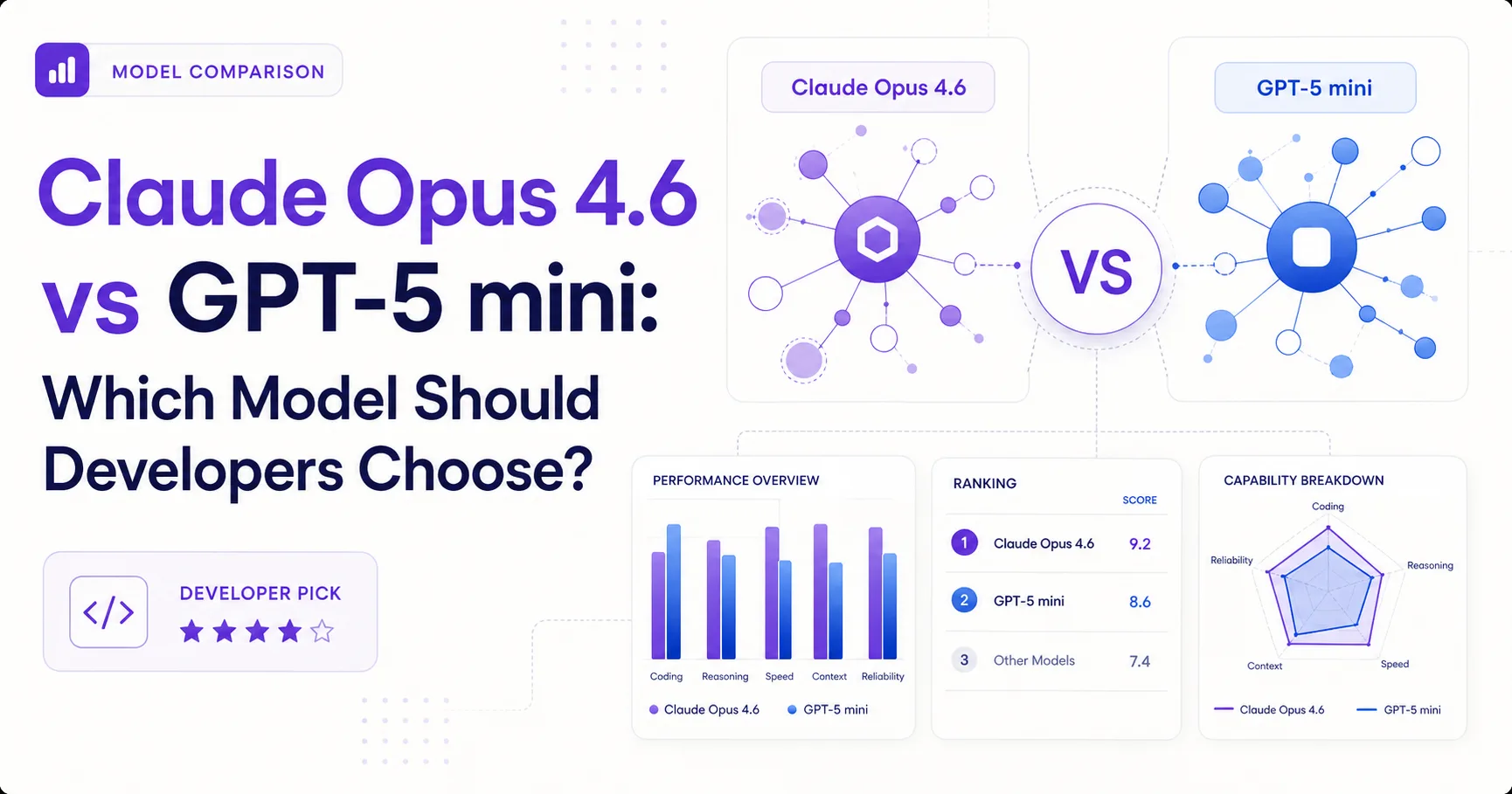
- **Winner overall:** Claude Opus 4.6, with an Artificial Analysis Intelligence Index score of 37.8 vs 25.3 - **Cheaper:** GPT-5 mini at $0.6875 vs $10 per 1M blended tokens - **Faster:** Claude Opus 4.6 and GPT-5 mini tie at 0.3 seconds median latency - **Pick GPT-5 mini when:** low operating cost matters more than a verified overall intelligence advantage - **Watch out:** output speed is unavailable for both models, while GPT-5 mini's current API availability is unverified Data provided by https://artificialanalysis.ai/
Claude Opus 4.6 vs GPT-5 mini
Claude Opus 4.6 is the stronger documented choice for difficult general-purpose work, while GPT-5 mini is the far cheaper choice with important availability gaps.
The quantitative snapshot gives Claude Opus 4.6 an Artificial Analysis Intelligence Index score of 37.8, compared with 25.3 for GPT-5 mini. GPT-5 mini has a much lower blended price, at $0.6875 per 1M tokens versus $10 for Claude Opus 4.6. Both models show 0.3 seconds of latency in the supplied data.
That result does not establish a universal winner for coding, mathematics, or streaming throughput. The data brief provides a coding score of 15.6 and a math score of 90.7 only for GPT-5 mini. It provides no comparable Claude score, and it provides no output-speed value for either model.
Model identity also matters. Anthropic documents claude-opus-4-6 as a fixed Claude API model ID in its Models overview. The supplied OpenAI sources do not verify that gpt-5-mini remains a directly callable model or explain how the high label maps to an API parameter. The comparison therefore favors Claude on documented availability, but it cannot treat GPT-5 mini as production-ready without an account-level verification.
The quantitative values in this article are Data provided by https://artificialanalysis.ai/.
Executive summary for developers
Claude Opus 4.6 offers the better-supported high-end default, while GPT-5 mini offers the better economics for workloads that can tolerate uncertain model status.
Claude leads the supplied overall intelligence measurement at 37.8 versus 25.3. That difference is meaningful for teams selecting a general-purpose model for complex planning, codebase analysis, or multi-step technical work. It is not a proof that Claude wins every task, because the supplied benchmark coverage is incomplete.
GPT-5 mini is dramatically less expensive in the supplied pricing snapshot. Its blended price is $0.6875 per 1M tokens, with input priced at $0.25 and output at $2. Claude Opus 4.6 costs $10 blended, with input at $5 and output at $25. The lower GPT-5 mini price can change the architecture decision for high-volume classification, extraction, routing, and first-pass generation.
Anthropic’s Models overview confirms text and image input, text output, multilingual capability, and vision capability for Claude Opus 4.6. The current OpenAI Models directory gives only general capability language and does not independently confirm those details for GPT-5 mini.
The practical conclusion is conditional. Choose Claude when verified model identity, documented multimodal support, and measured overall intelligence matter most. Choose GPT-5 mini when cost dominates and your team can first confirm access, naming, limits, and behavior in the target OpenAI account.
Performance: what the available evidence really says
Claude Opus 4.6 has the stronger verified overall intelligence result, but the evidence does not support a complete performance ranking.
The Artificial Analysis Intelligence Index reports 37.8 for Claude Opus 4.6 and 25.3 for GPT-5 mini. For a developer, that gap suggests Claude may be the safer first candidate for tasks where broad reasoning quality matters more than unit cost. It does not identify which task types create the difference, and it does not show whether the gap persists on a team’s own prompts.
The benchmark coverage is asymmetric. GPT-5 mini has a reported coding index of 15.6 and math index of 90.7. Claude Opus 4.6 has no corresponding coding or math values in the data brief. A developer cannot honestly infer that Claude wins coding or that GPT-5 mini wins mathematics from the available comparison alone. The correct decision is to treat those domains as unverified and run task-specific acceptance tests.
Latency is a tie in the supplied snapshot, with both models listed at 0.3 seconds. That value does not answer the question most production teams ask about interactive generation: how quickly does output continue after the first token? Median output tokens per second are unavailable for both models. A chat interface, code completion tool, or agent loop may therefore feel different even though the reported latency is equal.
Anthropic documents text and image input, text output, multilingual support, and vision capability for Claude Opus 4.6 in its Models overview. The OpenAI directory does not provide a model-specific confirmation for GPT-5 mini. This creates an evidence advantage for Claude, not necessarily a capability advantage in every modality.
For evaluation, compare completed task quality, correction rate, tool-call reliability, and sustained generation speed on representative workloads. The supplied materials do not provide those measurements, so any stronger claim would exceed the evidence.
Cost: GPT-5 mini wins, but workload shape still matters
GPT-5 mini is the clear cost choice in the supplied data, while Claude Opus 4.6 becomes easier to justify only when quality or workflow risk has higher value than token price.
The blended price is $0.6875 per 1M tokens for GPT-5 mini and $10 for Claude Opus 4.6. GPT-5 mini also has lower listed input pricing, at $0.25 versus $5, and lower output pricing, at $2 versus $25. Those differences affect more than infrastructure spend. They influence whether a team can afford retries, candidate generation, background enrichment, and automated quality checks.
The cheaper model is not automatically cheaper for every product outcome. A low-cost model can become expensive if it produces more failed tool calls, incorrect edits, manual review, or retry traffic. The supplied materials do not measure any of those factors for GPT-5 mini or Claude Opus 4.6. Teams should therefore calculate cost per accepted result after testing, not only cost per token.
Claude’s pricing documentation also describes prompt caching. The Anthropic pricing page lists input, cache-write, and cache-read prices for Claude Opus 4.6. That matters for applications with large repeated instructions, stable repositories, or recurring policy context. GPT-5 mini’s supplied materials do not provide comparable verified pricing details for caching.
Availability is part of cost. OpenAI’s current Pricing page does not list standard, Batch, Flex, or Fast mode prices for gpt-5-mini. It also does not confirm whether the model is still directly callable. A spreadsheet that assumes $0.6875 per 1M tokens without confirming access may understate migration and fallback costs.
Use GPT-5 mini for high-volume work after confirming service availability and quality. Use Claude when a higher token price is defensible because fewer failed outcomes, stronger broad performance, or documented model identity reduces operational risk.
Recommendation: choose by failure cost, not headline score
Claude Opus 4.6 is the recommended default for high-consequence developer workflows, while GPT-5 mini is the recommended candidate for cost-sensitive, easily verified workloads.
Pick Claude Opus 4.6 when the model will review substantial code changes, plan multi-step implementation work, interpret mixed text and image inputs, or support decisions where human correction is expensive. Its 37.8 overall intelligence score is the strongest comparative signal available. Anthropic also documents the fixed API ID claude-opus-4-6, which makes deployment planning more concrete than the supplied GPT-5 mini evidence.
Pick GPT-5 mini when request volume is high, each task is narrow, and the team can validate the exact model endpoint before launch. Its $0.6875 blended price creates room for repeated attempts and broad coverage. The reported math index of 90.7 may also make it worth testing for mathematical workloads, although the supplied evidence does not establish how that score transfers to a production prompt set.
Use a staged routing design if the product has both classes of work. A low-cost model can handle predictable first-pass tasks, while Claude can receive escalations that involve ambiguity, difficult edits, or high review cost. That is an architectural recommendation, not a benchmark finding. The materials do not show whether either model has better tool-use reliability or lower retry rates.
Before committing, verify four items for GPT-5 mini: the callable model ID, the meaning of high, the supported context and output limits, and the current price in the intended API mode. The OpenAI Models directory and Pricing page do not resolve those questions in the supplied evidence.
The final choice should be based on accepted-task cost and measured task quality. The current data supports a Claude quality lead and a GPT-5 mini price lead, but it does not support a complete claim about coding, mathematics, output speed, or production reliability.
Questions to answer before implementation
Claude Opus 4.6 is easier to identify from the supplied official documentation, while GPT-5 mini requires more verification before production use.
The main uncertainty is not simply which score is higher. It is whether the named model, configuration, pricing mode, and runtime behavior in the comparison match what a developer can actually deploy. The following questions address the gaps that the two briefs leave open.
Evidence boundaries and version risk
Claude Opus 4.6 has clearer current-status evidence than GPT-5 mini, but neither brief proves long-term suitability for a specific application.
Anthropic’s documentation lists Claude Opus 4.6 in the current model overview and pricing materials without marking it retired. The overview also explains that Claude 4.6 uses a fixed, undated model ID rather than an automatically moving date alias. That supports a more predictable integration target.
The same documentation lists later Claude Opus versions, including Claude Opus 4.7, Claude Opus 4.8, and Claude Opus 5, but it does not mark Claude Opus 4.6 as retired. Developers should still monitor model lifecycle notices because current listing status is not a promise of indefinite availability.
The OpenAI brief is materially less conclusive. Its current model directory does not list gpt-5-mini, and its pricing page does not list that model’s standard or alternative mode prices. The evidence does not prove that GPT-5 mini is unavailable. It proves only that the supplied current pages do not verify its status.
The named configuration also needs care. GPT-5 mini (high) may describe a model selection plus an effort setting, but the supplied official material does not confirm that relationship. Claude Opus 4.6 is likewise described in the data brief as “Non-reasoning, High Effort,” while the verified official pages do not document a dedicated API parameter for that variant.
For a durable integration, record the exact endpoint, configuration, date of verification, and fallback behavior. The briefs provide enough evidence for a cautious comparison, not enough evidence for an assumption-free production contract.
Frequently asked questions
Which model is better overall for developers, Claude Opus 4.6 or GPT-5 mini?
Claude Opus 4.6 is the better-supported overall choice because its Artificial Analysis Intelligence Index is 37.8 versus 25.3 for GPT-5 mini, although task-specific testing remains necessary.
Which model is cheaper for a production application?
GPT-5 mini is cheaper in the supplied data, costing $0.6875 per 1M blended tokens versus $10 for Claude Opus 4.6, but availability and current pricing still require verification.
Can this comparison prove which model is better at coding?
No, this comparison cannot prove a coding winner because GPT-5 mini has a coding index of 15.6 while the supplied data provides no comparable Claude Opus 4.6 coding score.
Do the models have the same speed?
The supplied latency data shows a tie at 0.3 seconds for both models, but output speed is unavailable, so the comparison cannot predict streaming or long-response experience.
Is GPT-5 mini ready to call through the OpenAI API?
The supplied evidence does not confirm that GPT-5 mini is currently directly callable, because the current OpenAI model directory and pricing page do not list it.
When should a team choose Claude Opus 4.6 despite its higher price?
Choose Claude Opus 4.6 when difficult reasoning, documented model identity, multimodal requirements, or expensive human correction matter more than minimizing token spend.
Sources
- Models overviewClaude Opus 4.6 API ID, fixed model naming, multimodal capabilities, current model documentation, and Message Batches output information
- Anthropic PricingClaude Opus 4.6 token pricing, prompt caching pricing, current listing status, and tokenizer notes
- OpenAI ModelsCurrent OpenAI model directory and the limits of model-specific evidence for GPT-5 mini
- OpenAI PricingCurrent OpenAI pricing directory and the absence of verified GPT-5 mini pricing
- Artificial AnalysisQuantitative benchmark, latency, release-date, and pricing values supplied in the data brief
Published: