
AI model analysis
Claude Opus 4.7 Non-reasoning vs GPT-5 mini: Which Model Should Developers Choose?
A developer-focused comparison of Claude Opus 4.7 Non-reasoning High Effort and GPT-5 mini, covering measured intelligence, cost, evidence gaps, and practical selection criteria.
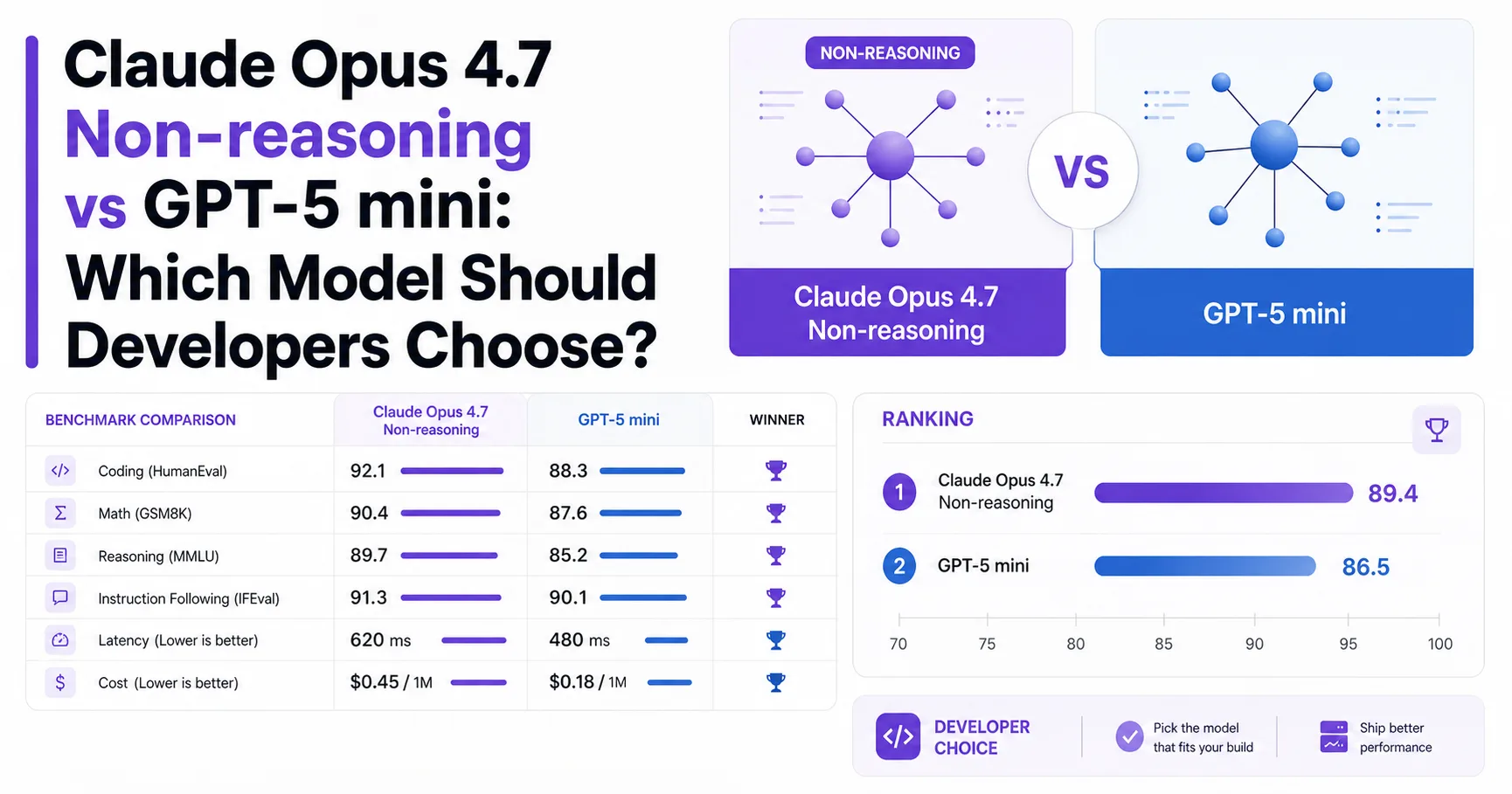
- **Winner overall:** Claude Opus 4.7 (Non-reasoning, High Effort), with an Artificial Analysis Intelligence Index of 42.7 vs 25.3 - **Cheaper:** GPT-5 mini (high) at $0.6875 vs $10 per 1M blended tokens - **Faster:** Neither model, both at 0.3 seconds median latency - **Pick Claude Opus 4.7 (Non-reasoning, High Effort) when:** broad capability matters more than the $25 output price per 1M tokens - **Watch out:** Official sources do not confirm whether either displayed configuration maps to a currently callable API model ID
Claude Opus 4.7 vs GPT-5 mini
Claude Opus 4.7 (Non-reasoning, High Effort) leads the measured intelligence comparison, while GPT-5 mini (high) is dramatically cheaper for production workloads.
The available evidence supports a capability-led choice for Claude and a cost-led choice for GPT-5 mini. Claude Opus 4.7 records an Artificial Analysis Intelligence Index of 42.7, compared with 25.3 for GPT-5 mini. The benchmark snapshot does not provide a coding score for Claude or a directly comparable math score for Claude, so the comparison cannot establish a general winner for every developer task.
GPT-5 mini costs $0.6875 per 1M blended tokens, compared with $10 for Claude Opus 4.7. Both models show 0.3 seconds of latency in the supplied data, and neither has a reported median output speed. Data provided by https://artificialanalysis.ai/.
Executive summary for developers
Claude Opus 4.7 (Non-reasoning, High Effort) is the stronger measured general-capability option, but GPT-5 mini (high) is the safer default for cost-sensitive software systems.
The central tradeoff is unusually clear. Claude has the higher reported intelligence score, while GPT-5 mini is priced at a small fraction of Claude’s blended-token cost. The supplied comparison lists Claude at $10 per 1M blended tokens and GPT-5 mini at $0.6875. Claude also costs $5 per 1M input tokens and $25 per 1M output tokens. GPT-5 mini costs $0.25 per 1M input tokens and $2 per 1M output tokens.
That price gap changes the architecture of a product. A team can use GPT-5 mini for high-volume classification, extraction, routing, routine code edits, and user-facing automation without treating every request as a substantial infrastructure expense. Claude becomes easier to justify when a response can prevent expensive retries, manual review, or downstream failures.
The evidence has important boundaries. No supplied source confirms a stable API ID for GPT-5 mini (high), and no supplied source confirms that Claude Opus 4.7 (Non-reasoning, High Effort) is an independently callable model configuration. Official model pages also do not provide complete, configuration-specific context or output limits. Developers should verify availability before committing to either displayed name.
Performance: what the benchmark gap means
Claude Opus 4.7 (Non-reasoning, High Effort) has the stronger measured intelligence result, but the available benchmark coverage is incomplete for developer-specific decisions.
The Artificial Analysis Intelligence Index reports 42.7 for Claude and 25.3 for GPT-5 mini. That result favors Claude for workloads where broad task quality is the main concern. It does not prove that Claude will write better code, solve more difficult mathematics, or produce fewer production defects in every environment.
The missing comparisons matter. GPT-5 mini has a coding index of 15.6 and a math index of 90.7 in the supplied data, while Claude has no corresponding values in the snapshot. Because the benchmark inputs are incomplete, developers should not convert the intelligence result into a universal coding or reasoning verdict. The evidence is insufficient to rank these models for code generation, debugging, mathematical reliability, or tool-use completion as separate categories.
The practical interpretation is narrower and more useful. Claude has a measured advantage on the one shared general-capability signal available here. GPT-5 mini has task-specific measurements that cannot be compared against Claude in this snapshot. A team selecting for coding should run its own repository-based evaluation rather than infer a coding winner from the general index.
Latency does not separate the options in the supplied data. Both models are listed at 0.3 seconds, and neither has a reported median output-tokens-per-second value. That means the evidence cannot support a throughput winner. Streaming behavior, queueing, rate limits, tool latency, and output length may dominate the user experience, but the research materials do not document those factors.
Cost: when the cheaper model is actually cheaper
GPT-5 mini (high) is the clear token-price winner, but Claude Opus 4.7 (Non-reasoning, High Effort) can still be economically rational when quality reduces operational rework.
The supplied prices make GPT-5 mini the default candidate for volume. Its blended price is $0.6875 per 1M tokens, versus $10 for Claude. Its input price is $0.25, versus Claude’s $5, and its output price is $2, versus Claude’s $25. The largest difference is on generated output, so verbose responses, code patches, and long structured outputs make Claude especially expensive relative to GPT-5 mini.
Price alone does not equal total cost. A lower-priced model becomes more expensive in practice if it requires repeated calls, stricter validation, human review, or a second model to repair its output. The supplied materials do not contain retry rates, task success rates, defect costs, or production volume, so no break-even point can be calculated. Any claim that Claude pays for itself through higher quality would exceed the evidence.
Claude’s tokenizer creates an additional planning concern. Anthropic states that Claude Opus 4.7 uses a newer tokenizer and that the same text usually produces about 30% more tokens, although the actual increase depends on content and workload. That can increase input consumption and context pressure even before output pricing is considered. Developers with large prompts should measure tokenization on representative repositories or documents.
Caching may change the result for repeated prompts, but the available materials do not provide a workload model for cache hit rates. Teams should compare complete request costs, validation costs, and failure costs rather than selecting from the displayed token prices alone.
Recommendation by workload
GPT-5 mini (high) is the best starting point for most high-volume developer products, while Claude Opus 4.7 (Non-reasoning, High Effort) is the better candidate for quality-sensitive workflows.
Choose GPT-5 mini when the system performs many predictable operations. Suitable examples include request classification, metadata extraction, short transformations, routine support responses, code-formatting assistance, and automated first-pass analysis. Its $0.6875 blended price gives teams more room for retries, parallel candidates, and validation calls. The supplied math index of 90.7 may also justify testing it for math-heavy workflows, although the materials do not provide a comparable Claude result.
Choose Claude when the cost of a poor answer is high and the task benefits from broad capability. Examples include complex planning, difficult code review, cross-file reasoning, high-stakes drafting, and workflows where a stronger first response can reduce manual intervention. The shared intelligence result favors Claude at 42.7 versus 25.3. That signal is meaningful, but it is not a substitute for a task-specific evaluation.
Use a two-tier design when the product has mixed traffic. GPT-5 mini can handle routine requests and escalation rules can route ambiguous or high-impact cases to Claude. This design is only a recommendation pattern, not a measured result from the supplied research. The materials do not report routing accuracy, comparative tool use, or production reliability.
Before launch, verify four unknowns: the callable API ID, current availability, context limits, and configuration semantics for “high effort” and “non-reasoning.” Official documentation does not resolve these points for the displayed variants.
Evidence gaps that should change the buying decision
Claude Opus 4.7 (Non-reasoning, High Effort) and GPT-5 mini (high) cannot be selected responsibly from benchmark and price data alone because their product identities remain partially unverified.
Anthropic’s model overview mentions Claude Opus 4.7 in connection with Message Batches and a maximum of 300,000 output tokens with the output-300k-2026-03-24 beta header. The page does not establish that the same limit applies to synchronous Messages API calls. It also does not provide a dedicated specification for the Non-reasoning, High Effort configuration.
Anthropic’s pricing documentation confirms the Claude Opus 4.7 prices and the tokenizer change, but it does not confirm a dedicated API slug for the displayed configuration. OpenAI’s model directory does not list GPT-5 mini in the supplied research, and the OpenAI pricing page does not list its standard, Batch, Flex, or Fast mode prices.
The community evidence is also insufficient. The research found no reliably verifiable Reddit, Hacker News, or X posts focused on either exact configuration. Developers therefore lack sourced evidence about coding style, speed perception, hallucination patterns, stable failure modes, or model temperament. Those unknowns should become explicit acceptance-test items, not assumptions hidden in procurement decisions.
FAQ before choosing
GPT-5 mini (high) is the stronger default when predictable operating cost matters more than the available general-capability score.
Frequently asked questions
Which model is better overall for developers?
Claude Opus 4.7 (Non-reasoning, High Effort) is better on the supplied overall intelligence signal, scoring 42.7 versus GPT-5 mini’s 25.3, but the evidence does not prove a coding winner.
Which model is cheaper for production workloads?
GPT-5 mini (high) is substantially cheaper, with a $0.6875 blended price per 1M tokens versus $10 for Claude Opus 4.7, before retries and operational review costs.
Which model is faster?
Neither model is faster in the supplied latency data because Claude Opus 4.7 and GPT-5 mini are both listed at 0.3 seconds, while median output speed is unavailable.
Is GPT-5 mini better for coding?
The supplied data cannot answer that conclusively because GPT-5 mini has a coding index of 15.6, but Claude Opus 4.7 has no comparable coding score in the snapshot.
Can developers safely use the displayed model names as API identifiers?
Developers should verify the identifiers first because the research does not confirm a stable API mapping for either GPT-5 mini (high) or Claude Opus 4.7 (Non-reasoning, High Effort).
Does Claude's 300,000-token output limit apply to normal API calls?
The research does not establish that limit for synchronous Messages API calls because the documented 300,000-token allowance is tied to Message Batches and a beta header.
Sources
- Artificial AnalysisSupplied benchmark, latency, release-date, and pricing comparison data
- Claude models overviewClaude Opus 4.7 batch-output capability, current product-line information, and model documentation gaps
- Claude pricingClaude Opus 4.7 input, output, blended, cache, and tokenizer information
- OpenAI ModelsCurrent OpenAI model-directory coverage and general model capability documentation
- OpenAI PricingCurrent OpenAI pricing-directory coverage and the absence of supplied GPT-5 mini pricing
Published: