
AI model analysis
Claude Opus 4.7 vs GPT-4o (Nov '24): Which Model Should Developers Choose?
A developer-focused comparison of Claude Opus 4.7 and GPT-4o (Nov '24), covering measured intelligence, price, latency, API evidence, operational risk, and model availability uncertainty.
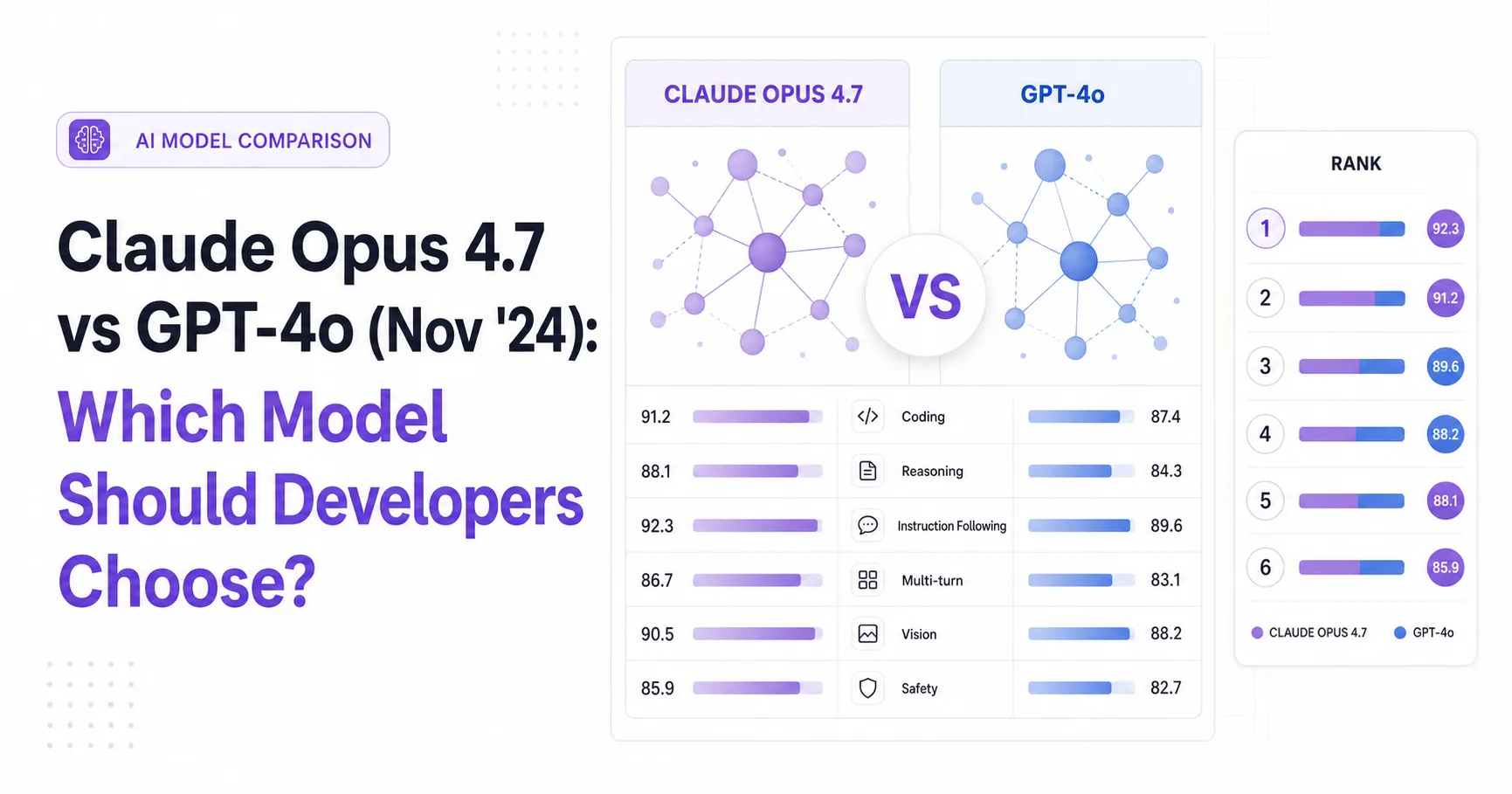
- **Winner overall:** Claude Opus 4.7, with an Artificial Analysis Intelligence Index of 53.5 versus GPT-4o at 11.2 - **Cheaper:** GPT-4o at $4.375 vs $10 per 1M blended tokens - **Faster:** Tie, with both models at 0.3 seconds latency - **Pick Claude Opus 4.7 when:** You need stronger measured intelligence and coding evidence, including a 73.6 coding index - **Watch out:** GPT-4o has no supplied coding score, so Claude Opus 4.7's 73.6 is not a complete head-to-head coding result
Claude Opus 4.7 vs GPT-4o for developers
Claude Opus 4.7 is the stronger default for demanding developer work, while GPT-4o is the lower-cost option with less current evidence.
The supplied data gives Claude Opus 4.7 an Artificial Analysis Intelligence Index of 53.5, compared with 11.2 for GPT-4o. That is a clear measured advantage for Claude on the shared intelligence metric. Claude also has a supplied Artificial Analysis Coding Index of 73.6, while GPT-4o has no coding score in the data brief.
GPT-4o changes the economics substantially. Its blended price is $4.375 per 1M tokens, compared with $10 for Claude Opus 4.7. Both models have a listed latency of 0.3 seconds, and neither has a supplied median output speed.
The important qualification is evidence quality. Anthropic publishes detailed Opus 4.7 capability, migration, pricing, and safety material. OpenAI’s supplied current documentation does not provide model-specific evidence for GPT-4o (Nov '24). Developers should therefore treat this as a decision under asymmetric information, not a complete benchmark verdict.
Data provided by https://artificialanalysis.ai/
Executive summary
Claude Opus 4.7 wins the measured intelligence comparison, while GPT-4o wins the measured price comparison.
| Decision factor | Claude Opus 4.7 | GPT-4o (Nov '24) | What it means |
|---|---|---|---|
| Intelligence Index | 53.5 | 11.2 | Claude has the supplied head-to-head advantage |
| Coding Index | 73.6 | Not supplied | Claude has evidence, but not a complete comparison |
| Math Index | Not supplied | 6 | GPT-4o has evidence on this metric, but Claude is not scored |
| Blended price | $10 | $4.375 | GPT-4o costs less on the supplied price measure |
| Input price | $5 | $2.5 | GPT-4o is cheaper for input-heavy workloads |
| Output price | $25 | $10 | GPT-4o is cheaper for generation-heavy workloads |
| Latency | 0.3 seconds | 0.3 seconds | The supplied data shows a tie |
Claude’s strongest case is capability density. Anthropic positions Opus 4.7 for complex, long-running software engineering and agent tasks, with emphasis on instruction following, continued execution, and output verification (Anthropic release announcement). That positioning aligns with the model’s higher supplied intelligence and coding evidence.
GPT-4o’s strongest case is budget control. A lower blended price can matter more than raw capability when requests are simple, high-volume, or easy to validate. However, the supplied OpenAI model directory does not list GPT-4o, and the supplied pricing directory does not list its price (OpenAI Models, OpenAI Pricing). The data brief provides prices, but current official availability remains unresolved.
The practical conclusion is conditional: choose Claude when failure costs are high and tasks require sustained reasoning; choose GPT-4o when cost dominates and your application can compensate with validation, routing, or human review.
Performance: what the scores mean in real developer work
Claude Opus 4.7 is the safer performance choice for difficult reasoning and coding workflows, but the comparison lacks a complete task-by-task baseline.
The Intelligence Index gap is large enough to affect model selection, not just benchmark rankings. A model scoring 53.5 against 11.2 on the supplied shared index is more attractive for tasks where the system must interpret ambiguous requirements, preserve constraints, and make several dependent decisions. Typical examples include repository-level changes, architecture decisions, incident analysis, and agent workflows that must recover from intermediate failures.
The coding evidence points in the same direction, but it needs careful interpretation. Claude has a Coding Index of 73.6. GPT-4o has no supplied coding result, so the evidence supports Claude as the better-documented coding candidate, not as a proven winner on a direct coding matchup. Developers should run their own repository tasks before treating the coding conclusion as final.
Claude’s official positioning also matters operationally. Anthropic describes Opus 4.7 as a model for complex, long-running software engineering and agent tasks, and documents adaptive thinking plus effort controls (Anthropic release announcement). Higher effort can improve difficult-task persistence, but Anthropic warns that it can increase latency and output consumption (migration guide).
Long context is another area where capacity and reliability should not be conflated. Anthropic documents a large context window, but community discussion of the model card reports retrieval results of 59.2% at 128k–256k context and 32.2% at 524k–1024k context (Hacker News discussion). Those figures are not an independent reproduction, yet they justify testing retrieval quality at your actual context sizes.
Community feedback is similarly mixed. One Reddit discussion reports verbosity, meta-commentary, and delayed execution, while other replies describe stable coding, planning, and document-reading performance (Reddit discussion). The evidence is anecdotal, so prompt style and harness design should be tested rather than assumed.
Cost: the cheaper model is not automatically the cheaper system
GPT-4o is the cheaper choice on every supplied token-price measure, but workload shape and validation overhead can change the system-level decision.
GPT-4o costs $4.375 per 1M blended tokens, compared with $10 for Claude Opus 4.7. Its input price is $2.5 versus $5, and its output price is $10 versus $25. The chart below makes the direct price advantage clear. The harder question is whether the lower price produces an acceptable result without extra engineering.
GPT-4o is most compelling for high-volume classification, summarization, extraction, routing, and other tasks with predictable outputs. In those workloads, lower input and output prices can reduce the cost of every request. The advantage is stronger when answers are short, validation is cheap, and occasional quality misses do not create expensive downstream work.
Claude can still be economically rational for complex tasks. A stronger first response may reduce retries, repair prompts, manual review, or multi-step agent loops. The supplied data does not quantify those effects, so no break-even claim can be made. Teams should measure cost per accepted result, not token price alone.
Anthropic also states that newer Claude models can produce about 30% more tokens for the same text, depending on workload shape (Anthropic pricing). That makes nominal price comparisons less complete for code and long documents. Prompt caching and batch processing may alter Claude’s effective economics, but the supplied brief does not provide equivalent GPT-4o pricing evidence for those mechanisms.
The cost decision therefore depends on error economics. GPT-4o is the rational first test for price-sensitive workloads. Claude deserves the higher-cost test when a failed answer creates materially more work than the token savings justify.
Recommendation by developer workload
Claude Opus 4.7 is the recommended default for high-consequence engineering tasks, while GPT-4o is the better starting point for cost-sensitive, easily validated automation.
Choose Claude Opus 4.7 when the model must reason across a codebase, follow detailed constraints, maintain a plan across multiple actions, or produce an answer that needs little repair. Its supplied Intelligence Index of 53.5 and Coding Index of 73.6 provide the strongest available capability signal in this comparison. Anthropic’s documentation also describes support for prompt caching, batch processing, files, PDFs, vision, client tools, and server tools (model overview).
Choose GPT-4o when request volume and price are the primary constraints. Its $4.375 blended price is less than half of Claude’s $10 blended price. GPT-4o is a reasonable candidate for applications where outputs are short, schemas are strict, confidence checks are available, and failed responses can be retried or routed to another model.
Do not choose either model solely from the apparent context-window advantage. The supplied evidence does not establish stable retrieval quality for GPT-4o, and community discussion raises retrieval concerns for Claude at very long contexts. Test context sizes, document layouts, and query distributions that match production.
Migration risk also favors a deliberate pilot. Claude Opus 4.7 requires attention to adaptive thinking, effort settings, older extended-thinking patterns, sampling parameters, and assistant prefill compatibility (migration guide). OpenAI’s supplied pages do not document GPT-4o-specific parameters or a stable alias for the named version (OpenAI Models). That absence is evidence of documentation uncertainty, not evidence that the model lacks the capability.
The final selection should use a small production-shaped evaluation. Track accepted-result rate, repair rate, latency, token use, and human review time. The supplied brief provides no values for those application-level measures, so the best recommendation remains workload-dependent.
Questions to resolve before deployment
Claude Opus 4.7 needs a live availability and workload validation check before a production commitment.
The named models are not equally documented in the supplied official sources. Anthropic provides detailed material for Claude Opus 4.7, including model identity, API behavior, pricing, migration constraints, and safety limitations. The supplied OpenAI pages provide current general model and pricing directories, but they do not list GPT-4o or document the named GPT-4o (Nov '24) version in detail.
That difference should shape the pilot. Confirm that the exact model identifier is callable through the intended provider, then test representative prompts and failure handling. Do not infer availability from a historical model name or from a price appearing in a third-party comparison. The data brief supplies useful comparative measurements, but it does not resolve current access, account-level availability, or production quotas.
Frequently asked questions
Which model should developers choose overall?
Claude Opus 4.7 is the stronger overall choice for demanding development work because it has the higher supplied Intelligence Index, stronger available coding evidence, and clearer documentation for complex agent workflows.
Which model is cheaper for API workloads?
GPT-4o is cheaper on the supplied pricing measures, with a $4.375 blended price per 1M tokens compared with $10 for Claude Opus 4.7, before workload-specific retry costs.
Is Claude Opus 4.7 faster than GPT-4o?
Neither model is faster on the supplied latency measure: Claude Opus 4.7 and GPT-4o are both listed at 0.3 seconds, while median output speed is not supplied.
Does Claude Opus 4.7 definitively win coding tasks?
Claude Opus 4.7 has a supplied Coding Index of 73.6, but GPT-4o has no coding score in the brief, so the evidence supports Claude without proving a complete head-to-head coding victory.
Should teams trust the listed GPT-4o availability?
Teams should verify GPT-4o availability through the intended provider because the supplied current OpenAI model directory does not list it and does not document a stable alias for GPT-4o (Nov '24).
Sources
- Artificial AnalysisComparative intelligence, coding, pricing, and latency data supplied in the data brief.
- Introducing Claude Opus 4.7Claude positioning, capabilities, effort controls, official evaluation context, and safety limitations.
- Models overviewClaude model identity, API model rules, capabilities, and supported features.
- PricingClaude token pricing, tokenizer effects, and pricing-related operational constraints.
- Migration guideClaude reasoning configuration, migration constraints, latency implications, and API compatibility.
- Opus 4.7 is a genuine regression and I'm tired of pretending it isn'tAnecdotal community reports about Claude coding, planning, verbosity, and execution behavior.
- So Opus 4.7 is measurably worse at long-context retrieval compared to Opus 4.6Community interpretation of long-context retrieval results and limitations.
- OpenAI ModelsCurrent OpenAI model-directory evidence and the absence of supplied GPT-4o-specific documentation.
- OpenAI PricingCurrent OpenAI pricing-directory evidence and the absence of supplied GPT-4o pricing.
Published: