
AI model analysis
Claude Opus 4.8 vs Claude Opus 5: Which Model Should Developers Choose?
A developer-focused comparison of Claude Opus 4.8 and Claude Opus 5 covering capability, coding, speed, pricing, reliability, and deployment risk.
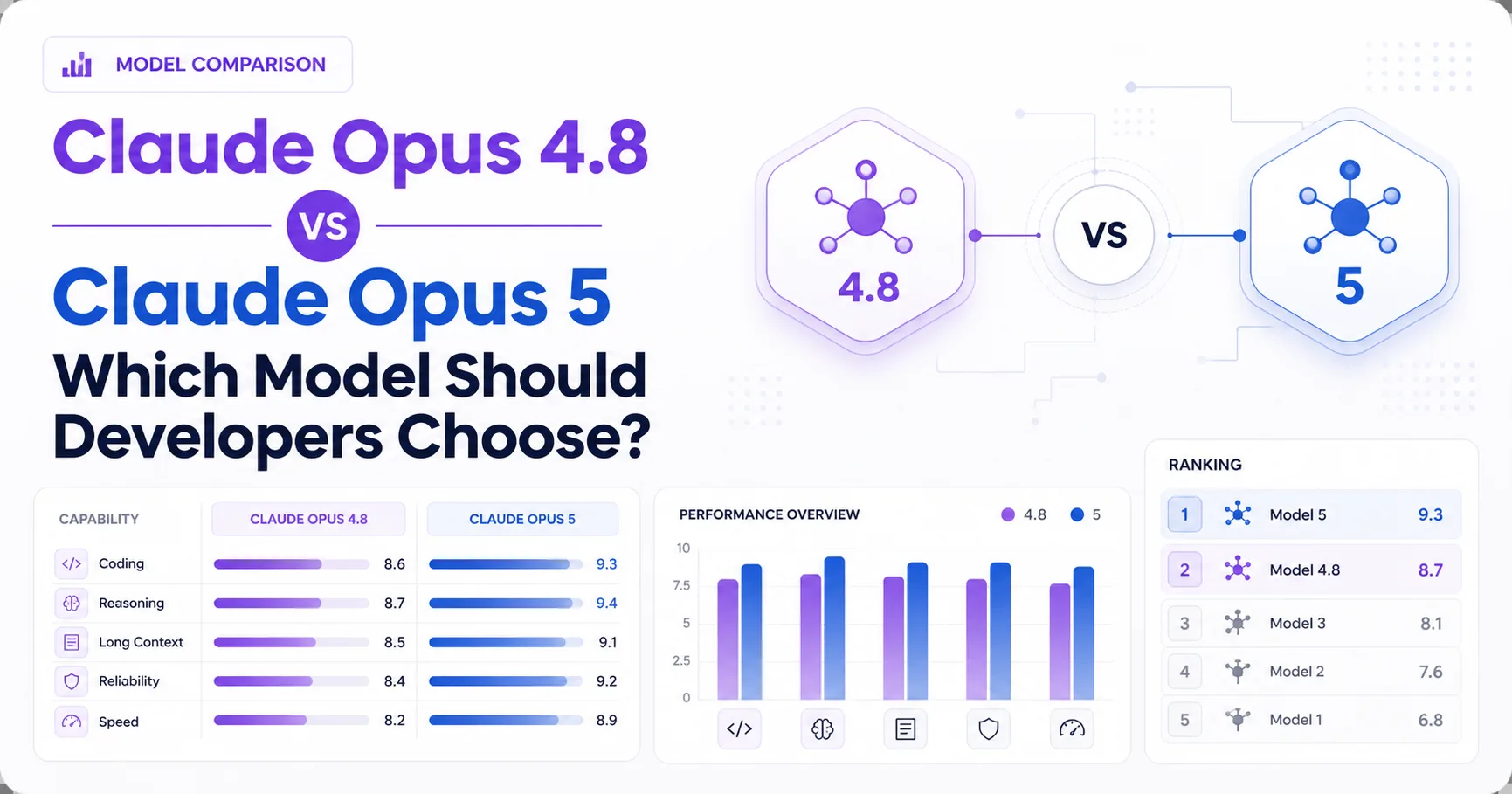
- **Winner overall:** Claude Opus 5, with a 60.7 Intelligence Index and 78 Coding Index - **Cheaper:** Claude Opus 4.8 and Claude Opus 5 at $10 vs $10 per 1M blended tokens - **Faster:** Claude Opus 5 at 60.088 median output tokens per second - **Pick Claude Opus 4.8 when:** You need a stable, already-proven snapshot and your workflow does not require the newest agent features - **Watch out:** Independent, reproducible evidence is insufficient to prove that Opus 5 is more reliable in every production workflow
Claude Opus 4.8 vs Claude Opus 5
Claude Opus 5 is the stronger default for new developer workloads because it improves the available evaluation scores without increasing the listed API price.
The Artificial Analysis snapshot gives Opus 5 an Intelligence Index of 60.7 and a Coding Index of 78, compared with 55.7 and 74.3 for Opus 4.8. Both models have a 0.3-second latency figure and the same $10 blended price per 1M tokens.
Anthropic positions Opus 5 for complex agentic coding and enterprise work in its launch announcement. Opus 4.8 remains an Active model, however, and Anthropic has not marked it Deprecated or Retired in the model lifecycle documentation.
Data provided by https://artificialanalysis.ai/
Executive summary for developers
Claude Opus 5 offers the better capability-to-price trade-off, while Claude Opus 4.8 offers a less disruptive migration choice.
| Decision area | Claude Opus 4.8 | Claude Opus 5 | What it means |
|---|---|---|---|
| Intelligence Index | 55.7 | 60.7 | Opus 5 has the stronger broad capability signal |
| Coding Index | 74.3 | 78 | Opus 5 is the better starting point for code-heavy work |
| Blended price per 1M tokens | $10 | $10 | Price does not decide this comparison |
| Input price per 1M tokens | $5 | $5 | Large prompts cost the same on the listed standard rate |
| Output price per 1M tokens | $25 | $25 | Verbose responses can matter more than model selection |
| Latency | 0.3 seconds | 0.3 seconds | The snapshot does not show a latency advantage |
| Median output speed | Not provided | 60.088 tokens per second | Only Opus 5 has a reported value |
Opus 5 was released on 2026-07-24, while Opus 4.8 was released on 2026-05-28. Anthropic describes Opus 4.8 as a model for complex coding, agent workflows, and professional knowledge work in its release announcement. The newer model therefore has a clear capability and lifecycle advantage, but not a lower price.
The comparison is less decisive for teams that value behavioral predictability above peak evaluation results. Community reports describe Opus 5 as strong on complex work, but also as slow, verbose, and prone to doing more work than requested in some workflows. Those reports lack reproducible task sets, so they should guide pilot design rather than settle the decision. See the Opus 5 experience discussion.
Performance: what the score gap means in practice
Claude Opus 5 is the better performance choice for difficult coding and reasoning tasks, but the evidence does not prove a universal production advantage.
The Coding Index favors Opus 5 at 78 versus 74.3 for Opus 4.8. The Intelligence Index also favors Opus 5 at 60.7 versus 55.7. These gaps support choosing Opus 5 for tasks where the model must understand a large system, plan several changes, or recover from partial failure. They do not show how either model behaves on your repository, tool stack, or test suite.
Anthropic reports that Opus 5 leads several evaluations, including Frontier-Bench v0.1, CursorBench 3.2, ARC-AGI 3, Zapier AutomationBench, and OSWorld 2.0 in its official announcement. The same source explains that at least one reported evaluation used five runs per task and a fallback model for certain safety refusals. That methodology makes the result useful context, but it is not a direct forecast of your agent’s success rate.
Opus 4.8 still has a credible case for teams that already have prompts, validators, and tool policies tuned around it. A Reddit user reported that Opus 4.8 could identify its own mistakes and adjust answer length, while still sometimes skipping explicit steps in multi-step agents. The report came from three days of use without a reproducible benchmark, as described in the community post.
The key unknown is reliability under identical production conditions. The supplied materials do not provide an independent, reproducible head-to-head study of tool-call accuracy, task completion, or regression rates. Teams should test those dimensions directly before replacing a working Opus 4.8 deployment.
Cost: equal list price, different operational exposure
Claude Opus 4.8 and Claude Opus 5 have the same listed token prices, so Opus 5 can be the cheaper operational choice only if it reduces rework.
The data snapshot lists both models at $10 per 1M blended tokens, with $5 input and $25 output pricing. The chart below this section should therefore be read as a tie on direct token cost. Model selection will not lower the invoice by itself.
Operational cost can still diverge. Anthropic documents adaptive reasoning and configurable effort for both model generations in its effort documentation. Effort is a behavior signal, not a strict token or latency ceiling. A low setting can therefore fail to produce a predictable spending cap, while a high setting can generate more internal work than a simple request needs.
Opus 5 also defaults to thinking, and its max_tokens limit covers thinking tokens and the final response together. Anthropic warns in the Opus 5 changes documentation that older, smaller limits may leave too little room for visible output. That creates a migration cost even when token rates match: existing SDK settings, output parsers, and timeout policies may need review.
Verbose agent updates can raise total output consumption. Community users have described Opus 5 as overly talkative and prone to overthinking simple tasks in the ClaudeCode discussion. This is not a controlled cost study, so the correct response is measurement. Track retries, tool calls, visible output length, cache hits, and human review time during a pilot.
For repeated long prompts, both models support prompt caching at the same documented cache prices. A workload with fewer failed attempts may favor Opus 5 despite identical rates, but the supplied evidence is insufficient to quantify that effect.
Recommendation by deployment scenario
Claude Opus 5 should be the default choice for new complex agents, while Claude Opus 4.8 remains sensible for stable workflows with proven controls.
Choose Opus 5 for a new coding agent when the work involves repository-wide changes, long tool sequences, enterprise automation, or difficult technical reasoning. Its higher Coding Index and Intelligence Index provide the strongest available evidence for that choice. Anthropic also documents support for beta mid-conversation tool changes and server-side fallback in the Opus 5 update notes. Those features may matter when the orchestration layer changes during a long run.
Choose Opus 4.8 when migration risk is more important than the newest capability signal. This applies when your prompts depend on its current response shape, when your validators assume its existing behavior, or when the model already performs acceptably on a measured workload. Opus 4.8 is still Active, so choosing it does not require an immediate emergency migration according to Anthropic’s lifecycle page.
Treat Opus 5 cautiously for unattended agents. Official documentation says its default responses and deliverables may be longer, agents may narrate progress more often, and multi-agent workflows may repeat verification work. Community reports also mention instruction drift, over-scoping, and excessive reasoning. These signals point to guardrails, not rejection.
A practical rollout is a shadow evaluation on real tasks. Keep the same system prompt, tools, context, output limits, retry policy, and acceptance tests. Compare completed work, invalid tool calls, unnecessary edits, review time, and total tokens. The supplied materials do not establish which model wins those production metrics. Your own task traces must decide the final switch.
Migration risks that the charts cannot show
Claude Opus 5 creates more integration risk than its equal price suggests because its thinking and response behavior differ from earlier assumptions.
Teams moving from Opus 4.8 should review max_tokens first. Opus 5 uses that limit for both thinking and the visible response, according to the official model changes. A previous setting can produce truncated or unexpectedly short answers even when the application receives a successful API response.
Teams should also test tool parsing with thinking enabled. Anthropic documents that disabling thinking can cause occasional tool calls to appear as ordinary text, or expose internal XML labels in the visible response. The documented recommendation is to keep thinking enabled. That matters for agents that treat a missing tool_use block as a normal assistant answer.
Output length is another compatibility concern. Longer progress narration can affect streaming interfaces, transcript storage, review queues, and downstream parsers. The supplied community evidence is mixed: some users report strong complex-task performance, while others report excessive verbosity and instruction drift. Neither side provides a controlled experiment, so no reliable universal preference can be inferred.
Opus 4.8 has its own limitations. Community feedback describes skipped process steps and occasional unverified guesses during multi-step agents. A separate GitHub issue records complaints about verbose, technical, metaphor-heavy explanations and style drift over multiple turns, but the issue is a user report rather than a confirmed vendor defect. See Claude Code Issue #77136.
The safest migration is therefore reversible. Route a measured subset of tasks to Opus 5, preserve Opus 4.8 as a fallback, and promote the newer model only after application-level checks pass.
FAQ before choosing a model
Claude Opus 5 is the recommended starting point for most new developer evaluations because its reported capability scores are higher at the same listed price.
The remaining questions concern fit, operational controls, and evidence quality. The available materials support a directional recommendation, not a guarantee that every repository or agent will improve.
Frequently asked questions
Is Claude Opus 5 better than Claude Opus 4.8 for coding?
Claude Opus 5 is the stronger coding candidate because its Coding Index is 78 versus 74.3, but the supplied evidence does not prove higher task completion on every repository or tool workflow.
Which model is cheaper, Claude Opus 4.8 or Claude Opus 5?
Claude Opus 4.8 and Claude Opus 5 have the same listed prices: $10 per 1M blended tokens, $5 per 1M input tokens, and $25 per 1M output tokens.
Does Claude Opus 5 respond faster than Claude Opus 4.8?
Claude Opus 5 has a reported median output speed of 60.088 tokens per second, while Opus 4.8 has no corresponding value in the data snapshot, and both list 0.3-second latency.
Should an existing Claude Opus 4.8 application migrate immediately?
An existing Claude Opus 4.8 application should migrate through a controlled shadow test, because Opus 5 changes thinking behavior, output limits, verbosity, and possible tool integration assumptions.
What is the main risk of using Claude Opus 5 in an autonomous agent?
The main risk is excess work rather than low capability: official notes and community reports describe longer responses, repeated verification, overthinking, and possible instruction drift without reproducible evidence of the frequency.
Sources
- Artificial AnalysisData attribution for evaluation, pricing, latency, and output-speed values.
- Introducing Claude Opus 4.8Opus 4.8 release date, positioning, and official capability claims.
- Introducing Claude Opus 5Opus 5 positioning, evaluation claims, and documented limitations.
- Models overviewModel availability and model-generation context.
- What’s new in Claude Opus 5Thinking behavior, max_tokens, tool behavior, beta features, and response changes.
- EffortAdaptive reasoning and effort behavior.
- Model deprecationsActive status and lifecycle considerations for both models.
- I’ve been running Opus 4.8 hard for 3 days. Here’s what actually changed vs 4.7Opus 4.8 community experience and evidence limitations.
- The Opus 5 ExperienceOpus 5 community reports about speed, verbosity, and complex-task performance.
- Claude Code Issue #77136Community reports about verbosity, readability, and multi-turn style drift.
Published: