
AI model analysis
Claude Opus 4.8 vs GPT-5.6 Sol: Which Model Should Developers Choose?
A developer-focused comparison of Claude Opus 4.8 and GPT-5.6 Sol across performance, cost, tooling, reliability, and production fit.
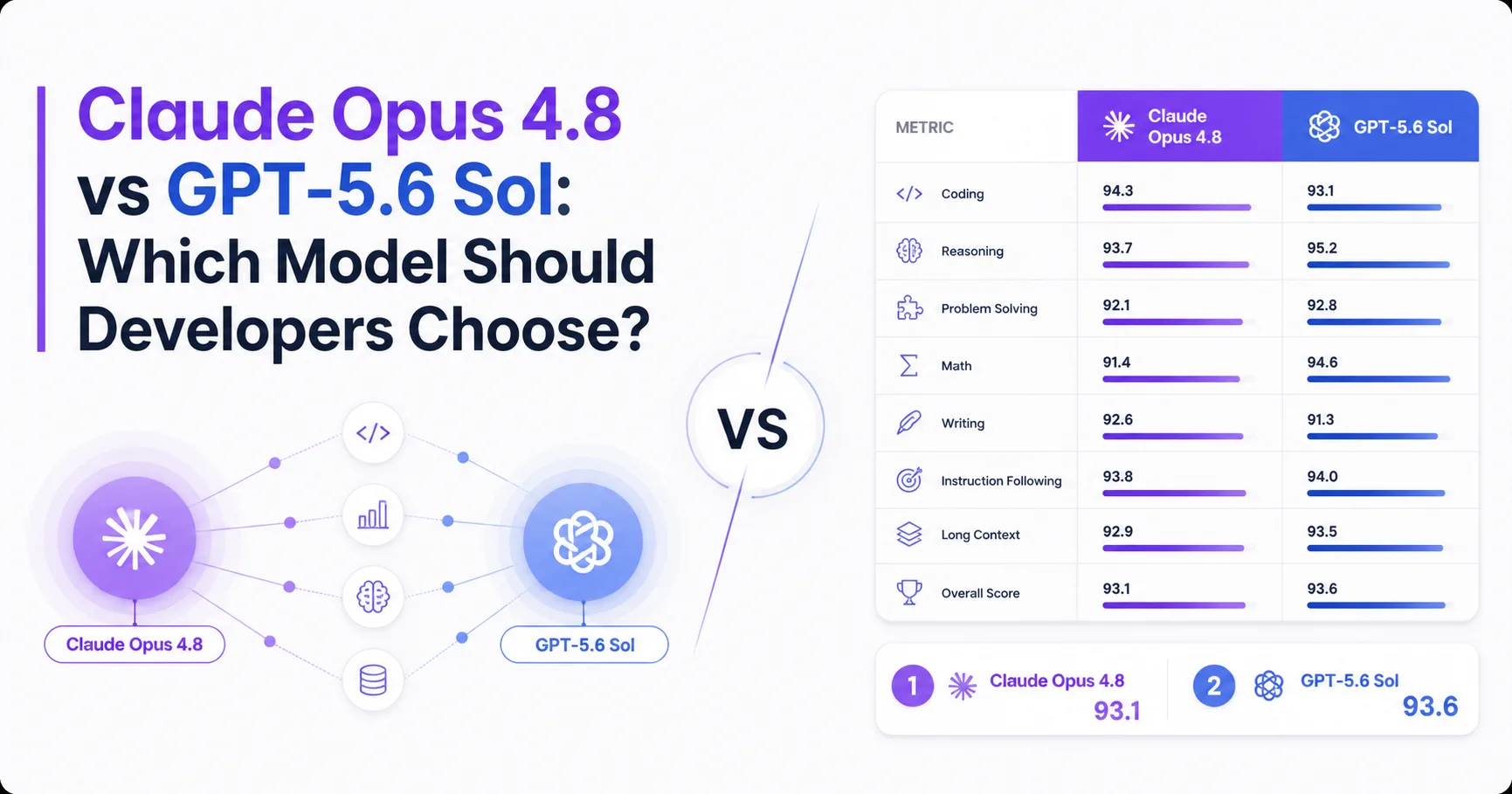
- **Winner overall:** GPT-5.6 Sol (max), with 77.4 coding and 58.9 intelligence versus Claude Opus 4.8 at 74.3 and 55.7 - **Cheaper:** Claude Opus 4.8 at $10 vs $11.25 per 1M blended tokens - **Faster:** GPT-5.6 Sol (max) at 77.617 median output tokens per second; Claude Opus 4.8 has no reported value - **Pick GPT-5.6 Sol when:** your workflow rewards the higher Artificial Analysis Coding Index of 77.4 - **Watch out:** both models report 0.3 seconds latency, but Claude has no comparable output-speed result
Claude Opus 4.8 vs GPT-5.6 Sol
GPT-5.6 Sol (max) is the stronger default for developers who prioritize measured coding and intelligence performance over the lowest blended cost. The shared Artificial Analysis snapshot places GPT-5.6 Sol at 77.4 on coding and 58.9 on intelligence, ahead of Claude Opus 4.8 at 74.3 and 55.7. Claude Opus 4.8 costs less in the reported blended workload, while GPT-5.6 Sol has the only reported output-speed result. Both models show 0.3 seconds latency in the snapshot, so the evidence does not prove that GPT-5.6 Sol responds faster in every production setting. OpenAI positions GPT-5.6 Sol for complex reasoning, programming, and professional work, while Anthropic positions Claude Opus 4.8 for complex coding, agent workflows, and specialist knowledge work. Data provided by https://artificialanalysis.ai/, with the provider linked here: Artificial Analysis.
Executive summary
GPT-5.6 Sol (max) is the broader default, while Claude Opus 4.8 wins the cleanest price argument.
| Decision factor | Evidence | Selection meaning |
|---|---|---|
| Coding performance | GPT-5.6 Sol: 77.4; Claude Opus 4.8: 74.3 | GPT has the stronger shared performance signal |
| Intelligence performance | GPT-5.6 Sol: 58.9; Claude Opus 4.8: 55.7 | GPT is the better starting point for varied reasoning tasks |
| Blended price | Claude Opus 4.8: $10; GPT-5.6 Sol: $11.25 per 1M blended tokens | Claude is better for predictable, cost-sensitive traffic |
| Input price | Both models: $5 per 1M input tokens | Prompt-heavy traffic does not create a price advantage |
| Output-speed evidence | GPT-5.6 Sol: 77.617; Claude Opus 4.8: not reported | GPT has a throughput signal, but the comparison is incomplete |
| Latency | Both models: 0.3 seconds | The snapshot shows no latency winner |
The capability boundary is more important than the score gap for some applications. GPT-5.6 Sol supports Responses API workflows with function calling, structured outputs, streaming, hosted tools, computer use, MCP, and related integrations, according to OpenAI’s model documentation. Claude Opus 4.8 supports text and image input, multilingual work, and access through the Claude API, Amazon Bedrock, Google Cloud, and Microsoft Foundry, according to Anthropic’s model overview.
The release situation also differs. Claude Opus 4.8 remains active in Anthropic’s lifecycle documentation, even though the current overview presents a newer Opus generation. GPT-5.6 Sol remains listed as a current callable model in OpenAI’s model documentation, and the supplied material identifies no later replacement.
Community evidence is divided rather than decisive. A Claude user reports better self-correction and answer-length control, while comments raise concerns about adaptive reasoning missing hidden subtask difficulty in the same Reddit discussion. GPT users report over-design, scope drift, and highly variable token use in a Reddit test and a Hacker News discussion. None of these reports provides a reproducible head-to-head test.
Performance and real task implications
GPT-5.6 Sol (max) has the stronger measured performance profile, but the evidence does not establish lower production latency.
The shared benchmark signal favors GPT-5.6 Sol on both dimensions. Its coding score is 77.4 versus 74.3 for Claude Opus 4.8, which supports choosing GPT as the initial candidate for repository work, code generation, and complex debugging. The advantage should still be treated as a probability shift, not a guarantee. The Artificial Analysis indices do not show whether a model followed every process instruction, made fewer tool mistakes, or produced safer patches in a particular codebase.
The official vendor evidence cannot settle that question because the releases emphasize different evaluations. Anthropic highlights browser interaction performance and claims stronger defect avoidance in generated code in its launch announcement. OpenAI highlights agent, browsing, operating-system, and security coding evaluations in its GPT-5.6 release post. These sources support each vendor’s positioning, but they do not form a common test set. The shared Artificial Analysis snapshot is therefore more useful for this comparison than either vendor’s isolated headline result.
Reasoning controls create a second selection variable. Claude uses Adaptive thinking and exposes effort levels through its effort documentation. OpenAI exposes reasoning effort and a higher-work mode for difficult tasks through its reasoning guide. Neither setting is a guaranteed wall-clock or token ceiling. A higher setting can improve hard-task quality while increasing work, delay, and spend.
The speed evidence is asymmetric. GPT-5.6 Sol has a reported median output speed of 77.617 tokens per second, while Claude Opus 4.8 has no reported value in the snapshot. That supports a GPT throughput signal, not a complete speed verdict, because both models show 0.3 seconds latency and the brief lacks an identical task-level measurement.
Reliability evidence remains qualitative. A Claude user reports self-correction but also skipped steps in multi-step agents. A Claude Code issue records complaints about verbosity, terminology, and style drift. GPT users report over-investigation and excessive defensive code. These reports are useful pilot risks, but their methods do not establish stable failure rates.
Cost, reasoning effort, and total workflow economics
Claude Opus 4.8 is the cheaper choice for the blended workload represented by the comparison data. The reported blended price is $10 for Claude Opus 4.8 versus $11.25 for GPT-5.6 Sol per 1M blended tokens. Input pricing is tied at $5, so the economic difference comes from output volume, reasoning work, caching behavior, and retries.
That distinction matters for agent systems. A workflow that repeatedly sends large repository context but produces short answers may see a smaller practical gap than the blended figure suggests. A workflow that generates long patches, detailed analysis, or extensive reasoning will expose the higher GPT output rate more directly. The supplied data does not include retry-adjusted cost, cache-hit rates, or cost per successfully completed task, so it cannot show whether the nominally cheaper model is cheaper after engineering intervention.
OpenAI’s pricing documentation separates standard, batch, flex, fast, cached, and long-context pricing. Anthropic’s pricing documentation also separates standard generation from prompt caching. Repeated system prompts, repository instructions, and stable tool definitions can therefore change the effective price of either model. Teams should model their own traffic shape instead of treating the blended figure as a universal invoice estimate.
Reasoning configuration can reverse an initial budget assumption. OpenAI states that hidden reasoning tokens occupy context and are billed as output tokens in its reasoning guide. Anthropic describes effort as a behavior signal rather than a strict token budget in its effort documentation. A lower setting may reduce routine work, but neither setting guarantees a fixed spend ceiling.
The cheapest model can also become more expensive through retries, manual correction, or review time. Claude community reports describe skipped steps and under-specified reasoning in some agent tasks. GPT community reports describe over-design and investigation drift. Those observations point to different operational costs, but the brief contains no controlled data for converting them into dollars. The right cost test is successful task completion at the required quality, not token price alone.
Recommendation by developer workload
GPT-5.6 Sol (max) is the better starting point for a general developer platform with varied reasoning and tool use.
Choose GPT-5.6 Sol when the product needs a single model for difficult coding, broad reasoning, structured responses, and tool-rich agents. Its higher shared coding and intelligence scores make it the stronger first hypothesis for repository changes and complex investigative work. Its Responses API supports function calling, structured outputs, streaming, hosted shell, code execution, computer use, MCP, and other tools described in the model documentation. The tradeoff is higher blended cost and a greater risk of unnecessary work at maximum reasoning effort.
Choose Claude Opus 4.8 when predictable unit economics matter more than the highest shared score, or when deployment across Anthropic’s supported cloud channels fits the platform better. Claude’s lower blended price and lower output price favor output-heavy workloads. Its image input, multilingual support, and availability through multiple infrastructure providers are documented in Anthropic’s model overview. Teams should add explicit checkpoints for multi-step agents because community feedback reports skipped process steps and occasional under-reasoning in the Claude Reddit discussion.
GPT-5.6 Sol is a poor fit if audio or video input, or fine-tuning, is a hard requirement because the supplied model documentation marks those capabilities as unsupported. Claude is a poor fit for teams that cannot tolerate manual verification of agent trajectories or verbose, drifting explanations. The Claude Code issue makes the latter a risk to test, not a confirmed universal defect.
Run a focused pilot before committing. Use the same repository, prompts, tools, acceptance tests, and review rules for both models. Record successful completion, hidden-test results, correction count, total output, latency, and human review time. Also test lower reasoning settings, because OpenAI’s reasoning guidance and community feedback suggest that maximum effort is not automatically the best operating point. The supplied evidence supports GPT as the default and Claude as the cost-conscious alternative, but it does not identify a universal winner.
What to verify before adoption
Claude Opus 4.8 remains a production-viable option despite a newer Anthropic model appearing in the current documentation. Anthropic’s lifecycle page lists Claude Opus 4.8 as active, while OpenAI’s model page lists GPT-5.6 Sol as current and callable. The main unresolved issue is not availability. It is whether each model’s reasoning behavior, tool discipline, and review burden match your workload. Pin the documented model identifier, test the exact effort setting, and measure successful outcomes before changing production defaults.
Frequently asked questions
Which model should I choose for a coding agent?
GPT-5.6 Sol (max) is the default pick for a coding agent because its Artificial Analysis Coding Index is 77.4 versus 74.3 for Claude Opus 4.8. Validate repository-specific completion and tool behavior before rollout, because community reports on both models remain anecdotal. See the Claude report and the GPT report.
Which model costs less?
Claude Opus 4.8 costs less for the comparison’s 3:1 blended workload, at $10 versus $11.25 per 1M blended tokens. GPT-5.6 Sol has the same $5 input price but a higher output price, so output-heavy workloads widen the nominal difference. Actual total cost still depends on caching, retries, and review time.
Is GPT-5.6 Sol faster?
GPT-5.6 Sol has the only reported output-speed figure, 77.617 median output tokens per second, while both models report 0.3 seconds latency in the snapshot. That evidence supports a throughput signal for GPT, not a complete production-speed verdict across different prompts, tools, queues, and reasoning settings.
Is Claude Opus 4.8 still safe to adopt?
Claude Opus 4.8 remains an active API option and is not marked deprecated in the supplied lifecycle documentation. Anthropic’s overview describes a fixed model snapshot, so teams can pin the documented identifier while monitoring lifecycle notices and validating agent process compliance.
What evidence is missing from this comparison?
No supplied source provides a reproducible, same-task comparison of agent completion, correction count, total token use, or production latency for these exact configurations. Community reports describe useful and frustrating behavior in Claude discussions and GPT discussions, but their methods do not support stable universal claims.
Sources
- Artificial AnalysisShared benchmark, latency, throughput, and blended pricing snapshot.
- Introducing Claude Opus 4.8Anthropic's release positioning, official benchmark claims, and agent capability claims.
- Claude Models OverviewClaude capabilities, access channels, model identifiers, and reasoning configuration.
- Claude EffortClaude effort behavior and its relationship to reasoning depth and token use.
- Claude PricingClaude generation and prompt caching pricing structure.
- Claude Model DeprecationsClaude Opus 4.8 lifecycle and active status.
- I’ve been running Opus 4.8 hard for 3 daysCommunity reports about Claude self-correction, adaptive reasoning, skipped steps, and agent behavior.
- Claude Code Issue #77136Community reports about verbosity, terminology, readability, and style drift.
- GPT-5.6 Sol Model DetailsGPT capabilities, API support, tools, unsupported modalities, model status, and pricing notes.
- Reasoning ModelsGPT reasoning effort, hidden reasoning tokens, higher-effort modes, and cost implications.
- OpenAI API PricingOpenAI standard, batch, flex, fast, cached, and long-context pricing structure.
- GPT-5.6: Frontier intelligence that scales with your ambitionOpenAI's release positioning and official evaluation claims.
- I spent two weeks testing GPT-5.6Community reports about GPT over-design, coding behavior, token use, and inconsistent experiences.
- Ask HN: How are you productive with GPT 5.6 Sol?Community reports about investigation drift, defensive code, and reasoning-effort preferences.
Published: