
AI model analysis
Claude Opus 4.8 vs Kimi K3: Which Model Should Developers Choose?
A developer-focused comparison of Claude Opus 4.8 and Kimi K3 across capability, speed, cost, agent reliability, lifecycle, and production fit.
- **Winner overall:** Kimi K3, with a 76.2 coding index vs 74.3 and a 57.1 intelligence index vs 55.7 - **Cheaper:** Kimi K3 at $6 vs $10 per 1M blended tokens - **Faster:** Kimi K3 at 34.453 median output tokens per second, while Claude Opus 4.8 has no reported value - **Pick Kimi K3 when:** you need $6 blended pricing, 76.2 coding performance, and native tool-oriented workflows - **Watch out:** Kimi K3's 34.453 speed reading is not a complete cross-model verdict because Claude's speed value is unavailable and both latency values are 0.3 seconds
Claude Opus 4.8 vs Kimi K3
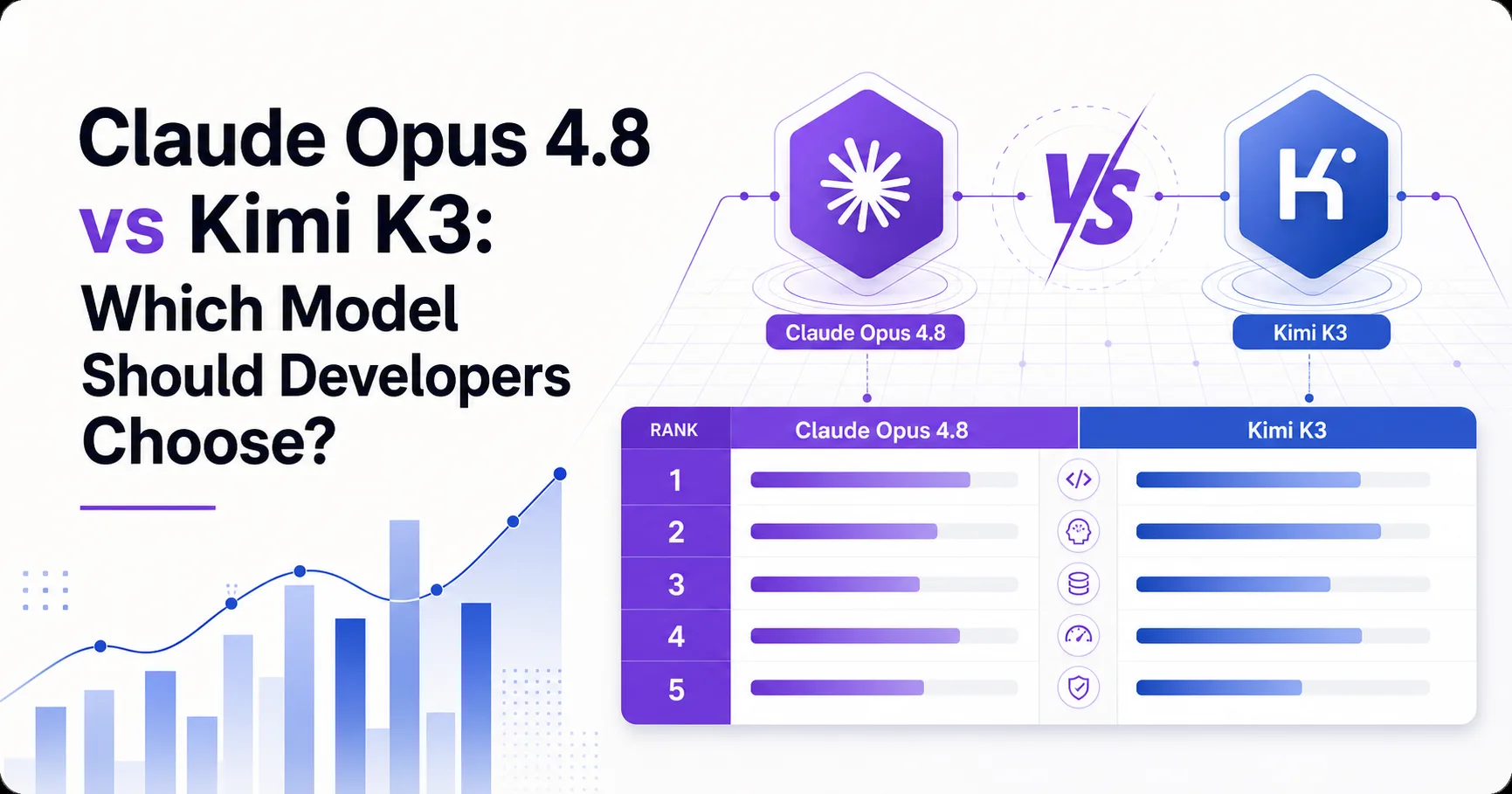
Kimi K3 is the stronger default for developers who want higher aggregate scores, lower listed prices, and measured output speed (Artificial Analysis). Data provided by https://artificialanalysis.ai/. Claude Opus 4.8 remains the more defensible choice when process discipline, Anthropic platform access, and adjustable reasoning effort matter more than unit economics. The snapshot gives Kimi K3 a coding index of 76.2 versus 74.3 for Claude Opus 4.8, and an intelligence index of 57.1 versus 55.7. It also lists Kimi K3 at $6 per 1M blended tokens, versus $10 for Claude Opus 4.8. Kimi K3 has a reported median output speed of 34.453 tokens per second, while Claude Opus 4.8 has no value reported in the snapshot. The latency value is 0.3 seconds for each model, so the speed result is useful but incomplete. The recommendation depends on whether your main risk is paying more for quality or trusting an agent to follow a controlled process.
Kimi K3 Leads the Current Developer Default
Kimi K3 wins the data snapshot comparison, while Claude Opus 4.8 retains a stronger process-control case (Artificial Analysis).
Anthropic positions Claude Opus 4.8 for complex coding, agent workflows, and professional knowledge work (Introducing Claude Opus 4.8). Its model documentation also describes text and image input, visual understanding, broad language support, and configurable adaptive reasoning (Claude models overview).
Kimi positions K3 as a flagship model for long-running coding, knowledge work, reasoning, native vision, and tool use (Kimi K3 official technical blog). Its API documentation adds structured output, JSON Schema, tool-choice controls, dynamic tool loading, and automatic context caching (Kimi K3 Quickstart).
The lifecycle evidence is slightly different. Anthropic marks Claude Opus 4.8 as Active and not deprecated, while its documentation also describes a later Opus-family successor (Model deprecations, Claude models overview). Kimi’s official model list still presents kimi-k3 as a current callable model and does not state that a successor has replaced it (Kimi model list).
That difference matters for procurement. Claude offers a clearer documented lifecycle state. Kimi offers a simpler current-model story, but the evidence does not establish which vendor will provide the more durable compatibility path. Developers should pin model identifiers, record prompt behavior, and rerun acceptance tests after platform changes.
Kimi K3 Has the Aggregate Edge, With Different Failure Risks
Kimi K3 leads the available aggregate evaluation and has the only reported output-speed measurement, but the evidence does not establish a universal production winner (Artificial Analysis).
The coding index is 76.2 for Kimi K3 and 74.3 for Claude Opus 4.8. That gap is large enough to justify a Kimi pilot, but it is not a task-completion guarantee. A developer tool can score well yet still lose time through poor state recovery, unnecessary edits, or weak process adherence. The useful question is whether your evaluator rewards final answers, intermediate actions, or both.
Anthropic says Claude Opus 4.8 places more emphasis on uncertainty signals and self-correction in agent tasks (Introducing Claude Opus 4.8). A long-use community report describes better answer-length control and more self-correction, but also reports that multi-step agents may skip requested steps and reach correct outcomes through messy paths (Claude Opus 4.8 Reddit report). Another commenter preferred the older model for some non-coding tasks because adaptive reasoning sometimes appeared to underestimate hidden difficulty (Claude Opus 4.8 Reddit report).
Kimi has a different operational risk. Its official technical blog warns that incomplete reasoning history or switching models inside an existing session can make output unstable (Kimi K3 official technical blog). The same source says K3 can make unexpected decisions when intent is unclear, so system prompts and AGENTS.md boundaries matter. A community report also describes a long coding task that reached its token limit before completion and required manual follow-up (Kimi K3 Hermes report).
The speed evidence is weaker than the score evidence. The snapshot reports 34.453 median output tokens per second for Kimi K3, but no comparable value for Claude Opus 4.8. The latency field is 0.3 seconds for each model. No reliable public evidence in the brief confirms Kimi’s stable average first-token experience or Claude’s comparative output speed. Treat the speed result as a pilot signal, not a settled cross-vendor conclusion.
Kimi K3 Costs Less, But Workflow Design Controls the Real Bill
Kimi K3 is cheaper on listed token prices, but Claude Opus 4.8 can become the lower-cost choice if it avoids retries and review work (Artificial Analysis).
The blended comparison lists Kimi K3 at $6 per 1M tokens and Claude Opus 4.8 at $10. That difference favors Kimi for high-volume workloads, especially when requests are routine, outputs are accepted directly, and the harness preserves state correctly. The price chart should therefore be read as a strong routing signal, not as a complete operating-cost forecast.
Output-heavy coding agents need a closer look. Kimi K3 lists output at $15 per 1M tokens, while Claude Opus 4.8 lists output at $25. Long answers, code patches, and tool-driven execution can make output pricing more important than input pricing. Anthropic documents prompt caching, while Kimi documents automatic context caching and cached-input behavior (Anthropic pricing, Kimi K3 pricing, Kimi K3 Quickstart). Your cache hit rate and context reuse pattern can therefore change the practical ranking.
Kimi becomes more expensive than its chart suggests when a long task reaches a limit, loses historical reasoning, or requires manual completion. The Hermes report describes that kind of unfinished workflow (Kimi K3 Hermes report). Claude can create the opposite tradeoff: a higher unit price may be acceptable if its process fits an existing review system and reduces reruns. Anthropic also states that effort is a behavior signal rather than a strict token budget, so a lower setting cannot serve as a precise cost ceiling (Effort documentation).
The missing evidence is a published, reproducible total-cost comparison across equivalent agent harnesses. Measure accepted task cost, retry cost, reviewer time, and unfinished-run recovery before treating the cheaper model as the cheaper system.
Choose Kimi K3 for Default Throughput, Claude for Controlled Execution
Kimi K3 is the best initial pilot for most new developer workloads, while Claude Opus 4.8 is the safer specialist for process-sensitive execution (Artificial Analysis).
Pick Kimi K3 when cost and tool breadth dominate
Kimi K3 fits teams that want a lower listed price, the higher coding index in the snapshot, and a measured output-speed signal. Its API supports native visual input, tool calls, JSON Mode, JSON Schema output, partial responses, tool-choice constraints, dynamic tool loading, and automatic context caching (Kimi K3 Quickstart). Those features reduce integration friction for coding agents that already manage structured tool state.
Kimi is a good fit for a new harness that can preserve complete reasoning history and keep model selection stable within a session. Its official guidance makes those conditions important for output quality (Kimi K3 official technical blog). Kimi needs clearer system boundaries when the agent can make irreversible choices. Its web-search capability should also stay outside production-critical paths until the API documentation stops warning against production use (Kimi K3 Quickstart).
Pick Claude Opus 4.8 when process quality is the main risk
Claude Opus 4.8 fits organizations already using Anthropic’s API, Amazon Bedrock, Google Cloud, or Microsoft Foundry (Claude models overview). It is also a strong candidate when developers need explicit reasoning-effort controls across task classes. Anthropic documents several effort levels, but the setting should guide behavior rather than act as a fixed spend or latency limit (Effort documentation).
Claude deserves preference when intermediate steps need human review, when the workflow values uncertainty reporting, or when the cost of a wrong action is higher than the token-price difference. The choice does not remove quality concerns. Community reports describe skipped process steps, and a GitHub issue records complaints about verbose, technical language and style drift across longer conversations (Claude Opus 4.8 Reddit report, Claude Code Issue #77136). Use concise style instructions and inspect tool traces.
Use a pilot to settle the unresolved questions
Run the same task set through each model with identical tools, context, acceptance rules, and review requirements. Score final correctness, process adherence, recovery after failed tools, reviewer effort, and accepted output cost. Include visual inputs, structured tool calls, long coding tasks, and ambiguous requests. These cases target the failure modes described in the official documentation and community reports.
A staged policy is reasonable when the evidence remains mixed. Kimi K3 can handle cost-sensitive first passes, while Claude Opus 4.8 can review process-sensitive work. That routing choice is an inference from the reported cost, score, harness, and behavior differences. It should be validated with your own tasks because no reliable public evidence in the brief proves that either model is consistently better across every agent workload.
What Developers Should Validate Before Switching
Kimi K3 should enter production only after a workflow-specific pilot validates state recovery, process compliance, and human-review cost (Kimi K3 official technical blog).
Check whether the harness preserves complete reasoning history and avoids model switching inside active sessions. Verify that visual inputs use the required object-array format rather than public image URLs (Kimi K3 Quickstart). Keep web search out of production-critical paths while the API documentation carries its current warning. For Claude Opus 4.8, test whether adaptive effort follows hidden subtask complexity and whether generated explanations meet your team’s preferred style (Effort documentation, Claude Code Issue #77136).
The evidence supports a clear pilot hypothesis, not a universal verdict. Kimi K3 offers the stronger cost and aggregate-score case. Claude Opus 4.8 offers the stronger case for a controlled, established enterprise workflow. Production selection should follow measured task outcomes rather than the benchmark chart alone.
Frequently asked questions
Which model should most developers choose first?
Kimi K3 should be the initial pilot for cost-sensitive developer workloads because it leads the snapshot’s coding and intelligence indexes, costs $6 versus $10 blended, and has the only reported output-speed result (Artificial Analysis).
Is Kimi K3 objectively faster?
Kimi K3 is the only model with a reported median output speed, at 34.453 tokens per second, but Claude Opus 4.8 has no comparable snapshot value, so a definitive cross-model speed claim remains unsupported (Artificial Analysis).
When is Claude Opus 4.8 the better choice?
Claude Opus 4.8 is the better choice when your workflow values adjustable reasoning effort, established Anthropic cloud access, and process-sensitive review more than Kimi K3’s lower listed price (Claude models overview, Effort documentation).
Can Kimi K3 replace web search in production?
Kimi K3 should not replace a production web-search layer yet because its API quickstart says the web-search capability is being updated and is not recommended for production workflows (Kimi K3 Quickstart).
Does a lower token price guarantee lower total cost?
A lower token price does not guarantee lower total cost because retries, unfinished agent runs, context handling, and human review can erase the $6 versus $10 blended advantage (Artificial Analysis, Kimi K3 Hermes report).
Sources
- Artificial AnalysisSnapshot scores, pricing, latency, and output-speed comparison.
- Introducing Claude Opus 4.8Claude Opus 4.8 positioning, agent behavior claims, and official capability framing.
- Claude models overviewClaude capabilities, platform availability, model identifiers, and reasoning controls.
- Effort documentationClaude effort settings and the limitation that effort is not a strict token budget.
- Anthropic pricingClaude token pricing and prompt-caching behavior.
- Model deprecationsClaude Opus 4.8 lifecycle status.
- I’ve been running Opus 4.8 hard for 3 days. Here’s what actually changed vs 4.7Community observations about Claude coding quality, self-correction, process adherence, and adaptive reasoning.
- Claude Code Issue #77136Community reports about Claude language style, readability, verbosity, and style drift.
- Kimi K3 official technical blogKimi K3 positioning, harness requirements, proactive behavior, and production integration guidance.
- Kimi K3 QuickstartKimi API controls, tool use, structured output, visual input requirements, caching, and web-search warning.
- Flagship Model Kimi K3 PricingKimi K3 token pricing and caching behavior.
- Kimi model listCurrent Kimi model availability and lifecycle comparison.
- Just tested Kimi K3 with HermesCommunity report about long-running coding completion, token limits, and manual follow-up.
- Kimi K3 Hermes reportEvidence cited in the article body
Published: